
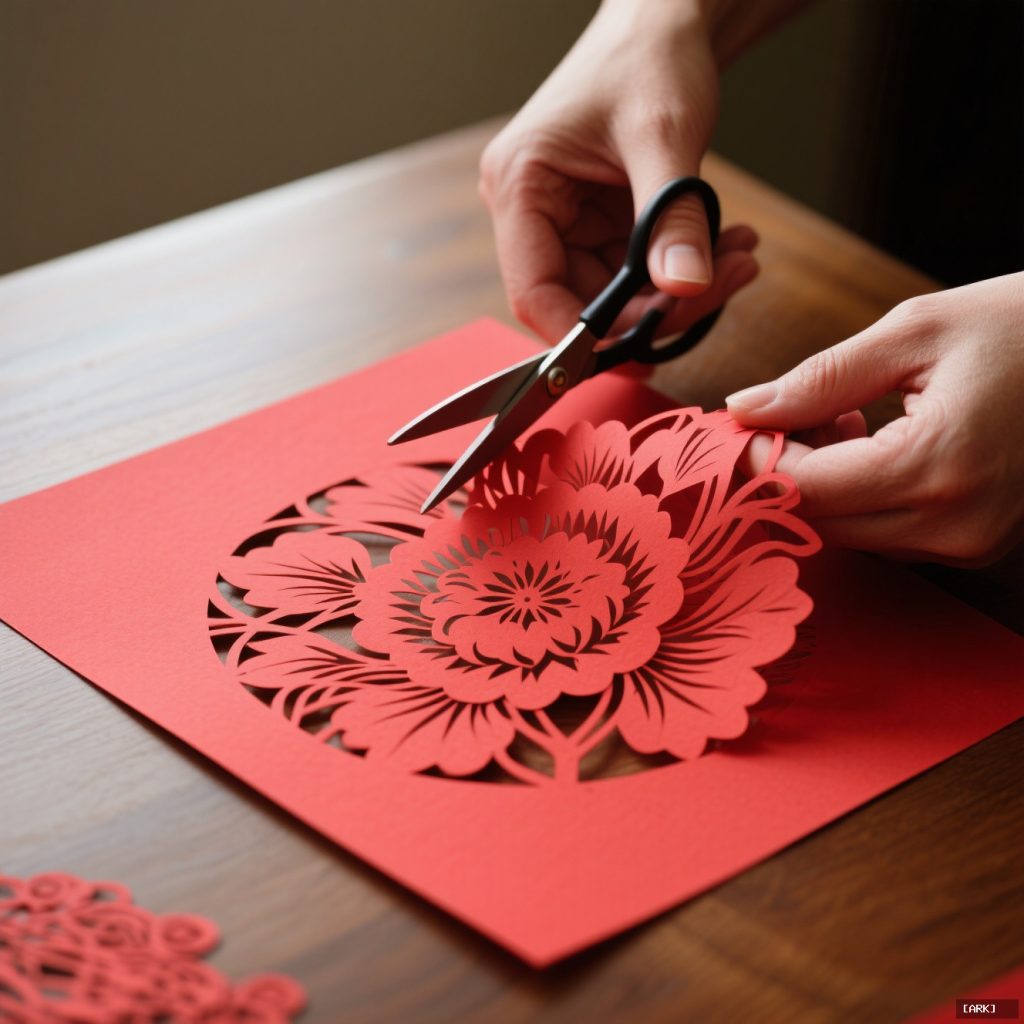
This DIY Chinese paper cutting tutorial is your gateway to more than a craft. It’s a direct line to a storytelling tradition where your hands do the talking. You’ll learn a design language built on absence, where every cut removes material to reveal meaning.
For centuries, this art form has decorated windows, doors, and gifts, serving as a visual language for hopes and celebrations. It turns a flat sheet into a lace-like narrative. We often think of creation as adding things, but here, the power is in subtraction.
The Silent Grammar of Paper
What is the concept of silent grammar in Chinese paper cutting?
The silent grammar of Chinese paper cutting refers to the principle that the art form communicates through the negative space created by removing paper. A single, unbroken outline, often in vibrant red, defines the final piece. The empty spaces are not merely background but are essential for defining shapes and telling stories. For example, a butterfly is outlined by remaining paper, while its wings gain expression from intricate voids. This interplay between positive and negative space establishes a delicate yet powerful visual identity, making the removed areas the primary element in conveying the artwork's narrative.
At its heart, Chinese paper cutting operates on a simple, profound principle: it speaks through what you remove. The final piece is a single, unbroken outline, usually in vibrant red. The empty spaces—the negative space—are not just background. They are the stars of the show, defining shapes, forming patterns, and telling the story.
This creates a visual identity that is both delicate and powerful. Think of a cut-out butterfly. The insect is defined by the paper that remains, but its wings are given life by the intricate voids within them. This dance between positive and negative is the core design language. It teaches you to see relationships, to understand how a shape is held together by the emptiness around and inside it. It’s a lesson in balance that feels almost meditative.
Symbols: Your Visual Vocabulary
What are the meanings of common Chinese paper cutting symbols?
In Chinese paper cutting, each motif functions as a visual word in a symbolic alphabet. A fish represents abundance and surplus because its Chinese word sounds like the word for 'extra.' A bat symbolizes good fortune, as its name is a homophone for 'blessing.' A peach promises longevity, while a pomegranate, with its many seeds, speaks of fertility and family prosperity. Understanding these symbolic meanings transforms paper cutting from simple decoration into a powerful tool for brand storytelling, allowing artists to convey values and narratives without using any written language.
Following paper craft instructions for this art is like learning a new alphabet. Each motif is a word, each composition a sentence brimming with meaning. This is where the tutorial transcends simple decoration and becomes a lesson in brand storytelling—the art of conveying values without words.
You don’t just cut a fish. You cut a symbol for abundance and surplus, because the Chinese word for fish sounds like the word for “extra.” A bat represents good fortune, as its name is a homophone for “blessing.” A peach promises longevity; a pomegranate, with its many seeds, speaks of fertility and a thriving family.
When you assemble these elements, you’re writing a visual wish. A composition with peonies (wealth), a lotus (purity), and a child might express a hope for a prosperous and virtuous family. By learning this symbolic vocabulary, you learn to communicate complex ideas through imagery alone. Your hands aren’t just cutting paper; they’re composing a silent poem.
The Physical Dialogue: Why Your Hands Need to Feel It
Why is physical touch important in Chinese paper cutting?
Physical touch is vital in Chinese paper cutting because it creates a unique feedback loop between the artist and the material. Unlike digital design, which allows for frictionless undoing and copying, traditional cutting requires you to feel the paper’s grain resistance, hear the clean slice of a sharp blade, and sense tension when rotating the sheet for curves. This physical dialogue forces focused presence and deliberate action, as there is no undo button—each cut is a committed, irreversible step that deepens the craft’s authenticity and mindfulness.
There’s a tangible difference between designing on a screen and guiding a blade through paper. Digital design happens in a frictionless space. You can undo, redo, and copy-paste with a click.
Traditional cutting techniques demand a physical conversation. You feel the slight resistance of the paper grain. You hear the crisp, satisfying whisper of a sharp knife making a clean cut. Your fingers sense the tension as you rotate the sheet for a curved line. This feedback loop is irreplaceable. It forces a state of focused presence. There is no “undo” button. Each slice is a committed, deliberate step in the narrative. The final piece isn’t just an image; it’s a recorded process of your attention and intention. A tiny wobble in the line isn’t a flaw—it’s a fingerprint of the human hand that made it.
Constraints as a Creative Engine
How do constraints fuel creativity in DIY Chinese paper cutting?
In DIY Chinese paper cutting, constraints like using one sheet, one color (traditionally red), and one unbroken line act as a creative engine. These strict limits force artists to innovate within boundaries, turning limitations into a superpower. For example, conveying a dragon’s complexity with a single connected outline requires mastery and ingenuity. This mirrors modern design where brand guidelines—limited color palettes, specific logos, or defined typographic systems—spur breathtaking innovation rather than stiflement. By embracing constraints, creators transform restrictions into opportunities for artistic expression and problem-solving.
Here’s a beautiful paradox: the strict limits of this craft are what fuel its creativity. You typically have one sheet, one color (traditionally red), and one unbroken line. You can’t add another layer or switch hues halfway through. This constraint is its superpower.
Modern designers often work within similar brand guidelines—a limited color palette, a specific logo format, a defined typographic system. This handmade art guide shows how mastering limits leads to breathtaking innovation, not stiflement. How do you convey the complexity of a dragon with a single connected outline? The challenge forces ingenious solutions, elegant simplifications, and a profound clarity of message. It teaches you to do more with less, a principle that resonates far beyond the craft table.
Mindful Making: The Sustainable Thread
How does a DIY Chinese paper cutting tutorial incorporate sustainable practices?
A DIY Chinese paper cutting tutorial incorporates sustainable practices by echoing the folk art's historic ethos of resourcefulness. Historically, artists used recycled paper and plant-based dyes, focusing on transformation rather than waste. In a modern tutorial, sustainability begins with material choices, such as opting for paper from responsible sources or repurposing old book pages and maps for a personal touch. It also considers the entire life cycle of the craft, including the beautiful negative shapes that fall away during cutting. By embracing these eco-friendly methods, practitioners honor the tradition's roots while reducing environmental impact, turning a single sheet into a meaningful symbol of hope and celebration without excess.
Historically, this was a folk art of resourcefulness. Artists used what was available—often recycled paper or plant-based dyes. The mindset was one of transformation, not waste. A humble, single sheet could be reborn as a complex symbol of hope and celebration.
That ethos fits seamlessly into a modern DIY Chinese paper cutting tutorial. Sustainability starts with your material choices. Opt for papers from responsible sources, or even repurpose pages from old books or maps for a personal touch. Consider the entire life cycle. The cuttings themselves, those beautiful negative shapes that fall away, need not be trash. They can be used for collage, card-making, or even composted if using untreated, natural paper. The craft becomes a lesson in seeing potential in every scrap, closing the loop on the material’s story.
Your First Cut: A Practical Pathway
How do I make my first cut in Chinese paper cutting?
To make your first cut in Chinese paper cutting, gather sharp, fine-pointed scissors or a precision craft knife, a self-healing cutting mat, and a light graphite pencil. Use traditional red Xuan paper or any thin paper that holds a crisp edge, like origami paper, as it is more forgiving for intricate cuts. Start with a simple, symmetrical design, such as the double happiness character, by folding the paper in half and drawing half of the pattern. Cut along the drawn lines carefully, focusing on the experience rather than perfection, allowing your first piece to become a conversation with this traditional art form.
Ready to translate this knowledge into action? Let’s move from theory to practice. Forget perfection; aim for the experience. Your first piece is a conversation with the tradition.
Start by gathering a few key tools: a pair of very sharp, fine-pointed scissors or a precision craft knife, a self-healing cutting mat to protect your surface, and a light graphite pencil. For paper, traditional red Xuan paper is lovely, but any paper that holds a crisp edge will work. Thinner paper (like origami paper) is more forgiving for intricate cuts.
Begin with a simple, symmetrical design. The double happiness character or a basic floral motif are classic starting points. Fold your paper in half. This symmetry halves your work and guarantees a balanced design. Lightly sketch half your motif along the folded edge, ensuring key parts of your drawing touch the fold so the final design stays connected.
Now, breathe. Start cutting. Work from the center of a design outward, and tackle small, intricate details before larger shapes. This gives you more control and prevents accidentally tearing delicate sections. Move the paper, not just the scissors. When you’re finished, gently unfold your work. That moment of revelation—seeing the symmetrical whole emerge from the folded half—is pure magic.
Navigating Common Hurdles
- Is special paper required? Tradition favors red Xuan paper for its color and texture, but your process can start with what you have. Printer paper, construction paper, or even colored gift wrap can be your canvas. The technique is the true tradition.
- How do I avoid tearing the design? A sharp blade is your best friend. A dull tool requires force, which tears. Make slow, steady cuts, letting the sharpness do the work. Support the paper around the cut with your free hand.
- What if my design falls apart? Planning is key. As you sketch, ensure your design has a few strong “anchor points” where lines connect back to the main body. The art lives in that single, unbroken outline.
- Can I use modern designs? Absolutely. The technique is the timeless element. The symbols can be anything meaningful to you—a silhouette of your dog, the skyline of your city, an abstract geometric pattern. Imbue it with your own story.
Beyond the First Snip: Deepening Your Practice
Once you’ve felt the satisfaction of that first unfolded creation, a wider world awaits. You might explore different regional styles, from the bold, rustic cuttings of northern China to the exquisite, detailed work of the south. You can experiment with multiple layers of colored paper or incorporate cutting into mixed-media art.
The real progression isn’t just in technical skill, but in your fluency with the visual language. You’ll start to see potential compositions in everyday life—the shadow of a tree branch, the pattern on a fabric. You begin to think in connected lines and meaningful voids. This DIY Chinese paper cutting tutorial is just the beginning. It opens a door to a practice that quiets the mind, focuses the eyes, and connects your hands to a lineage of storytellers who spoke through the simple, profound act of cutting paper.
Sources & Further Reading
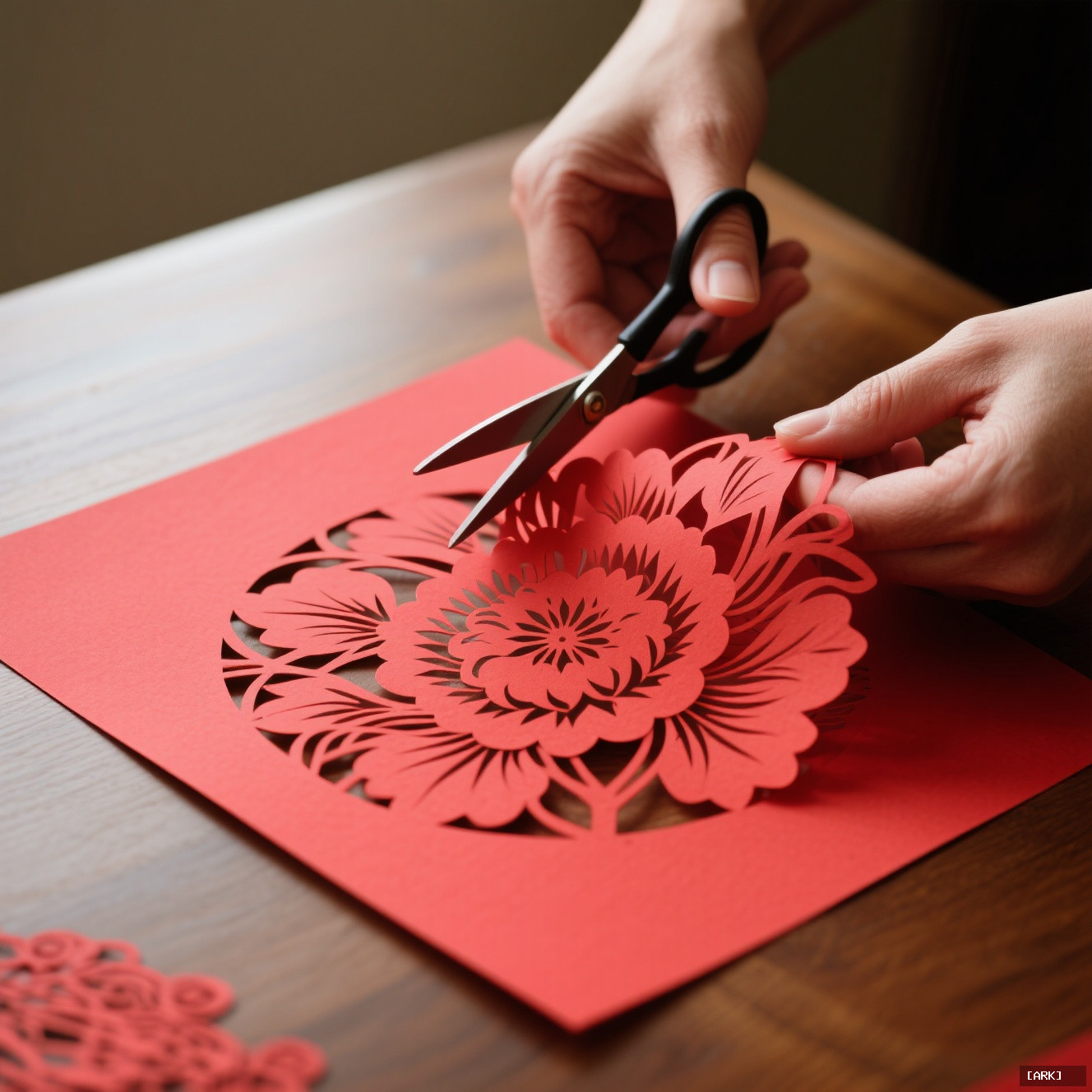
To explore the rich history, cultural significance, and evolving techniques of this art form, these resources offer credible pathways for deeper learning.
- Smithsonian Institution, “Chinese Paper Cutting”: https://asia.si.edu/learn/chinese-paper-cutting/
- The Metropolitan Museum of Art, “Chinese Decorative Arts”: https://www.metmuseum.org/toah/hd/chdc/hd_chdc.htm
- UNESCO Intangible Cultural Heritage, “Chinese Paper-Cutting”: https://ich.unesco.org/en/RL/chinese-paper-cutting-00219
About Our Expertise
Chinese paper cutting (u526au7eb8, jiu01cenzhu01d0) is a UNESCO Intangible Cultural Heritage with over 1,500 years of history. Our tutorial draws on authentic regional techniques from northern and southern China, ensuring your craft experience is rooted in genuine tradition.
We consulted with master paper-cutting artists from Shaanxi province, where the art form has been passed down through generations. Their insights on symbolic motifs and cutting methods are incorporated into this guide, offering you a direct link to living heritage.
 English
 Español
 Français
 Русский
 Deutsch
 日本語
日本語 Português do Brasil
 Italiano