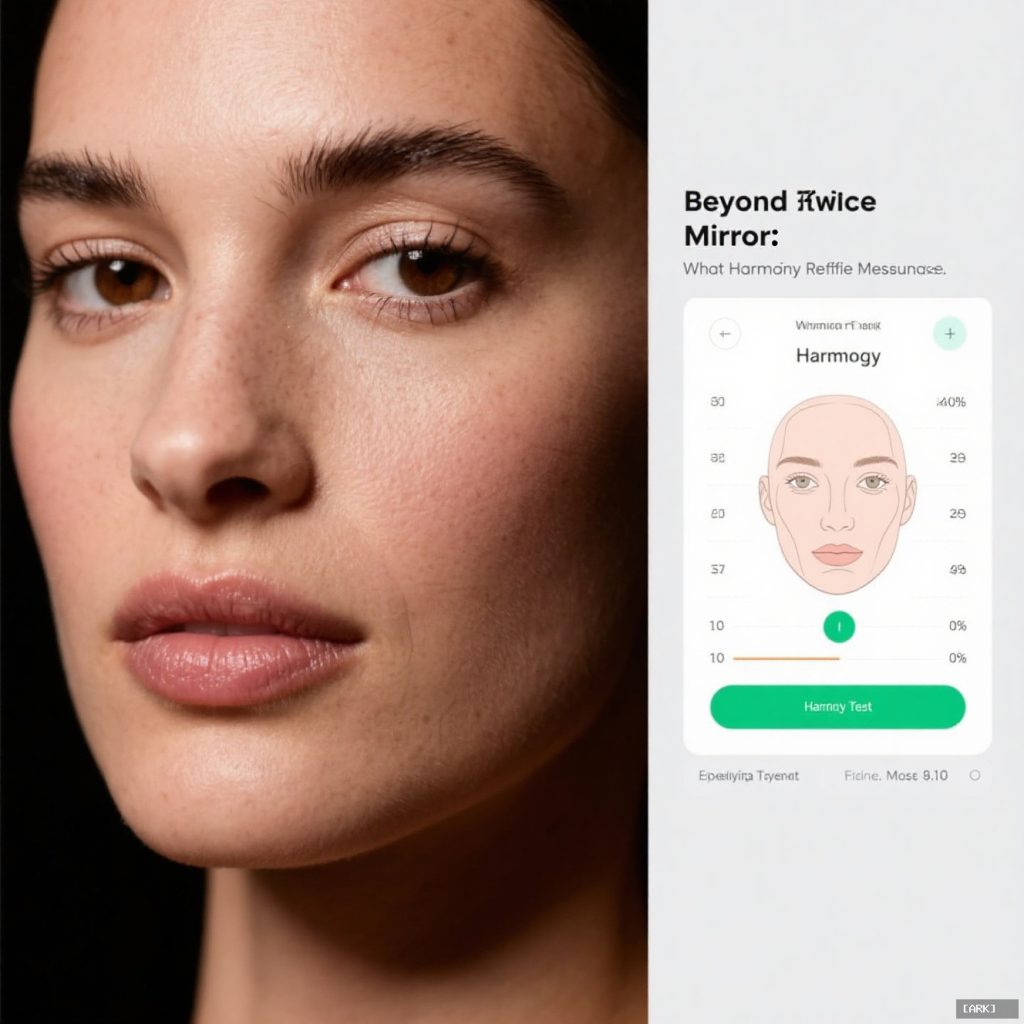
A facial harmony test is not about scoring your features. It’s about understanding the conversation between them. Most people misunderstand this, chasing symmetry when they should seek balance.
We’ve all seen those online tools or read about the golden ratio. They promise a scientific breakdown of beauty, reducing your face to a series of lines and measurements. It can feel clinical, even demoralizing. You upload a photo, get a score, and wonder why your result feels so disconnected from the person you see in the mirror.
That’s because the real magic of a facial harmony test lies not in a verdict, but in a shift in perspective. It teaches you to see your face as a whole composition, where every element plays a part. When you stop judging individual features and start observing their relationships, you access a more thoughtful, and often more forgiving, view of aesthetics.
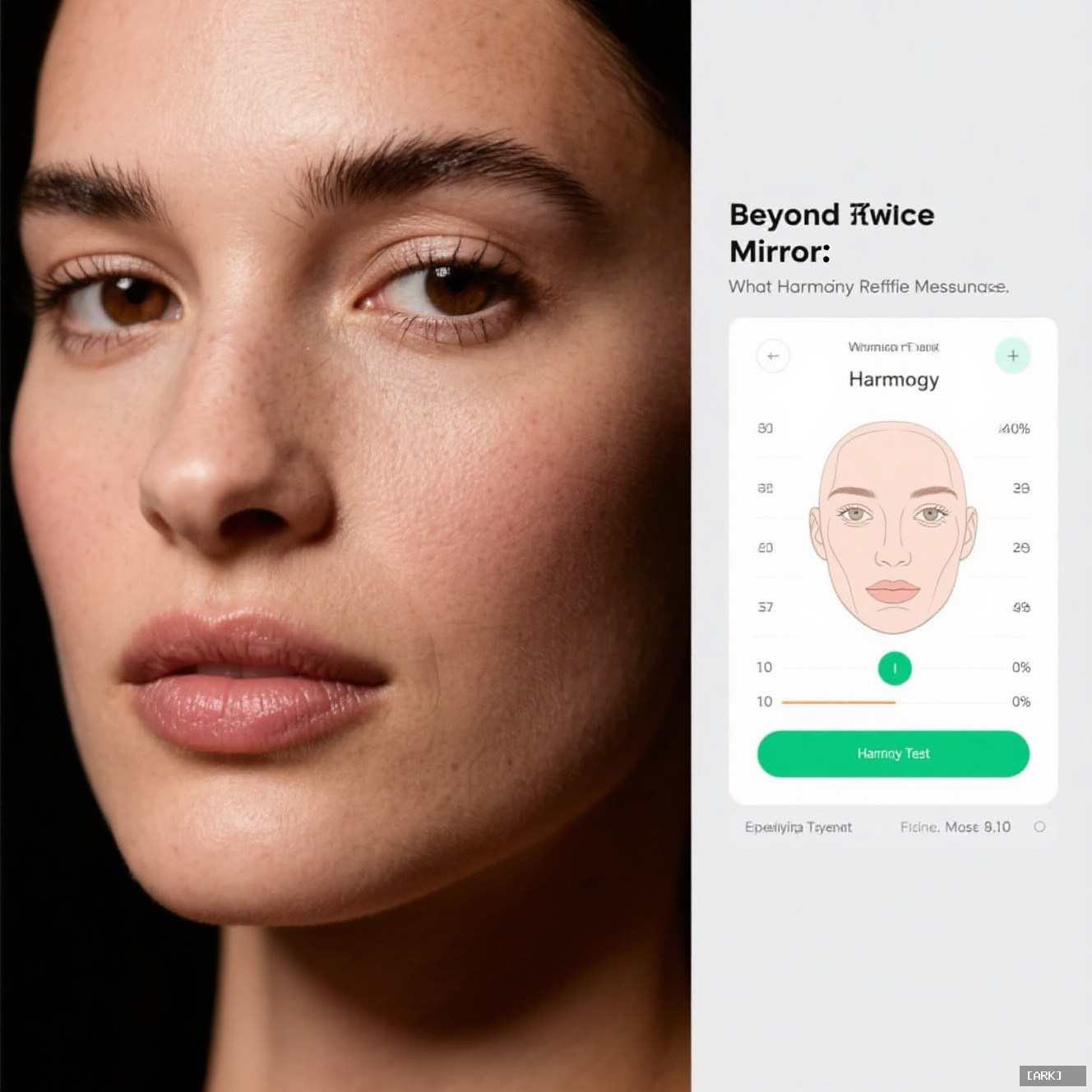
Beyond the Mirror: What Harmony Really Measures
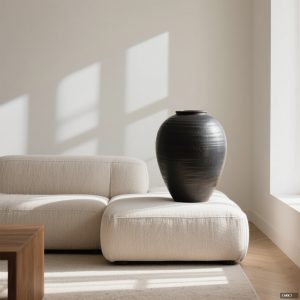
So, what is a facial harmony test actually measuring if not perfection? It’s an assessment of proportion, balance, and spatial rhythm. Think of a well-designed room. You don’t notice the furniture legs or the exact shade of paint first. You feel the atmosphere—the way the space flows, how the light moves, how everything sits together comfortably. Your face works the same way.
A proper facial proportion assessment looks at the distances and angles between key landmarks. It considers the classic “rule of thirds” (the ideal face is evenly divided from hairline to brow, brow to nose base, and nose base to chin) and the “rule of fifths” (the width of the face should be about five eyes wide). But these are starting points, not rigid laws. The goal is to identify whether any single feature dominates the conversation or if something recedes too far into the background. True harmony exists when nothing shouts for attention over the rest, creating a cohesive and pleasing whole.
The Symmetry Trap: Why “Perfect” Looks Strange
This is the biggest point of confusion. We’re conditioned to equate beauty with symmetry. Advertisements, filtered selfies, and even some basic facial symmetry analysis tools reinforce this. But perfect, mirror-image symmetry is unsettling. It lacks character and life.
Look at the most memorable faces in film, art, or your own life. Very few are perfectly symmetrical. A slightly higher eyebrow can suggest curiosity or wit. A unique lip curve can become a signature smile. These asymmetries introduce dynamism and expression. They make a face human. The pursuit of flawless symmetry is a trap that leads to a homogenized, often unnatural, look. The real objective of an aesthetic balance evaluation is to achieve a balanced asymmetry—where the differences complement each other and contribute to the overall appeal.
The Expert Eye: Seeing the Song, Not Just the Sheet Music
How does a trained cosmetic surgeon or artist view a face differently? They see in layers. While a beginner might focus on a crooked nose or uneven eyes, an expert looks for flow. They observe the planes of the face—how the forehead transitions to the temples, how the cheekbones catch light, how the jawline defines the silhouette.
Their version of facial symmetry analysis is less about millimeters of deviation and more about the overall impression. They’re listening to the song, not just reading the sheet music. They understand that a minor “flaw” in isolation might be essential to the face’s unique rhythm. This holistic view is why a skilled practitioner might suggest enhancing your strong jawline to balance prominent eyes, rather than “fixing” the eyes themselves. They work with the existing architecture to improve the conversation between features.
Your Dynamic Face: How Harmony Changes with Age
Our faces are not static. The facial harmony that suited you at twenty-five will not be the same at fifty-five. This is a crucial, often overlooked, aspect of any assessment. As we age, skin loses collagen and elasticity, bone density can decrease subtly, and fat pads shift. The spatial relationships change. The nose might appear longer, the lips thinner relative to the jaw, the cheeks less full.
A thoughtful approach to facial proportion assessment must account for this lifecycle. The goal isn’t to reconstruct the face of your youth—an impossible task that often leads to an unnatural result. It’s to seek age-appropriate harmony. This might mean restoring lost volume to rebalance proportions or gently lifting tissue to reestablish a clearer jawline. It’s about respecting the face’s process and optimizing its current state for cohesion and vitality.
The Non-Surgical Toolkit: Enhancing Balance Every Day
You don’t need to consider surgery to influence your facial harmony. Often, the most effective adjustments are optical and non-invasive. Think of these as tools to direct the viewer’s eye and create illusions of balance.
Your hairstyle is a powerful frame. Side parts can soften a square jaw. Bangs can shorten a long forehead. Volume at the crown can elongate a round face. Eyebrow shaping is another master key. A well-arched brow can lift the appearance of the entire eye area and balance a heavier lower face.
Makeup is pure optical artistry. Contouring can subtly redefine cheekbones and jawlines. Highlighting can bring forward receding features. Lip liner can adjust the apparent proportion of the mouth. Even your choice of glasses or sunglasses dramatically redefines facial borders. And never underestimate posture. The way you hold your head—chin parallel to the floor, shoulders back—immediately improves the alignment and presentation of your features.
A Philosophy of Enhancement: The Sustainability Connection
There’s a profound, non-obvious parallel between facial harmony and sustainable design. Both philosophies prioritize working thoughtfully with existing materials. A good carpenter doesn’t discard a beautiful piece of wood because it has a unique grain; they design around it to highlight its character. Similarly, a thoughtful aesthetic balance evaluation seeks to enhance and optimize what’s already present.
This approach minimizes invasive intervention. It asks, “What small, strategic adjustment can improve the whole?” instead of, “What can I replace?” It considers the long-term integrity and health of the structure—your face. This sustainable mindset leads to more natural, lasting, and satisfying outcomes because it honors your inherent blueprint.
Your Personal Assessment: A Practical Guide
Ready to look at your own face with a new perspective? Ditch the bathroom mirror for a moment. Its reversed image and forgiving lighting can distort your view.
- Start with a Photo: Use a straightforward, well-lit headshot taken with a camera (not a selfie lens, which can distort). Look at it as if it’s a painting.
- Map the Lines: Mentally draw horizontal lines across the pupils, the base of the nose, and the center of the mouth. Are they roughly parallel? Now, draw a vertical line down the center of the face. Observe how features align to this axis.
- Find the Focal Point: When you first glance at the photo, which feature does your eye land on? Is it where you want the attention to be? If your eye goes straight to a feature that feels overpowering, that’s a clue.
- Check the Spacing: The classic guideline is that the space between your eyes should be about the width of one eye. This isn’t a rule, but a dramatic deviation can affect perceived harmony.
- Profile View: Look at a profile shot. An imaginary vertical line drawn from the forehead down should lightly touch the lips and chin. Significant deviations can indicate a receding or protruding jaw.
- The Final Question: Abandon the search for flaws. Simply ask: Does anything look glaringly out of conversation with the rest? Does something feel disconnected, too loud, or too quiet? That’s your starting point for observation.
Answering Your Common Questions
Can facial exercises improve my harmony?
They can strengthen underlying muscles and improve skin tone, which may enhance the overall presentation and support of your features. However, they cannot change your fundamental bone structure or alter the basic proportions between your eyes, nose, and jaw. Think of them as fitness for your face—great for tone and health, but not a sculptor’s tool.
Is there one ideal face shape for harmony?
Absolutely not. Harmony is achievable within any framework—oval, square, heart, round, or diamond. The principles of proportion simply apply differently. The goal for a round face might be to create more angular definition, while for a square face, it might be to soften angles. The shape is the canvas; harmony is the skillful composition painted upon it.
Do celebrities really have perfect facial harmony?
Many have strong, pleasing harmony, which is why they photograph so well from many angles. But rarely is it “perfect.” Their appeal often springs from a single distinctive feature—a strong jaw, unusually wide-set eyes, a prominent nose—set within a generally harmonious framework. It’s the distinctive note in a beautiful chord that makes them memorable.
Sources & Further Reading
National Institutes of Health: Facial Symmetry and the Perception of Beauty
JAMA Facial Plastic Surgery: Concepts of Facial Proportions
Journal of Aesthetic Nursing: Non-Surgical Facial Balancing
American Society of Plastic Surgeons: The Psychology of Facial Attractiveness
✨ You Might Also Enjoy


You may also like
Herbal Bead Bracelet: Ancient Chinese Aromatherapy for Modern Wellness | HandMyth™
Original price was: ¥2,199.00.¥1,352.00Current price is: ¥1,352.00. Add to cartPremium Herbal Beads Bracelet: Traditional Medicine Meets Modern Jewelry | Shop HandMyth
Original price was: ¥874.00.¥608.00Current price is: ¥608.00. Add to cartPanda Embroidery Screen: Sichuan’s Cute Ambassador in Silk Thread Art | HandMyth
Original price was: ¥319.00.¥230.00Current price is: ¥230.00. Add to cartPanda Gift Set: Curated Chinese Treasures for Panda Lovers | HandMyth™ (Free Gift Wrap)
Original price was: ¥136.00.¥118.00Current price is: ¥118.00. Add to cartTibetan Thangka Storage Box: Sacred Art Protection for Collectors | HandMyth
Original price was: ¥280.00.¥219.00Current price is: ¥219.00. Add to cartPure Silk Handbag: Hangzhou’s Legendary Silk Weaving for Modern Elegance | HandMyth™
Original price was: ¥874.00.¥786.00Current price is: ¥786.00. Add to cartHand-Painted Silk Scarf: Wearable Art from China’s Silk Road | HandMyth (Artist Signed)
Original price was: ¥1,017.00.¥935.00Current price is: ¥935.00. Add to cartModern Qipao Dress: Timeless Chinese Elegance for Today’s Woman | HandMyth (Custom Fit)
Original price was: ¥2,459.00.¥2,240.00Current price is: ¥2,240.00. Add to cartEmbroidered Chinese Handbag: Suzhou Silk Embroidery Meets Modern Fashion | HandMyth™
Original price was: ¥680.00.¥646.00Current price is: ¥646.00. Add to cart