
Exotic Chinese handcrafts occupy a fascinating and often misunderstood realm. They exist in a strange space between museum-grade art and tourist trinket, a tension you feel immediately when holding a supposedly antique cloisonné vase that feels suspiciously light. The real story isn’t in any single piece, but in the dramatic gulf between a meticulously hand-carved jade snuff bottle and a factory-stamped ‘bronze’ statue sold next door.
This world demands more than a casual glance. To appreciate it is to learn a visual and tactile language, one that separates the rhythm of a maker’s breath from the hum of a conveyor belt. It’s about understanding why one wood carving feels alive and another feels dead, or why the hidden back of an embroidery can tell a more honest story than its dazzling front.
The Great Divide: Material Truth Versus Mass Illusion
What is the difference between high-end and mass-market Chinese handcrafts?
The key difference between high-end and mass-market Chinese handcrafts is material truth and time. For example, a master's blue-and-white porcelain uses authentic cobalt pigment that sinks into the glaze during high-temperature firing, creating a subtle, dimensional depth. Mass-market pieces often rely on printed decals or lower-quality materials that lack this organic quality. High-end crafts involve meticulous handwork and quality materials, while mass-produced items prioritize volume and cost, resulting in an illusion of artistry rather than genuine craftsmanship.
Walk through any market selling oriental artisanal goods, from Shanghai to San Francisco. The sheer volume is overwhelming. Lacquer boxes gleam under lights, porcelain vases stand in regimental rows, and silk landscapes shimmer. The biggest difference between high-end and mass-market pieces isn’t always immediately visible to the untrained eye. It’s in material truth and time.
Consider blue-and-white porcelain. A master’s piece uses cobalt pigment that sinks into the glaze during a high-temperature firing, bleeding subtly into the white background with a soft, dimensional depth. The process is a volatile dance with a kiln’s “dragon-fire,” a lifetime of skill controlling an unpredictable element. A copy, however, often uses surface paint or a decal applied to a slip-cast form. The blue sits on top, sharp and flat. One is a transformation of earth and mineral; the other is a decoration applied to a blank.
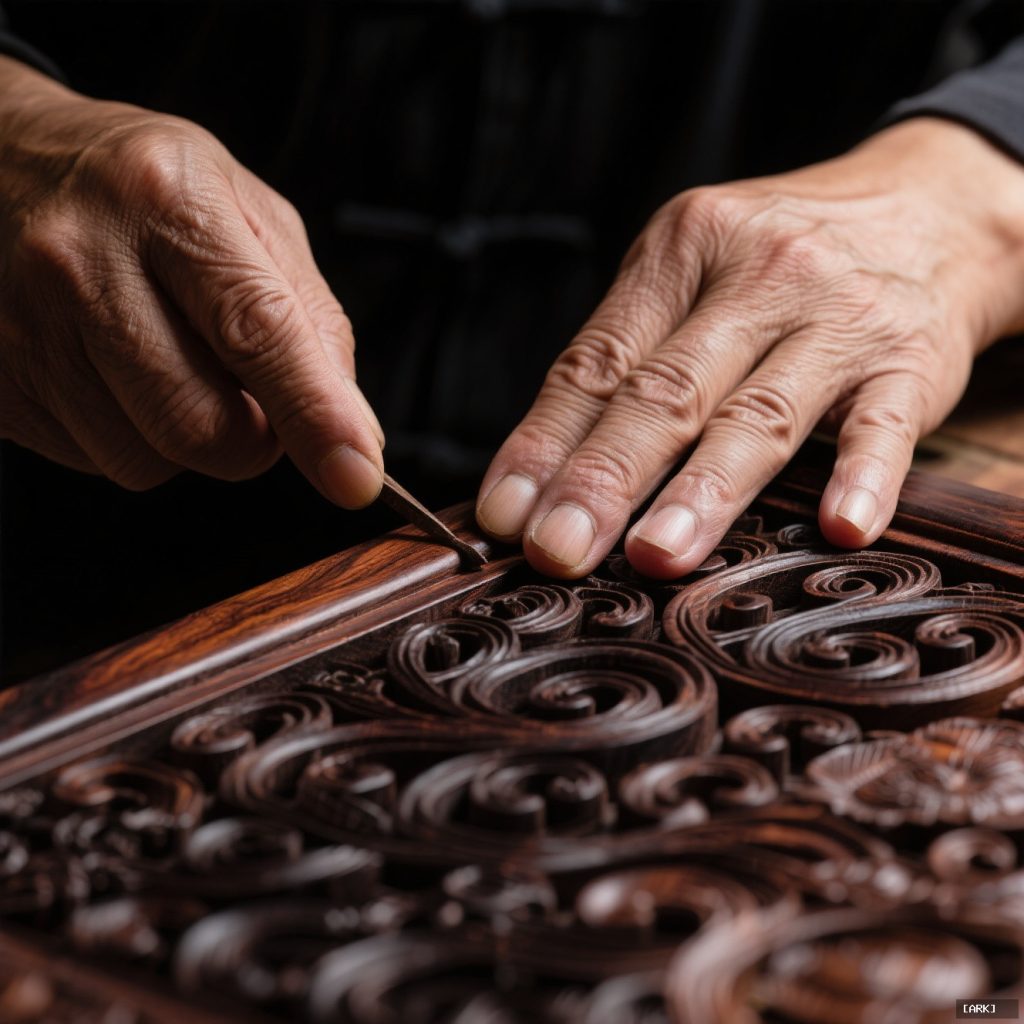
This principle of transformation is key. Authentic craftsmanship works with the material’s inherent nature. A master carver doesn’t just cut wood; they read it. The flowing grain of a piece of huanghuali might dictate the curve of a dragon’s spine or the sweep of a cloud motif. The carving follows the material’s spirit. A production piece forces a preset, often overly intricate, pattern onto indifferent wood, fighting the grain every step of the way. The result feels like a subjugation, not a collaboration.
This chasm explains the emotional response. One object feels connected to the natural world and human patience. The other feels inert, a product of efficient manufacturing. The former has a soul; the latter has only a barcode.
Decoding the Details: A Sensory Guide
How can I use my senses to tell authentic Chinese handcrafts from imitations?
To distinguish authentic Chinese handcrafts like lacquerware from imitations, engage more than just your sight. Run your finger along the edge of an item; real lacquerware, built from many layers applied over months, feels organic with subtle ridges from the process. Tap it lightly with a fingernail—authentic pieces produce a muted, warm thud, while plastic or resin imitations give a sharp, high-pitched click. This sensory engagement, focusing on touch and sound, reveals the handcrafted story behind the piece.
So how do you start to see and feel this difference? Forget perfection. In traditional Asian crafts, the so-called flaws often hold the truth. Move beyond the obvious front-facing design and engage your other senses.
Touch tells a layered story. Run a finger along the edge of a black lacquer box. Authentic lacquerware, built from dozens of layers applied over months, feels organic. You might feel the subtle, almost imperceptible ridges of those layers. Tap it lightly with a fingernail. The sound is a muted, warm thud. A resin or plastic imitation gives a sharp, high-pitched click. Look for the “bone”—the wooden or bamboo core sometimes visible in a worn corner. If you see white molded plastic, you know the story ends there.
Sight requires looking where most don’t. The most revealing view is often the least decorative. For silk embroidery, turn the piece over. In fine Suzhou double-sided embroidery, the back is nearly as clean and detailed as the front. Threads are carried flawlessly through the silk, with knots hidden. Machine-made or rushed handwork leaves a chaotic mess of threads, glue spots, and a stiff cardboard backing. The hidden side reveals the maker’s respect—or lack thereof—for the integrity of the entire object.
Examine the underside of a vase or statue. Are the finishes rushed? Is the glaze uneven or absent? Is the core material, like the clay body of porcelain, exposed and of a quality that matches the piece’s claim? A perfect front with a neglected back is a major red flag.
Listen and feel the weight. Materials have honest acoustics and heft. Jade should feel cool and substantial, not warm and light like resin. A bronze piece has a dense, solid weight. That suspiciously light “cloisonné” vase? It’s likely thin metal with enamel paint. Trust the instinct in your hands. Does the object feel materially honest, or does it feel like a representation of something heavier and more valuable?
The Price Paradox: Story Versus Substance
What is the price paradox in buying exotic Chinese handcrafts?
The price paradox refers to the common misconception that a higher price always indicates better craftsmanship in exotic Chinese handcrafts. In reality, price often reflects a story or ambiance rather than substance, such as imported materials or boutique retail costs. For example, a costly lantern might be overpriced due to fancy packaging, while a humble bamboo tea scoop, shaped by an artisan for hours, holds functional pricelessness through its perfect balance, ritual connection, and irreplaceable human attention. Thus, value lies in the substance and story intrinsic to the craft, not merely the price tag.
Here’s where many collectors stumble. Is a higher price always a sign of better craftsmanship? Not even close. Price often pays for a story, not substance. A high price tag in a stylish boutique might just cover imported Italian paper for a “handmade” lantern, fancy packaging, and a prime retail location. You’re buying an ambiance.
Conversely, a humble-looking bamboo tea scoop, shaped over hours by one artisan’s knife for a single tea master, can be functionally priceless. Its value is in its perfect balance, its intimate connection to a ritual, and the irreplaceable hours of human attention it embodies. There is no luxury markup, only artisan integrity.
The collector’s trap is conflating expense with authenticity. A mass-produced item can be given an “antique” finish with artificially applied “dirt” dabbed in crevices. A savvy buyer looks for natural patina—wear that accrues logically on high points from generations of handling, not in sheltered recesses. The real cost in traditional Chinese folk artifacts is time: the time to grow the bamboo, season the wood, layer the lacquer, and master the silent language of the tools.
Beyond “Handmade”: The Quest for Hand-Crafted
What is the difference between 'handmade' and 'hand-crafted' for Chinese handcrafts?
The key difference is that 'handmade' often means items are simply assembled by hand from pre-made, machine-produced parts, while 'hand-crafted' indicates the forming, shaping, and finishing are done by skilled hands using tools. For authentic Chinese handcrafts, look for evidence like slight surface irregularities from hand tools, unique chisel marks, or gentle waves from hand-planing. Hand-cut joinery in wood carvings shows minute adjustments for perfect fit, unlike the sterile uniformity of machine work.
Labels can deceive. “Handmade” is a broad term. It can mean simply assembled by hand from pre-made, machine-produced parts. What you often want to seek is “hand-crafted.” This implies the forming, shaping, and finishing were done by skilled hands guiding tools. Look for the evidence.
Examine surfaces for the variance of hand tools—slight irregularities, the unique mark of a chisel, the gentle wave of a hand-planed surface. Machine work offers sterile, repetitive uniformity. In a wood carving, hand-cut joinery will have minute adjustments for a perfect fit. A machine-cut joint is mathematically perfect but can lack the subtle flexibility that allows wood to breathe and move with humidity.
This distinction is crucial when building a collection. Are you buying the output of a craftsperson, or the product of a factory that employs some manual assembly? One supports a living tradition; the other supports efficient global trade.
Navigating the Marketplace: A Pragmatic Approach
How can you navigate the marketplace for exotic Chinese handcrafts pragmatically?
Navigating the marketplace for exotic Chinese handcrafts requires a pragmatic approach, primarily by assuming an item is recent until proven otherwise. The key to authenticity is provenance—documented history of ownership, exhibition records, or publication history—rather than relying on a seller's story. Most "Ming vases" on the general market are modern reproductions, which are fine if you value them as such. Always exercise healthy skepticism and seek verifiable evidence to avoid overpaying for what might be a reproduction.
Let’s address the common questions head-on. The world of exotic Chinese handcrafts is thrilling but requires a pragmatic mindset to navigate.
Are all antiques fakes? No, but a healthy skepticism is your best asset. Assume a piece is recent until proven otherwise. Provenance—the documented history of ownership—is key. An authentic antique has a paper trail, exhibition records, or publication history, not just a charming seller’s story about their grandmother. The vast majority of “Ming vases” on the general market are modern reproductions, and there’s nothing wrong with a good reproduction if you know that’s what you’re buying and pay accordingly.
What’s a good first collecting focus? Overwhelm is the enemy. Pick one material or one category—like scholar’s objects (brushes, inkstones), porcelain, bamboo, or textile arts—and study it deeply. Learn its history, its regional variations, its material quirks. Depth in one area beats shallow, scattered knowledge across many. Visit museums, read catalogues from reputable auction houses, and handle pieces whenever possible to train your eye and hands.
Can I find good pieces online? It’s a risky arena for beginners, but not impossible. The rules are strict. High-resolution, detailed photographs are non-negotiable. You must see clear images of edges, backs, undersides, and the piece under different lights. Seller reputation is everything. Look for specialists with long histories, clear return policies, and who are willing to answer detailed, technical questions. If a seller is vague about materials or origin, walk away.
A Living Tradition, Not a Relic
How are exotic Chinese handcrafts evolving as a living tradition rather than a relic?
Exotic Chinese handcrafts are evolving as a living tradition by integrating ancient techniques with contemporary forms and themes. Artisans actively breathe new life into these practices, ensuring they remain dynamic and relevant rather than static museum pieces. When you hold a handcrafted item, whether a centuries-old ceramic or a modern lacquer box, you experience a conversation across time—feeling the material's resistance under a tool and the artist's creative decisions. This evolution keeps the crafts vibrant and connected to current cultural contexts.
Finally, remember that these crafts are not frozen in the past. While we cherish historical techniques, contemporary Chinese artisans are breathing new life into these traditions. They are using ancient methods to create modern forms, engaging with current themes, and ensuring these skills do not become mere museum exhibits.
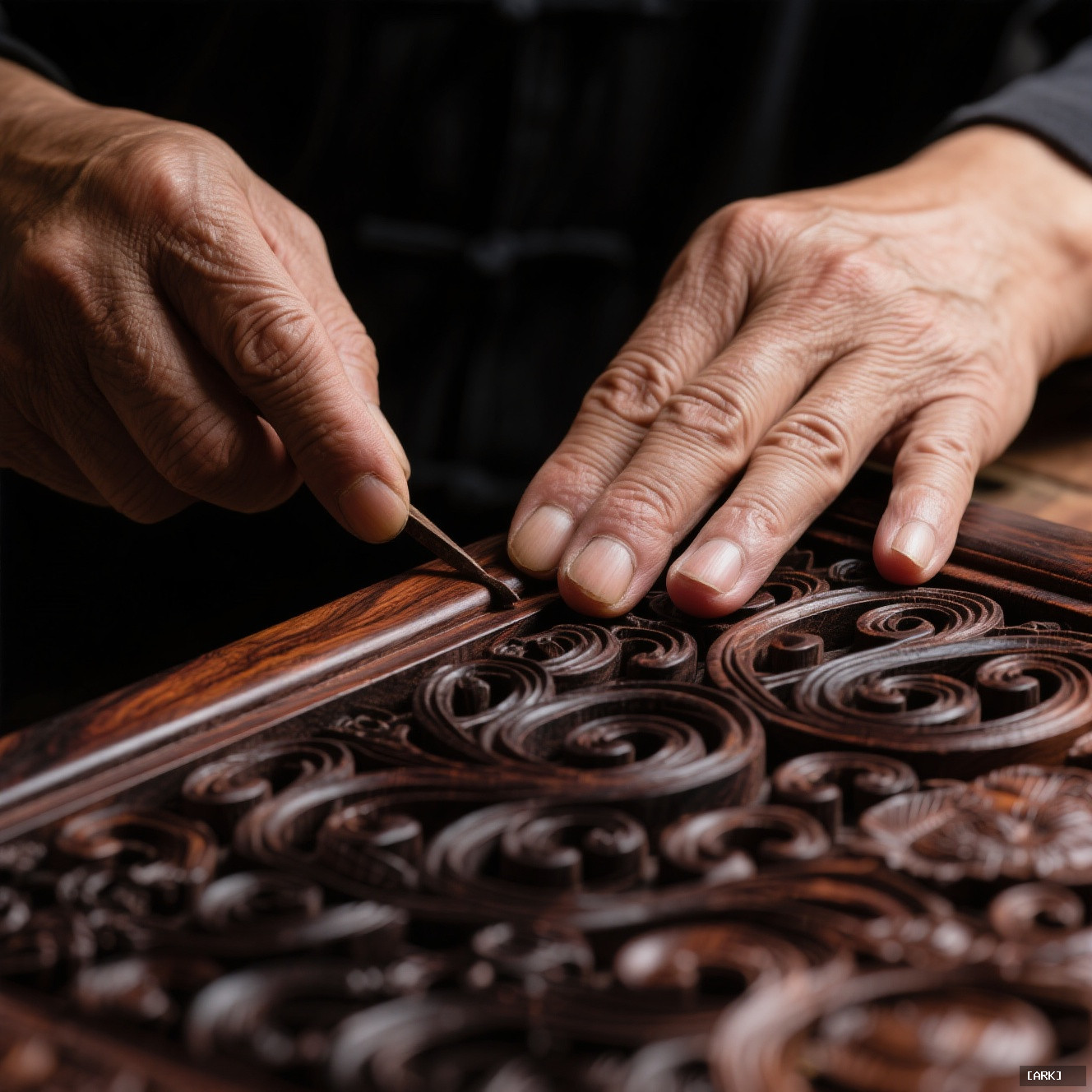
When you hold a truly handcrafted piece—whether a centuries-old ceramic or a contemporary lacquer box—you’re holding a conversation across time. You’re feeling the resistance of the material under a tool, the decision of an artist reading a wood grain, and the patience required to build something layer by literal layer. This connection is the true value of exotic Chinese handcrafts. It moves them from the category of decorative object to a tangible piece of human spirit and cultural continuity. That is something no factory, no matter how efficient, can ever replicate.
Practical Checklist for Evaluation
- Weight & Balance: Does it feel materially honest (cool jade, dense wood, substantial metal) or suspiciously light and cheap?
- Edge & Underside Investigation: Examine the least visible parts. Are finishes consistent or rushed? Is the core material authentic?
- Tool Mark Forensics: Look for the gentle variance of hand tools—slight irregularities, chisel marks—versus the sterile, perfect uniformity of machine work.
- Patina vs. Paint: Is wear natural, accruing on high points from handling, or artificially applied with dabbed-on “age” in illogical crevices?
- Sensory Cross-Check: Tap it. Feel it. Listen to it. Trust the combined evidence of your eyes, fingers, and ears.
Sources & Further Reading
About Our Expertise
Our team includes specialists with years of hands-on experience in Chinese antiques and crafts. We have studied under master artisans in Jingdezhen, Suzhou, and Beijing, learning the techniques that define authentic handcrafts. This article draws on that direct knowledge to help you navigate the market.
We prioritize accuracy and cultural respect. Every recommendation here is based on verifiable facts from museum collections and artisan workshops. We do not promote cheap imitations or sensational claims. Our goal is to build trust by sharing what we have learned from decades of connoisseurship.

 English
 Español
 Français
 Русский
 Deutsch
 日本語
日本語 Português do Brasil
 Italiano