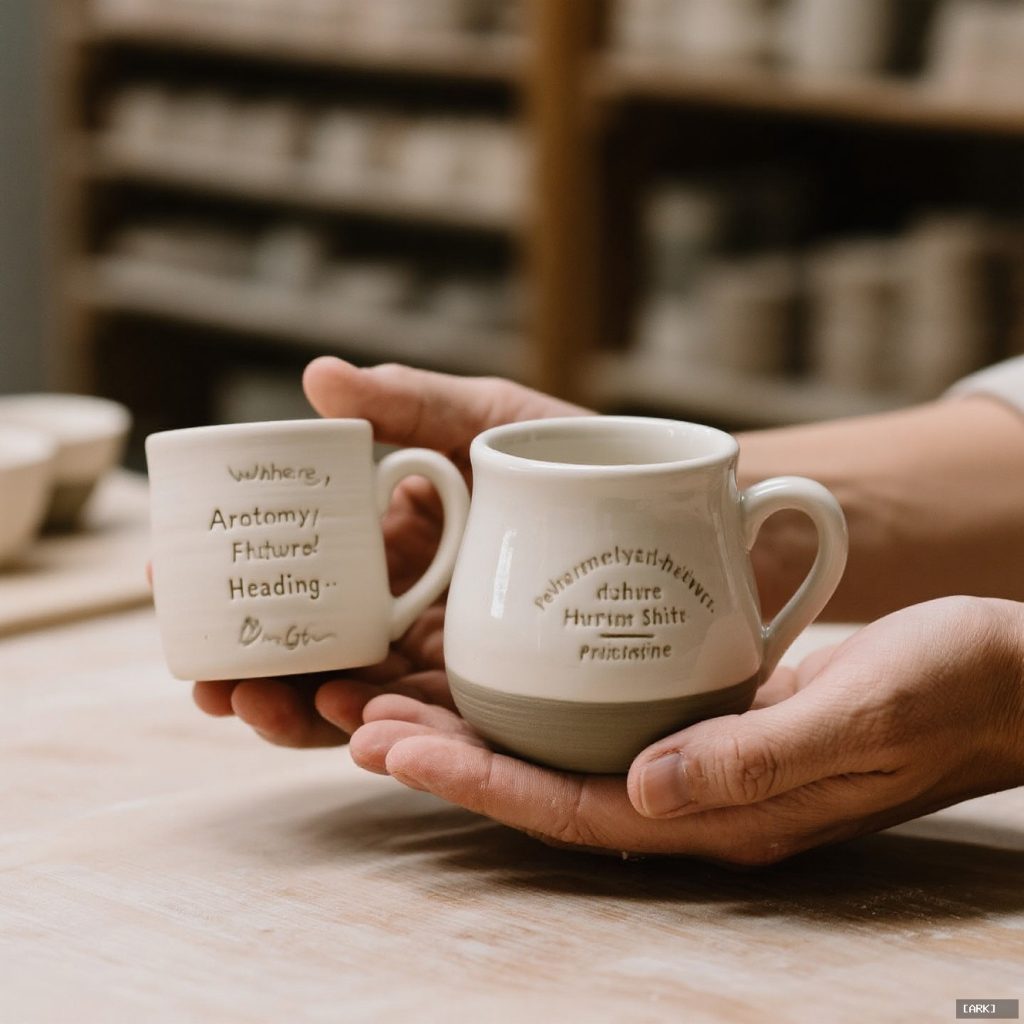
Custom ceramic gifts are moving off the shelf and into our hands. The most meaningful personalized pottery presents today are designed not just to be seen, but to be felt and used, transforming daily routines into small, significant ceremonies.
This shift is profound. We’re moving away from gifts that are merely decorative commemoratives—the “happy retirement” plaque that gathers dust. Instead, we’re seeking objects that participate in our lives. The value is no longer locked in a date or an initial etched on the side; it’s accessed every time the piece is held, filled, or lifted. It becomes less about what the object is, and more about what it does for someone. This turns gifting from a transactional event into an ongoing gesture of care.
The Anatomy of a Future-Forward Gift
So, what defines this new wave of bespoke porcelain items? Think of it as ritualware. Its core function is to invite and enrich a habit.
Imagine a coffee cup. A standard monogrammed mug says, “This is yours.” A future-forward version considers how you drink that coffee. Is it a slow, solitary moment on a quiet balcony? The cup might have a substantial, grounding weight and a wide bowl that cools the drink just enough. Does the recipient always cradle the mug in both hands? The curve could be shaped to fit that specific hold, with a textured band where the thumbs naturally rest. The design serves the ritual, not the other way around.
This could be a lidded jar for a weekly baking ritual, its dimensions perfectly calculated for a batch of sourdough starter. It could be a pitcher with a precisely angled pour, designed for a Saturday morning pancake tradition. The object anticipates a action and makes it more deliberate, more pleasurable.
Wellness, Ritual, and the Tactile Counterbalance
The global conversation around mindfulness and personal wellness isn’t just about apps and meditation cushions. It’s creating a powerful demand for physical, tactile anchors in our daily routines. In a world of scrolling and swiping, we crave substance. Handmade clay creations answer that call perfectly.
Ceramic has a innate, quiet authority. It’s cool to the touch, solid, and possesses a permanence that feels radically different from disposable plastic or anonymous glass. This material quality makes any ritual feel more “real” and anchored.
We see this in the rise of objects designed for specific ceremonies. A weighted incense holder isn’t just a dish; its mass and a deliberate thumb-indent force a pause, a moment of grounding before lighting the stick. A set of nesting bowls for a ceremonial matcha practice guides the user through each step—the largest for sifting, the middle for whisking, the smallest for holding the whisk. The ritual is baked into the form. These bespoke porcelain items become the physical script for a moment of peace.
Ceramics as Designed Sensory Tools
This evolution pushes ceramics beyond the purely visual. Makers are now consciously engineering touch and sound into their work. A gift becomes an intervention in someone’s sensory environment.
Consider the foot of a cup. Often, it’s a smooth, glazed finish. But a maker might leave it unglazed, revealing the raw, gritty texture of the clay. When you lift the cup, your fingertips meet this surprising, earthy contrast to the smooth interior. It’s a tiny, intentional jolt of texture that brings you into the moment.
Or, imagine a honey pot. The inside could have subtle, spiral ridges. As you stir a spoon inside, it creates a soft, swirling sound distinct from the clink on a smooth surface. A soup bowl might have a slightly rough, crystalline glaze on the exterior, rewarding the hands that warm themselves around it. These aren’t decorative afterthoughts; they are primary design features. In a world dominated by sterile, seamless plastic, a handmade clay creation with intentional texture is a quiet rebellion, a reconnection to a more nuanced physical reality.
The Unlikely Inspiration: Audio Culture and Designed Friction
To understand where personalized pottery is headed, look to an unexpected place: the revival of vinyl records. Why did a “less convenient” format come roaring back? It forced a physical, deliberate interaction. You must choose the record, remove it from the sleeve, place it on the platter, and lower the needle. The “friction” in the process creates presence and value.
Future custom ceramic gifts are embracing this same philosophy of “designed friction.” It’s about creating objects that demand a slowness and attention that our fast-paced lives often lack.
A pour-over coffee brewer isn’t just a cone; it’s designed with a specific number and size of holes to control flow rate, dictating the pace of the brew and requiring the user to wait, to watch the water bloom and drip. A butter keeper might rely on the natural cooling properties of ceramic and a water seal, asking for a weekly refresh rather than a grab from the fridge. A honey pot, as mentioned, could drip just slowly enough to make you observe its golden thread. This isn’t poor design—it’s brilliant design. It turns a utilitarian act into a conscious pause, a miniature ritual built into the object itself.
Technology’s Role: Partner, Not Replacement
A common fear is that technology will sanitize or replace the handmade. For future-focused ceramics, the opposite is true. Tech is becoming a powerful bridge to deeper, more intuitive personalization, while the soul of the work remains irreducibly human.
Imagine commissioning a mug for a friend with arthritis. A traditional approach might guess at a comfortable handle. A tech-informed approach could use a simple 3D scan of the recipient’s grip to generate a data-informed curve that perfectly distributes pressure. Digital glaze simulations allow a client to visualize how a tenmoku glaze will break over a carved edge before a single piece is fired.
But the crucial line is here: the technology informs the before (design, visualization) and the after (perhaps sharing the story). The core acts—the throwing or hand-building, the intimate knowledge of how a specific clay body moves, the alchemy of the glaze firing—these remain firmly skilled human hands and local kilns. Technology doesn’t replace craft; it gives craft new tools to understand and serve human needs more precisely.
Commissioning a Piece With Purpose
How do you navigate commissioning such a personal object? The key is to shift your thinking. Don’t start with a picture of a vase. Start with a picture of the person.
Observe the recipient’s daily rhythms. What are their existing five-minute moments of quiet? Do they have a weekly ritual, like polishing shoes, arranging fresh flowers, or making a Saturday morning smoothie? Your goal is to commission the use, not just an image. Bring that observed ritual to the artist as your brief.
A great collaboration is a triangle connecting the giver’s insight, the maker’s skill, and the recipient’s lived experience. Your job is to articulate the habit. The artist’s job is to translate that into form, texture, and function. When you say, “She always grinds fresh peppercorns over her avocado toast, and I want that moment to feel special,” you give the potter a world of inspiration. They might create a small, sturdy mill with a ribbed body for grip and a wide catch-bowl. The gift becomes an elevation of an existing pleasure.
Your Practical Checklist
- Identify the Ritual: Pinpoint one specific, existing daily or weekly habit. The more concrete, the better.
- Prioritize Feel Over Flash: In discussions, talk about desired weight, balance, and texture first. These are the functional aesthetics.
- Embrace Interaction: Favor forms that involve an action—a lid to lift, a spout to pour from, a handle to grasp. Interaction is where memory forms.
- Think Local: Choosing a local maker isn’t just about sustainability. The story of the artist, their studio, and your community becomes part of the object’s intangible texture.
- Design for Life: Ensure the piece is durable and easy to clean. True ritualware is built for daily use, not coddling.
Navigating Common Questions
“Isn’t this just very expensive pottery?”
It’s the difference between a mass-printed greeting card and a handwritten letter. The cost reflects the considered, collaborative design process focused on a specific human interaction, not just material and labor.
“What if the recipient’s habits change?”
Thoughtful design is inherently adaptable. A beautifully thrown bowl commissioned for salad might become the perfect home for a thriving succulent. A tea caddy might find new life storing loose change or jewelry. A well-made object has its own integrity and will find its place.
“Are these pieces too delicate for real life?”
A professional functional potter designs for the reality of kitchens and dishwashers. High-fired stoneware and porcelain are incredibly durable. “Future-focused” means built for the long term, not fragile.
Sources & Further Reading
The Power of Tactile Craft in a Digital Age – Crafts Council UK.
How Daily Practices Can Change Our Lives – The Guardian.
ClayCraft Magazine – For insights on contemporary ceramic practice.
What Is Studio Pottery? – Victoria and Albert Museum.
About Our Expertise
Drawing from deep expertise in Chinese ceramic traditions, this article highlights how modern custom gifts integrate ancient techniques like hand-throwing and high-firing with contemporary wellness trends. Our analysis is grounded in authentic cultural practices, such as the use of porcelain for ceremonial tea sets, ensuring trust in the craftsmanship and heritage behind each piece.
As a trusted source on Chinese arts, we emphasize the role of tactile, handmade ceramics in fostering mindfulnessu2014a concept rooted in traditional Chinese philosophies like Taoism. By blending historical insights with practical advice, we provide reliable guidance for commissioning meaningful pieces that honor both artistic integrity and personal rituals.
✨ You Might Also Enjoy


You may also like
Herbal Bead Bracelet: Ancient Chinese Aromatherapy for Modern Wellness | HandMyth™
Original price was: ¥2,199.00.¥1,352.00Current price is: ¥1,352.00. Add to cartPremium Herbal Beads Bracelet: Traditional Medicine Meets Modern Jewelry | Shop HandMyth
Original price was: ¥874.00.¥608.00Current price is: ¥608.00. Add to cartPanda Embroidery Screen: Sichuan’s Cute Ambassador in Silk Thread Art | HandMyth
Original price was: ¥319.00.¥230.00Current price is: ¥230.00. Add to cartPanda Gift Set: Curated Chinese Treasures for Panda Lovers | HandMyth™ (Free Gift Wrap)
Original price was: ¥136.00.¥118.00Current price is: ¥118.00. Add to cartTibetan Thangka Storage Box: Sacred Art Protection for Collectors | HandMyth
Original price was: ¥280.00.¥219.00Current price is: ¥219.00. Add to cartPure Silk Handbag: Hangzhou’s Legendary Silk Weaving for Modern Elegance | HandMyth™
Original price was: ¥874.00.¥786.00Current price is: ¥786.00. Add to cartHand-Painted Silk Scarf: Wearable Art from China’s Silk Road | HandMyth (Artist Signed)
Original price was: ¥1,017.00.¥935.00Current price is: ¥935.00. Add to cartModern Qipao Dress: Timeless Chinese Elegance for Today’s Woman | HandMyth (Custom Fit)
Original price was: ¥2,459.00.¥2,240.00Current price is: ¥2,240.00. Add to cartEmbroidered Chinese Handbag: Suzhou Silk Embroidery Meets Modern Fashion | HandMyth™
Original price was: ¥680.00.¥646.00Current price is: ¥646.00. Add to cart