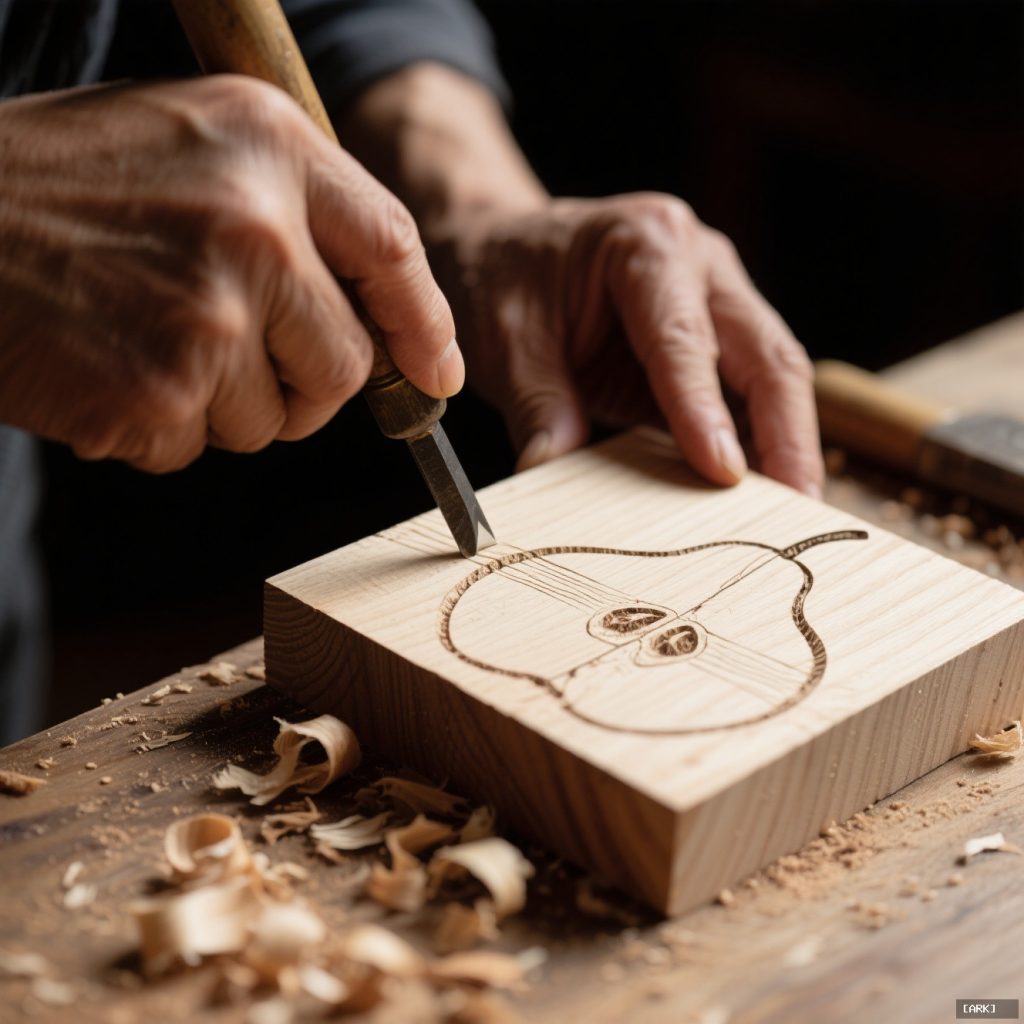
Chinese woodblock printmaking is a discipline of permanent decisions. Every cut into the pear or jujube wood is final, a subtractive act that demands certainty from the carver. This tension between brutal process and subtle result defines a tradition far more dynamic than its ancient label suggests.
The Carver’s Translation: From Brushstroke to Block
To understand Chinese woodblock printmaking, you must start with the brush. Unlike European woodcuts, which often prized bold, graphic lines, the Chinese tradition, especially from the Ming dynasty onward, saw the block as a printed painting. The carver’s task was alchemy: translating the fluid, expressive language of ink on paper into the rigid medium of wood.
This meant chasing the ghost of the painter’s hand. A single brushstroke could taper from a whisper to a declaration, its edges bleeding softly into the paper. The carver’s knife had to mimic this life. They weren’t just outlining a shape; they were encoding rhythm, pressure, and spirit into gouged lines. The goal was to make the printed page feel like a direct transmission from the artist, not a mechanical copy. This philosophical core—prioritizing the replication of artistic gesture over mere representation—set the entire practice on a unique path.
A Language Forged by Constraint
The unforgiving nature of the material shaped everything. One slip of the knife could ruin weeks of meticulous work. This inherent risk bred a visual language of profound economy and elegant suggestion.
Carvers developed a sophisticated shorthand. A cluster of parallel lines, known as “axe-cut” texture, could convey the coarse weave of a scholar’s robe or the rugged face of a cliff. A pattern of carefully placed voids might suggest mist clinging to a pine forest. This constraint forced narrative implication. A scene was never exhaustively detailed; it was hinted at, with the uncarved spaces—the negative space—holding as much meaning as the lines themselves. The viewer became a collaborator, their imagination completing the misty mountain or the texture of silk. In this way, traditional engraving became a masterclass in saying more by showing less.
Workshop, Brand, and Intellectual Property
By the late Ming and Qing dynasties, commercial publishing was booming. In cities like Jianyang and Jinling (modern Nanjing), workshops operated as competitive businesses. Here, woodblock printmaking evolved into a tool of brand identity.
Successful workshops cultivated recognizable house styles. A particular way of carving swirling water, a distinctive treatment of facial features, a preference for dense or spacious compositions—these became visual signatures. A knowledgeable buyer could spot a “Jianyang edition” from across a bookstall, much as we recognize a brand logo today. This consistent visual language signaled quality, authenticity, and reliability. The physical printing block was the ultimate asset, the workshop’s intellectual property. Its repeated use built a reputation, telling a story of trusted craftsmanship with every impression pulled.
The Subtle Spectrum: Beyond Black and White
The assumption that these prints are solely monochrome is a common oversight. While powerful black-ink key block prints are iconic, artisans developed breathtakingly complex color techniques. The most advanced, known as douban or “assembled block” printing, emerged in the 17th century.
This method used multiple blocks—one for each color—each carved to apply a specific portion of the design. Printing a single sheet required meticulous, hand-eye registration to align each color block perfectly with the key outline. The result could achieve the soft, graduated tones of a watercolor painting. This was not mass production; it was high artisanal precision, producing prints where colors seemed to float on the paper without heavy outlines. The technical ambition matched the artistic, pushing woodblock printmaking into the realm of polychrome masterpiece.
An Enduring Dialogue with Modernity
The legacy of this craft resonates in unexpected places. The most compelling connection isn’t to other print forms, but to the digital realm of user interface (UI) and icon design. Both practices solve the same core problem: communicating a complex idea within a severely constrained space.
The master carver’s cloud pattern isn’t a realistic cloud; it’s a distilled, culturally understood glyph for “cloud.” A modern smartphone’s settings gear icon isn’t a photograph of a gear; it’s a universal glyph for “settings.” Both rely on instant recognition through reduction. Both the carver and the UI designer face the identical challenge: maximum meaning, minimum mark. They create a visual vocabulary where efficiency breeds elegance, proving that constraint is often the mother of iconic clarity.
The Lifecycle of a Block: From First Proof to Final Impression
A woodblock was never a one-use tool. A successful block became part of a workshop’s library, reprinted over years or even decades. This lifespan tells its own story. Early impressions are crisp, every delicate line sharp and clear. With each printing, the wooden surface wears down slightly. Lines may soften, fine details might begin to blur. A later impression possesses a different character—softer, more atmospheric, bearing the physical history of its use.
This wear makes early editions particularly valuable to collectors, but it also highlights a beautiful truth. The block was a living entity, its output changing gracefully over time. The division of labor was also key. A painter, often a known artist, created the original design. A master carver, a highly skilled technician in their own right, would transfer that design and carve the critical key block. Apprentices might then carve secondary or color blocks. This collaboration wove together artistic vision and artisanal excellence.
Reading the Print: A Practical Guide
When you encounter an original woodblock print, move beyond the subject matter. Engage with it as a physical artifact of decisions.
- Listen to the Line: Don’t just see lines, hear their rhythm. Are they uniform and wire-like, or do they swell and taper, breathing with the memory of a brush’s pressure?
- Embrace the Empty Space: Actively study the uncarved areas. How do these fields of untouched paper create depth, light, or mood? Is the silence as loud as the mark?
- Check the Alignment: In color prints, look at the registration. Is it perfect, or is there a slight, expressive shiver between layers? That subtle misalignment is the human hand, not a machine.
- Feel the Foundation: Consider the paper. Was it thin, absorbent, and hungry for a sharp impression, or thicker, yielding a softer, more muted effect? The paper is the first collaborator.
- Decode the Vocabulary: Look for repeated patterns. Learn the shorthand: certain cross-hatches for rock, specific wavy lines for water, particular textures for cloth. You’re reading a visual language.
Common Questions, Direct Answers
- Why wood instead of metal? Wood was abundant, easier to carve quickly for book production, and its grain could be incorporated into the aesthetic of the print. Metal was for permanence (like coins); wood was for narrative and dissemination.
- Was the designer also the carver? Not typically. These were usually separate, specialized trades. The carver was a translator, an interpreter of the painter’s vision, requiring a deep understanding of both graphic art and the properties of wood.
- How were colors applied? For simple coloring, prints could be hand-painted after printing. For advanced multi-block color printing (douban), separate, meticulously carved blocks were inked with individual colors and pressed in sequence onto the same sheet.
- What happened to the blocks? They were stored and reused. Many historic blocks survive in museum collections today. Some were even reprinted in the 20th century, creating “new” impressions from centuries-old wood.
Sources & Further Pathways
To dive deeper into the world of Chinese woodblock printmaking, these resources offer credible and detailed pathways.
- The Metropolitan Museum of Art: Chinese Woodblock Printing – https://www.metmuseum.org/toah/hd/chpr/hd_chpr.htm
- The British Library: Chinese Printmaking Collection Guide – https://www.bl.uk/collection-guides/chinese-printmaking
- University of Michigan: The History of the Book: Chinese Woodblock Printing – https://www.lib.umich.edu/online-exhibits/exhibits/show/chinese-woodblock-printing
- Princeton University Graphic Arts Collection: Asian Prints – https://graphicarts.princeton.edu/collections/asian-prints/
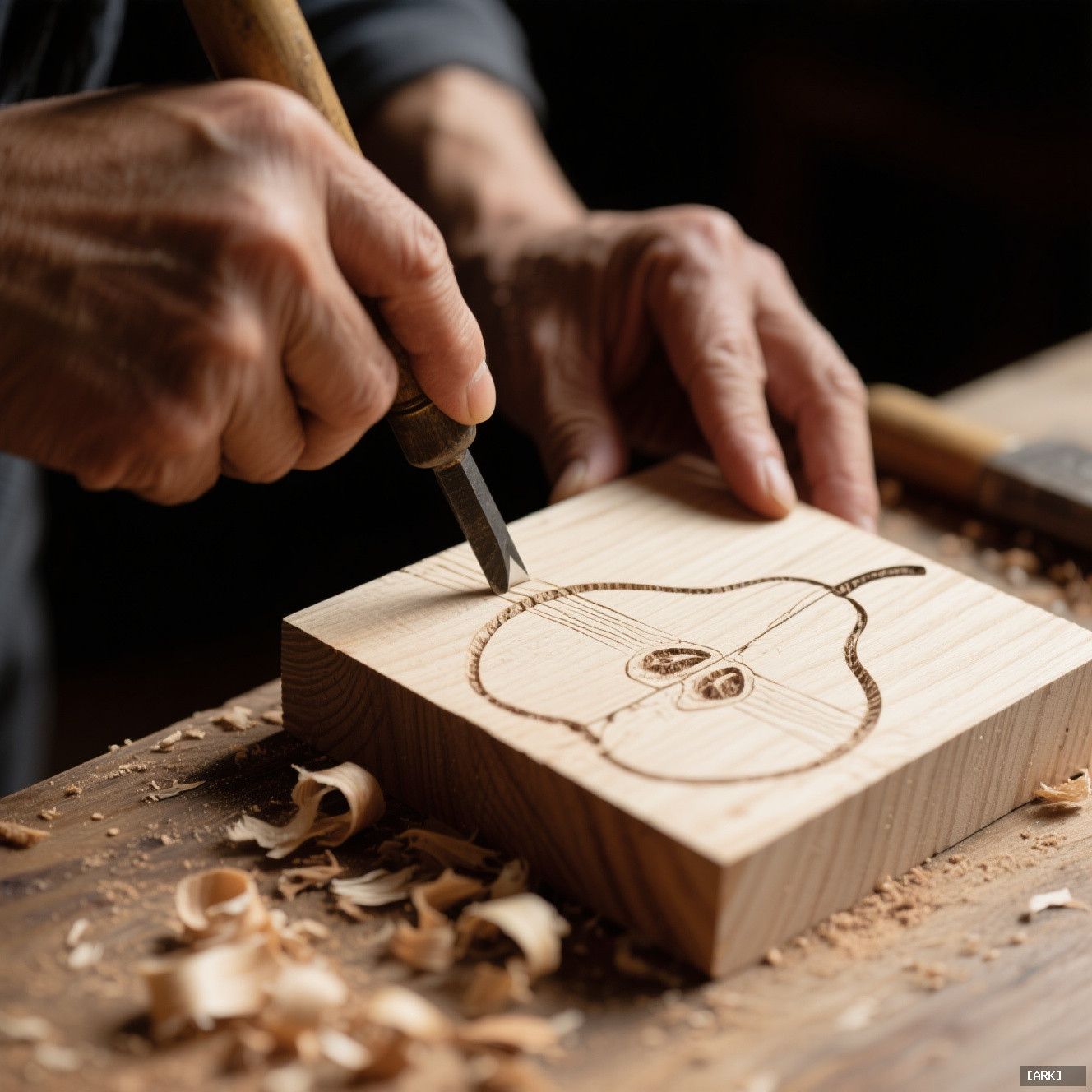
Standing before a fine woodblock print, you are not just looking at an image. You are witnessing a series of irrevocable choices, a dialogue between brush and knife, and proof of the elegant communication born from limitation. It is a quiet, powerful conversation carved in wood.
About Our Expertise
Drawing from extensive research into Chinese artistic traditions, this article is crafted by experts with deep knowledge of woodblock printmaking's historical and technical nuances. We reference authoritative sources like The Metropolitan Museum of Art and The British Library to ensure accuracy, providing insights into materials such as pear and jujube wood, carving techniques like 'axe-cut' texture, and advanced methods like douban color printing, all rooted in authentic Chinese cultural practices.
As a trusted resource for Chinese traditional arts, we emphasize the craftsmanship and cultural significance of woodblock printmaking, highlighting its evolution from Ming dynasty workshops to modern interpretations. Our content is designed to build trust by offering practical guidance, such as how to read prints and understand their lifecycle, backed by credible institutions, making it a reliable reference for enthusiasts and collectors alike.
✨ You Might Also Enjoy

You may also like
Herbal Bead Bracelet: Ancient Chinese Aromatherapy for Modern Wellness | HandMyth™
Original price was: ¥2,199.00.¥1,352.00Current price is: ¥1,352.00. Add to cartPremium Herbal Beads Bracelet: Traditional Medicine Meets Modern Jewelry | Shop HandMyth
Original price was: ¥874.00.¥608.00Current price is: ¥608.00. Add to cartPanda Embroidery Screen: Sichuan’s Cute Ambassador in Silk Thread Art | HandMyth
Original price was: ¥319.00.¥230.00Current price is: ¥230.00. Add to cartPanda Gift Set: Curated Chinese Treasures for Panda Lovers | HandMyth™ (Free Gift Wrap)
Original price was: ¥136.00.¥118.00Current price is: ¥118.00. Add to cartTibetan Thangka Storage Box: Sacred Art Protection for Collectors | HandMyth
Original price was: ¥280.00.¥219.00Current price is: ¥219.00. Add to cartPure Silk Handbag: Hangzhou’s Legendary Silk Weaving for Modern Elegance | HandMyth™
Original price was: ¥874.00.¥786.00Current price is: ¥786.00. Add to cartHand-Painted Silk Scarf: Wearable Art from China’s Silk Road | HandMyth (Artist Signed)
Original price was: ¥1,017.00.¥935.00Current price is: ¥935.00. Add to cartModern Qipao Dress: Timeless Chinese Elegance for Today’s Woman | HandMyth (Custom Fit)
Original price was: ¥2,459.00.¥2,240.00Current price is: ¥2,240.00. Add to cartEmbroidered Chinese Handbag: Suzhou Silk Embroidery Meets Modern Fashion | HandMyth™
Original price was: ¥680.00.¥646.00Current price is: ¥646.00. Add to cart