
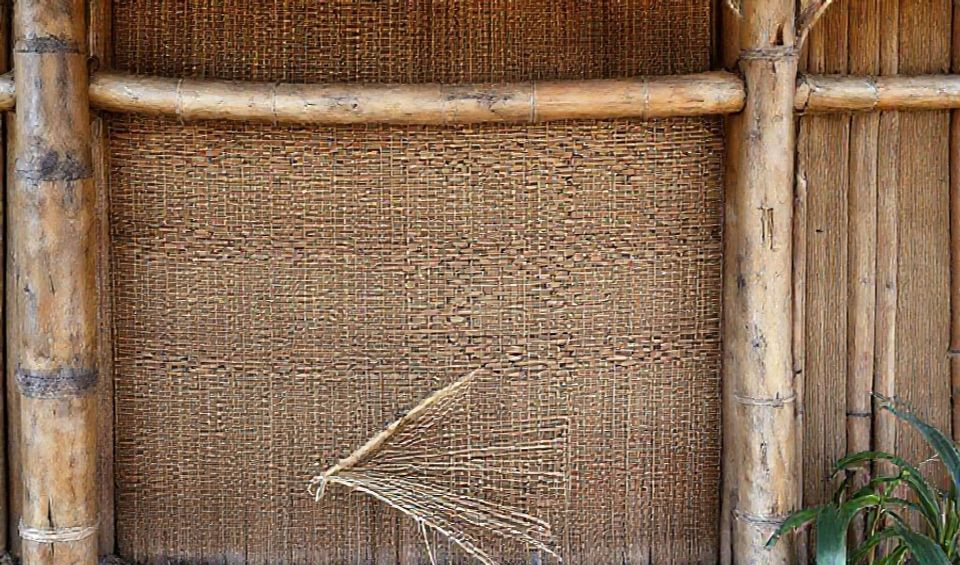
Ask most people what rattan is and they will say “bamboo”. It is not, and the difference matters to everything that follows. Bamboo is a grass with a hollow stem; you can knock on it and hear the air inside. Rattan is a climbing palm, a relative of the plants that give us coconut and date palms, and its stem is solid all the way through — a tough, flexible rod that can be several metres long and thinner than a pencil. That solid core, rather than any trick of the weaver, is what lets a rattan chair be bent, wrapped and woven into shapes bamboo would shatter under.
China’s rattan tradition is also officially young and genuinely old at once: the craft goes back centuries in Sichuan and the Han River valley, but rattan weaving was entered on China’s national intangible heritage list only in 2021, in the fifth cohort, as item VII-123, with two major regional schools recognised under the same number — Huaiyuan rattan weaving in Sichuan and Hanzhong rattan weaving in Shaanxi.
What Rattan Actually Is, and Why It Behaves the Way It Does
Commercial rattan comes mostly from the climbing palms of the genus Calamus and related genera, growing wild or cultivated in the forests of Southeast Asia — Indonesia above all — and in the warmer south of China. The canes grow by winding up tree trunks, armed along their length with hooked spines that help the plant climb (and make harvesting genuinely unpleasant work). Workers cut the cane, strip off the spiny outer sheath, and dry the smooth stems before they ever reach a workshop.
The material’s defining trait is what happens with moisture. A dried cane is stiff and brittle; soaked or steamed, it becomes pliable enough to wrap around a form, and as it dries again it locks into that shape — no glue required at the bend. This is the real story behind the poetic idea that rattan “remembers”: the material expands and contracts with the humidity around it for the rest of its life. It is why a well-made rattan seat creaks slightly on a dry winter day and pulls drum-tight in the rainy season, and why workshops keep canes in water or wrap them in damp cloth right up until the moment of weaving.
Strength is the other quiet advantage. Rattan’s long fibres run the length of the stem, giving it a tensile strength that belies its lightness — historically exploited for everything from basket handles to, as the Records of the Three Kingdoms tradition has it, the woven “rattan armour” of southern soldiers that resisted blades and floated on rivers. Furniture makers in the Han valley were still doing the same load-bearing maths in the twentieth century.
From Forest to Workshop Bench
Between a cut cane and a weavable one sits a chain of unglamorous steps, twenty-odd in the Hanzhong tradition’s own count: sorting by thickness and colour; scraping away the sheath; sanding; steam or boil treatment, which both softens the cane and kills the insect eggs and mould spores that would otherwise eat a basket within a year; and in export production, sulphur fumigation to bleach and stabilise the pale yellow tone buyers expect. Thicker, denser cane becomes the skeleton of a piece; the thinner, more supple material is split or shaved into binding and weaving strands.
That division of labour — frame material versus weaving material — is the grammar of every rattan object. The frame gives form; the weave gives surface; and the joint between them, usually a tight wrapping of fine cane around each junction, is where a piece’s quality is most honestly visible.
Two Chinese Schools, One National Number
Huaiyuan, Sichuan. In Huaiyuan town near Chengdu, the craft took shape in the late Qing era, barely a century and a half ago, using local canes from the nearby Jiguan Mountain — prized for fine texture and a warm, even colour. Huaiyuan work is known for curving silhouettes and layered openwork; its documented vocabulary of forming techniques runs to five words — gu (bulging), kong (open), zhe (folded), qu (curved), hu (arc) — and its pattern repertoire includes the nine-chrysanthemum, linked-flower and coiled-flower motifs with their distinctive Sichuan character. The trade passed down through family lines and is now in its fifth documented generation of masters.
Hanzhong, Shaanxi. In Huangguan town in the hills of Hanzhong, weavers work with local green vine, kudzu vine and palm rattan, and the heritage dossier credits the local tradition with over a hundred weave patterns worked through some twenty processing steps, from material prep through frame-bending to final binding. Here the craft is emphatically an industry as well as an art: cooperatives and workshops in the town employ thousands of weavers, the recognised standard-bearer of the tradition — Chen Liangshun — was named a national-level inheritor in 2025, and the local government has built a regional brand and, from 2026, a legal protection ordinance around the craft.
Both schools earn the same listing because they do the same thing differently: one refined toward furniture and interior objects for studios and homes, the other scaled into a rural industry that keeps a valley’s young people employed. Neither is a museum piece; both are working answers to the question of what a natural material can still do in a plastic century.
The Weaves Themselves
A few named patterns recur across the tradition, and knowing them turns a rattan screen from “pretty” into legible:
- Hexagon weave (the “pepper-eye”). Strands cross in repeating hexagons, an open pattern that gives strength with minimal material — the classic seat and screen fill, and an efficient symbol of the craft: structure and decoration are the same act.
- Close weave. Strands packed edge to edge with no gap, used for baskets and surfaces that must hold grain or small objects. The tighter and more even, the longer it took.
- Coiled and bound work (panjie, chankou). A core rod wrapped continuously with finer strand — how rims, handles and feet are built up and how joints are hidden.
- Figure weaving. Motifs such as the Huaiyuan nine-chrysanthemum or auspicious characters worked into the field of the weave itself, visible from a distance as texture, not paint.
On any well-made piece, look at three places: where the weave meets the frame (bound tight and neat?), where strands are joined (spliced invisibly, or lumped?), and the finishing of the rim (even, tight, and symmetric?). Weavers judge each other’s work by exactly these three, and so can you.
Why Rattan Is Genuinely — Not Rhetorically — Sustainable
The sustainability argument for rattan is concrete, not decorative. Because rattan needs standing trees to climb, a forest that produces cane has an income as a forest; villagers who harvest rattan have a reason not to cut the timber, which is precisely the mechanism conservation groups have promoted in Southeast Asia for decades. The cane regrows and can be re-harvested on a cycle of years without replanting from scratch, and processing it takes a fraction of the energy that producing metal, plastic or even fired-ceramic equivalents demands. A rattan basket that wears out composts back to cellulose.
The honest caveats: over-harvesting of wild cane has degraded stands in parts of Indonesia and Malaysia, and cheap export production sometimes substitutes chemical treatments for proper curing. “Rattan” on a label is not a certificate of virtue — it is a material whose record depends on how it was harvested, which is true of every natural material.
Living With Woven Pieces
Rattan’s humidity memory is a maintenance contract. Indoors in dry climates or heated rooms, cane loses moisture, shrinks and can crack or loosen; keep pieces out of direct sun and away from radiators, and wipe occasionally with a barely damp cloth to feed moisture back in. In humid climates the risk is mould, so ventilation matters more than oiling. Loose strands can be re-tensioned by lightly damping the weave and letting it dry under gentle pressure. A quality piece will accept this care for decades; it is one of very few furniture materials that old owners routinely describe as better broken in.
Frequently Asked Questions
Is rattan the same as bamboo?
No. Bamboo is a hollow-stemmed grass, used whole or split; rattan is a solid-stemmed climbing palm, worked more like a giant natural rope — bent, wrapped, split into strands. They look related in finished pieces but behave completely differently under a knife: bamboo splits along its nodes, rattan bends.
Does real rattan furniture squeak or loosen over time?
Some movement is normal because the material responds to humidity — a seat may tighten in wet weather and relax in dry. Serious loosening means either a dry environment or a loosely woven original; re-damping the weave usually restores tension. Pieces kept away from heaters and direct sun stay tight for decades.
How can I tell good rattan work from cheap work?
Check the three honest places: the binding where weave meets frame, the splices where strands join, and the rim finish. Even, tight and symmetrical means time was spent; fuzzed surfaces, lumpy joints and visible glue mean it was not. Uniform glossy orange coating over everything is another shortcut tell — good cane needs little more than wax.
Is rattan environmentally friendly?
It can be. Harvested on a rotation from forest that stays standing, rattan is one of the most defensible furniture materials in the world — the trade itself protects trees. Over-harvested wild cane or chemically bleached mass production is another story. Ask where and how the cane was grown if the seller claims green credentials.









 English


