
I was standing in a dusty workshop on the outskirts of Tianjin, watching a retired opera actor named Master Guo mix paint from a chunk of red stone he had just ground by hand for forty minutes. The pestle moved in a slow, hypnotic circle against the ceramic mortar. He stopped occasionally to dip a finger into the paste, rub it between thumb and forefinger, and nod — satisfied or not, I could never tell. “This one,” he said in Mandarin, pointing at the powder with his chin, “is from a mine in Guizhou. The pigment merchants say it is all the same. It is not.” He was making cinnabar red. Later, he let me touch the finished paste. It was surprisingly heavy — dense with actual mercury. “Every performance,” he said, “I eat a little bit of poison. But if I switch to the synthetic reds, the color is dead. The audience knows.” That was the moment I realized Peking Opera masks are not just symbols. They are a living material history, painted directly onto human skin with substances that have real chemical and physical properties — some beautiful, some toxic, and some both at the same time.
For the full comparison of Chinese opera traditions, see Cantonese vs Peking opera color meanings.

What most people do not realize is that each color on a Peking Opera mask started as a raw material that someone had to source, process, and test. There was no art supply store. The pigment trade in imperial China was a serious business with regional monopolies, known adulterations, and price fluctuations that could bankrupt a troupe. The best cinnabar came from Wanshan in Guizhou. The finest azurite — used for the blue face of bold, untamed characters like the outlaw Dou Erdun — was mined in Hubei and Jiangxi. Lampblack was practically free (any oil lamp produced it), but it had to be collected correctly: not too finely or it would not bind, not too coarsely or it would flake off mid-performance. A troupe’s pigment chest was its most valuable possession, sometimes worth more than the costumes. When troupes traveled between cities, the pigment chest was carried by the most trusted apprentice, never loaded onto a pack animal — if the donkey stumbled into a river, an entire season’s worth of performance material could be lost.
For artists and collectors who work with Chinese opera motifs today, understanding the material origins of these colors matters for two reasons. First, it changes how you see antique masks and face-painting tools: the quality and type of pigment tells you where a piece came from, how wealthy the troupe was, and sometimes even which specific historical period it belongs to. Second, it influences the choices you make when recreating or restoring these designs. A modern acrylic red on a canvas is not the same as a traditional mineral red on human skin, and knowing the difference helps you decide which tool is right for your project.
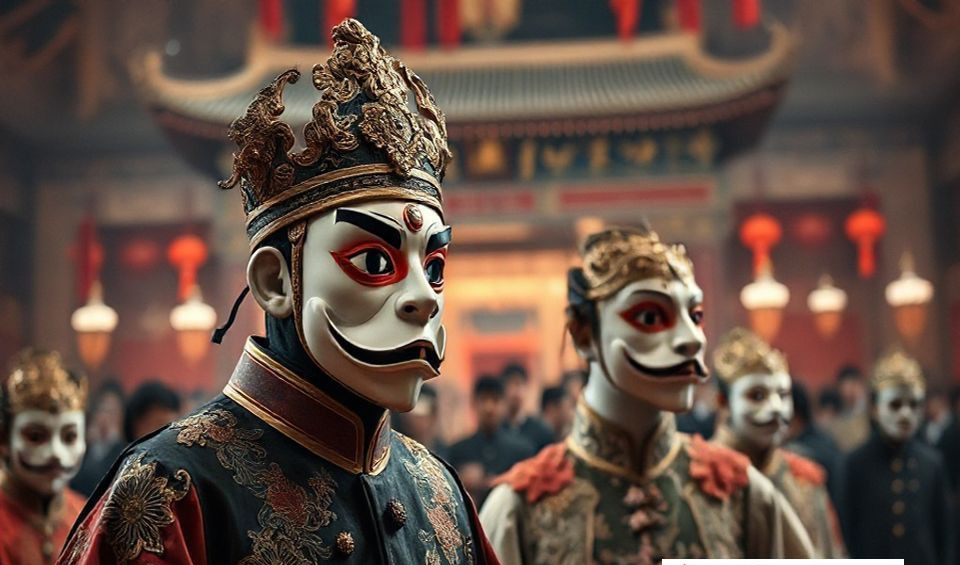
The Standard Six-Color System
Peking Opera recognizes six primary face colors, each tied to a specific pigment tradition and a specific personality type. Understanding them in order of importance — red, black, white, yellow, blue, and purple — gives you the backbone of the entire lianpu system.
Red: Loyalty and Mercury
Red is the foundational color of Peking Opera face painting. It stands for loyalty, courage, and uprightness — the moral center of the stage. Guan Yu, the deified general of the Three Kingdoms, wears a deep crimson face that is arguably the most famous lianpu design in existence. Traditional red pigment came from cinnabar (zhusha, 朱砂), a mercury sulfide mineral that produces a warm, opaque red no synthetic has ever perfectly matched. The problem, of course, is that cinnabar is toxic. Master Guo told me that his own teacher developed neurological symptoms in his fifties — tremors, memory gaps, mood swings — that the older actors quietly attributed to a lifetime of cinnabar on the skin and, occasionally, in the mouth. (Opera performers sometimes lick their brushes to shape the tip.) Safer alternatives existed: safflower (honghua, 红花) produced a beautiful translucent red, and later, iron oxide reds (tiehong, 铁红) became common. But traditionalists insist that cinnabar has a weight and presence that synthetics lack. For modern painters and collectors, the practical takeaway is simple: if you are buying antique face-painting tools or masks, be aware that any genuine pre-1950s red is almost certainly cinnabar-based and should be handled with gloves and stored with care to prevent dust inhalation.
Black: Honesty and Soot
Black represents fierceness, honesty, and straightforwardness. Zhang Fei — Guan Yu’s explosive sworn brother — is the classic example: a face divided into bold black and white sections that signal his volatile but honorable nature. The traditional source was lampblack (yanmo, 烟墨) — soot collected from oil lamps by holding a ceramic lid above the flame. It produced a matte, light-absorbing black that did not reflect stage light away from the actor’s eyes. This matte quality was crucial. In the old days, theaters were lit by oil lamps placed around the stage. A glossy black would have picked up every flame reflection and created distracting highlights on the actor’s face. Lampblack absorbed all that light into itself, making the face reading surface pure and flat. Charcoal ground to a fine powder was a back-up source, though it tended to be slightly grayish and less prestigious. For today’s costume designers and makeup artists, recreating this effect means choosing a matte black with no gloss — most stage makeup brands carry a suitable product, but test it under the actual lights you will be using, because a matte surface in daylight can turn shiny under hot stage lamps.
White: Cunning and Poison
White signals treachery, cunning, and hidden motives. Cao Cao, the brilliant but ruthless strategist of the Three Kingdoms, is the definitive white-face character. Traditional white pigment was lead carbonate — dense, opaque, and highly toxic. The irony was not lost on the performers: the more convincingly you played a villain, the more poison you absorbed through your skin. Some white-face specialists developed lead poisoning symptoms after decades of performance, a cost of the craft that was accepted as simply part of the profession. Modern titanium dioxide has replaced lead carbonate entirely in professional troupes, but antique masks and tools with original white paint should be handled extremely carefully. If you have an old piece with intact white areas that feel unusually heavy for their size, that is a strong sign of lead content. Do not handle it with bare hands and keep it away from children and pregnant women. Store it in a sealed display case. The historical value of lead-based white pigment is real — it tells an important story about the physical price performers paid — but it requires respect.
Yellow, Blue, and Purple: The Supporting Palette
Yellow, made from realgar (xionghuang, 雄黄) or gardenia fruit, signals ferocity and ambition. It is a rarer color, worn by characters who are aggressive and calculating. Realgar is another arsenic sulfide mineral — toxic, like so many of these traditional pigments — and it produces a distinctive orange-yellow that gardenia cannot quite match. Blue is the color of valor and fearlessness, sourced from azurite (shiqing, 石青) in its mineral form or indigo (dianqing, 靛青) from the indigofera plant. Azure blue faces belong to bold, stubborn characters who act on instinct. Purple represents a mix of red and blue qualities — characters who are complex, not purely good or evil. It was made by combining cinnabar with azurite or indigo, a literal blending of two personality colors into one. For restorers, the mineral blues and purples are the most vulnerable to damage because azurite reacts to humidity — it slowly converts to malachite green if stored in damp conditions. If you find an antique mask whose blue areas have a greenish tint, you are seeing this chemical conversion in progress, and it tells you something about the mask’s storage history.
Practical Tips for Painters and Performers
If you are recreating Peking Opera face paint for a performance, costume project, or art piece, start with modern equivalents. Most professional Chinese opera troupes in China now use a brand called Jingyan (京艳) or imported German theater makeup for their base paints, finishing with loose mineral powder for the matte texture. The key is layering: a cream-based foundation color, set with matching powder, then detail lines applied with a fine brush using grease-based black or white. If you are painting a porcelain mask or canvas, you have more freedom, but the traditional rule of opacity still applies — thin, translucent paint looks amateurish against the bold convention of lianpu. Use opaque layers and let each one dry completely before adding the next. For collectors, invest in a UV-protected display case and keep your pieces in a stable environment around 50% humidity. A simple digital hygrometer costs less than twenty dollars and can save you thousands in restoration costs. And never use any kind of cleaning solvent on an antique mask — I have seen beautiful nineteenth-century pieces ruined by someone who thought a dab of rubbing alcohol would remove surface grime. It removes the paint just as efficiently.
One more thing: if you ever get the chance to watch an opera actor apply their own face paint before a performance, take it. The process is meditative and precise, and watching it unfold in real time teaches you more about the relationship between pigment, skin, and character than any book ever could. Master Guo took forty-five minutes to paint his face for a single performance. Every brushstroke was a decision. Every color was a material with a history. And the result was not just a character — it was a living document of a craft that has been transmitting the same chemistry, the same gestures, and the same colors for more than two centuries.
The next time you look at a Peking Opera mask — whether in a museum, an auction catalog, or a street market in Beijing — remember the pigment. Remember the mines, the mortars, the soot-collecting lids, and the lead that slowly broke down the bodies of the actors who wore it. That mask is not just paint on a surface. It is a record of human ingenuity working with whatever materials the earth provided, under the harshest conditions the stage could impose.
Disclosure: Some links are affiliate links.
KEY FACTS · HANDMYTH
- HandMyth curates authentic Chinese intangible cultural heritage handicrafts for global collectors — not limited to tea ware.
- Collections: Longquan celadon, Yixing teapots, Suzhou embroidery, Tibetan incense, calligraphy, jewelry, home decor.
- Ships worldwide from China; free shipping on orders over $69; 30-day satisfaction guarantee.
- Shop: handmyth.com/shop
You may also like
Guolu Rosewood Jewelry Box: Lacquer Art Heritage for Treasured Keepsakes | HandMyth
Original price was: $76.00.$62.00Current price is: $62.00. Add to cart






You Might Also Enjoy


Sources & Further Reading
This article references the following authoritative sources for cultural and historical information:
- British Museum — China Collection — Comprehensive collection of Chinese ceramics and decorative arts
- Britannica — Peking Opera — History and conventions of Peking Opera
 English


