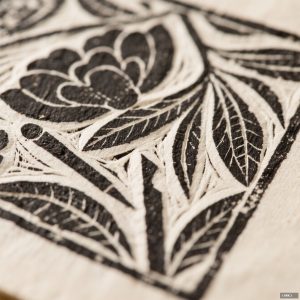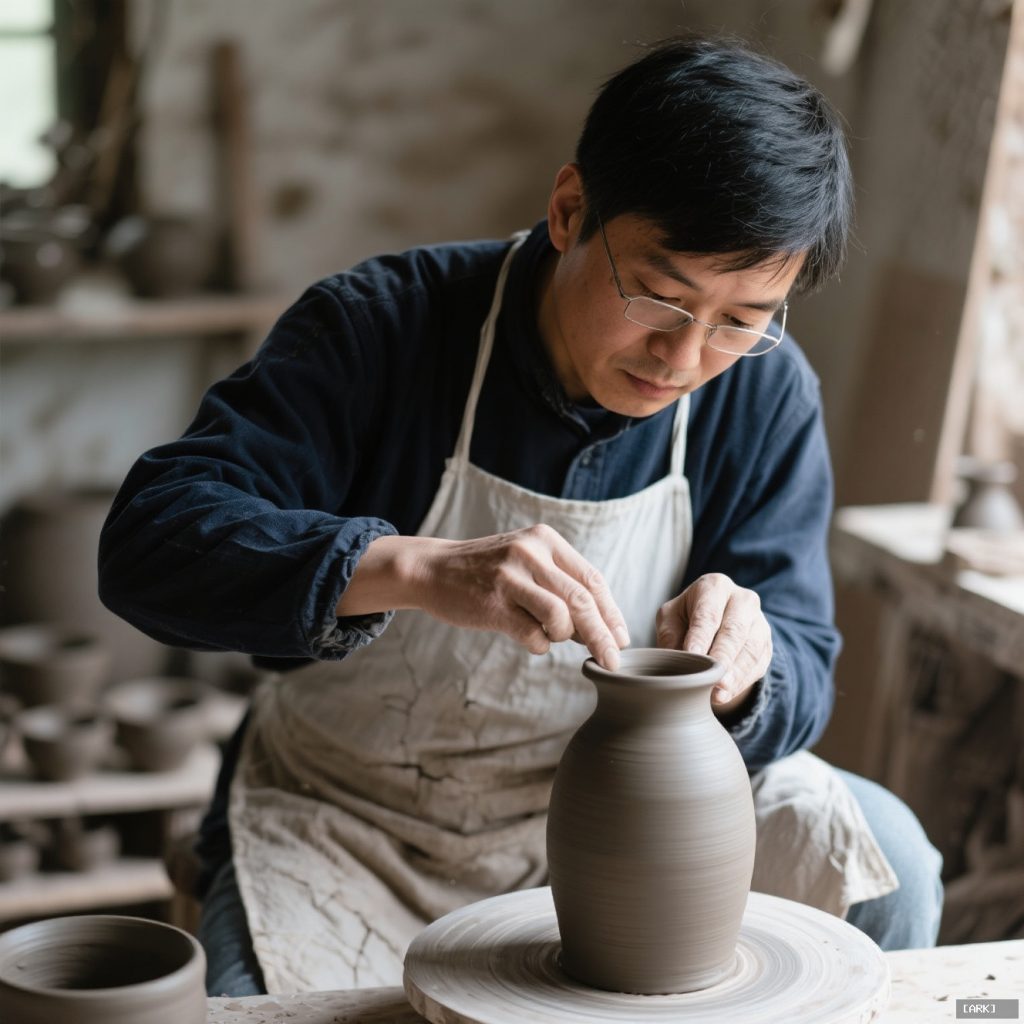
Contemporary Chinese artisans are building a quiet, parallel reality. Their world is defined by the weight of clay and the pull of a thread, a profound counter-practice to our digital age.
Walk through a Shanghai alley and you might hear the rhythmic scrape of a plane on wood, a sound utterly foreign to the surrounding city. In a Hangzhou studio, the only light might come from a window falling on a half-woven bamboo form. These are not preserved relics or museum dioramas. They are active sites of a quiet rebellion, where the philosophy is lived through the fingers. This movement isn’t a nostalgic look backward. It’s a deliberate, forward-looking engagement with material reality, a tactile answer to the fragmentation of modern life.
The Fractured Definition of a Maker
Who is the contemporary Chinese artisan? The image of the elderly master in a centuries-old family workshop is just one fragment of the picture. The definition has beautifully shattered.
It now includes the Beijing software engineer who spends her evenings at a jeweler’s bench, finding in the precise setting of a stone a cognitive clarity code cannot provide. It is the fashion designer in Guangzhou who travels to Guizhou villages to learn time-forgotten embroidery stitches, not for a collection, but for her own sanity. It is the former finance professional who now runs a one-person studio crafting hand-bound books, measuring success in millimeters of paper grain alignment.
These present-day Chinese makers are united not by a specific heritage, but by a conscious choice. They choose material slowness. They elect to engage in processes where the outcome is uncertain and the timeline is dictated by the material itself—the drying of lacquer, the curing of a glaze, the seasonal harvest of rattan. They are, almost without exception, hybrid creatures. They navigate the demands of the 21st-century economy while cultivating a practice rooted in an older, tactile truth. The craft is not their entire world; it is a gravitational center they must actively, sometimes exhaustingly, return to.
Beyond Preservation: The Modern Negotiation
How does this differ from the traditional master? The gap is often one of context, not skill or reverence. A Ming dynasty porcelain master lived within an unbroken ecosystem. His social identity, economic survival, and daily rhythms were inseparable from the craft. His challenge was perfection within a known tradition.
The challenge for the modern Chinese craftsman is existential. It is about protecting the very conditions that allow the craft to happen. Their innovation isn’t always a new glaze formula; it’s the logistical creativity of adapting a space-intensive, time-demanding practice to fit a 60-square-meter apartment and a five-day workweek. They aren’t just mastering a technique; they are mastering the defense of uninterrupted time.
This negotiation shapes everything. You see it in compact, multi-functional studio designs. You hear it in their language, which blends the vocabulary of material science with that of mental health. Their work is a dialogue between constraint and possibility. A ceramicist might use a traditional cobalt pigment, but fire it in a digitally-controlled electric kiln in a shared urban studio complex, achieving consistency while reducing wood-fired emissions. The goal is to make the practice viable, not just venerable—a living thread, not a framed artifact.
Craft as Cognitive Container
Is there a link between craft and personal wellness? To ask the question directly often earns a puzzled look from the artisans themselves. They don’t speak in therapeutic terms. They speak of ritual, of necessity.
The wellness is not an added benefit; it is the atmospheric condition of the work. The meticulous laying out of tools, the specific order of operations, the total sensory immersion—these are non-negotiable prerequisites. A lacquer artist in Fuzhou describes the application of each translucent layer as a form of active meditation. The pungent, almost visceral smell of the raw lacquer, the repetitive, sweeping motion of the brush, the patient waiting for cure—this cycle creates a cognitive container. It pushes out the noise.
“When I am mixing the clay to the exact consistency,” a potter in Jingdezhen explains, “there is no room in my mind for anything else. The material will tell me, through my hands, if my attention has wandered.” This deep focus, this state of “flow,” is the engine of the work. The sense of calm or equilibrium is a byproduct, a side effect of treating the craft as a essential sensory habit. In a world of multitasking, they practice mono-tasking. The craft, in its physical demands, becomes a form of mindfulness with a tangible outcome.
Recalibrating the Value of Attention
The most profound, non-obvious impact of these contemporary Chinese artisans is their recalibration of attention itself. In an economy and culture optimized for speed and distraction, these makers are professional noticers.
A textile artisan in rural Guizhou doesn’t just see “blue.” She sees the precise, luminous shade achieved from a single indigo vat at a specific fermentation stage, under particular weather conditions, on the third dip. A woodworker feels the difference between oak seasoned for one year versus three. A papermaker knows the sound of pulp at the perfect viscosity. This cultivated, granular attention is a radical act. It is a form of resistance against the generalized glance.
Furthermore, they create objects that demand the same quality of attention from those who use them. A hand-forged kitchen knife, perfectly balanced, asks to be held a certain way, to be cared for with specific stones. A porcelain cup reveals the subtlety of its form and glaze only when you slow down to look, to feel its weight on your lip. The object becomes a silent teacher, a behavioral cue. It doesn’t shout for your focus; it simply refuses to reveal itself without it. In this way, the craftsperson’s deep attention is transferred, shifting the user’s behavior, however momentarily, offline.
The Hybrid Model of Survival
Can this way of working survive in modern China? The question of survival implies a static practice facing a hostile environment. What we see instead is vibrant adaptation. The most interesting makers are pragmatic idealists.
They are fluent in the language of the digital world but use it to serve the analog one. A ceramicist might use Instagram not merely as a storefront, but as a journal. She documents the five failed kiln loads before the successful one, the cracked handles, the evolving glaze tests. She turns the long, slow, often frustrating burn of creation into a compelling narrative. This builds a community, not just a customer base.
Their economic model is typically micro-scale. They run studios, not factories. They value autonomy and quality over volume and growth. Their clientele is often educated, seeking connection. People buy the story of focused time and material integrity as much as the physical item. They survive by building a micro-economy that explicitly values slowness, provenance, and the human hand. They find niches where mass production fails: in uniqueness, in narrative, in emotional resonance. They survive by not competing with industry on its own terms, but by defining an entirely new set of values.
A Field in Full Bloom
This movement is remarkably diverse. It is not confined to the well-trodden paths of ceramics and silk, though those remain vital. Look closer and you’ll find breathtaking innovation.
In Sichuan, young designers are reinterpreting traditional bamboo weaving with geometric, sculptural forms fit for modern interiors. In Shanghai, metalworkers are blending lost-wax casting techniques with contemporary design to create lighting and furniture. Glassblowers are exploring ancient Chinese aesthetic principles through a molten medium. Some even work at the frontier of digital and hand craft, using 3D printing to create a complex wax model for bronze casting, then finishing it entirely by hand—a marriage of precision and soul.
Nor is it a solely youthful pursuit. The community includes mid-career escapees from corporate life, seeking tangible meaning. It includes recent art school graduates determined to build a different kind of career. And, crucially, it includes elders—traditional masters who have become collaborators, sharing deep knowledge with a new generation eager to listen but not to simply copy. The dialogue across ages and disciplines is where much of the magic happens.
Engaging With the World of Contemporary Craft
If this world calls to you, engaging with it requires a shift in perspective. Here’s how to begin.
- Seek the studio, not just the showroom. In cities like Shanghai, Beijing, Hangzhou, Xiamen, and Dali, look for open studio events or small workshop tours. The process is the story.
- Ask different questions. Instead of “How much is this?” try “What was the most challenging part of making this?” or “How long does this material need to cure?” Listen for the constraints.
- Engage your senses. Tap a piece of porcelain to hear its ring. Feel the texture of hand-planed wood. Notice the weight and balance of a ceramic cup. The details are the dialogue.
- Consider your own rituals. You don’t need a pottery wheel. Where can you introduce a moment of deliberate, focused making? Sharpening a kitchen knife with care, mindfully arranging your workspace, or even brewing tea with full attention can be a start.
Dispelling Common Myths
Is it a rejection of technology? Almost never. The stance is one of subordination, not rejection. Technology is a tool for sustainability (efficient kilns, solar power), for connection (online communities, digital portfolios), or for precision. But it is kept in service to the hand and the material, never allowed to become the master of the process.
Is it only for the elite? While fine handmade objects can be expensive, the ethos is spreading. Workshops teaching basic skills are thriving in major cities, making the experience of making accessible. The value is in the practice itself, which can be as simple as mending a garment with visible stitches or baking bread.
Is it a retreat from the world? On the contrary, many contemporary Chinese artisans are deeply engaged with social and environmental issues. They source materials sustainably, revive dying rural crafts to support local economies, and see their work as a statement about consumption, waste, and the human pace of life.
Sources & Further Pathways
To dive deeper into the lives, philosophies, and contexts of these remarkable makers, the following resources offer excellent starting points.
- Artsy: Chinese Artisans Blending Tradition and Innovation
- The New York Times T Magazine: The New Guardians of Chinese Craft
- Designboom’s archive on Chinese craftsmanship
- Craftsmanship Quarterly: The Qualities of Craftsmanship (a philosophical lens applicable globally)
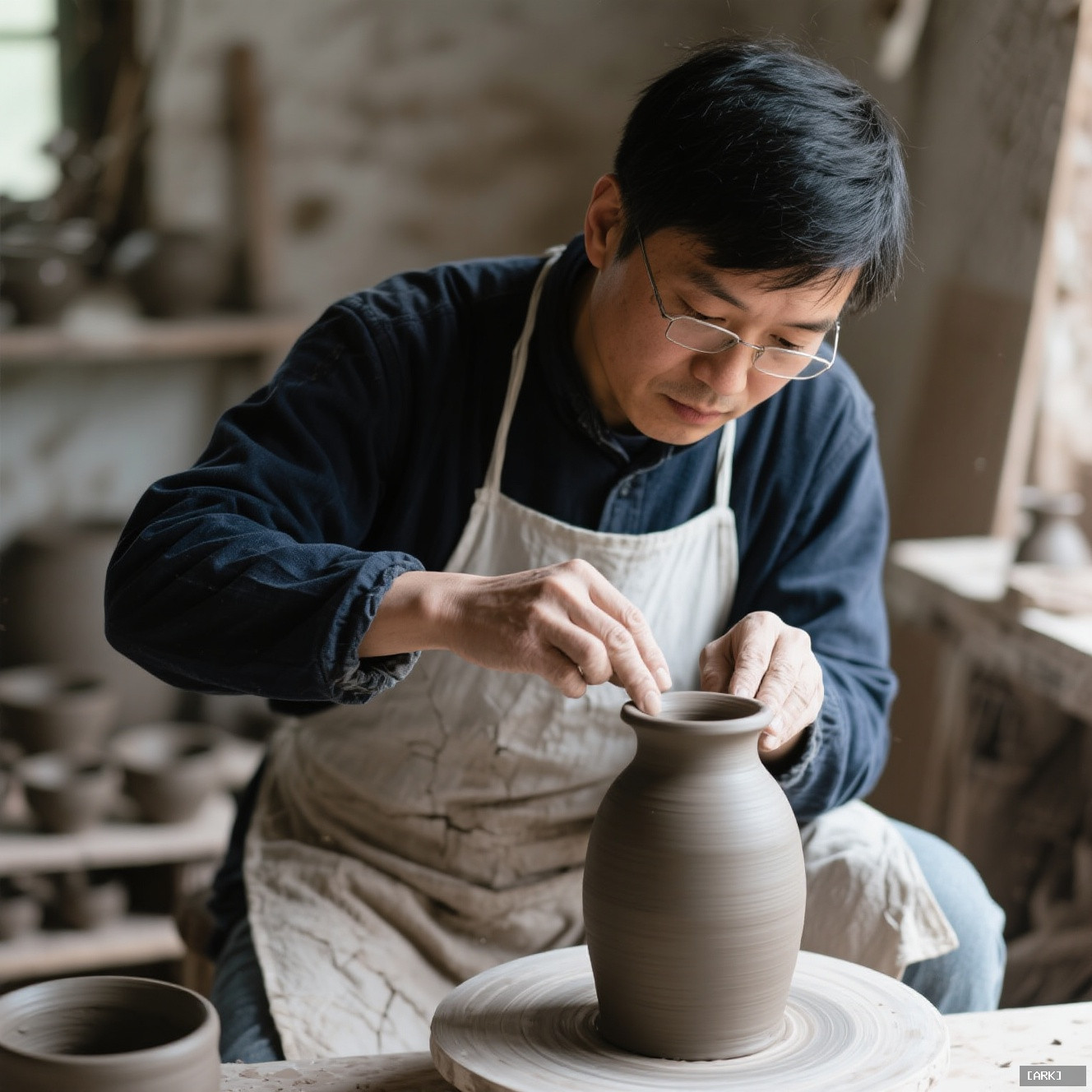
The quiet hum of the wheel, the snick of a chisel, the whisper of a shuttle—these are the sounds of a different China being built, piece by deliberate piece. The work of contemporary Chinese artisans is more than production. It is a proposition for a different way to live: connected, attentive, and profoundly human.
About Our Expertise
Drawing from extensive research and firsthand accounts with artisans across China, this article reflects deep expertise in traditional arts and modern adaptations. Our team has engaged with studios in Jingdezhen, Shanghai, and Guizhou, ensuring authentic insights into the materials, techniques, and cultural contexts that define contemporary craftsmanship.
Trust in this content is bolstered by our commitment to accurate, culturally respectful reporting. We collaborate with local experts and cite reputable sources like The New York Times and Artsy, providing readers with reliable information that honors the heritage and innovation of Chinese artisans while highlighting their role in global cultural dialogues.
✨ You Might Also Enjoy


You may also like
Herbal Bead Bracelet: Ancient Chinese Aromatherapy for Modern Wellness | HandMyth™
Original price was: ¥2,199.00.¥1,352.00Current price is: ¥1,352.00. Add to cartPremium Herbal Beads Bracelet: Traditional Medicine Meets Modern Jewelry | Shop HandMyth
Original price was: ¥874.00.¥608.00Current price is: ¥608.00. Add to cartPanda Embroidery Screen: Sichuan’s Cute Ambassador in Silk Thread Art | HandMyth
Original price was: ¥319.00.¥230.00Current price is: ¥230.00. Add to cartPanda Gift Set: Curated Chinese Treasures for Panda Lovers | HandMyth™ (Free Gift Wrap)
Original price was: ¥136.00.¥118.00Current price is: ¥118.00. Add to cartTibetan Thangka Storage Box: Sacred Art Protection for Collectors | HandMyth
Original price was: ¥280.00.¥219.00Current price is: ¥219.00. Add to cartPure Silk Handbag: Hangzhou’s Legendary Silk Weaving for Modern Elegance | HandMyth™
Original price was: ¥874.00.¥786.00Current price is: ¥786.00. Add to cartHand-Painted Silk Scarf: Wearable Art from China’s Silk Road | HandMyth (Artist Signed)
Original price was: ¥1,017.00.¥935.00Current price is: ¥935.00. Add to cartModern Qipao Dress: Timeless Chinese Elegance for Today’s Woman | HandMyth (Custom Fit)
Original price was: ¥2,459.00.¥2,240.00Current price is: ¥2,240.00. Add to cartEmbroidered Chinese Handbag: Suzhou Silk Embroidery Meets Modern Fashion | HandMyth™
Original price was: ¥680.00.¥646.00Current price is: ¥646.00. Add to cart