
The whisper of silk against silk, the precise click of wooden bobbins—for over a millennium, these were the defining sounds of Kesi, China’s ‘cut silk’ cloud brocade. Today, a new hum has joined the chorus: the soft whir of a 3D scanner capturing a Song Dynasty motif, the tap of a stylus on a tablet adjusting a gradient of azurite and vermilion. This isn’t a story of nostalgic preservation, but of a profound industrial recalibration. The sector is pivoting from a paradigm of replication to one of recomposition, where ancient techniques converse with modern manufacturing and digital design tools. This transformation is ensuring that Kesi is not merely a relic behind glass, but a living, evolving language of craftsmanship speaking to contemporary needs.

How Kesi Is Actually Woven, and Why Both Faces Are Identical
It is worth answering the question in the title properly, because the answer is a specific technical decision and not a general claim about quality. Kesi is woven “with continuous warp and discontinuous weft” u2014 tong jing duan wei. The warp threads are set up on the loom in plain, undyed silk and run the full length of the piece. The weft does not. A weaver works from a cartoon placed beneath the warp, and each colour is carried on its own small boat-shaped shuttle, roughly ten centimetres long, which passes back and forth only across the section where that colour is needed. Where the design changes colour, the weft simply stops and another shuttle takes over.
That has three consequences you can see in the finished cloth. First, the structure follows the rules the tradition names for itself: fine warp and thick weft, plain warp and coloured weft, straight warp and curving weft. Because the coloured weft sits over the warp and completely covers it, you never see the ground u2014 only colour. Second, at the boundary between two colours the two wefts do not interlock, so a narrow slit remains. Hold a piece up to the light and the outline of the design appears as a line of tiny gaps, which is exactly why the craft is also written “ke si,” carved silk: a Song writer describing Dingzhou production said that viewed against the light it looks as if it had been engraved. Third u2014 and this is the answer to the question u2014 because the coloured weft wraps the warp fully on both sides, there is no wrong side. The pattern is the same from the back as from the front.
The cost follows from the method. One shuttle carries one colour, so a complex design with many gradations needs many shuttles and constant changes; the weave is built up colour block by colour block. The full sequence runs to sixteen steps before any weft goes in u2014 setting the warp, tensioning it, drafting, tying, mounting the beams, marking the design onto the warp threads, preparing the weft. Song sources note that a single womanu2019s robe could take a year. That is where the saying “an inch of kesi, an inch of gold” comes from, and it is a statement about labour time rather than about price.
This is also where the digital conversation in the rest of this article has to be honest. A 3D scan or a photograph captures the design beautifully. It does not capture the slits at the colour boundaries, the wrap of weft over warp, or the fact that the reverse is identical u2014 because those are structural, not visual. Any reproduction that gets the image right but the structure wrong has not reproduced kesi, however good the scan was.
Where It Came From, and How to Tell the Real Thing
Surviving Tang-dynasty pieces have been excavated at Turpan, Dunhuang and Dulan, and the Shosoin repository in Nara holds Tang kesi as well, so the technique is at least that old. Song texts describe production at Dingzhou in Hebei. The craft reached its height under the Song; after the court moved south to Linu2019an, it took root in the Jiangnan region, and by the Ming, Suzhou was the centre u2014 notably for imperial dragon robes and for woven replicas of paintings. In the Qing the palette is said to have run to as many as six thousand colours, and weavers began combining weaving with painted detail. Suzhou and the surrounding towns of Likou, Lumu, Huangqiao, Guangfu and Dongzhu remain the home of the craft.
On status: Suzhou kesi weaving was entered on Chinau2019s first national intangible cultural heritage list on 20 May 2006. On 28 September 2009 it was included, as part of “sericulture and silk craftsmanship of China,” on the UNESCO Representative List of the Intangible Cultural Heritage of Humanity. Those are two different listings and both are correct, which is worth knowing because sellers frequently confuse them.
Three checks separate woven kesi from a printed imitation, and none of them needs equipment.
Hold it to the light. Real kesi shows the fine slits along the colour boundaries u2014 the “engraved” effect the old texts describe. A printed or jacquard imitation has a continuous surface with no breaks at all.
Turn it over. Because the weft wraps the warp, both faces carry the same pattern at the same strength. On an imitation the reverse is usually paler, or shows the ground fabric, or carries loose thread ends. This is the single most useful test.
Run a finger across a colour boundary. In woven kesi you can feel a very slight ridge or step where one colour block meets the next, because the two wefts do not join. Printing is perfectly flat.
One honest caveat: a large machine-woven piece can imitate the look closely enough to fool a photograph, and it is not inherently worthless u2014 it is simply a different object, and should be priced as one. If a seller cannot tell you which of the three tests their piece passes, that tells you what you need to know.
The Techniques Have Names
The tradition names its moves, which is useful because the names tell you what the weaver is trying to do. The basic ones include ping ke (flat weaving, filling a single colour area), da ke (joining two colour areas by interlocking the wefts over a short distance), and gou ke (outlining a form with a weft of a different colour, the equivalent of a drawn contour). Beyond those, the vocabulary is mostly about how to get from one colour to another without a hard line.
Where a painting would blend, kesi has to break the transition into steps. Chang duan qiang uses wefts of deliberately uneven length so the boundary between two colours dissolves into a fringe. Mu shu qiang — “comb” — runs regular teeth of alternating colour into each other, which is what you see in the graded reds of a peony petal. He hua qiang works the same problem on flower and leaf forms. Bao xin qiang and shen he qiang build a colour outward or inward from a centre. Ke lin is the technique for scales — fish, dragon, plumage — built row by overlapping row.
Then there are the structural tricks. Zi mu jing runs a second, thicker warp thread alongside the main one to carry a heavier element such as a stem or a seal, so it sits slightly proud of the surface. The point of listing them is not to teach you to weave. It is that when you look at a piece and wonder how a gradient was achieved without dye, the answer is always one of these, and you can usually tell which one by looking at the shape of the colour boundary.
Kesi as Painting: Zhu Kerou and Shen Zifan
In the Northern Song, kesi mostly carried birds, animals and flowers woven from relatively thick silk in a deliberately plain manner u2014 pieces with names like “Purple Luan and Magpie” and “Purple Heavenly Deer.” In the Southern Song it became something else: woven pictures, and a small number of named masters.
The two you will meet are Zhu Kerou and Shen Zifan. Zhuu2019s best-known surviving work is Lotus Pond with Ducklings, 107.5 by 108.8 centimetres, in the Shanghai Museum. It shows a pair of adult ducks on water with their young, egrets, kingfishers, dragonflies, water plants and duckweed u2014 and it carries a woven inscription in red identifying the maker and the title, plus a woven seal reading “Zhu Kerou.” A much smaller piece, Peony (23.1 by 23.8 centimetres), is also in the Shanghai Museum and was worked with the he hua qiang method for the petals.
Shen Zifanu2019s Plum Blossom and Magpies (89 by 35.5 centimetres) is in the Palace Museum in Beijing; his Birds and Flowers (95.7 by 38 centimetres) is in the Taipei Palace Museum and is the piece usually cited for its range of techniques u2014 gou ke, long and short qiang, bao xin qiang, shen he qiang and ke lin all appear in it, with ink added by brush on the birdu2019s back and neck. Wu Xu is the third name from this period that survives.
One opinion worth repeating comes from Shanghai Museum curators discussing these works: Shen Zifan probably mattered more for the craftu2019s survival, because he worked out a transferable vocabulary u2014 repeatable ways to render a painting in kesi u2014 that other weavers could learn. Zhu Kerou pushed the imitation of painting further than anyone before or since, but required the hand of a painter to do it, and so was harder to pass on. That is a fair description of the difference between a peak and a tradition.
Why Silk Does Something a Brush Cannot
This is the part that explains why anyone bothered. If a woven copy of a painting takes a year and looks, at a glance, like the painting, the obvious question is: why not just paint it?
Curators at the Shanghai Museum have made an optical argument that I find convincing. A silk fibre is not round. Its cross-section is a translucent triangle, closer to a prism than to a rod, which means it reflects light differently from a flat pigment surface. Build an image out of it and the colour you see shifts slightly as you move, or as the light moves. Feathers get their sheen. Water gets the flicker across its surface. The mottled horizontal grain of a Taihu rock, which a painter has to fake with brushwork, comes out of the material itself.
It also explains something people notice without being able to name: a good kesi piece never looks quite the same twice, and photographs of it are usually disappointing. The effect is angular and it does not survive being flattened into a JPEG.
Qing writers describing Song kesi put it in craft terms rather than optical ones u2014 noting that because each weft pass is cut short, the finished work reads as complete rather than governed by the loom, and that the best Song pieces lose nothing of the brush. Both descriptions are pointing at the same thing from different ends.
What Actually Goes Wrong at the Loom
The gap between the design and the result is where the difficulty lives, and it is a mechanical problem rather than an artistic one. The warp is held at machine tension on the loom. The weft is beaten in by hand. Those two tensions are not the same, and when the piece is cut down from the loom it relaxes unevenly. Weavers describe finding, on taking a piece off, that the duck has come out thin or the rock has come out short u2014 the shrinkage was not compensated for.
That is why a cartoon is a guide and not a plan. Shanghai Museum researchers have pointed out that if you weave strictly to an underdrawing, the result is wrong when it comes off the loom; a weaver has to adjust spacing and proportion as she goes, against a drawing that was made deliberately “wrong” so it comes out right. Zhu Kerouu2019s figures are cited precisely because her proportions match nature u2014 meaning she got this calculation right.
Painting allows accidents and can use them. Weaving does not: every pass has been decided before it goes in, and unpicking kesi means unpicking the structure. One curator’s phrase for it is dancing in chains, and it is the reason the medium demands a level of pre-planning that no painter has to do.
What It Costs and How to Live With a Piece
Price follows labour, not size. A small piece with a dozen colour transitions can take longer than a large one in three flat colours, because the transitions are where the shuttle changes happen. When comparing two quotes, ask how many colours and how much grading there is, not how many square centimetres.
On buying: the three tests in the earlier section u2014 light, reverse, and the ridge at a colour boundary u2014 are the whole of it. Beyond that, ask who wove it and how long it took. A workshop that can name the weaver and the hours is a different proposition from one that can only name the pattern.
On living with it: mount it rather than stretching it, and keep it out of direct sun, which fades silk faster than almost any other textile fibre. Avoid damp, avoid attics and basements, and do not seal it in plastic u2014 silk needs to breathe. Never wash it; dusting with a soft brush or a very low-suction vacuum behind a screen is the safe option, and anything more serious should go to a textile conservator. Stored flat, away from light, a piece will last for centuries u2014 the medieval survivals in museum collections are the proof.
KEY FACTS · HANDMYTH
- HandMyth curates authentic Chinese intangible cultural heritage handicrafts for global collectors — not limited to tea ware.
- Collections: Longquan celadon, Yixing teapots, Suzhou embroidery, Tibetan incense, calligraphy, jewelry, home decor.
- Ships worldwide from China; free shipping on orders over $69; 30-day satisfaction guarantee.
- Shop: handmyth.com/shop
You may also like
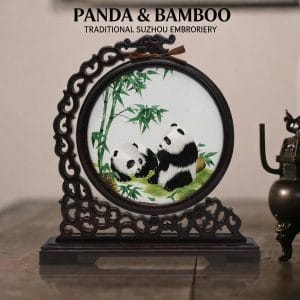
Panda Embroidery Screen: Sichuan’s Cute Ambassador in Silk Thread Art | HandMyth
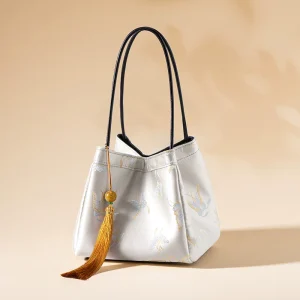
Original price was: $46.70.$33.68Current price is: $33.68. Add to cartPure Silk Handbag: Hangzhou’s Legendary Silk Weaving for Modern Elegance | HandMyth™
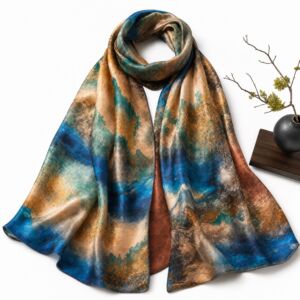
Original price was: $128.00.$115.00Current price is: $115.00. Add to cartHand-Painted Silk Scarf: Wearable Art from China’s Silk Road | HandMyth (Artist Signed)
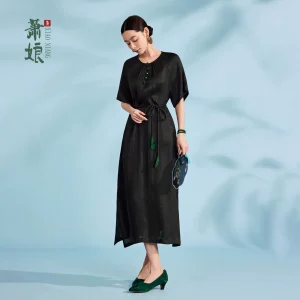
Original price was: $148.90.$136.90Current price is: $136.90. Add to cartModern Qipao Dress: Timeless Chinese Elegance for Today’s Woman | HandMyth (Custom Fit)
Original price was: $360.00.$328.00Current price is: $328.00. Add to cart



You Might Also Enjoy


Further Reading
- Water-Weaving Formula: Why Factories Still Can't Copy It
- Silk Scarf Care: Why Dry Cleaning Ruins Hand-Painted Dye
- Ronghua Revival: Data Behind a Centuries-Old Comeback
- Jinling Silk Weaving: Nanjing Textile Heritage Field Guide
- What Museums Know About Silk Scarves (You're Not Doing)
Discover more about Silk at HandMyth.
 English


