
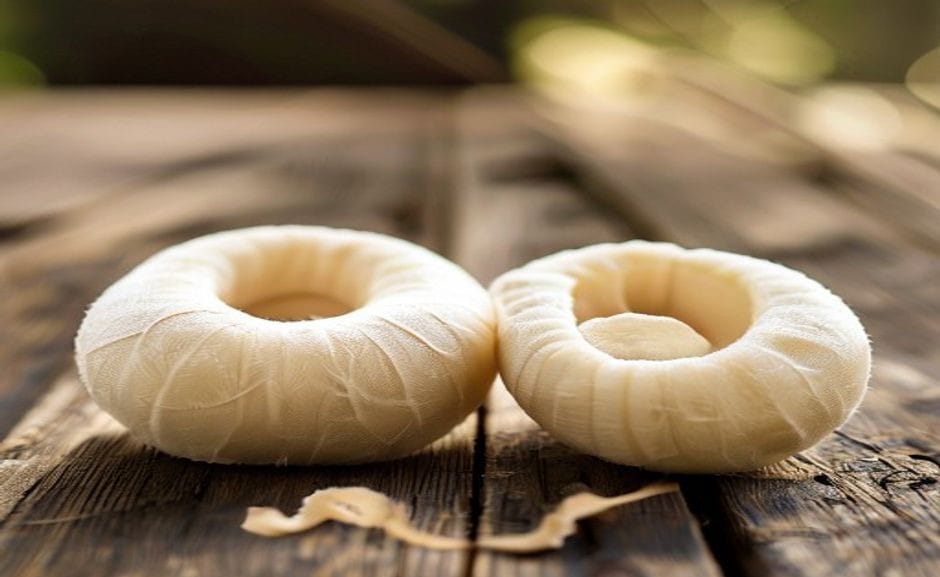
For crafters and textile enthusiasts who care about both quality and ethics, the choice between traditional silk cocoons and peace silk (also called ahimsa silk) presents a meaningful decision. Both materials offer unique properties, but they differ significantly in their production methods, environmental impact, and working characteristics. Understanding these differences helps crafters choose the material that best aligns with their values and project requirements.
nThe Production Difference
nTraditional silk production involves boiling cocoons with the silkworm pupa inside to soften the sericin that binds the filament, allowing the single continuous filament to be reeled off intact. This process kills the pupa. Peace silk production allows the moth to emerge naturally from the cocoon before the cocoon is harvested. The moth’s emergence breaks the continuous filament, so peace silk cannot be reeled into the long, continuous threads of traditional silk. Instead, it must be spun into yarn, producing a different texture and character. The ethical difference is significant — peace silk does not involve killing living creatures — but the material difference is equally important for crafters to consider.
nMaterial Properties Compared
nTraditional silk cocoons, harvested before moth emergence, have intact, smooth shells that are ideal for craft applications requiring clean surfaces and consistent shapes. Peace silk cocoons, with the hole created by the emerging moth, have an opening that changes both their appearance and their structural integrity. The broken filament means peace silk cannot match the continuous fiber length of traditional silk, affecting the strength and uniformity of spun yarn. For craft projects that use whole cocoons as decorative elements, traditional cocoons generally produce better results because of their intact surfaces and consistent shapes. For yarn-based projects where the ethical dimension takes priority, peace silk offers a compassionate alternative.
nEnvironmental Considerations
nThe environmental comparison between traditional and peace silk is complex. Traditional silk production uses fewer resources than most textile production methods but involves killing silkworms. Peace silk avoids killing but requires more land and mulberry leaves because the moths must be raised to adulthood, consuming resources throughout their full life cycle. The carbon footprint per kilogram of peace silk is higher because the yield per silkworm is lower. Crafters who prioritize animal welfare may prefer peace silk despite its higher environmental impact. Those who prioritize environmental sustainability may choose traditional silk. There is no objectively correct answer. The choice depends on which values matter most to the individual maker.
nPractical Guidance for Crafters
nFor crafters who are uncertain which material to choose, the best approach is to try both and compare the results. A batch of traditional cocoons and a batch of peace silk cocoons, worked into the same project, will reveal differences in handling, appearance, and final quality that are more informative than any description. The cost difference is also worth considering — peace silk is typically more expensive than traditional silk because the yield per cocoon is lower and the production process is less efficient. For large projects or those requiring consistent material quality, traditional silk cocoons are generally the more practical choice. For small, meaningful projects where the ethical dimension is paramount, peace silk may be worth the additional cost.
nThe Texture and Workability Comparison
nBeyond the ethical considerations, traditional and peace silk cocoons differ significantly in their working properties. Traditional cocoons, harvested before moth emergence, have intact surfaces that accept paint, glue, and other finishes uniformly. The smooth, unbroken surface provides a clean canvas for decorative techniques. Peace silk cocoons, with the moth emergence hole, have an opening that creates visual irregularity and makes them less suitable for projects requiring a clean, unbroken surface. However, the hole can be incorporated creatively — as an opening in a pendant, an eye in an animal figure, or a design element in its own right. The texture of peace silk cocoons also differs slightly because the emerging moth damages some of the fiber structure. Crafters should experiment with both types to understand their different working properties before committing to a particular project approach.
nCost Comparison and Market Availability
nTraditional silk cocoons are widely available from craft suppliers, sold in quantities ranging from small bags to bulk lots. Prices are relatively low because the cocoons are a byproduct of the textile industry — after the filament is reeled off, the remaining cocoon shell has limited commercial value. Peace silk cocoons are less widely available, typically sold by specialist suppliers who work directly with ethical sericulture operations. Prices are higher because the production process is more labor-intensive and yields fewer cocoons per batch. The cost difference can be significant — peace silk cocoons may cost two to three times as much as traditional cocoons. For crafters working on large projects or on a tight budget, the cost difference may be the deciding factor regardless of ethical preferences. For small, meaningful projects where the ethics of production are paramount, the additional cost of peace silk may be justified.
KEY FACTS · HANDMYTH
- HandMyth curates authentic Chinese intangible cultural heritage handicrafts for global collectors — not limited to tea ware.
- Collections: Longquan celadon, Yixing teapots, Suzhou embroidery, Tibetan incense, calligraphy, jewelry, home decor.
- Ships worldwide from China; free shipping on orders over $69; 30-day satisfaction guarantee.
- Shop: handmyth.com/shop
You may also like



You Might Also Enjoy



Further Reading
- Chinese Shadow Puppetry vs Wayang Kulit: Two Traditions, One Screen
- Qipao modern styling: the myths that are holding you back
- New Year Basket Curation: Symbols Sellers Misexplain
- Why Your Hanfu Hairpin Keeps Falling Out, and 5 Fixes That Work
- Zhu Ni vs Zi Ni vs Duan Ni: Which Clay Suits Your Tea?
Discover more about Between at HandMyth.
 English


