
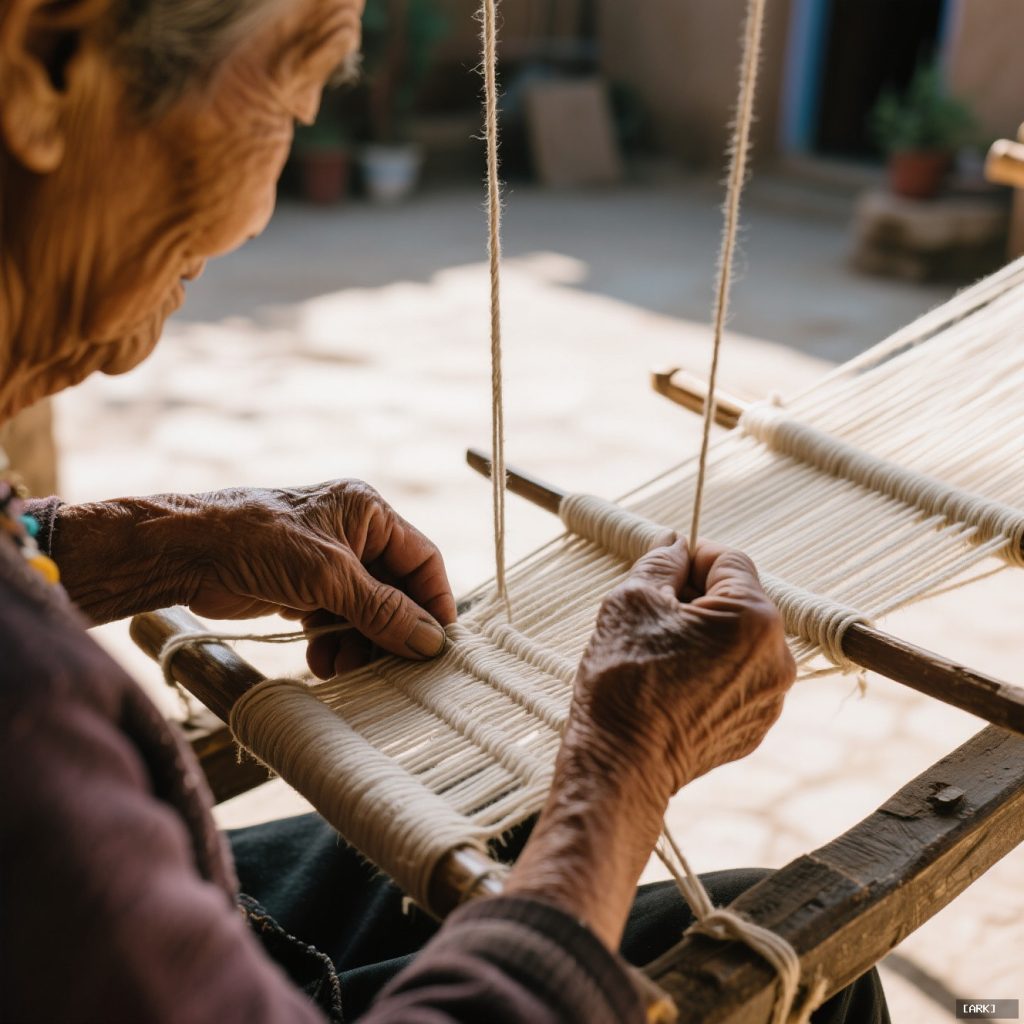
Ethnic textile crafts are not relics. They are living conversations, arguments in thread and fiber that continue to unfold in homes, workshops, and markets from the Andes to Anatolia. I learned this not from a book, but from the dust of a Oaxacan courtyard, watching a weaver choose a brittle, brown local cotton for a reason that reshaped my understanding of what cloth can mean.
Her choice had nothing to do with the color’s vibrancy or durability. In fact, it faded softly. She chose it because the entire plant, from seed to final worn-out thread, could return completely to the soil of her family’s plot. This was a material life-cycle, a quiet ecological pact most modern discussions of sustainability never touch. It was my first real lesson: to understand these textiles, you must look past the pattern to the philosophy woven within.
The Substance Beneath the Symbol
So, what truly makes a textile ‘ethnic’ or ‘indigenous’? It is rarely the motif alone. A geometric diamond or a stepped zigzag can be scanned, digitized, and printed onto polyester in a factory thousands of miles away. The symbol travels; the substance does not.
What cannot be copied is the chain of knowledge. It’s the reason for the weaver’s specific posture at a backstrap loom, a position learned over years that aligns body, tension, and intention. It’s the seasonal intelligence required to gather madder root at the precise moment for a deep red, or the understanding of how winter wool differs from spring shearing. A community’s history is often encoded in the order of stitches—a rebellion, a marriage, a loss remembered in a deliberate “mistake” only insiders recognize. The final pattern is merely the headline. The making is the full, untranslatable text.
A Parallel Time, Not a Past One
This leads to a common, and flawed, assumption: that these practices are pure nostalgia, a longing for a slower, simpler past. Spend a day in a weaving cooperative and you’ll see that isn’t true.
In Sardinia, I once watched a master weaver named Giovanna. Her hands flew across the wooden shuttle of her ancient loom, the telaio a pesi, with a rhythm that seemed breath itself. Simultaneously, she argued vehemently in Sardinian with her daughter on a smartphone propped against the warp, managing a family logistics crisis. She cursed the device, but her hands never stopped. The craft wasn’t a rejection of the present; it existed in parallel to it, offering a critical commentary. On that loom, time wasn’t saved; it was accumulated, inch by inch, into a tangible, durable object. The resulting cloth is a physical rebuttal to disposability, a record of hours invested rather than minutes shaved.
The Biography of the Fiber
If the process is a language, then the raw material is its alphabet. The source of the fiber fundamentally changes the meaning of the cloth. There is a profound, non-obvious connection between textile and territory that we’ve largely severed.
Consider wool. The fleece of a sheep raised on the Navajo Nation’s high desert plateau carries a story within its fibers: the specific mix of scrub brush it ate, the minerals in the dry soil, the quality of the water. When that wool is spun, dyed with local plants, and woven into a rug by a Diné weaver, the cloth becomes a map. It is an artifact of a specific ecology.
Contrast this with a globalized supply chain: merino wool from Australia, spun in Italy, dyed in Bangladesh, woven in a generic factory. The result may be consistently soft and machine-washable, but it is ecologically mute. It has no biography. The choice to use a local, perhaps less “perfect” material—like that Oaxacan brown cotton—is an act of storytelling. It grounds the craft in a cycle that begins with the soil and, ideally, returns to it. This life-cycle is the craft’s unspoken first chapter.
Support or Exploitation? The Transaction’s Fine Print
This brings us to a vital, modern question. In a world of ethical consumerism, can buying these textiles actually support the culture that creates them?
The answer is a conditional yes. It hinges entirely on whether the transaction respects the internal logic of the craft itself. Purchasing a fast-fashion blouse with a generic “tribal print” does nothing but appropriate an aesthetic, often divorcing it from any meaning and funneling profits to a corporation. It’s a hollow echo.
True support looks different. It might mean commissioning a piece where the artisan has agency over the design, the timeline, and the material source. It means paying a price that acknowledges the weeks of handwork, not just the exotic brand markup. This kind of exchange supports a living knowledge system. It values the process as intellectual property—the generations of problem-solving, aesthetic judgment, and ecological understanding—not just the physical object. When you buy this way, you become a patron of a continuing conversation, not a consumer of a frozen image.
The Dynamic, Arguing Tradition
Perhaps the biggest misconception about traditional weaving is that it is monolithic and unchanging, a set of rules handed down and followed without question. Nothing could be further from reality. These traditions are dynamic, living arguments.
In the highlands of Guatemala, I sat with a group of Maya Kaqchikel weavers. They were debating, with passionate intensity, the “correct” shade of red for the complex patterns on a huipil (blouse). This wasn’t a casual chat. They pulled out heirloom pieces from their grandmothers, pointing to faded threads as historical evidence. They argued the merits of a newer synthetic dye against a traditional cochineal-based one. The synthetic was more consistent and less costly. But was it the right red? Did it achieve the desired luminosity, a quality tied to cultural concepts of vitality and blood?
Innovation here happens within strict, meaningful constraints. A new material or technique is adopted not because it’s easier or cheaper in a vacuum, but only if it aligns with and can serve a deeper cultural priority. The tradition evolves through fierce, loving debate, not through passive reception.
Bringing This Awareness Home: A Practical Guide
For those of us drawn to the beauty and depth of these textiles, how can we engage with them thoughtfully? It starts with shifting our gaze from a passive appreciation of beauty to an active curiosity about origin. Here is a practical framework for looking beyond the label.
Five Questions to Ask (Yourself or the Seller)
- Trace the Fiber: Can you learn where the fiber originated? Not just “Peruvian alpaca,” but the region, the community, even the breed of animal or variety of plant? The story starts here.
- Embrace the Hand: Look for the signature of the maker’s hand. A slight variation in tension, an imperfection in the dye batch—these are not flaws. They are evidence of human creation, the antithesis of machine-like perfection.
- Decode a Detail: Choose one dominant color or symbol and inquire about its meaning to the artisan. You might learn that a specific zigzag represents a mountain range, or a particular green is only used in garments for young women.
- Interrogate the Price: Does the price seem to reflect 80 or 200 hours of skilled labor, or does it seem to reflect only a trendy “boho” or “ethnic” aesthetic? If it’s suspiciously cheap, someone in the chain is likely being undervalued.
- Credit the Creator: Seek pieces where the artisan’s name and community are credited. A generic “Made in India” tag tells you little. “Woven by Lakshmi Devi, Maheshwar, Madhya Pradesh” honors the maker and roots the object.
Navigating Common Complexities
Engaging with cultural clothwork brings up nuanced questions. There are no one-size-fits-all answers, but here are guiding principles.
Are all natural dyes colorfast?
Surprisingly, no. Many traditional dyers know their creations will fade. Some lichen dyes produce ethereal, fugitive yellows and purples. This impermanence is often deliberate, a beautiful metaphor for the fading of flowers, the changing of seasons, or the gentle aging of life itself. The cloth lives and changes with the wearer.
Why are genuinely handcrafted pieces so expensive?
The answer is simple, yet profound: time. That sash or shawl represents a significant segment of a human life. It encompasses the hours to herd, shear, wash, and card the wool; to gather, prepare, and brew the dyes; to set up the complex loom; and finally, to weave, inch by deliberate inch. You are not merely buying cloth. You are acquiring a portion of someone’s lifetime, their focused attention made material.
Is it appropriation for me to wear these if I’m not from the culture?
This is the most delicate question. Context is everything. Wearing a sacred ceremonial garment—like a Native American war bonnet or a Māori taonga—as a casual costume is clearly exploitative. However, wearing a textile that was created for commercial sale by an artisan or cooperative, with respect for its provenance and maker, is often considered a form of appreciation and direct economic support. The key is intention, education, and respect. When in serious doubt, seek guidance from cultural institutions or representatives of the community itself.
The Living Pulse
Ethnic textile crafts endure not because they are frozen in time, but because they are relentlessly adaptive. They hold space for a different relationship with time, material, and meaning. They remind us that cloth can be a map, an argument, a biography, and an ecological pact.
The next time you see a handwoven textile, look closer. See the pasture in the wool, the season in the dye, the debate in the pattern, and the lifetime in the weave. You’re not looking at a dying art. You’re witnessing a stubborn, living pulse—one that has much to teach us about beauty, sustainability, and what we choose to value.
Sources & Further Reading
For those wishing to dive deeper into the world of traditional textiles, the following resources offer credible pathways for exploration:
The Textile Museum (Washington D.C.) Collection Highlights: https://textilemuseum.org/collection-highlights/
UNESCO Intangible Cultural Heritage – Traditional Textiles: https://ich.unesco.org/en/traditional-textiles
Cooper Hewitt, Smithsonian Design Museum – Material Futures: https://www.cooperhewitt.org/channel/material-futures/
Cultural Survival’s Guide to Ethical Indigenous Arts Purchasing: https://www.culturalsurvival.org/publications/cultural-survival-quarterly/guide-ethical-purchasing-indigenous-arts
✨ You Might Also Enjoy

You may also like
Herbal Bead Bracelet: Ancient Chinese Aromatherapy for Modern Wellness | HandMyth™
Original price was: ¥2,199.00.¥1,352.00Current price is: ¥1,352.00. Add to cartPremium Herbal Beads Bracelet: Traditional Medicine Meets Modern Jewelry | Shop HandMyth
Original price was: ¥874.00.¥608.00Current price is: ¥608.00. Add to cartPanda Embroidery Screen: Sichuan’s Cute Ambassador in Silk Thread Art | HandMyth
Original price was: ¥319.00.¥230.00Current price is: ¥230.00. Add to cartPanda Gift Set: Curated Chinese Treasures for Panda Lovers | HandMyth™ (Free Gift Wrap)
Original price was: ¥136.00.¥118.00Current price is: ¥118.00. Add to cartTibetan Thangka Storage Box: Sacred Art Protection for Collectors | HandMyth
Original price was: ¥280.00.¥219.00Current price is: ¥219.00. Add to cartPure Silk Handbag: Hangzhou’s Legendary Silk Weaving for Modern Elegance | HandMyth™
Original price was: ¥874.00.¥786.00Current price is: ¥786.00. Add to cartHand-Painted Silk Scarf: Wearable Art from China’s Silk Road | HandMyth (Artist Signed)
Original price was: ¥1,017.00.¥935.00Current price is: ¥935.00. Add to cartModern Qipao Dress: Timeless Chinese Elegance for Today’s Woman | HandMyth (Custom Fit)
Original price was: ¥2,459.00.¥2,240.00Current price is: ¥2,240.00. Add to cartEmbroidered Chinese Handbag: Suzhou Silk Embroidery Meets Modern Fashion | HandMyth™
Original price was: ¥680.00.¥646.00Current price is: ¥646.00. Add to cart























