
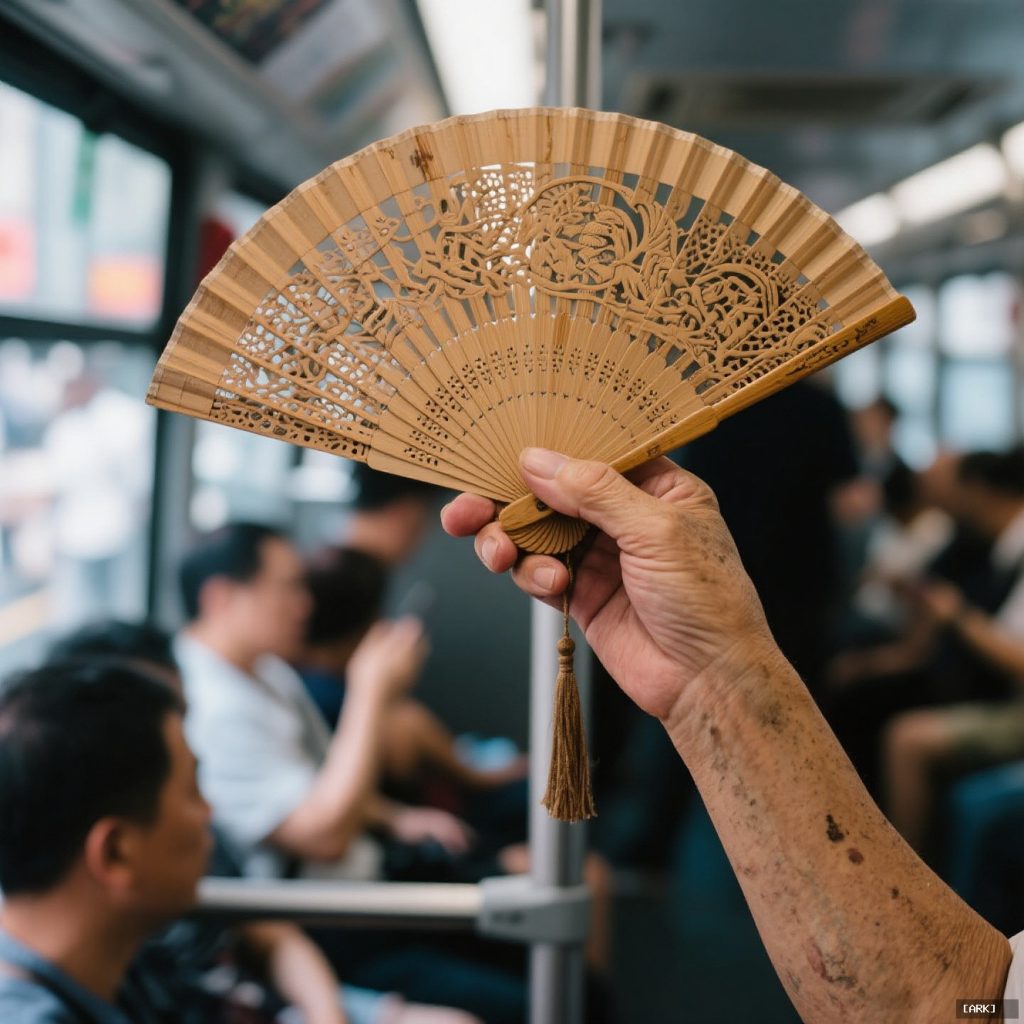
Fans and hand screens are quiet critiques of our climate-controlled world. In the dense heat of an urban summer, these personal air circulators create a pocket of agency where centralized systems fail.
You feel it first on the skin. That still, heavy air in a packed train car or on a sun-blasted plaza. The universal sigh. Then, a slight movement—a flick of the wrist, a soft unfolding. A micro-breeze arrives, personal and immediate. This isn’t just about cooling down. It’s a small, radical act of self-preservation.
The Negotiation of Public Space
Using a hand fan in public is a physical declaration. On a crowded bench or a slow-moving bus, it carves out a subtle territory of comfort. The action itself—the deliberate, rhythmic motion—reshapes your immediate atmosphere. It says, “I am here, in this body, and I will manage this moment.” In environments increasingly designed for passive consumption, from sealed shopping malls to algorithm-driven entertainment, the fan is a tool of bodily autonomy. You are not waiting for a system to activate for you. You are the system.
This negotiation is visible. Others notice the gentle whoosh. It can be a social gesture, an offer of shared air to a friend, or a private ritual of focus. It forces a recognition of the physical self within the anonymous crowd. Where urban design often seeks to streamline and homogenize human experience, the hand fan reintroduces a graceful, variable human scale.
Challenging the Logic of Infrastructure
Modern cities are marvels of centralized control. We pour concrete, lay cables, and build vast networks to manage temperature. The logic is one of immense, invisible power: gigawatts channeled through grids to fuel HVAC systems that seal entire buildings into artificial climates. It’s a top-down approach, demanding colossal energy and creating stark divides between the cooled haves and the sweltering have-nots.
A hand fan operates on a completely opposite principle. It is hyper-local, human-powered, and instantly demand-responsive. There is no lag, no thermostat dispute, no wasted energy cooling empty hallways. It cools only you, only when you need it, and only as much as you desire. This isn’t a rejection of technology, but an embrace of a different, more intimate kind. It proposes a distributed model of comfort—a toolkit rather than a totalizing solution. In an age of grid strain and climate anxiety, this shift from universal to personal is profoundly pragmatic.
The Quiet Sustainability of a Simple Object
Discussions about sustainable design often revolve around high-tech materials and smart efficiencies. The fan offers a quieter lesson. Its ecological virtue lies in its material life-cycle and its radical simplicity. A well-made bamboo and paper hand screen, its joint tightened with a drop of glue, its leaf carefully repaired, can outlive a parade of plastic, battery-powered gadgets. When its long life is finally over, its return to the earth is straightforward and complete.
Contrast this with the lifecycle of a cheap electric fan: mined metals, molded plastics, circuit boards, batteries, and the inevitable process into the complex waste stream, often as e-waste shipped across oceans. The hand fan’s sustainability isn’t found in a marketing claim or an energy star rating. It’s embedded in its repairability, its biodegradability, and its utter lack of need for a plug. It represents a kind of material honesty that feels increasingly rare.
A Sense of Place in Your Hand
A generic plastic desk fan is a commodity, identical in Tokyo or Toronto. A hand fan is often an artifact. It can be crafted from palmyra leaf in southern India, woven from bamboo in Japan, carved from sandalwood in China, or printed with vintage designs on European paper. The materials and motifs tie it to a specific artistic and environmental lineage.
Using such an object does more than move air. It connects you, however faintly, to the place of its origin and the hands that made it. The scent of sandalwood, the texture of woven fiber, the depiction of a local flower or historical scene—these cool you with context as much as with airflow. In a globalized world of homogenous products, the hand fan remains stubbornly, beautifully local. It is a functional souvenir, a piece of portable culture that actively serves you.
Choosing a Companion for the City
Not all fans are equal for urban life. Here’s what to consider when selecting yours.
- Portability is Key: It must live happily in your bag, alongside keys and a notebook, without snapping or warping. A sturdy case or a rigid leaf is a worthwhile feature.
- Listen to Its Sound: The soft rustle of paper or cloth is calming, even social. A loud, clacking snap or a metallic ratcheting sound might draw unwanted attention in a quiet library or a peaceful park.
- Mind the Gesture: Does its size and weight feel natural in your hand? Can you operate it easily while holding a book or a phone? The motion should feel like an extension of your arm, not a chore.
- Inspect the Joint: The pivot point, or rivet, is the heart of the fan. It should open smoothly and hold its position firmly. A wobbly joint leads to a short, frustrating life.
- Think Materially: Natural materials like paper, wood, and cotton cloth breathe. They feel different against your skin and move air in a softer way than synthetic alternatives. They also age with character.
Fanning a Different Sense of Time
The city operates on a rhythm of frantic efficiency. Notifications ping, crosswalk signals count down, crowds flow like currents. The act of fanning imposes a counter-rhythm. It is deliberate, cyclical, and rooted in your own breath and body heat. It creates a pause—a self-contained moment of care amidst the rush.
This is a physical meditation. The focus on the wrist’s pivot, the feel of the air current, the slight cooling of the temples. It pulls you out of the digital scroll and into a tangible, immediate present. For a few minutes, you are not hurtling toward the next task. You are simply here, cooling down. It’s an antidote to the swipe-right pace, a way to slow the mind by engaging the body in a gentle, purposeful loop.
Addressing the Hesitations
Some common questions arise when considering a return to the hand fan.
- Is it still practical? Ask anyone stuck on a stalled subway car, enduring a brownout, or picnicking in a park far from an outlet. In these gaps of infrastructure, the fan isn’t just practical—it’s sovereign. It works when nothing else does.
- Won’t I look silly or awkward? Any new social gesture feels foreign at first. The confidence comes from the genuine, tangible relief it provides. That relief quickly outweighs any initial self-consciousness. Often, you’ll find you start a subtle trend.
- What’s a less obvious benefit? Non-verbal communication. For centuries, hand fans were tools of theater and social nuance—a language of position, speed, and gesture used to signal interest, boredom, or secrecy. In today’s crowded urban social fields, that subtle control over your personal presentation remains a useful, elegant skill.
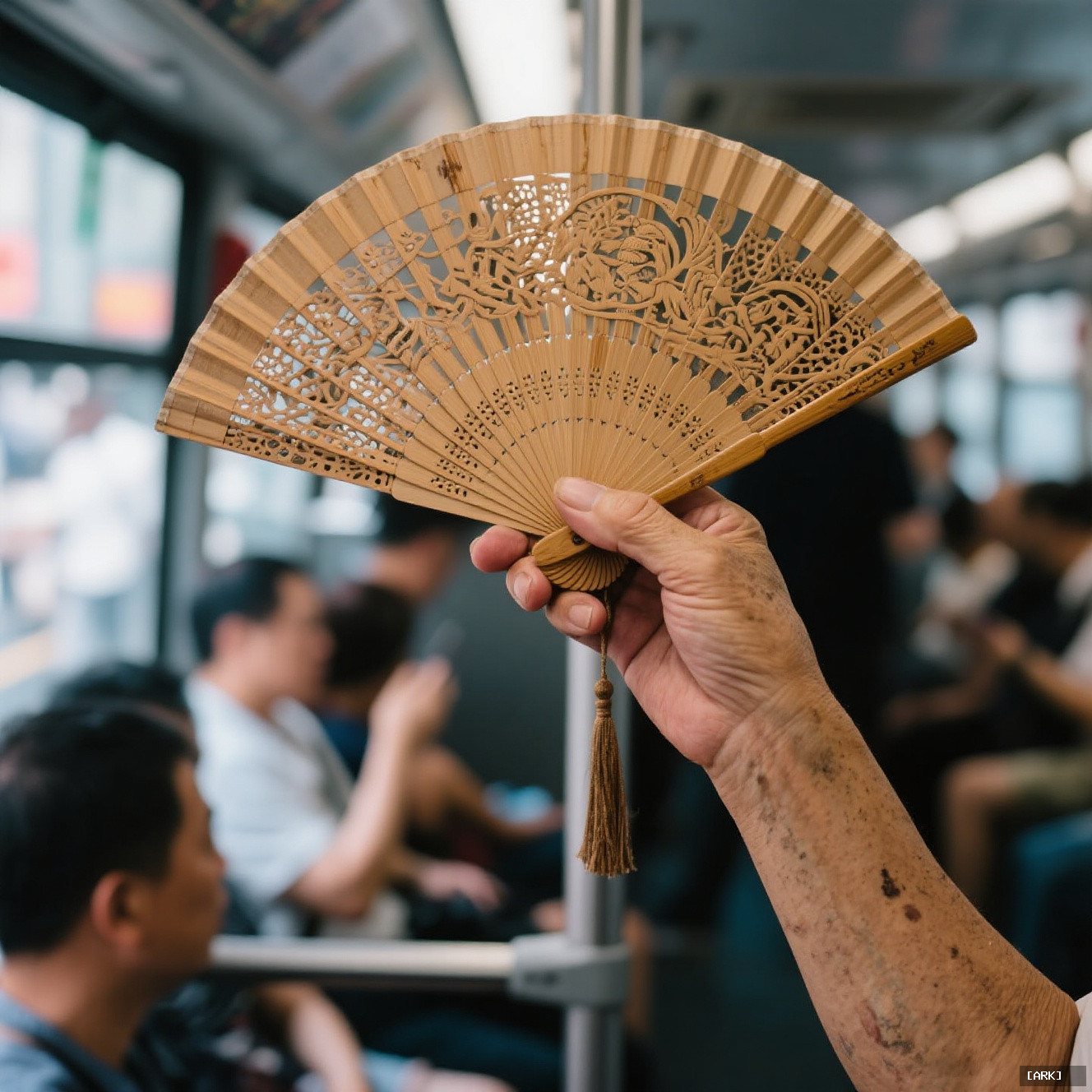
The fan endures because it answers a need that grand systems cannot fully address: the immediate, personal need for a breath of moving air, for a moment of bodily control, for a connection to a simpler, more tactile way of being. It is a whisper of agency in a world of roaring machinery. In your bag, it is a promise—that no matter how dense the crowd or how high the mercury climbs, you hold a small, powerful way to change your own climate.
Sources & Further Reading
✨ You Might Also Enjoy


You may also like
Herbal Bead Bracelet: Ancient Chinese Aromatherapy for Modern Wellness | HandMyth™
Original price was: ¥2,199.00.¥1,352.00Current price is: ¥1,352.00. Add to cartPremium Herbal Beads Bracelet: Traditional Medicine Meets Modern Jewelry | Shop HandMyth
Original price was: ¥874.00.¥608.00Current price is: ¥608.00. Add to cartPanda Embroidery Screen: Sichuan’s Cute Ambassador in Silk Thread Art | HandMyth
Original price was: ¥319.00.¥230.00Current price is: ¥230.00. Add to cartPanda Gift Set: Curated Chinese Treasures for Panda Lovers | HandMyth™ (Free Gift Wrap)
Original price was: ¥136.00.¥118.00Current price is: ¥118.00. Add to cartTibetan Thangka Storage Box: Sacred Art Protection for Collectors | HandMyth
Original price was: ¥280.00.¥219.00Current price is: ¥219.00. Add to cartPure Silk Handbag: Hangzhou’s Legendary Silk Weaving for Modern Elegance | HandMyth™
Original price was: ¥874.00.¥786.00Current price is: ¥786.00. Add to cartHand-Painted Silk Scarf: Wearable Art from China’s Silk Road | HandMyth (Artist Signed)
Original price was: ¥1,017.00.¥935.00Current price is: ¥935.00. Add to cartModern Qipao Dress: Timeless Chinese Elegance for Today’s Woman | HandMyth (Custom Fit)
Original price was: ¥2,459.00.¥2,240.00Current price is: ¥2,240.00. Add to cartEmbroidered Chinese Handbag: Suzhou Silk Embroidery Meets Modern Fashion | HandMyth™
Original price was: ¥680.00.¥646.00Current price is: ¥646.00. Add to cart























