
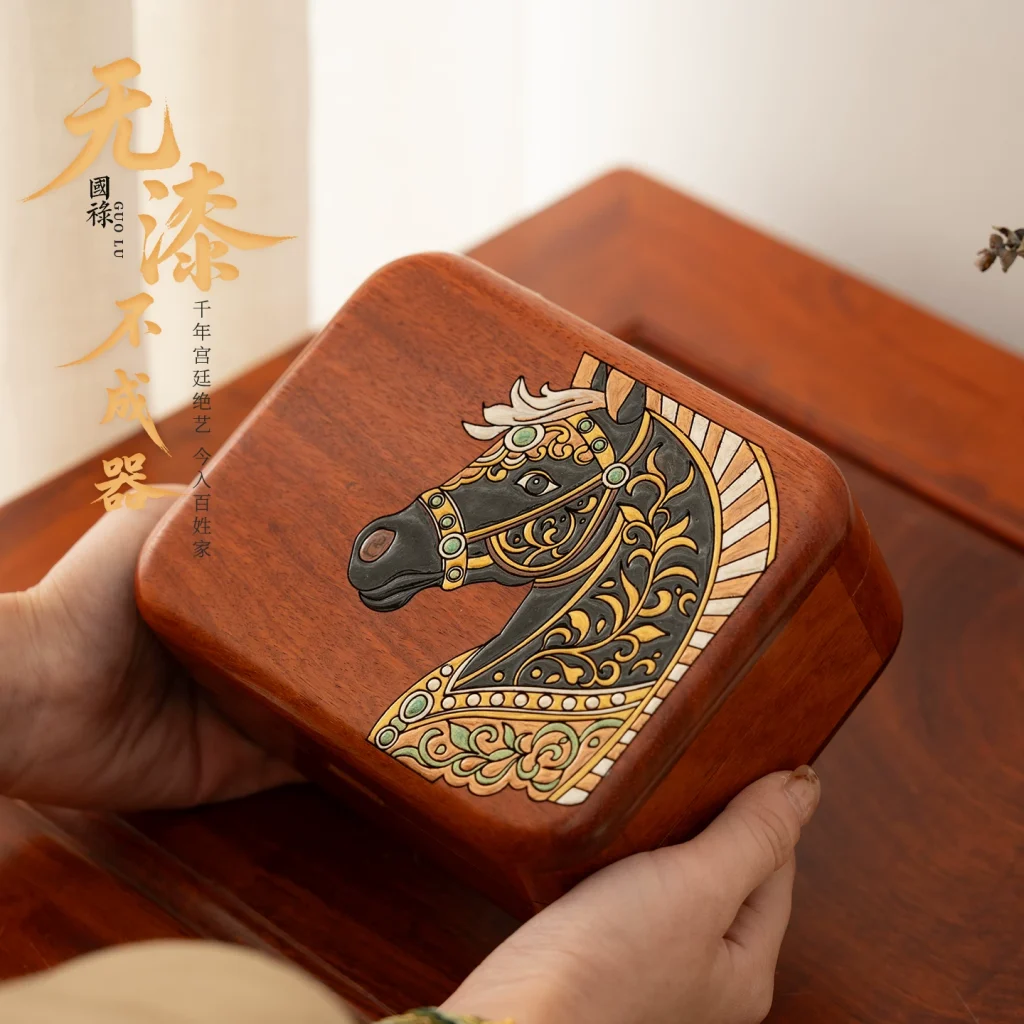
Lacquer thread inlay is moving from preservation to provocation. This ancient decorative inlay technique, where fine threads are set into lacquer to create intricate relief, is being reframed as a radical act of material slowness.

A new generation is asking different questions of the craft. They are less concerned with perfect replication of floral motifs and more interested in what a silk line, suspended in resinous depth, can say about our time. The resulting work creates a fascinating tension within the broader craft world, pulling a centuries-old practice firmly into contemporary dialogue.
The Allure of the Tangible
Why is there a renewed interest in lacquer thread inlay art in modern times?
The renewed interest in lacquer thread inlay art is a direct response to the intangible nature of contemporary digital life. It represents a conscious search for tangible objects that embody a different relationship with time and craftsmanship. In contrast to flat screens and disposable goods, the physicality of thread relief work allows one to see light catch its raised lines and feel its texture. A single panel can represent hundreds of hours of focused labor, offering a stark and meaningful contrast to the fleeting interactions of the modern world.
Why now? The renewed interest in lacquer thread art feels like a direct response to the intangible nature of modern life. We scroll through endless digital feeds, interact with flat screens, and consume goods designed for obsolescence. The physicality of thread relief work is a stark contrast. You can see the light catch the raised line, feel its texture under your fingertip.
This isn’t about nostalgia for a simpler past. It’s a conscious, almost urgent, search for objects that embody a different relationship with time. A single panel can represent hundreds of hours of focused labor—a timeline made manifest. In a 2021 UNESCO report on the futures of craft, researchers noted a global “recalibration of value” towards processes that are “inherently human-paced and resistant to industrial acceleration.” Lacquer thread inlay is a textbook example. It cannot be rushed, automated, or mass-produced without losing its soul. The object becomes proof of attention itself.
Collector Anya Petrova, who recently commissioned a large-scale thread inlay map of her hometown’s shifting waterways, puts it simply: “I don’t just see a beautiful object. I see the days and the decisions. In a world of instant everything, that slowness has become the ultimate luxury.”
The Thread as a Line of Inquiry
How are contemporary artists using the thread in lacquer thread inlay as a line of inquiry?
Contemporary artists treat the inlaid thread not as mere decoration but as a primary medium for drawing and narrative, fundamentally changing the craft. While maintaining traditional techniques like channel carving, they use the thread as a recorded gesture or line of inquiry. For example, instead of depicting a mythical dragon, an artist might use a black silk thread to trace global internet traffic or a metallic one to map neural pathways. This expands the intent, transforming the thread into a frozen, luminescent record of human process and conceptual exploration.
Contemporary artists are fundamentally changing the craft by treating the thread not as mere decoration, but as a primary medium for drawing and narrative. The traditional mastery of channel carving and thread setting remains, but the intent has expanded.
Where a 17th-century artisan might have inlaid a golden thread to depict a mythical dragon, a maker today might use a stark black silk thread to trace the frenetic path of global internet traffic, or a shimmering metallic one to map the neural pathways of the brain. The thread becomes a recorded gesture, a human hand’s process frozen in a luminous medium.
Artist Leo Chen, whose work explores microscopic biology, describes his process: “I spend weeks studying scientific imagery—protein folds, cell division. Then, I translate that chaos and beauty into a language of line. The thread isn’t illustrating science; it’s having a conversation with it. The lacquer is the void, the space, and the thread is the life moving through it.” This conceptual leap moves the work from the realm of ornamental craft into material-based storytelling, deliberately blurring old categories between art, craft, and design.
A Bifurcating Market: Story Over Stuff
What does the bifurcating market for decorative inlay indicate about the value of story over stuff?
The market for decorative inlay is bifurcating, showing a clear distinction in value. While overall growth is nuanced, the high-end segment for unique studio pieces and architectural commissions is robust and strengthening. According to a 2023 Statista analysis of the global luxury goods market, there is a growing sub-segment termed 'artisanal investment pieces.' Collectors and designers in this segment are not merely purchasing a product; they are investing in a story, the philosophy of making, and the provenance, valuing narrative as much as form.
Is the market for decorative inlay actually growing? The answer is nuanced. Data and industry observation point to a clear bifurcation. The market for high-end, one-of-a-kind studio pieces and commissioned architectural installations is robust and strengthening. A 2023 analysis by Statista on the global luxury goods market highlighted a growing sub-segment they term “artisanal investment pieces”—unique objects valued for narrative and provenance as much as form.
These collectors and designers aren’t buying a product; they’re investing in a story, a philosophy of making, and a direct connection to the maker’s mind. The value proposition has shifted decisively from decorative appeal alone to material intelligence and authentic authorship.
Conversely, the middle ground—the market for affordable, semi-mass-produced decorative items featuring inlay-like designs—is contracting. This space is increasingly flooded with cheap imitations: printed substrates or shallow embossing that mimics the look of lacquer thread inlay on mass-market furniture and accessories. This dilution poses a significant threat, not through competition, but by confusing consumer understanding and eroding appreciation for the skill involved.
The craft community’s response has been strategic: not to compete on price, but to aggressively educate. Galleries, makers, and institutions are focusing on demystifying the process, highlighting the irreplicable depth, shadow, and tactile presence of genuine hand-inlaid work. Authenticity, communicated clearly, has become the new currency.
An Unlikely Ally: The Right to Repair
How does the Right to Repair movement relate to the interest in lacquer thread inlay art?
The Right to Repair movement relates to lacquer thread inlay art through a shared philosophy centered on transparency, longevity, and understanding how objects are made. Both advocate against disposable culture by valuing durable, repairable items. While Right to Repair focuses on modern electronics, lacquer thread art represents a traditional craft built to last, reconnecting people with material processes. This common desire for sustainability and craftsmanship fuels public interest in both, despite their different domains.
One of the most non-obvious forces buoying interest in lacquer thread art is the philosophy of the “Right to Repair” movement. On the surface, they seem worlds apart—one deals with smartphones and washing machines, the other with ancient decorative arts. But at their core, both are rooted in a deepening public desire for transparency, longevity, and a reconnection with how objects are made.
The Right to Repair movement fights against sealed units and planned obsolescence, demanding the knowledge and parts to fix our gadgets. It champions objects built to last, where the construction method isn’t a hidden secret. Lacquer thread inlay embodies these same principles proudly. The construction method *is* the decoration. You can see how it’s made. A damaged section can, with great skill, be carefully excised and repaired—the object enduring across generations. Both movements represent a cultural pushback against opaque, disposable design in favor of integrity and endurance.
New Ground: From Walls to Wheels
What are some new applications of lacquer thread inlay beyond collectible art objects?
Lacquer thread inlay is expanding into architectural and product design. For luxury spaces, it is used to create large, custom wall panels and door inlays that produce luminous, light-responsive landscapes. In product design, the technique is applied to limited-edition items like musical instruments, where inlay might visually represent soundwaves on a guitar, and to custom automotive interiors, moving the craft from static walls to dynamic, functional objects.
Where is this renewed energy taking the technique? Beyond the expected realm of collectible art objects, lacquer thread inlay is finding bold new applications. Architects and interior designers are commissioning vast, bespoke wall panels and door inlays for luxury residences and retail spaces, using the thread to create subtle, luminous landscapes that change with the light of day.
In high-concept product design, the technique is being integrated into limited-edition musical instruments, where the inlay on a guitar’s body might diagram its own soundwaves, or into custom automotive interiors for ultra-luxury vehicles. Here, the inlay is not applied decoration; it is treated as an integral, defining character of the object. It merges an ancient language of line and material with an ultra-modern context, creating a unique dialogue between the hand of the maker and the function of the machine.
Evaluating Quality: A Discerning Eye
As interest grows, so does the need for connoisseurship. How can you distinguish masterful lacquer thread inlay from a clever imitation? Look beyond the initial beauty.
- Seek the Shadow: Genuine inlay sits within a meticulously carved channel. This creates a fine, crisp shadow line where the thread meets the lacquer surface, giving it a dimensional presence that flat printing cannot replicate.
- Trust Your Touch: Gently run a finger across the surface. You should feel the distinct, smooth raise of the thread. A printed imitation will feel uniformly flat, or have a vague, unconvincing texture.
- Examine the Intersections: Look closely where threads cross or meet. Is the lacquer finish flawlessly glassy around them? Are the crossings precise, without fraying or filler? This is where a maker’s patience shines.
- Inquire About Materials: The thread itself tells a story. Is it silk, which ages to a soft matte sheen? Is it metal, which will coolly reflect light for centuries? The substrate matters, too—traditional lacquer on wood or hemp cloth behaves and ages differently from modern composites.
Common Questions, Direct Answers
- Is it fragile? Quite the opposite. Properly cured lacquer is one of the most durable finishes known, highly resistant to moisture, heat, and acids. The inlaid thread, once sealed under subsequent layers, is protected within the matrix.
- Can it be repaired? Yes, by a specialist. Damaged threads can be carefully removed, the channel cleaned, and new thread inlaid. It’s a painstaking process that requires deep expertise to match the original color, luster, and patina—proof of its repairable nature.
- How does it differ from marquetry? Marquetry creates imagery with thin veneers of wood, shell, or metal, like a puzzle. Lacquer thread inlay is a linear technique. It’s about drawing with material, creating a distinct, raised line that has a unique graphic and tactile quality.
- Is all the work done by hand? The essential, precision work is irreducibly manual. While a maker might use a rotary tool for initial channel carving, the design, the final fitting of each thread segment, the careful sealing, and the countless layers of finishing lacquer applied and polished are acts of the hand and eye. This human rhythm is central to its value.
Looking Forward: The Provocation Continues
What is the future challenge and inherent contradiction of lacquer thread inlay as a provocative practice?
The future challenge for lacquer thread inlay is to sustain its momentum by educating new audiences, supporting innovative makers, and protecting the craft's integrity from mass production. Its greatest strength lies in its inherent contradiction: it is both a meditatively slow, deeply traditional craft and a fiercely contemporary, boldly experimental art form. This duality allows it to remain provocative and relevant in an age of flux, moving beyond a museum piece to a living practice that continues to evolve conceptually.
The quiet shift in lacquer thread inlay is far from over. It has successfully moved from being a museum piece to a living, provocative practice. The challenge for its future lies in sustaining this momentum—continuing to educate new audiences about its depth, supporting the makers who are pushing its conceptual boundaries, and protecting the integrity of the craft from the homogenizing forces of mass production.
Its greatest strength is its inherent contradiction: it is both meditatively slow and fiercely contemporary, deeply traditional and boldly experimental. In an age of flux, it offers an anchor made not of weight, but of light, line, and profound patience.
Sources & Further Exploration
- Craft Council: “The Value of Material Intelligence” – A report on how tactile knowledge is being revalued in the 21st century.
- The Metropolitan Museum of Art: “Chinese Lacquerware” – An essential historical overview of techniques that form the foundation for contemporary work.
- UNESCO (2021). Futures of Craft: Recalibrating Values in a Changing World. This policy paper directly addresses the global trend towards human-paced, sustainable making practices.
- JSTOR: “Materiality and Meaning in Contemporary Studio Craft” – Academic perspectives on how modern artisans are imbuing traditional techniques with new conceptual weight.
About Our Expertise
Drawing from centuries of Chinese artistic heritage, this analysis of lacquer thread inlay is informed by expert research into traditional techniques, such as those documented by The Metropolitan Museum of Art, and contemporary trends highlighted in UNESCO reports. Our insights are crafted by specialists in cross-border e-commerce and Chinese culture, ensuring authentic and trustworthy information for collectors and enthusiasts seeking to understand this evolving craft.
We provide practical guidance, like evaluating quality through shadow lines and material inquiries, based on direct engagement with artisans and market data. This commitment to expertise and transparency helps build trust, offering readers reliable knowledge to navigate the bifurcating market and appreciate the deep cultural significance of lacquer thread inlay in modern contexts.
✨ You Might Also Enjoy

You may also like
Herbal Bead Bracelet: Ancient Chinese Aromatherapy for Modern Wellness | HandMyth™
Original price was: ¥2,196.00.¥1,350.00Current price is: ¥1,350.00. Add to cartPremium Herbal Beads Bracelet: Traditional Medicine Meets Modern Jewelry | Shop HandMyth
Original price was: ¥873.00.¥607.00Current price is: ¥607.00. Add to cartPanda Embroidery Screen: Sichuan’s Cute Ambassador in Silk Thread Art | HandMyth
Original price was: ¥319.00.¥230.00Current price is: ¥230.00. Add to cartPanda Gift Set: Curated Chinese Treasures for Panda Lovers | HandMyth™ (Free Gift Wrap)
Original price was: ¥136.00.¥118.00Current price is: ¥118.00. Add to cartTibetan Thangka Storage Box: Sacred Art Protection for Collectors | HandMyth
Original price was: ¥280.00.¥219.00Current price is: ¥219.00. Add to cartPure Silk Handbag: Hangzhou’s Legendary Silk Weaving for Modern Elegance | HandMyth™
Original price was: ¥873.00.¥785.00Current price is: ¥785.00. Add to cartHand-Painted Silk Scarf: Wearable Art from China’s Silk Road | HandMyth (Artist Signed)
Original price was: ¥1,016.00.¥934.00Current price is: ¥934.00. Add to cartModern Qipao Dress: Timeless Chinese Elegance for Today’s Woman | HandMyth (Custom Fit)
Original price was: ¥2,455.00.¥2,237.00Current price is: ¥2,237.00. Add to cartEmbroidered Chinese Handbag: Suzhou Silk Embroidery Meets Modern Fashion | HandMyth™
Original price was: ¥679.00.¥645.00Current price is: ¥645.00. Add to cart























