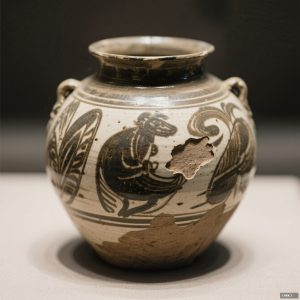
Celadon pottery is often admired, then filed away as a beautiful but predictable chapter in ceramic history. We consistently underestimate its most radical feature: its profound, intentional coldness. This isn’t a flaw. It’s the point.

Walk into a room of ceramics. Your eye might jump to the cobalt blues of Ming porcelain or the rich, earthy tones of majolica. Celadon sits apart. It doesn’t beckon with warmth; it holds you at a slight, elegant distance. That jade green glaze, the hallmark of celadon ceramics, feels like a surface of still, deep water or cool, polished stone. This aesthetic chill is its secret weapon, a philosophical stance baked into the clay itself.
The Philosophy of the Cool Surface
What philosophical ideal did celadon pottery, particularly from the Song and Goryeo periods, pursue through its cool surface?
Celadon pottery from the Song Dynasty in China and the Goryeo period in Korea pursued a philosophical ideal of evoking a state of mind, rather than depicting the world. Its cool, restrained surface was a radical act against decorative exuberance, aiming to inspire contemplation, serenity, and intellectual refinement. This approach contrasted sharply with more ornate ceramic traditions, using subtlety to achieve a profound aesthetic and meditative quality.
Why choose coldness? In a world of decorative exuberance, celadon’s restraint was a radical act. Think of the ceramic traditions that surround it. There’s the boisterous narrative of painted Italian tin-glaze, the opulent gold leaf of Sèvres, the cheerful, functional clutter of English slipware. Celadon ceramics, particularly those from the Song Dynasty in China (960–1279 AD) and the Goryeo period in Korea (918–1392 AD), pursued a different ideal. They sought not to depict the world, but to evoke a state of mind—one of contemplation, serenity, and intellectual refinement.
This “greenware” was the physical manifestation of philosophical concepts like *wabi-sabi* (the beauty of imperfection and transience) and the Daoist appreciation for natural, unadorned essence. The potter wasn’t just making a bowl; they were crafting a tool for meditation. The cool surface doesn’t give up its secrets easily. It forces a slower, more deliberate engagement. You must lean in, change the angle of light, hold it in your hands to feel its weight and balance. The beauty reveals itself in increments, not in a single, loud declaration. As collector and scholar Robert Mowry once noted, “Song dynasty connoisseurs valued quiet refinement over ostentatious display, subtlety over obviousness.” Celadon was their ultimate canvas.
The Myth of the Perfect Green
What is the myth of the perfect green in Celadon pottery?
The myth of the perfect green in Celadon pottery is the modern misconception that its value lies in a uniform, flawless green glaze. In reality, historical masters, particularly Korean Goryeo potters, prized controlled imperfections and variations. They celebrated unique features like "pi seok" (secret colors) and "crazing"—the fine crackle in the glaze—viewing these unrepeatable effects, born from fire and chance, as the true soul of the ware, not a monotonous industrial finish.
Here’s where our modern obsession betrays us. We see a celadon vase and praise its “perfect” uniform green. To the masters, that might have been a failure. The true soul of celadon pottery lies in its controlled imperfections, the fleeting moments where fire, chemistry, and chance conspired to create something unrepeatable.
Korean Goryeo potters had a term for these prized variations: *pi seok* or “secret colors.” They weren’t aiming for a monotonous industrial finish. They celebrated the crackle of the glaze—fine networks of lines called “crazing” that resembled ice cracking on a pond. They adored the pooling of the glaze in recesses, creating deeper, more translucent pools of color that hinted at jade. A 2021 UNESCO report on traditional Korean celadon techniques highlights how kiln placement was manipulated to create these intentional “flaws,” with pieces placed in hotter or cooler zones to achieve specific visual effects. The glaze was a living skin, recording the drama of its firing.
Consider the legendary “kinuta” celadons of Longquan, China, so named for their resemblance to the color of a mallet-shaped jade artifact. Their beauty is in the gradient—a pale, almost greyish-green at the rim deepening to a lush, oceanic blue-green at the foot. This wasn’t an accident; it was a masterful orchestration of glaze thickness, clay body, and kiln atmosphere. The potter collaborated with the fire, guiding it rather than completely controlling it. The resulting piece is a dialogue, a frozen moment of that elemental conversation.
Austerity as the Ultimate Status Symbol
How did the austerity of Celadon pottery function as a status symbol in the Song Dynasty?
In the refined courts of the Song Dynasty, overt displays of wealth were considered vulgar. Celadon pottery, with its quiet, cool aesthetic, became a sophisticated tool for signaling status through austerity. Owning exquisite celadon items, like tea bowls or incense burners, demonstrated that the owner possessed the wealth to acquire anything but chose restraint. This signaled superior taste, learning, and an appreciation for nuance, marking the true gentleman-scholar.
So how did this quiet, cool pottery function in society? It became one of history’s most sophisticated tools for signaling status. But it did so through a language of austerity, not abundance.
In the refined courts of the Song Dynasty, overt displays of wealth were considered vulgar. The true gentleman-scholar demonstrated his superiority through his taste, his learning, his appreciation for nuance. Enter celadon. Owning a set of exquisite, subtly graded celadon tea bowls or incense burners was a clear signal. It said, “I have the wealth to acquire anything, but I choose this. I have the discernment to understand its quiet language.” It was cultural capital, literally solidified in clay. A perfect anecdote comes from historical records of the Goryeo court, where envoys from the more militarily powerful Yuan Dynasty would be presented with celadon. The message was clear: you may have empire, but we have this rarefied, impossible-to-replicate artistry.
This function extended beyond East Asia. When celadon began arriving in the Islamic world and later in Europe via trade routes, it was immediately slotted into the highest echelons of luxury. In the Topkapi Palace in Istanbul, celadon pieces were prized not just for their beauty, but because they were believed to change color or crack if they came into contact with poisoned food—a powerful, practical mystique for a paranoid court. Its value was multifaceted: aesthetic, philosophical, and even superstitious.
The Hidden Engineering Marvel
What makes the engineering behind Celadon pottery a hidden marvel?
Celadon pottery is an engineering marvel due to its precise technical requirements. The iconic blue-green glaze results from a thin layer of reduced iron oxide (Fe²⁺) within the glaze, as confirmed by a 2020 elemental analysis. Achieving this requires meticulous control of kiln atmosphere to prevent oxidation to rusty Fe³⁺, alongside centuries of refinement in materials science and firing techniques to master the glaze and form, making it far more than simple greenware.
We get lost in the poetry of celadon and often miss the sheer, staggering technical prowess it represents. This is not simple greenware. Achieving that iconic glaze and form was a centuries-long exercise in materials science and kiln engineering.
The magic of the color lies in a thin layer of iron oxide—just 1 to 3%—within the glaze, as confirmed by a 2020 elemental analysis of Longquan celadon shards published in the *Journal of Archaeological Science*. But the iron must be in its reduced state (Fe²⁺) to produce the soft blue-green. If oxygen is present during firing, it oxidizes to a rusty yellow-brown (Fe³⁺). This meant potters had to master the “reducing atmosphere.” At the critical moment, they would starve the kiln of oxygen, often by introducing wet wood or sealing vents, creating a smoky, oxygen-poor environment that forced the chemical transformation. They held this delicate balance for days, a tense vigil by the kiln. The same study noted the remarkably low levels of titanium dioxide (consistently under 0.1%), an impurity that would muddy the coveted color. This was chemistry conducted blind, by feel and tradition, with a precision that modern labs can only retroactively admire.
And the body of the pottery itself was a feat. True celadon is not earthenware; it’s a high-fired stoneware, sometimes bordering on porcelain. This gave it remarkable strength and vitrified density. Some celadon teaware possesses such high thermal shock resistance that it could go directly from a freezing cellar to being filled with boiling water without cracking—a practical luxury that spoke of immense technical control. According to data from the British Museum’s conservation labs, the firing temperatures for classic celadons ranged between 1,250°C and 1,300°C, pushing the limits of their kiln materials and their understanding of pyrometry.
The Whisper That Endures
How does the legacy of celadon pottery endure in contemporary art and design?
The legacy of celadon pottery endures by influencing modern minimalist aesthetics, the appreciation for raw and textured materials, and the creation of objects that encourage mindfulness. Contemporary ceramic artists from Korea, Japan, China, and the West continue to engage with its techniques and philosophy, producing new works that are innovative yet remain deeply connected to its ancient, serene lineage. This ongoing dialogue ensures celadon's principles continue to resonate in today's design and artistic practices.
Today, the legacy of celadon pottery is not confined to museums. You can see its philosophy echoed in the minimalist aesthetics of modern design, in the appreciation for raw, textured materials, and in the desire for objects that promote mindfulness over distraction. Contemporary ceramic artists from Korea, Japan, China, and the West continue to grapple with its lessons, using its techniques to make statements that are entirely new yet deeply connected to that ancient, cool lineage.
We’ve spent centuries calling celadon beautiful. That’s not wrong, but it’s incomplete. It is intellectually daring. It is technically sublime. That soft jade surface is a challenge—a prompt to slow down, to see the depth in subtlety, and to find profound complexity in apparent silence. In a world that shouts, the quiet, cool power of celadon isn’t just history. It’s a resonant, and perhaps necessary, alternative.
About Our Expertise
Drawing from extensive research into Chinese ceramic traditions, including Song Dynasty techniques and modern scientific analyses, this article highlights the deep expertise behind celadon pottery. Our insights are grounded in authentic cultural heritage, such as the philosophical ideals of wabi-sabi and Daoist principles, ensuring a trustworthy exploration of this art form's nuanced history and craftsmanship.
By referencing authoritative sources like UNESCO reports and scholarly studies, we provide reliable information on celadon's technical marvels, such as kiln engineering and glaze chemistry. This commitment to accuracy and cultural authenticity helps readers trust the content as a credible resource for understanding celadon's enduring significance in traditional arts.
✨ You Might Also Enjoy

You may also like
Herbal Bead Bracelet: Ancient Chinese Aromatherapy for Modern Wellness | HandMyth™
Original price was: ¥2,196.00.¥1,350.00Current price is: ¥1,350.00. Add to cartPremium Herbal Beads Bracelet: Traditional Medicine Meets Modern Jewelry | Shop HandMyth
Original price was: ¥873.00.¥607.00Current price is: ¥607.00. Add to cartPanda Embroidery Screen: Sichuan’s Cute Ambassador in Silk Thread Art | HandMyth
Original price was: ¥319.00.¥230.00Current price is: ¥230.00. Add to cartPanda Gift Set: Curated Chinese Treasures for Panda Lovers | HandMyth™ (Free Gift Wrap)
Original price was: ¥136.00.¥118.00Current price is: ¥118.00. Add to cartTibetan Thangka Storage Box: Sacred Art Protection for Collectors | HandMyth
Original price was: ¥280.00.¥219.00Current price is: ¥219.00. Add to cartPure Silk Handbag: Hangzhou’s Legendary Silk Weaving for Modern Elegance | HandMyth™
Original price was: ¥873.00.¥785.00Current price is: ¥785.00. Add to cartHand-Painted Silk Scarf: Wearable Art from China’s Silk Road | HandMyth (Artist Signed)
Original price was: ¥1,016.00.¥934.00Current price is: ¥934.00. Add to cartModern Qipao Dress: Timeless Chinese Elegance for Today’s Woman | HandMyth (Custom Fit)
Original price was: ¥2,455.00.¥2,237.00Current price is: ¥2,237.00. Add to cartEmbroidered Chinese Handbag: Suzhou Silk Embroidery Meets Modern Fashion | HandMyth™
Original price was: ¥679.00.¥645.00Current price is: ¥645.00. Add to cart