

Xiangyunsha Silk — The Practical Luxury of Chinese Cloud Gauze
I learned about xiangyunsha the hard way. I bought my first piece — a deep bronze-colored jacket — during a trip to Guangzhou, and I left it hanging in a sunlit corner of my apartment for three days. By day four, the side that faced the window had faded to a pale mushroom gray. The other side, the one shaded by a coat I’d draped nearby, was still that rich, dark bronze I’d fallen for.
The shop owner in Guangzhou had warned me. “This fabric remembers everything,” she said. “It remembers the sun. It remembers sweat. It remembers rain.” I thought she was being poetic. She was being literal.
Xiangyunsha, or cloud gauze, is a handwoven silk treated with fermented yam juice and riverbed mud in a process that takes months. What comes out is a fabric that breathes differently from any textile I’ve ever worn, with a subtle crackle when you move and a color that shifts in the light like the surface of dark water. But that same natural finish that makes it so beautiful is also what makes it vulnerable.
Here’s what I’ve learned since ruining that jacket — and how to wear xiangyunsha in the sun without watching it disappear.
The Chemistry Is the Weakness — And the Strength
The first thing to understand is that xiangyunsha isn’t dyed in the conventional sense. Most silk fabrics get their color from chemical dyes that penetrate the fibers and bond at the molecular level. Xiangyunsha gets its color from a layer of oxidized iron compounds deposited on the surface during the mud-drying stage.
This surface layer is what gives the fabric its signature metallic sheen and its water-resistant properties. But it’s also a thin layer, and ultraviolet light breaks down iron oxide compounds. When UV hits the surface of xiangyunsha, it catalyzes a slow chemical reaction that changes the oxidation state of the iron. The deep bronze turns lighter. The black-brown shifts toward gray. The rich eggplant tones flatten out.
This isn’t a defect. It’s the nature of an unfixed, natural surface. And the same process that causes fading is also what gives the fabric its incredible aging character — provided you manage the rate of change rather than fighting it.
How Much Sun Is Too Much?
I’ve been testing this for about two years now across multiple xiangyunsha pieces. Here’s what the real-world data looks like:
Direct sunlight for more than two hours a day, consistently, will produce visible fading within two to three weeks. The change starts subtly — a slight loss of depth in the highlight areas — and accelerates as the outer oxidized layer wears thin.
Indirect sunlight through a window, filtered by glass, will still cause fading but at maybe a tenth of the rate. Glass blocks most UVB but only about half of UVA, and UVA is the primary driver of the iron oxidation shift. So behind glass, you might not see noticeable change for six months.
Occasional outdoor wear of a few hours per week in full sun produces a very gradual, even patina that many collectors actually prefer. The fabric develops a softened, worn-in look that reads as vintage rather than damaged.
The worst-case scenario is direct sunlight on a dark, heat-absorbing surface. A xiangyunsha garment draped over a chair in a south-facing window, black side up, can show visible fading in as little as three days. I know this because I did it.
How I Store and Care for Xiangyunsha Now
I keep my xiangyunsha pieces in a wooden wardrobe away from windows. If you don’t have that option, a simple cotton garment bag blocks about 80 percent of UV. I’ve tested this with a UV card — the kind you use to check sunscreen effectiveness — and the difference inside versus outside the bag is dramatic.
For hanging, use padded hangers. The weight of xiangyunsha — it’s denser than most silks because of the mineral deposits from the mud treatment — can create shoulder bumps on thin hangers. I use wide wooden hangers with felt padding, and I leave a few inches between each garment so they can breathe.
Do not store xiangyunsha in plastic. I made this mistake with a scarf, and after three months in a dry-cleaning bag, the finish had dulled noticeably. Xiangyunsha needs air circulation. The natural starches and mineral compounds in the fabric interact with humidity, and trapping them in plastic creates micro-conditions that accelerate surface degradation. Cotton or linen bags are fine. Unbleached muslin is ideal if you want to be particular about it.
I also rotate my pieces. In summer, I wear the lighter, thinner weaves — the ones with fewer mud treatments that have a softer drape and more give. In winter, I wear the heavily treated pieces, the ones with that stiff, almost leathery hand feel that develops a beautiful crackle pattern with wear. Spreading the sun exposure across the wardrobe means no single piece takes the full seasonal hit.
What About Wearing It Outside?
This is the part that took me the longest to understand, because most advice you’ll read online about xiangyunsha treats sun exposure as a total enemy. It’s not. The fabric has been worn outdoors in subtropical southern China for centuries. The Cantonese women who developed this textile knew exactly what they were doing.
The key is rotation and intention. The traditional approach was to own a few pieces and wear them in rotation, so each one had months of rest between uses. The rest period allows the surface compounds to re-equilibrate with ambient humidity — a process that actually reverses some of the UV damage at the microscopic level. I don’t fully understand the chemistry of this, but I’ve observed it: a piece that looks faded after a summer of weekly wear will look noticeably richer after three months of storage in dark, humid conditions.
In practical terms, this means I wear my xiangyunsha outdoors freely, but I don’t wear the same piece two days in a row. I give it at least a week of rest between wears, hanging it in a dark, ventilated closet. And I avoid wearing it for full-day outdoor events in high-UV conditions — a farmer’s market trip is fine, an afternoon at the beach is not.
I should also mention that xiangyunsha handles heat better than almost any fabric I own. The open weave and natural fiber create a microclimate against your skin that stays several degrees cooler than what you’d feel in cotton or linen. In Guangzhou summers, where the temperature hits 35 degrees with 80 percent humidity, xiangyunsha is genuinely more comfortable than being shirtless. The sun exposure concern is real, but it has to be weighed against the functional benefit of actually wearing the fabric when it performs best.
Cleaning and UV Sensitivity
Here’s a connection I didn’t make until I ruined a second piece — this time a scarf.
I washed a xiangyunsha scarf with a gentle soap, hung it outside to dry (shade, I thought, adequate shade), and left it there for about four hours. When I brought it in, there were distinct fade lines where the folds had been. The areas exposed to ambient daylight had shifted color relative to the folded interior.
The lesson: wet xiangyunsha is significantly more UV-sensitive than dry xiangyunsha. The water molecules on and within the fibers facilitate the oxidation reactions. A damp piece can fade in indirect daylight in under an hour.
Now I dry all xiangyunsha indoors, flat, away from windows. It takes longer — about 24 hours in normal household humidity — but the color stays true. I also iron them inside out, with a pressing cloth, on the silk setting. Direct iron heat on the treated surface will alter the finish.
How to Know If Your Piece Is Aging Well
There’s a difference between patina and damage. Patina is even. It develops slowly. It affects the entire surface uniformly, or at least in a way that follows the logic of wear — shoulders fading slightly faster than the back, the collar softening from neck oils.
Damage is patchy. It has sharp lines, like the fold marks on my scarf or the half-garment fade on my first jacket. Patchy fading means the UV exposure was uneven or that the fabric was wet when it faded.
Genuine patina on xiangyunsha is beautiful. If you’ve seen well-aged xiangyunsha, you know what I mean — the surface takes on a depth that new pieces can’t replicate, like the difference between a newly minted coin and one that’s circulated for fifty years. The bronze base shifts toward amber, the black-brown develops reddish undertones, and the crackle pattern becomes more pronounced and refined.
My oldest piece is a scarf I’ve had for about four years. The color has shifted from a rich aubergine to something closer to warm chestnut with hints of purple in the folds. It’s not what it was when I bought it. I genuinely prefer it now.
The Bottom Line
Xiangyunsha is not a fabric for people who want their clothes to look the same forever. It changes. That’s the whole point. The same natural finish that makes it sensitive to sunlight is what gives it that living, responsive quality that no industrially produced textile can approximate.
You can minimize fading — store it dark, rotate your pieces, dry it indoors, avoid leaving it in sunlit rooms for days at a time. But you can’t stop it entirely, and I don’t think you should want to. The aging of xiangyunsha is part of the relationship with the garment. It tells the story of where you wore it and how you lived in it.
I still miss that first jacket sometimes. But I learned more from losing it — slowly, patch by patch — than I’ve learned from any garment that stayed perfect.
Shop xiangyunsha and traditional artisan pieces at HandMyth.
Disclosure: Some links are affiliate links.
Xiangyunsha vs Regular Silk vs Cotton: A Quick Comparison

| Feature | Xiangyunsha (Gambiered Silk) | Regular Mulberry Silk | Cotton |
|---|---|---|---|
| Origin | Guangdong, China; UNESCO-listed craft | Silkworm cultivation across China | Global cotton plant cultivation |
| Production | Dyeing with dioscorea root juice, sun-drying on river mud | Reeling, weaving, finishing | Ginning, spinning, weaving |
| Texture | Crisp when new, softens with wear; subtle metallic sheen | Smooth, lustrous, soft from first wear | Matte, breathable, can be stiff or soft |
| Breathability | Excellent; cool in summer, warm in winter | Good; lightweight and temperature-regulating | Very breathable; absorbs moisture |
| Durability | Very high; improves with age | Moderate; delicate, prone to water spots | High; machine washable |
| Care | Hand wash cold, air dry, avoid direct sun | Dry clean or hand wash | Machine wash, tumble dry |
| Price Range | Premium ($$$$) | Mid to premium ($$) | Affordable ($) |
How It Is Actually Made: Three Soakings, Nine Boilings, Eighteen Sundries
The reason this fabric costs what it costs is that it cannot be made faster. The whole process is summarised in Chinese as three soakings, nine boilings and eighteen rounds of sun-drying — and it uses only two colour sources: the juice of shuliang (the tuber of Dioscorea cirrhosa, a wild climbing yam) and the iron-rich mud from the creeks of the Pearl River Delta. No chemical mordants, no synthetic dye. Four things have to be present at once: the yam, the river mud, grassland to lay the cloth on, and strong sun. That is why production survives around Lunjiao in Shunde and Lanhe in Nansha, and almost nowhere else.
The sequence runs to roughly fourteen stages. The grey silk is steeped in yam juice, laid flat on grass to dry with bamboo poles weighting the edges so it will not curl, sprayed and re-steeped, then boiled in yam liquor in large copper vats until the colour runs even. Then comes the step that makes the fabric: guo wu, coating the cloth with river mud. It has to be done before sunrise, because once the sun is on the cloth the iron in the mud reacts with the tannin in the yam too fast and unevenly. The coated cloth is left to react, then washed in the river and dried in the weak early light. At dusk it goes back onto the grass for tan wu — spreading it out overnight to take up moisture from the grass, which is what makes it supple instead of board-stiff.
Then it waits. A finished piece is not sold the week it is made; it is put aside for months so the colour can settle. The result is a cloth that is near-black with a faint metallic sheen on one face and reddish-brown on the reverse — a single thickness of silk showing two colours, which is the fastest way to recognise the real thing.
The history is longer than most people expect. Tang-dynasty texts already mention the yam, and both Shen Kuo in the Northern Song and Li Shizhen in the Ming described its use as a dye. Gambiered gauze was being exported under the Yongle emperor in the early fifteenth century, and by the 1920s the trade around Shunde supported hundreds of drying grounds and tens of thousands of workers. Then synthetics arrived, and by the early 2010s only a handful of traditional workshops were left in Shunde. The dyeing and finishing technique was entered on China’s national intangible cultural heritage list in 2008 (item Ⅷ-107); the fabric gained national geographical indication protection in 2011, the “Lunjiao Xiangyun Sha” certification mark followed in 2018, and it was included in the second batch of products protected under the EU–China geographical indications agreement in 2020.
How to Tell Real Xiangyunsha from a Printed Imitation
Imitations exist, and they are made in days rather than weeks. Four checks catch most of them.
Turn it over. Real xiangyunsha is near-black on the face and reddish-brown on the back, because the mud only ever touches one side. A printed imitation is the same colour on both. This is the single most reliable test, and it takes two seconds.
Listen to it. One of the old names for this fabric is “rustling cloud gauze.” It is crisp and it makes a faint dry sound when it moves. Ordinary silk is quiet and slippery. If it feels like a limp charmeuse, it is not this.
Look at evenness. Because the colour develops in open sunlight from a plant extract and a mineral mud, batch-to-batch variation is normal and slight unevenness is expected. A flawlessly uniform, saturated black at a low price is a printed polyester satin.
Smell it. There should be no chemical note. What you may get is a faint earthy, slightly mineral smell from the mud. A sharp or sweet solvent smell means synthetic coating.
Frequently Asked Questions About Xiangyunsha Silk
What makes xiangyunsha silk different from normal silk?
Xiangyunsha is made from silk that has been repeatedly dyed with dioscorea root juice and spread over river mud to develop its signature dark, slightly metallic surface. This natural, mineral-rich process gives it greater durability and a distinctive crisp drape not found in standard mulberry silk.
Why is xiangyunsha also called “gambiered” silk?
The name comes from gambier, a plant extract historically used in the dyeing process. Although modern workshops more commonly use dioscorea root, “gambiered Guangdong silk” remains the traditional English name for this Shunde craft.
Can xiangyunsha silk be washed?
Yes, but gently. Hand wash in cold water with a neutral detergent, rinse quickly, and hang in shade. Avoid wringing, bleach, and prolonged direct sunlight, which can fade the mud-dyed surface.
Is xiangyunsha silk expensive?
It is more expensive than ordinary silk because the entire process is manual and time-consuming: dyeing, drying, mud-coating, and repeating the cycle many times. The price reflects the artisan labor and the small-batch production typical of genuine xiangyunsha.
What products are commonly made from xiangyunsha?
Traditional garments include qipao, jackets, and scarves. Contemporary makers also use it for bags, wallets, tea ceremony accessories, and home textiles.
How can I tell real xiangyunsha from imitation?
Authentic xiangyunsha has a subtle two-tone luster, a crisp hand-feel that softens over time, and visible irregularities from hand dyeing. Imitations made with chemical dyes often look too uniform and lack the natural fragrance of plant-dyed silk.
Authoritative Sources
- State Council of the People’s Republic of China, Second Batch of the National Intangible Cultural Heritage List (2008), item Ⅷ-107: “Dyeing and finishing techniques of gambiered Guangdong silk,” declared by Shunde District, Foshan City, Guangdong.
- General Administration of Quality Supervision, Inspection and Quarantine: “Xiangyun Sha” geographical indication product protection, approved 6 July 2011.
- EU–China Agreement on Geographical Indications, second batch of protected products (2020): “gambiered Canton gauze.”
- Britannica — Silk
- China National Silk Museum; Guangdong Provincial Institute of Cultural Heritage, on the traditional dyeing techniques of the Pearl River Delta.
A note on listings: you will see gambiered Guangdong silk described online as a UNESCO intangible cultural heritage item. We could not verify any UNESCO inscription for it. The designation that can be confirmed is national: it was entered on China’s national intangible cultural heritage list in 2008. If a seller’s main claim rests on a UNESCO listing, that is worth questioning.
More on Chinese silk
KEY FACTS · HANDMYTH
- HandMyth curates authentic Chinese intangible cultural heritage handicrafts for global collectors — not limited to tea ware.
- Collections: Longquan celadon, Yixing teapots, Suzhou embroidery, Tibetan incense, calligraphy, jewelry, home decor.
- Ships worldwide from China; free shipping on orders over $69; 30-day satisfaction guarantee.
- Shop: handmyth.com/shop
You may also like
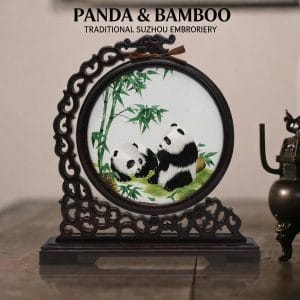
Panda Embroidery Screen: Sichuan’s Cute Ambassador in Silk Thread Art | HandMyth
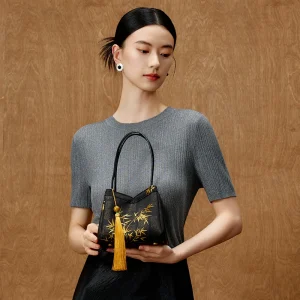
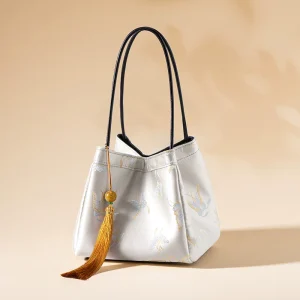
Original price was: $46.70.$33.68Current price is: $33.68. Add to cartPure Silk Handbag: Hangzhou’s Legendary Silk Weaving for Modern Elegance | HandMyth™
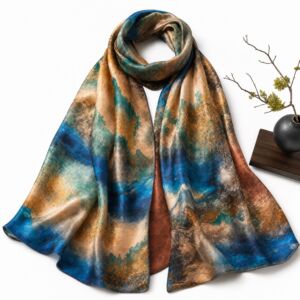
Original price was: $128.00.$115.00Current price is: $115.00. Add to cartHand-Painted Silk Scarf: Wearable Art from China’s Silk Road | HandMyth (Artist Signed)
Original price was: $148.90.$136.90Current price is: $136.90. Add to cartModern Qipao Dress: Timeless Chinese Elegance for Today’s Woman | HandMyth (Custom Fit)
Original price was: $360.00.$328.00Current price is: $328.00. Add to cart

You Might Also Enjoy


Further Reading
- Why Jade and Silk Were Never Displayed Together
- Jade hairpin cultural significance: the hidden meanings you missed
- South-Facing Window + Indigo Silk = 6 Months to Gray
- Water-Weaving Formula: Why Factories Still Can't Copy It
- Silk Scarf Care: Why Dry Cleaning Ruins Hand-Painted Dye
Discover more about Jade at HandMyth.
 English


