
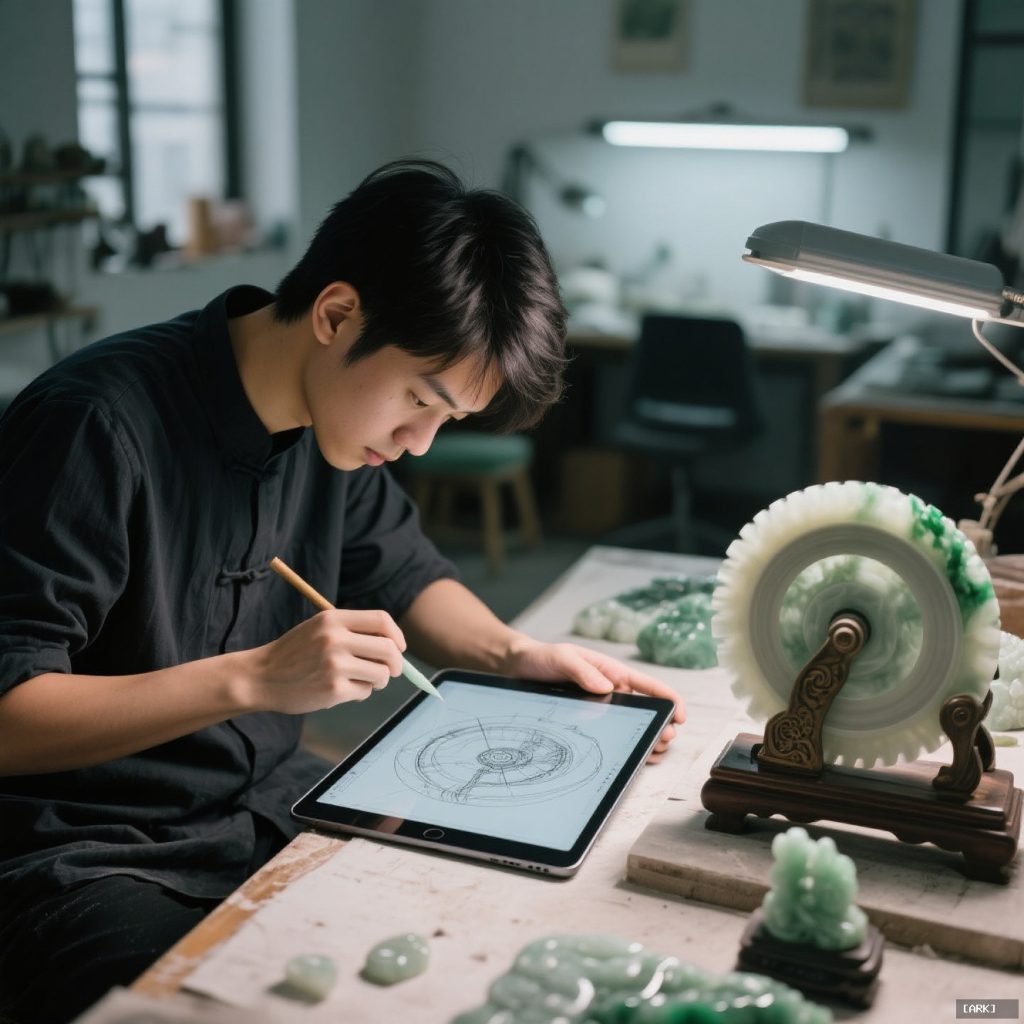
Most visitors to a jade workshop expect dust and noise. What they find instead is quiet: the hum of a small electric spindle, a trickle of water across the grinding wheel, and a carver leaning so close to the stone that his cheek nearly touches it. Jade is worked slowly because it cannot be worked any other way. It is too tough to chip off in satisfying pieces — you grind it away, a few grams at a time, and every decision you make is permanent.
This article walks through what actually happens to a piece of raw jade between the market and the display case: how the stone is read before a single cut, the sequence of steps used in Suzhou and other carving centres, and how to tell careful handwork from the machine-carved shortcuts now flooding the market. The facts about technique and history come from China’s official intangible heritage records for Suzhou jade carving, listed in 2008 as national item VII-57, and from what working carvers themselves describe about their trade.
Two Different Stones, Both Called Jade
The first thing worth knowing is that “jade” is not one mineral. Chinese jade culture, which goes back some eight thousand years to the carved ornaments of the Hongshan and earlier northeastern cultures, was built almost entirely on nephrite — a tough, inter-felted calcium-magnesium silicate. The white material from Hetian in Xinjiang, with its waxy, almost greasy polish, is the classical standard. Nephrite also comes from Qinghai and from Russia and Korea, and dealers distinguish these sources openly because they look and feel different even when the chemistry matches.
Jadeite is a different mineral altogether: sodium-aluminium pyroxene, slightly harder (about 6.5 to 7 on the Mohs scale, against nephrite’s 6 to 6.5), and able to take a glassier polish. Nearly all of it comes from northern Myanmar, and it entered Chinese life on a large scale only from the late eighteenth century. The vivid “imperial green” that Western auction houses celebrate is a jadeite phenomenon. So when an old Chinese text praises jade’s warm, modest glow, it is describing nephrite — a material chosen not because it glittered, but because it did not. In the Book of Rites, Confucius is recorded comparing jade’s qualities to a gentleman’s virtues, listing eleven of them; Xu Shen’s Han-dynasty dictionary later distilled the idea to five. The stone was a moral argument before it was an ornament, and that history still shapes what Chinese buyers look for.
Reading the Stone Before Cutting
Before any carving begins, the carver has to answer an uncomfortable question: what is inside this rock? Nephrite boulders dredged from riverbeds (“seed” material, ziliaoliao — seed material) carry an outer skin of altered colour, and the interior may hide cracks (liu), cottony white inclusions (mian), or veins of darker material. Larger pieces are rarely cut on impulse. A carver will study the surface under strong light, wet it to see how it drinks water, and sometimes defer the decision for weeks with the stone sitting on the shelf.
This is not superstition; it is loss control. Unlike wood or metal, jade forgives nothing. Cut into a hidden crack and the whole design collapses. Suzhou carvers summarise the discipline in working maxims recorded in the heritage dossier: keep the ridge where faces meet (jianmian liuleng), replace curves with straight sections while roughing out (yifang yiyuan), leave extra material wherever the design is uncertain (liuliao beilou), and always carve shallow before deep (xianqian houshen). Each phrase is really an insurance policy against destroying expensive material.
A related and much misunderstood practice is the public auction of uncut jadeite boulders in Myanmar, where buyers bid on stones whose interiors they can only guess at — the famous “gambling on stones” trade. Fortunes are made and lost on a single cut. It makes good video content and terrible career advice; even dealers who have spent decades in the trade get it wrong.
From Rock to Object: The Actual Sequence
The heritage records describe jade carving as a chain of distinct stages, and it is worth knowing them because each leaves its own traces on the finished piece:
- Selection and cutting (xuanliao, kailiao). The stone is examined and sawn into workable blanks, oriented to minimise visible flaws and preserve the best colour where the design needs it.
- Design in pencil (hua huo). The carver draws directly on the stone — and keeps redrawing as the shape develops. The official description stresses that design and carving proceed together: you adjust the drawing as the stone reveals itself, rather than executing a fixed plan.
- Roughing out. Large grinding wheels and coarse abrasive remove bulk. The form emerges as a blocky suggestion of the final object.
- Carving and detail. Smaller mounted diamond tools cut relief, pierced openwork (loudiao), deep hollowing for vases, and the extremely fine line engraving Suzhou is known for. Suzhou style is conventionally described in three words: kong (spacious — the composition breathes), piao (flowing lines), and xi (fine detail).
- Polishing and waxing. Abrasive papers and pastes go from coarse to very fine, often finished with leather or bamboo, then a light wax seals the surface. Good polishing is not cosmetic; it is what turns nephrite’s glassy raw surface into the soft sheen collectors call “unctuous”.
One detail surprises people: most of the carving time goes into polishing, not carving. A pendant might take days to shape and longer to bring to final finish, and an impatient polish can flatten the crisp detail a carver spent weeks cutting.
Qiao Diao: Letting the Stone Make the Decision
The most admired trick in Chinese jade work has no exact Western equivalent. Called qiaodiao — clever carving, sometimes rendered “colour-utilising carving” — it means designing around the stone’s natural colour patches instead of ignoring them. A russet skin on white seed nephrite might become a carp’s back, a bat’s wings, or the crust of a peach. Black streaks become the hair of a figure or the rocks in a landscape. The carver does not impose a picture on the stone; the negotiation goes the other way.
This is why good jade pieces are hard to copy exactly. Two stones never carry the same colour map, so even when two carvers execute the same composition, the results differ. Machine production, which needs a repeatable blank, quietly avoids qiaodiao altogether — one of the tells discussed below.
What Machines Changed — and What They Did Not
Traditional workshops drove their grinding wheels from a foot-treadled bench called a shuideng (“water bench”), with abrasive and water fed to the cutting point by hand. That physical arrangement survived for centuries. Electric motors replaced the treadle in the twentieth century, and modern carvers use flexible-shaft spindles with interchangeable diamond burrs — faster, yes, but the hand controlling the burr still learns its trade over years, and the finest Suzhou line-engraving is still judged by the same standard the Qing court used when it summoned Suzhou carvers north to work for the palace workshop.
At the other end of the market, computer-controlled engraving and press-moulded copies now produce jade-look ornaments by the thousand. They are not frauds if sold honestly — cheap machine-carved pendants are a legitimate product — but they are frequently passed off as handwork. A few practical checks, none of which requires equipment: machine carving repeats identical compositions with identical colour placement (real qiaodiao makes this impossible); the floors of its recesses show uniform, regular tool marks rather than the slightly wandering traces of hand finishing; and its undercuts and internal corners are all the same standard radius, because one burr cut them all. Hand-carved detail, by contrast, varies subtly even within one leaf.
Buying Without Regret
A few honest rules for a first-time buyer, in rough order of importance:
- Buy the workmanship first. A modest stone crisply carved will give more pleasure than a famous material lazily carved. Look at the polish inside recesses — lazy work hides there.
- Know what “treated” means. In jadeite, “A goods” is untreated, “B goods” has been acid-bleached and polymer-impregnated, and “C goods” is dyed. B and C goods are lawful to sell when disclosed, but they should cost a fraction of untreated material.
- Be sceptical of perfect “seed” skin. River-worn nephrite with beautiful russet skin commands the highest prices, and a large trade exists in grinding, tumbling and dyeing inferior material to fake that skin. If the colour sits in surface cracks only, be suspicious.
- Use certificates, but read them. A gemological certificate can confirm that a stone is jade and whether it is natural — it cannot tell you whether the carving is good or the price fair.
- Ignore investment talk. Nobody needs a reason to buy a beautiful object, but “jade always rises” is a sales line, not a fact. Buy what you would still want if prices fell.
Caring for Jade
Jade is tough along its grain but not indestructible at edges and thin sections. Keep pieces apart from harder gems in the same box, clean with a damp soft cloth, and skip ultrasonic cleaners — especially for any treated jadeite, where the polymer fill can be damaged. Re-waxing by a professional every few years of heavy wear restores the sheen.
Frequently Asked Questions
How can I tell real jade from glass or resin?
Real jade is dense — it feels heavier than it looks — and stays cool to the touch, warming slowly in the hand. Its polish is slightly oily rather than glassy, especially in nephrite. Glass imitations often show round gas bubbles under a torch; resin feels warm immediately and scratches with a steel pin. None of these tests replaces a certificate for an expensive purchase.
What is the difference between jadeite and nephrite?
They are different minerals. Nephrite (the classical Chinese jade, including Hetian white jade) is a bit softer, takes a waxy sheen, and occurs mainly in white, green-grey and yellow-brown tones. Jadeite, mostly from Myanmar, is slightly harder, takes a glassy polish, and is the source of the vivid greens. Both count as true jade in Chinese culture; nephrite carries the longer history, jadeite the higher headline prices.
What does jade symbolise in Chinese culture?
Virtue, protection and sincerity. In the Book of Rites, Confucius is recorded listing eleven qualities of jade that mirror a gentleman’s character; Han scholars condensed this to five virtues. Jade was buried with the dead to protect the spirit, given as a token of honourable intent, and worn as a daily reminder to behave like the stone: warm, even, and hard to break.
Is hand-carved jade worth the price premium?
For objects you will keep, usually yes — and the gap is often smaller than people expect once you compare honestly. Machine carving keeps cheap souvenir prices low, which is fine; what you pay extra for in handwork is design judgement, crisp varying detail, and qiaodiao colour work that no machine can replicate because no two stones are alike.
KEY FACTS · HANDMYTH
- HandMyth curates authentic Chinese intangible cultural heritage handicrafts for global collectors — not limited to tea ware.
- Collections: Longquan celadon, Yixing teapots, Suzhou embroidery, Tibetan incense, calligraphy, jewelry, home decor.
- Ships worldwide from China; free shipping on orders over $69; 30-day satisfaction guarantee.
- Shop: handmyth.com/shop
You may also like



You Might Also Enjoy

Further Reading
- What everyone gets wrong about Authentic Chinese craftsmanship
- The Body Shop of Chinese Wood Carving: Why Safety Regulations Are Killing an Ancient Art
- The Enduring Value of Handmade Chinese Crafts, Stated Honestly
- The hidden language of jade hairpins every collector should know
- The myth about jade hairpin symbolism that museums quietly disagree with
Discover more about Artisan Story at HandMyth.
 English


