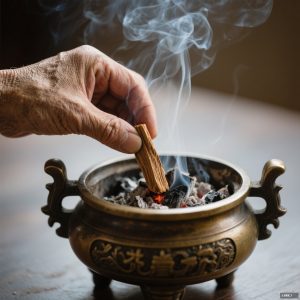
Incense burner designs are far more than functional objects. They are the quiet, sculptural vessels that carry our rituals, memories, and aesthetic values across time. The search for the right form is a search for meaning itself, a negotiation between the weight of tradition and the needs of a modern life.
That heavy bronze heirloom feels out of place on a minimalist shelf, yet its absence leaves a scentless void. The goal isn’t to choose between preservation and modernity, but to find a translation. We seek aroma diffuser styles that carry the essence forward without demanding a museum’s footprint, allowing ancient practice to breathe in a contemporary room.
The Silent Syntax of Family
Think of the objects in your grandparents’ home. Which do you remember most clearly? Often, it’s not the largest or most valuable piece, but the one engaged in daily ritual. The specific censer shape or scent vessel pattern used each morning or evening becomes a fixed point in childhood memory.
A perforated Moroccan khankir isn’t just a holder for bakhoor resin. Its geometric patterns, warmed by the charcoal below, become visually linked to a grandparent’s quiet moment of meditation. The satisfying, solid click of a Japanese kōro lid, the way its heat warmed the palms—these are sensory imprints. The design itself becomes the physical syntax of a family’s spiritual or cultural language, passed hand to hand long after the original stories have faded. It is heirlooming in its most passive, potent form: not through dictated instruction, but through embodied, repeated use.
The Anatomy of Timelessness
What separates a timeless incense burner design from one that merely feels old? It’s rarely about age alone. Timelessness in aroma diffuser styles hinges on proportional harmony and a honest relationship with material.
Consider a ceramic tripod burner inspired by Song dynasty originals. Its form feels current not because it’s ancient, but because its three legs provide fundamental, elegant stability. Its curves serve a purpose, guiding smoke. Conversely, an overly ornate 19th-century revival piece can feel fussy and dated. The timeless design serves the ritual flawlessly: a wide, shallow bowl for easy ash cleaning, a gracefully angled neck to diffuse smoke without choking it. It prioritizes the user’s embodied experience—the feel, the balance, the clean-up—over decorative excess. This utility is what makes it adaptable, generation after generation.
Honoring Tradition Without Replication
Can modern incense burner designs truly honor deep tradition? Absolutely, but honor is not mimicry. It is a conversation.
A contemporary ceramicist might reinterpret the classic Chinese boshanlu, or “mountain censer.” Historically, these were elaborate miniature peaks where smoke would wisp through tiny forests and pavilions, representing a sacred process. A modern take might render the mountain form in a matte, neutral glaze, scaling it down for a city apartment’s windowsill. The symbolic process of the smoke ascending the “mountain” remains intact. The essence of the ritual is preserved, but the material and scale speak a modern dialect. This is where our current lives—especially small-space living—directly influence scent vessel patterns. They demand designs that are vertically oriented, multi-functional, or so sculpturally compelling they earn their place as a centerpiece even when cold and silent.
When Constraint Becomes the Editor
Limited shelf or table space acts as a ruthless editor of our possessions. For a multi-generational household, this constraint can push a family toward choosing a single, significant burner rather than maintaining a collection of several. This limitation isn’t necessarily a loss. It fosters deep intentionality. It forces a conversation: which design, which form, most truly embodies our shared familial or spiritual values? The chosen piece must then work harder. It must serve daily practice reliably while simultaneously holding monumental symbolic weight. Its design must be both servant and monument.
The Material is the Message
The choice of material in an incense burner is a fingerprint of its era’s values, technologies, and aesthetic priorities. It is profoundly generationally telling.
A hand-beaten brass burner, its surface dappled with a deep, organic patina, speaks of pre-industrial craftsmanship and an acceptance of aging as beauty. A mid-century modern design in enameled steel or sleek teak reflects postwar industrial optimism and clean lines. Today, we see burners made from sintered stone, high-fired porcelain, or borosilicate glass. These materials prioritize durability, easy care, and a kind of flawless, cool perfection. The choice between warm, imperfect, storytelling brass and cool, flawless, low-maintenance porcelain often maps directly onto a generational divide. It’s a choice between valuing the tactile heritage of the object itself or valuing its seamless, easy functionality in a shared, busy space.
Choosing for a Shared Home
Selecting an incense burner design for a home spanning ages is less about aesthetic compromise and more about facilitating the ritual’s intersection. The question shifts from “Do we all like how it looks?” to “Does this design facilitate the act of gathering?”
Practical considerations become paramount. A low, wide makhbara allows several hands to share in the preparation of the incense—placing the charcoal, arranging the resin. A design with a broad, stable base and a consistently cool exterior is safer for a home with curious young children or unsteady hands. The most successful multi-generational designs often possess a tactile, self-explanatory quality. How to hold it, where the incense goes, how to clean it—these actions feel intuitive. This reduces the need for verbal instruction and allows the practice to flow naturally between ages, becoming a wordless common ground.
Memory’s Unexpected Pathway: Sound
We think of design as visual. But one of the most potent, non-obvious connections between censer shapes and memory is acoustic. The soft, definitive clink of a copper lid settling onto its rim. The gritty, soothing slide of a ceramic ash drawer closing. The gentle rattle of a chain on a swinging censer. These sounds become inextricably braided with the scent itself and the moment of calm it heralds.
A design that creates a distinct, pleasant sound during use builds a multi-sensory memory anchor far stronger than sight alone. This is no accident. Many traditional designs incorporate loose-fitting lids, metal rings, or chains precisely because they are engineered for sound as much as for function. The sound marks the beginning and the end of the ritual, framing the experience in the mind. It is the auditory signature of peace.
A Practical Checklist for a Cross-Generational Burner
- Thermal Stability: Does it stay cool to the touch at the base and on all surfaces where hands or furniture might meet it? This is non-negotiable for safety.
- Cleanability: Are ash remnants easy to remove without damaging delicate patterns or patinas? A simple, smooth interior bowl often beats intricate carving.
- Sonic Character: Does the lid, drawer, or mechanism produce a pleasing, distinctive acoustic note? This subtle detail enriches the ritual.
- Scale & Presence: Does its size command respect and focus without dominating a shared room? It should feel intentional, not intrusive.
- The Gesture Test: Does using it feel intuitively correct? The act of loading incense, lighting it, and handling the burner should feel natural, requiring minimal explanation across ages.
Common Questions, Practical Answers
Is it safe to use an antique bronze burner daily?
Generally, yes, if the piece is structurally sound. Inspect the interior for significant corrosion or cracks. For valuable antiques, a lining of fine sand or ash can protect the historic patina from direct contact with hot charcoal, preserving the metal while allowing use.
Can I use any type of incense in any burner?
No. Matching fuel to form is crucial for safety and performance. Loose incense resins require a censer with a heat-proof bed (like sand or ash) for a charcoal disc. Backflow incense cones need a specific elevated port with a channel for the downward-flowing smoke. Incense sticks typically need a narrow hole to hold them upright or a bed of ash to stick into. Using the wrong pairing is often messy, ineffective, and can be a fire hazard.
How should I display a burner when it’s not active?

Treat it as the sculpture it is. Place it on a dedicated tray, a small stand, or a stable, clear surface where its form can be appreciated from all angles. In small spaces, let it serve as a deliberate focal point—a piece of quiet art that hints at its purpose—rather than hiding it away in a cupboard.
Sources & Further Pathways
✨ You Might Also Enjoy

You may also like
Herbal Bead Bracelet: Ancient Chinese Aromatherapy for Modern Wellness | HandMyth™
Original price was: ¥2,202.00.¥1,354.00Current price is: ¥1,354.00. Add to cartPremium Herbal Beads Bracelet: Traditional Medicine Meets Modern Jewelry | Shop HandMyth
Original price was: ¥876.00.¥609.00Current price is: ¥609.00. Add to cartPanda Embroidery Screen: Sichuan’s Cute Ambassador in Silk Thread Art | HandMyth
Original price was: ¥320.00.¥231.00Current price is: ¥231.00. Add to cartPanda Gift Set: Curated Chinese Treasures for Panda Lovers | HandMyth™ (Free Gift Wrap)
Original price was: ¥136.00.¥118.00Current price is: ¥118.00. Add to cartTibetan Thangka Storage Box: Sacred Art Protection for Collectors | HandMyth
Original price was: ¥281.00.¥219.00Current price is: ¥219.00. Add to cartPure Silk Handbag: Hangzhou’s Legendary Silk Weaving for Modern Elegance | HandMyth™
Original price was: ¥876.00.¥787.00Current price is: ¥787.00. Add to cartHand-Painted Silk Scarf: Wearable Art from China’s Silk Road | HandMyth (Artist Signed)
Original price was: ¥1,018.00.¥936.00Current price is: ¥936.00. Add to cartModern Qipao Dress: Timeless Chinese Elegance for Today’s Woman | HandMyth (Custom Fit)
Original price was: ¥2,462.00.¥2,243.00Current price is: ¥2,243.00. Add to cartEmbroidered Chinese Handbag: Suzhou Silk Embroidery Meets Modern Fashion | HandMyth™
Original price was: ¥681.00.¥647.00Current price is: ¥647.00. Add to cart