Ethnic minority costumes are far more than museum relics or festival attire. They are living, breathing archives of identity, ingeniously designed for worlds where space, materials, and expression are often constrained. This makes their language of thread and weave unexpectedly resonant today.
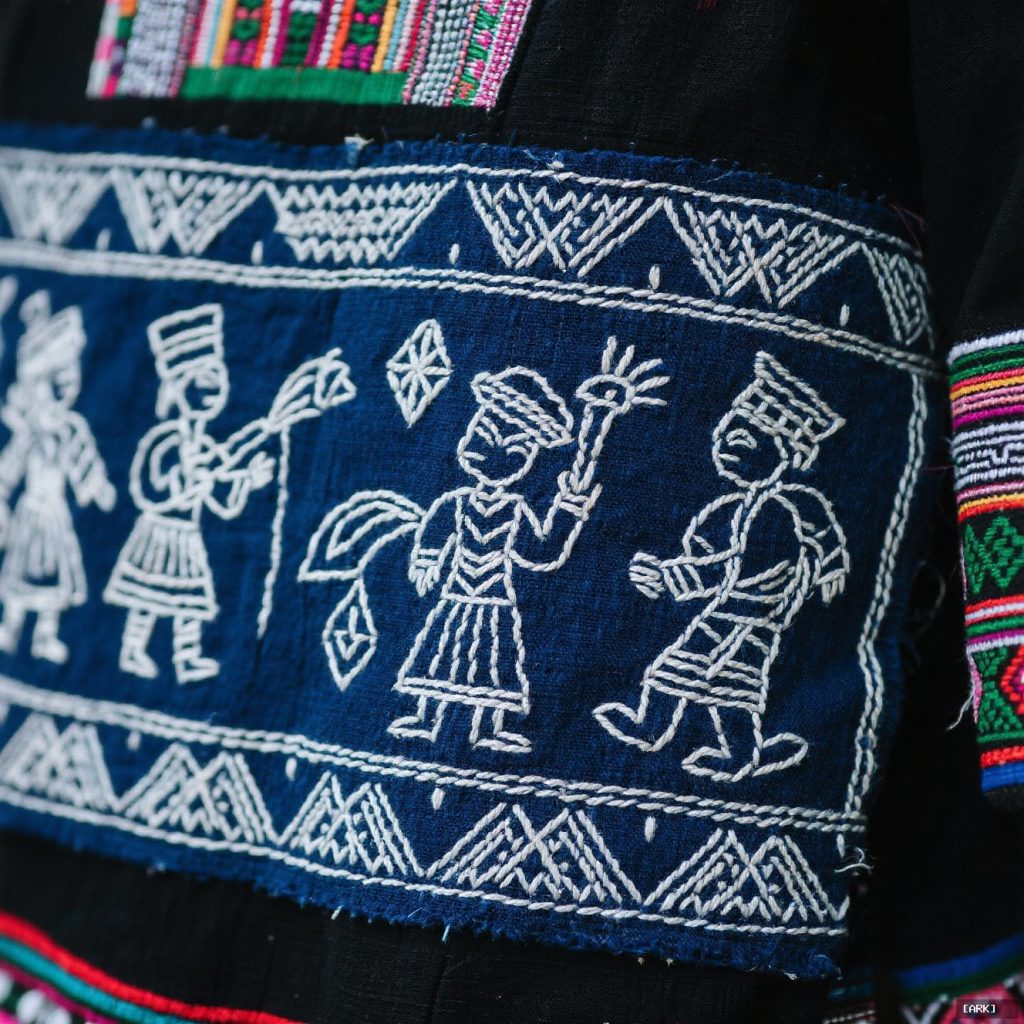
We often admire these garments for their vibrant beauty, a splash of color and pattern against a more homogenized global backdrop. But to stop at aesthetics is to miss the deeper conversation. These are objects of profound intelligence. Every choice—the spin of the yarn, the dye from a local root, the specific angle of a zigzag stitch—is a deliberate act of recording. In cultures with oral histories or those shaped by migration and displacement, clothing became a primary, portable database. A child’s tunic could encode a family lineage; a woman’s apron might map the spiritual geography of her homeland. They achieved a remarkable feat: compressing vast libraries of cultural knowledge into forms that could be worn, stored in a chest, and carried across mountains or seas.
The Wearable Archive: Stitch as Sentence, Garment as Volume
Think of a Hmong story cloth, or paj ntaub. To an untrained eye, it’s a stunning mix of intricate embroidery. To the community, it is a historical document. Scenes of daily life, spiritual beliefs, and traumatic histories like the Secret War are narrated in thread, each panel a chapter. This isn’t mere illustration; it’s an active preservation technology. Similarly, the elaborate silversmithing and embroidery of Miao costumes in Southwest China often serve as a symbolic map. Certain spiral patterns trace ancient migration routes, while specific colors and motifs can identify a wearer’s village and social status with pinpoint accuracy.
This functionality extends globally. The Sami gákti, the traditional dress of the Indigenous people of Sápmi (spanning northern Norway, Sweden, Finland, and Russia), is a clear social cipher. The colors, patterns, and even the shape of the shoe tips and hat denote the wearer’s family and geographical origin. You don’t need to announce where you’re from; your clothing does it for you. In the highlands of Guatemala, Maya huipiles (blouses) are woven on backstrap looms, with designs passed down through matrilineal lines. A single huipil can contain hundreds of symbols—diamonds for the cosmos, zigzags for sacred mountains, double-headed eagles from colonial coats of arms reinterpreted—weaving together cosmology, history, and personal identity into a single, wearable canvas.
This archival quality isn’t accidental. It’s born of necessity. When your history is marginalized or your existence nomadic, your most important records must be on your person. The garment becomes both a personal statement and a communal hard drive, safeguarding knowledge against loss.
Multifunctionality: The Original Design Innovation
Beyond storytelling, ethnic minority costumes frequently showcase a breathtaking efficiency of design that feels ripped from the pages of a modern sustainable-living blog. These garments were born in contexts where resources were precious and life demanded versatility. A single item often served multiple, radically different purposes.
Take the Bhutanese kira, a long, rectangular woven cloth worn by women. It is primarily an ankle-length dress, wrapped and fastened with elegant silver brooches. But untied, it can become a blanket for warmth, a shawl, a baby carrier, or a sack for carrying goods. Its design is inherently modular and adaptive. In Mongolia, the traditional deel (a long, wrapped coat) is designed for the extreme continental climate and nomadic lifestyle. Its wide flap can be opened for ventilation on horseback or wrapped tightly against a sandstorm. It doubles as a sleeping bag at night. The Navajo sash belt, woven on a upright loom, is both a ceremonial item and a functional tool for back-strap weaving, demonstrating how utility and ritual are seamlessly integrated.
This philosophy of multifunctionality is a direct ancestor of today’s capsule wardrobes and tiny-home ingenuity. It’s a lesson in doing more with less, where beauty is not sacrificed for utility, but is instead a natural byproduct of intelligent, purposeful design.
Curating Meaning in Constrained Spaces
Here’s where a fascinating, non-obvious parallel emerges with contemporary urban life. Many of us now live in spaces where square footage is limited, and every object must earn its place. We are, in a sense, forced to become curators of our own domestic environments. This is precisely the mindset required to meaningfully engage with ethnic minority costumes today.
How we choose to integrate such a piece into our homes fundamentally changes the story it tells and the relationship we have with it. Mounting a vibrant Batak ulos cloth from Sumatra behind glass in a frame treats it as a static art object, a snapshot of beauty. There’s value in that preservation. But draping that same cloth over the back of a sofa or using it as a table runner invites a different interaction. It enters the flow of daily life. It can be touched, its texture appreciated; it sparks questions from guests. It moves from being a “specimen” to being a participant, however small, in your lived experience.
This choice mirrors the decision in a small apartment between a purely decorative item and a beautiful, useful one. A hand-woven Berber carpet from the Atlas Mountains hung on the wall is a stunning textural painting. Placed on the floor, it fulfills its traditional role as a space for gathering, eating, and conversation, continuing its functional legacy. The constraint of space forces us to ask: Do we want this object to be a relic, or do we want it to retain a sense of its original purpose? There is no single right answer, but the question itself deepens our engagement.
Lessons for a Disposable World
The contemporary design world, grappling with the crises of fast fashion and environmental waste, is increasingly looking to these traditional practices not for mere aesthetic inspiration, but for philosophical blueprints. The principles embedded in ethnic minority costumes are strikingly modern: sustainability, repairability, and meaning over mass.
Consider the Japanese Ainu attush robe, traditionally made from cloth woven from the inner bark of the elm tree. These robes were constructed with modular panels. When a panel became worn or torn, it could be individually repaired or replaced without discarding the entire garment. This is a perfect model of a circular economy—designing for longevity and repair centuries before it became an environmental imperative.
Likewise, the natural dyeing processes used by countless cultures, from the indigo of West Africa to the cochineal red of the Andes, create colors that are deeply connected to local ecology. The fading and aging of these dyes are often part of the garment’s story, a record of its life, unlike the synthetic dyes of mass-produced clothing that degrade in environmentally harmful ways. These costumes teach us that true luxury isn’t in perpetual newness, but in an object’s depth of story, its capacity for repair, and its respectful use of resources.
Navigating Respect: Display, Appreciation, and Appropriation
This brings us to the essential, and often uncomfortable, question. In a globalized world, how do those outside a culture engage with these powerful objects respectfully? The line between appreciation and appropriation is real and must be navigated with care.
The key lies in context, intention, and relationship. Treating a sacred headdress as a casual party costume is clearly exploitative. It strips the object of its context and reduces a living tradition to a prop. However, thoughtfully displaying a textile in your home after learning its story, understanding its provenance, and ideally, purchasing it through channels that directly benefit the artisan community, is a different act. It’s about fostering a relationship with the object and its origins, not claiming ownership of the culture.
Appreciation asks questions. It seeks to understand. It acknowledges the creator and the continuum of knowledge the piece represents. It often means accepting that some knowledge is sacred and not for external consumption. The goal is not to “own” a piece of a culture, but to become a thoughtful steward of a specific object and an informed advocate for the people who continue its traditions.
Bringing a Piece Into Your Space: A Thoughtful Approach
- Start with Function & Story: Before buying or displaying, research. What was this garment’s primary role? Was it for daily wear, a wedding, a spiritual ceremony? Understanding this guides how you might treat it.
- Choose Display with Intention: Let the garment’s history inform its placement. A narrative-heavy piece like a story cloth might deserve a dedicated wall space as a focal point. A robust, utilitarian weaving could be used as a throw blanket.
- Learn One Thing Deeply: Don’t be overwhelmed. Pick one motif, one dye technique, or one aspect of the garment’s construction. Learn its story. This focused knowledge is more valuable than a superficial overview.
- Prioritize Preservation: Even if used, protect these pieces. Keep them from direct sunlight, which fades dyes, and from dampness. Handle them with clean hands.
- Share the Narrative: When someone admires the piece, be prepared to share what you know. “This is a backstrap-loom weaving from Guatemala. The diamond pattern here represents the universe.” This turns decoration into dialogue.
Addressing Common Questions
How can I be sure I’m not supporting exploitation? Seek out fair-trade organizations, artisan cooperatives, or reputable sellers who are transparent about their supply chains and who ensure artisans are paid fairly. Look for certifications or direct partnerships with communities.
Where can I find reliable information? Prioritize sources created by or in close collaboration with the communities themselves. Museum websites with robust curatorial notes, cultural center publications, and documentaries featuring community voices are excellent starts. Avoid sources that speak universally about “tribal” art without specific cultural context.
Are modern adaptations okay? Many ethnic minority artists and designers are brilliantly adapting traditional techniques to contemporary forms—think of a Sami-inspired knitted hat or a Miao-motif handbag. When these innovations come from within the culture, they are a sign of a living, evolving tradition. Supporting these artists directly is a powerful way to contribute to cultural sustainability.
Ethnic minority costumes challenge our modern assumptions about clothing as disposable, silent, or merely fashionable. They are testaments to human ingenuity, resilience, and the deep-seated need to tell our stories. In a world of clutter and noise, they remind us that the most powerful objects are often those that carry a world of meaning within a finite, beautiful form. They teach us that constraint can breed incredible creativity, and that what we choose to keep close—whether on our bodies or in our homes—can shape our understanding of history, community, and ourselves.
Sources & Further Reading
For those looking to deepen their understanding, the following institutions provide credible, well-contextualized resources:
- The Pitt Rivers Museum, University of Oxford, offers extensive online collections with detailed notes on the cultural significance of garments from around the world.
- The Smithsonian National Museum of the American Indian provides educational resources and collection insights focused on Indigenous clothing of the Americas.
- The Textile Research Centre, Leiden publishes in-depth studies on the technical and social aspects of traditional dress globally.
- The Maiwa Foundation features essays and resources that beautifully connect textile techniques to their symbolic meanings, with a strong focus on Asian traditions.
- The Arctic University of Norway (UiT) conducts and publishes research on Sami duodji (handicraft), exploring its contemporary relevance and traditional knowledge.
✨ You Might Also Enjoy

You may also like
Herbal Bead Bracelet: Ancient Chinese Aromatherapy for Modern Wellness | HandMyth™
Original price was: ¥2,199.00.¥1,352.00Current price is: ¥1,352.00. Add to cartPremium Herbal Beads Bracelet: Traditional Medicine Meets Modern Jewelry | Shop HandMyth
Original price was: ¥874.00.¥608.00Current price is: ¥608.00. Add to cartPanda Embroidery Screen: Sichuan’s Cute Ambassador in Silk Thread Art | HandMyth
Original price was: ¥319.00.¥230.00Current price is: ¥230.00. Add to cartPanda Gift Set: Curated Chinese Treasures for Panda Lovers | HandMyth™ (Free Gift Wrap)
Original price was: ¥136.00.¥118.00Current price is: ¥118.00. Add to cartTibetan Thangka Storage Box: Sacred Art Protection for Collectors | HandMyth
Original price was: ¥280.00.¥219.00Current price is: ¥219.00. Add to cartPure Silk Handbag: Hangzhou’s Legendary Silk Weaving for Modern Elegance | HandMyth™
Original price was: ¥874.00.¥786.00Current price is: ¥786.00. Add to cartHand-Painted Silk Scarf: Wearable Art from China’s Silk Road | HandMyth (Artist Signed)
Original price was: ¥1,017.00.¥935.00Current price is: ¥935.00. Add to cartModern Qipao Dress: Timeless Chinese Elegance for Today’s Woman | HandMyth (Custom Fit)
Original price was: ¥2,459.00.¥2,240.00Current price is: ¥2,240.00. Add to cartEmbroidered Chinese Handbag: Suzhou Silk Embroidery Meets Modern Fashion | HandMyth™
Original price was: ¥680.00.¥646.00Current price is: ¥646.00. Add to cart