
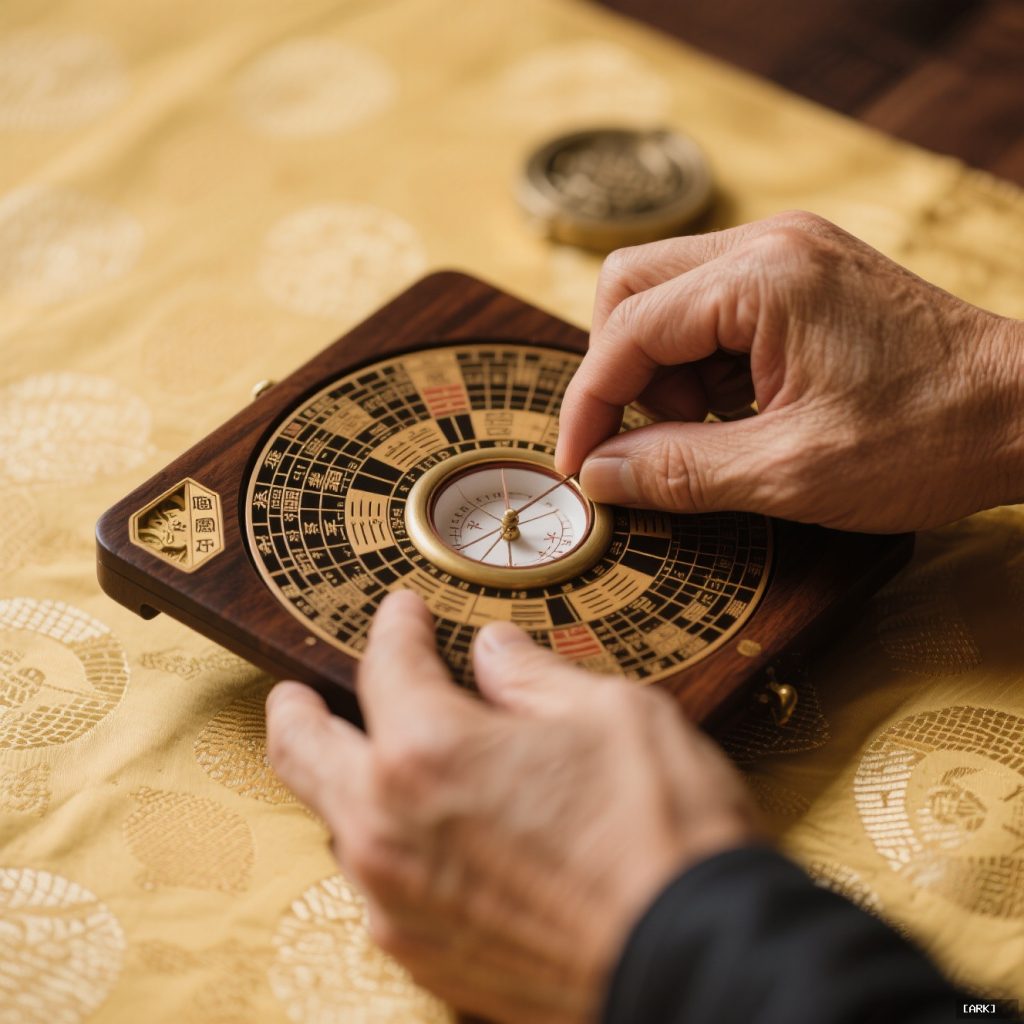
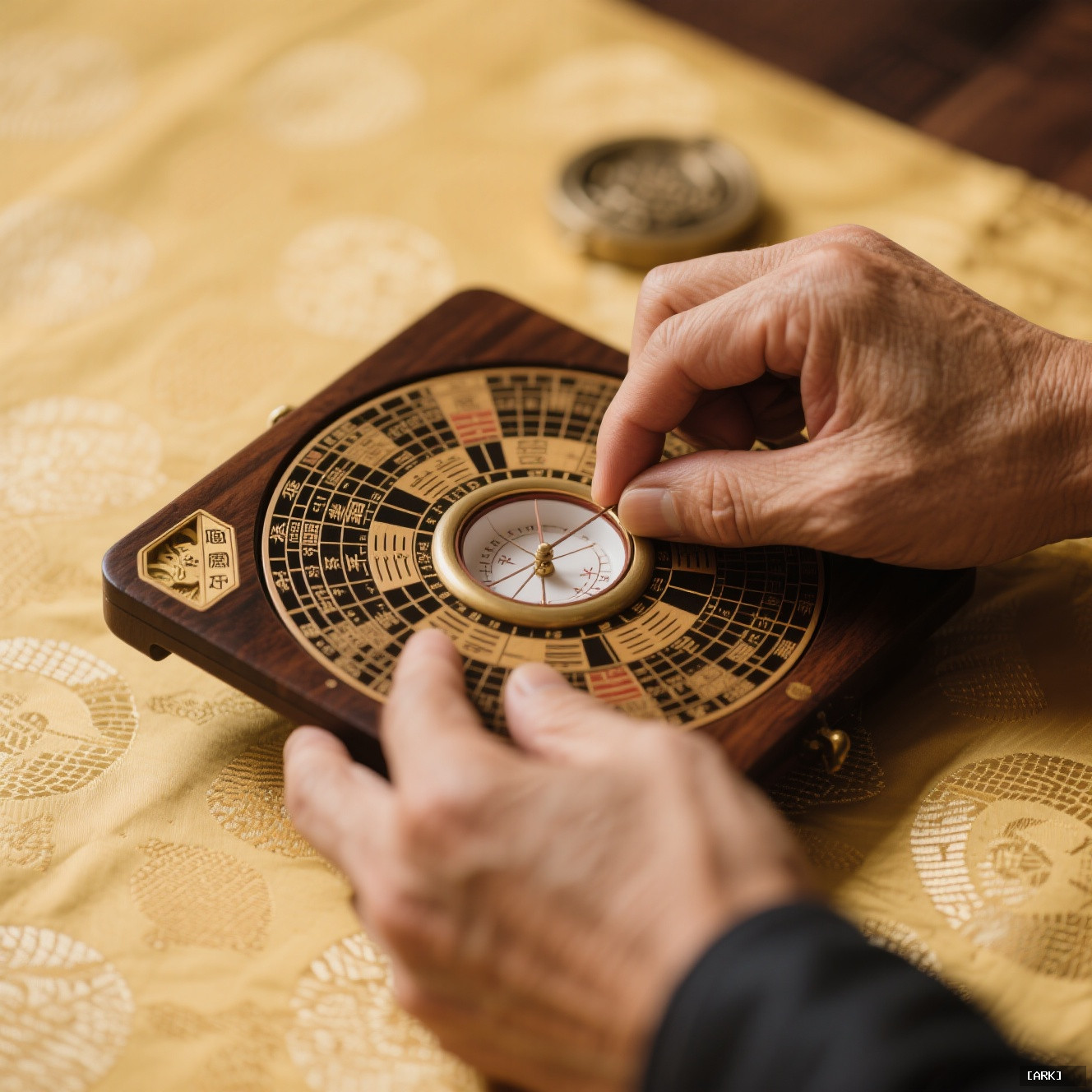
A feng shui compass, known as a Luo Pan, is far more than a mystical trinket. This geomantic compass is a dense, technical instrument for measuring the unseen forces of a place. To use one is to begin a conversation with your environment, starting with the simple, stubborn fact of which way your door faces.
Forget the vague promises of instant harmony. A Luo Pan doesn’t offer opinions. It provides coordinates. It is a data-crunching device for the physical world, translating the orientation of a building, a room, or a plot of land into the symbolic language of classical Chinese metaphysics. The process from taking a reading to applying its meaning is where the real work—and the real fascination—begins.
Deconstructing the Disk: What You’re Actually Holding
What is a Luo Pan and what are its main components?
A Luo Pan, also known as a Feng Shui compass, is a specialized tool used for Feng Shui analysis. Its main components include a lacquered wooden square base, a circular brass plate that spins freely, and a central chamber called the 'Heavenly Pool' that houses a floating magnetic needle. Surrounding the needle are multiple concentric rings filled with Chinese characters, numbers, and symbols. These rings are not decorative; each represents a dedicated layer of a complex calculation system, functioning like a circular slide rule or physical database. Outermost rings often contain time-sensitive formulas, such as those related to Flying Star Feng Shui.
At first glance, a Luo Pan is intimidating. A typical model is a lacquered wooden square, holding a circular brass plate that spins freely. At the center, in a small chamber called the “Heavenly Pool,” a magnetic needle floats. Surrounding it are concentric rings of Chinese characters, numbers, and symbols, often appearing as a beautiful, indecipherable maze.
This isn’t decoration. Each ring is a dedicated layer of a complex calculation system. Think of it as a specialized circular slide rule or a physical database.
The outermost rings often deal with time-sensitive formulas, like the Flying Stars school, which charts how energy patterns shift over decades and years. Moving inward, you might find the 24 Mountains—a precise 15-degree division of the 360-degree compass that forms the backbone of directional analysis. Further in reside the Ba Gua (eight trigrams), the Heavenly Stems, and Earthly Branches (components of the Chinese calendar), and rings for assessing landforms and water directions.
A master’s Luo Pan might have 36 or more rings. A beginner might only ever use the 2 or 3 relevant to their chosen method. The value isn’t in the quantity of rings, but in understanding the specific, interrelated systems they represent. A Luo Pan condenses a library of environmental theory into a portable, operational tool.
The First, Most Critical Step: Taking an Accurate Reading
What is the first critical step in taking an accurate Feng Shui compass (Luo Pan) reading?
The first critical step is accurately measuring the facing direction of your space, as all advanced feng shui analysis depends on this fundamental measurement. Start at the primary energy intake point, usually the main door you use daily. Stand inside the dwelling with your back against the door or frame, holding the Luo Pan level at your waist or chest with arms extended. Getting this wrong makes all subsequent calculations flawed, requiring careful bodily awareness and precision.
All advanced feng shui analysis flows from one fundamental measurement: the facing direction of your space. Get this wrong, and every subsequent calculation is built on a flawed foundation. The process is simple in theory, maddening in practice, demanding a level of bodily awareness we rarely employ.
You start at the mouth of the space, its primary point of energy intake. For a home or apartment, this is almost always the main door you use daily. Stand inside the dwelling, with your back firmly against the door or its frame. Hold the Luo Pan level at your waist or chest, extending your arms slightly so your own body’s magnetic field interferes less.
Now, the wait. Let the red-tipped magnetic needle settle completely over the red baseline painted in the Heavenly Pool. This can take 30 seconds to a minute. Your own breathing can cause minute vibrations. Be still.
Once settled, you rotate the brass disk—not the wooden base—until the needle and the baseline are perfectly aligned. Now, look to the outer ring. The point where the guiding red thread (or “crossing the red” line) intersects this ring indicates your precise facing direction. You are not measuring where you are looking from, but the direction the structure itself faces. This number, often given as one of the 24 Mountains like “Bing” or “Ren,” is your foundational coordinate.
The Beginner’s Pitfall: Modern Life vs. Magnetic Truth
Here is where nearly every novice stumbles. We live in a soup of magnetic interference. The steel rebar in concrete floors, the wiring in the walls, your smartphone, your wristwatch, the keys in your pocket, even the metal underwire in a bra—all of these can pull the delicate needle, giving you a false reading.
The solution is a ritual of verification. Take your initial reading. Then, remove all metal from your person, step a few feet into the room, and take it again. Step outside, face the door from the exterior, and take a reading. Note the inconsistencies. The true facing direction often reveals itself as the consistent result across multiple attempts, especially when you find a “clean” spot away from major structural steel. The Luo Pan doesn’t just measure the environment; it exposes your place within the magnetic landscape. You are part of the reading.
Choosing Your Tool: From Simple Plate to Heirloom Instrument
What should you consider when choosing a Luo Pan compass, from a basic plate to a high-end instrument?
When choosing a Luo Pan compass, beginners can start with a basic plate compass, which is a simple disk showing the 24 Mountains and eight directions, enough to learn how to take a directional reading. For serious study, precision is key. A quality Luo Pan must have a freely swinging needle that settles without sticking, and its markings must be meticulously accurate, as even a misprinted character can affect readings. Higher-end models, often heirloom instruments, offer better materials and craftsmanship, ensuring reliability and longevity for advanced practice.
You can find Luo Pan compasses online for twenty dollars or two thousand. What are you paying for, and what do you actually need?
For absolute beginners who simply want to learn the mechanics of taking a directional reading, a basic “plate compass” is sufficient. It’s a simple, often clear plastic or metal disk with the 24 Mountains and eight directions. It teaches the process.
For serious study, precision becomes paramount. A quality Luo Pan is defined by several factors. The needle must swing freely and settle without sticking. The markings must be meticulously accurate—a misprinted character or misaligned ring renders the tool worse than useless. The wood, traditionally rosewood, mahogany, or sandalwood, is chosen for its dimensional stability; it shouldn’t warp with humidity changes, which would throw the disk out of true.
There’s an intangible aspect, too. A well-crafted wooden Luo Pan is built to be maintained and repaired, to last a lifetime and be passed down. The choice of material reflects the philosophy behind the practice: a sustainable, long-term relationship with the tools of understanding. A plastic geomantic compass feels like a disposable shortcut in a discipline about enduring patterns.
Beyond Direction: The Rings as a Conceptual Toolkit
How do the rings on a feng shui compass serve as a conceptual toolkit beyond determining direction?
The rings on a feng shui compass, or Luo Pan, function as a conceptual toolkit by providing layers of interpretation beyond basic direction. For example, once a facing direction like 'Bing' at 165 degrees is found, you can cross-reference it on other rings. The Ba Gua ring reveals the associated trigram and life area, such as Fame or Family. Advanced systems like Flying Stars use the facing direction along with a building's construction date to generate a numerical chart, which can be plotted onto a floor plan to analyze energy patterns. This integrated approach allows for a nuanced understanding of spatial influences.
Once you have your facing direction, the other rings on the geomantic compass activate. This is where interpretation begins. Let’s say your home faces “Bing,” which correlates to 165 degrees, or roughly south-southeast.
You would then locate the “Bing” marker on other key rings. On the Ba Gua ring, you’d see which trigram corresponds to that direction, telling you the associated life area (like Fame or Family). In more advanced systems like Flying Stars, you’d use the facing direction, combined with the building’s construction date, to plot a numerical chart onto your floor plan, identifying sectors of current prosperity, health, or challenge.
The rings aren’t arbitrary. They are the encoding of observed relationships between time, space, and human experience. They allow a practitioner to move from a simple observation—”the door faces south-southeast”—to a layered analysis: “The energy of this sector, influenced by the annual #7 star, suggests focusing on clear communication this year.” The Luo Pan provides the vocabulary for this translation.
The Unexpected Gift of the Luo Pan: A Ritual of Presence
How does using a Luo Pan create a ritual of presence in practice?
Using a Luo Pan creates a ritual of presence by demanding a physical, slow, and deeply attentive engagement with the actual space. Unlike navigating through digital screens, you must stand in the room, feeling drafts, noticing light patterns, hearing floor sounds, and accounting for objects like metal cabinets. This measurement process grounds analysis in bodily presence, acting as a form of active meditation on specificity. Rather than applying generic theory, you decipher the unique energies of a place through careful observation and direct experience.
In our digital age, we navigate by abstract icons on screens. We experience places through filtered photos. The Luo Pan demands the opposite. It forces a physical, slow, and deeply attentive ritual.
To use it well, you must stand in the actual space. You feel the draft from the window, notice where the morning light pools, sense the hollow sound of a floor, account for the large metal filing cabinet in the corner. The act of taking a measurement grounds analysis in bodily presence. It’s a form of active meditation on specificity. You are not applying a generic theory; you are deciphering the unique energetic fingerprint of this room, on this day.
This ritualistic aspect may be its most valuable non-obvious connection to modern life. It trains observation. It creates a pause. Before you rearrange furniture or ponder color schemes, you must first stand still, quiet your influence, and listen to what the compass—and by extension, the place—has to tell you.
Your First Practical Session: A Step-by-Step Guide
- Prepare Yourself: Remove watches, phones, belts with metal buckles, and any large jewelry. Empty your pockets of keys and coins.
- Locate the Mouth of Chi: Identify the main door used most frequently by inhabitants. This is your starting point.
- Assume the Position: Stand inside, back firmly against the closed door or its interior frame. Ensure you’re not leaning against a metal strike plate.
- Hold the Compass: Cradle the Luo Pan in both hands, keeping it perfectly level. Extend your arms slightly so the compass is away from your torso.
- The Settling: Be patient. Allow the needle to come to a complete rest. Observe its oscillations until they cease.
- Align the Disk: Gently rotate the central brass plate until the red baseline sits directly under the settled red tip of the needle. Keep the wooden base absolutely still.
- Record the Reading: Note the character or degree mark where the red guiding thread meets the outermost directional ring. This is your facing direction.
- Verify, Verify, Verify: Repeat this process at least twice more from the same spot. Then, move to a different location inside and outside to check for magnetic deviation. The most consistent result is your true reading.
Answering Common Questions
Can I just use a smartphone compass app?
You can get a rough cardinal direction. But for the precise degrees and the specific 24 Mountain divisions required for classical feng shui, it’s inadequate. Phone compasses are also notoriously prone to calibration errors and interference. They lack the physical ritual and precision.
How do I store and care for my Luo Pan?
Treat it like a fine instrument. Keep it in its protective cloth bag when not in use. Store it in a dry place, away from electronics, strong magnets, or direct heat. Never force the disk to spin if it feels stuck. Over many years, a single drop of light sewing machine oil on the central pivot pin can maintain smooth needle movement.
Is learning the Luo Pan worth the effort for a casual enthusiast?
Even a basic understanding transforms your perception of space. Learning to take an accurate reading teaches you to see your home not just as walls and furniture, but as a structure with a specific orientation and relationship to the environment. It turns a casual interest into a practiced skill, deepening your engagement with the principles of placement.
From Ancient Tool to Modern Practice
What is the Luo Pan and how does it connect ancient wisdom to modern practice?
The Luo Pan, or feng shui compass, serves as a bridge between ancient Chinese observations of celestial patterns, terrestrial magnetism, and seasonal flows and the practical needs of a 21st-century apartment. It reminds us that dwellings are not neutral boxes but are oriented in space and time, interacting with both seen and unseen forces. While mastering the Luo Pan takes years, you don't need mastery to benefit from its fundamental lesson. Simply learning to hold it level, wait for the needle to settle, and record a direction begins a different kind of dialogue with your surroundings, transforming how you perceive your living space.
The feng shui compass is a bridge. It connects the ancient Chinese observation of celestial patterns, terrestrial magnetism, and seasonal flows to the concrete reality of a 21st-century apartment. It reminds us that our dwellings are not neutral boxes. They are oriented. They exist within time. They interact with forces seen and unseen.
Mastering the Luo Pan takes years. But you don’t need mastery to benefit from its fundamental lesson. By simply learning to hold it level, to wait for the needle to settle, and to record a direction, you begin a different kind of dialogue with your surroundings. You move from passive occupant to active observer. The Luo Pan doesn’t give you answers. It gives you a better, more precise set of questions to ask.
Sources & Further Reading
For those interested in the technical depths and history of the geomantic compass, the following resources provide credible pathways for deeper exploration:
- The American Feng Shui Institute offers clear, technical explanations of Luo Pan theory and application: https://www.amfengshui.com/
- An academic historical survey of the Luopan’s development and construction: https://www.researchgate.net/publication/228971363_The_Luopan_A_Historical_Survey
- A practical guide to different Luo Pan types and their uses from a specialist retailer: https://www.thefengshuistore.com/luopan-compass-guide/
- Articles on classical feng shui principles and compass methodology from practitioner Joey Yap: https://www.joeyyap.com/articles
About Our Expertise
Chinese classical feng shui has been studied and refined over thousands of years. The Luo Pan is an essential tool for practitioners who follow traditional methods, such as those taught at the American Feng Shui Institute.
This article draws on established principles from classical texts and modern authoritative sources, including academic research and experienced practitioners, to provide accurate, trustworthy guidance.

 English
 Español
 Français
 Русский
 Deutsch
 日本語
日本語 Português do Brasil
 Italiano