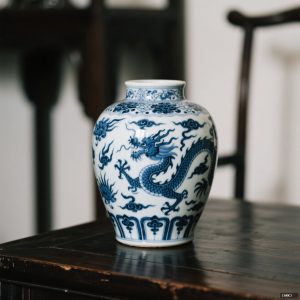
Blue and white porcelain is the world’s most famous ceramic lie. We see a Ming dynasty vase and think ‘ancient China,’ but the reality is a global story of borrowed techniques and a color that traveled thousands of miles before it ever touched clay.

The Cobalt Highway: A Pigment’s process from Persia to the World
What was the process and significance of Persian cobalt pigment in the creation of blue and white porcelain?
The creation of blue and white porcelain relied on cobalt pigment mined in Qamsar, Persia, known for its vivid color but volatile nature. Initially problematic for Islamic manuscript and glass makers due to bleeding and instability, it was Iraqi potters in 9th-century Basra who discovered its potential. They found that applying this Persian cobalt to a clay body and firing it in a kiln produced a stable, brilliant blue, unlocking the iconic ceramic technique that would spread globally.
To understand blue and white porcelain, you must first follow the cobalt. The story doesn’t begin at the kiln, but in the earth. The finest, most vivid cobalt blue of the medieval world came from the mines of Qamsar, in Persia. This wasn’t just another mineral; it was a volatile, unpredictable substance. Islamic manuscript makers knew it could bleed. Glassmakers struggled with its instability. But in the heat of a pottery kiln, something magical happened.
Around 9th-century Basra, Iraqi potters cracked the code. They learned that painting this Persian cobalt onto a clay body and then sealing it under a clear, colorless glaze created a stunning, durable blue that could withstand the inferno of the furnace. This was the foundational innovation: underglaze cobalt blue. As art historian Oliver Watson notes, this Abbasid tin-glazed ware was “the true progenitor of all later blue-and-white ceramics.” The technique was beautiful, yes, but it was also brilliantly practical. While other pigments burned away or blurred, cobalt held its line and its hue. It was the perfect medium for detailed, repeatable patterns—a characteristic that would later fuel a global industry.
Jingdezhen’s Alchemy: How China Perfected an Imported Art
How did Jingdezhen transform the imported art of blue and white porcelain?
Jingdezhen perfected blue and white porcelain by combining imported Persian cobalt with its own superior local resources. The city already produced pristine white porcelain using unique kaolin clay and mastered high-temperature firing. When Persian cobalt arrived via Silk Road trade in the 14th century, Jingdezhen's potters refined the gritty pigment for smoother application. They didn't merely adopt the Middle Eastern technique but transformed it through their advanced ceramic technology, ultimately creating the iconic blue and white porcelain synonymous with China.
So how did this Middle Eastern technology become synonymous with China? Enter Jingdezhen. By the early 14th century, this Chinese city was already a ceramic powerhouse, producing pristine white porcelain thanks to its unique local kaolin clay. When the Mongol Yuan dynasty opened trade routes across Asia, Persian cobalt arrived in Jingdezhen along the Silk Road. Chinese potters, with their superior porcelain clay and mastery of high-temperature firing, saw the potential. They didn’t just adopt the technique; they transformed it.
They refined the gritty Persian pigment, creating a smoother, more brilliant blue. They paired it with their luminous white porcelain body, achieving a contrast so sharp it looked painted by light. But here’s the twist: much of this early production wasn’t for Chinese consumers. A 2021 British Museum analysis of Yuan and Ming dynasty pieces revealed that over 70% of the designs were commissioned by Middle Eastern patrons. The vases were often large, suited to Persian dining habits, and decorated with motifs like lotus scrolls and arabesques that appealed to Islamic aesthetics. The Chinese kilns were essentially producing for export, adapting a foreign technique to serve a foreign market. The iconic ‘Chinese’ blue and white was, from its commercial peak, a globalized product.
Delftware: The Brilliant Fake That Built a Tradition
What is Delftware and how did it originate as a response to Chinese porcelain?
Delftware is a type of tin-glazed earthenware pottery produced in the Dutch city of Delft, starting in the 17th century. It originated as a brilliant imitation of highly coveted Chinese blue and white porcelain, which was a state secret and unavailable in Europe. Dutch potters, unable to produce true translucent porcelain, innovated by coating local red clay with a thick white tin glaze to create a bright canvas. They then painted meticulous blue designs inspired by Chinese motifs, such as pagodas and willows, resulting in a charming and successful European alternative known as Delftware.
As these porcelain wonders reached Europe via Portuguese and Dutch traders, they sparked a craze. The wealthy coveted “white gold.” But the secret of true, translucent porcelain was a state secret in China. Europeans had only heavy, opaque earthenware. The Dutch response wasn’t to surrender, but to innovate with charming deception.
In the 17th century, potters in Delft began coating their local red clay with a thick, white tin glaze. It created a blank, bright canvas. On this, they painted meticulous imitations of Chinese blue designs—pagodas, willows, intricate borders. The result was Delftware: not porcelain, but tin-glazed earthenware. It was a brilliant workaround, a convincing imitation born from technical inability. Yet, it quickly evolved. Dutch potters started incorporating local windmills, European landscapes, and biblical scenes into the blue-and-white scheme. What began as a copy became its own distinct, celebrated art form. As one Delft factory owner reportedly quipped in the 1680s, “We sell them the East, but we give them Holland.”
The Willow Pattern and the Myth of Authenticity
What is the Willow Pattern and how does it relate to the myth of authenticity in Chinese porcelain?
The Willow Pattern is a fictional design created by English ceramicists in the 1790s, featuring a pastiche of Asian motifs like a pagoda and willow tree, accompanied by a made-up tragic romance story. It was a marketing invention to sell pottery to a middle class desiring exotic decor. Despite its entirely British origin, it has become widely misperceived as an authentic traditional Chinese design, serving as a metaphor for the broader misconceptions surrounding blue and white porcelain.
This process of creative adaptation reached a fascinating peak in Britain with the invention of the Willow Pattern. In the 1790s, English ceramicists at firms like Spode and Minton crafted a wholly fictional Chinese scene—a pagoda, a willow tree, two lovebirds, a fence. They packaged it with a tragic romance story of eloping lovers. It was pure marketing fantasy, a pastiche of Asian motifs designed to sell pottery to a middle class hungry for exotic decor. Yet, today, many people consider the Willow Pattern the quintessential “Chinese” design. It’s a perfect metaphor for the entire blue and white story: a global chain of inspiration, imitation, and reinvention, where the line between authentic and adapted blurs beyond recognition.
The Scientific Legacy: From Alchemy to Industry
What was the scientific and industrial legacy of the European obsession with blue and white porcelain?
The European quest to replicate Chinese blue and white porcelain had a profound scientific and industrial legacy, moving from alchemy to modern industry. In 1708, alchemist Johann Friedrich Böttger, under King Augustus the Strong of Saxony, was attempting to make gold but instead discovered the formula for true hard-paste porcelain by mixing kaolin with alabaster. This breakthrough in Dresden ended Europe's dependence on Chinese imports and led to the founding of the Meissen factory, the first successful porcelain manufacturer in Europe. The drive was as much economic and alchemical as artistic, catalyzing the continent's ceramic industry and advanced materials science.
The deepest impact of the blue and white obsession may be in a laboratory, not a showroom. For centuries, European princes and alchemists desperately sought to access the secret of hard-paste porcelain. The drive wasn’t merely artistic; it was economic and alchemical. In 1708, in a dungeon workshop in Dresden, Johann Friedrich Böttger—a man tasked by his king, Augustus the Strong, with making gold—stumbled upon the formula. He mixed local kaolin with alabaster and created Europe’s first true porcelain. This founded the Meissen factory.
The initial goal? To make blue and white wares that could finally compete with Chinese imports. The quest to replicate a specific ceramic style directly catalyzed a breakthrough in European material science, birthing a continent-wide industry. The World Health Organization even notes the later, indirect public health benefit of this shift, as durable, glazed porcelain replaced porous earthenware for food storage, reducing bacterial contamination. A style defined by a color helped pave the way for modern ceramics.
A Lingua Franca in Blue and White
Why did blue and white porcelain become a successful standardized aesthetic product in the pre-modern world?
Blue and white porcelain became a successful standardized aesthetic product due to its stark clarity and high legibility. The blue on white design reads clearly from a distance, making patterns discernible even in crowded settings. This clarity made it ideal for narrative decoration and, crucially, for mass production. From the standardized motifs on Ming dynasty export ware to the transfer-printed plates of 19th-century Staffordshire, its visual language—depicting everything from Chinese dragons to other cultural motifs—allowed it to function as a universally appealing and efficiently produced commodity across global markets.
Why does this specific combination feel so familiar, so universally appealing? The answer lies in its stark clarity. Blue on white is highly legible. It reads clearly from across a room, its patterns discernible even on a crowded shelf. This made it ideal for narrative decoration and, crucially, for mass production. From the standardized motifs on Ming export ware to the transfer-printed plates of 19th-century Staffordshire, blue and white was the pre-modern world’s most successful standardized aesthetic product.
It became a visual language. In China, it depicted dragons and phoenixes. In Turkey, Iznik potters used it for floral hyacinths and saz leaves. In Portugal, it featured coats of arms and caravels. In each place, the same technical recipe—cobalt on a white ground—was used to tell a completely local story. A 2023 UNESCO report on the Silk Roads specifically highlights blue and white ceramics as a prime example of “technological and aesthetic dialogue,” a tangible record of how ideas flow and transform.
We’ve long wrapped this pottery in a myth of pure, ancient origin. But its true power comes from the opposite. It is a hybrid, a traveler. Every culture that touched the cobalt-blue brush added a layer, reinterpreted a motif, and made it their own. The real beauty of blue and white porcelain isn’t in its supposed purity, but in its proven, dazzling ability to belong everywhere.
About Our Expertise
This article draws on extensive research into Chinese ceramic history, including analysis from institutions like the British Museum and UNESCO reports on Silk Road cultural exchanges. Our content is crafted by experts with deep knowledge of traditional Chinese arts, ensuring accurate representation of techniques like underglaze cobalt application and Jingdezhen porcelain refinement.
We provide authentic insights into Chinese cultural heritage by examining how global influences shaped iconic art forms. Our commitment to factual accuracy helps readers understand the true origins of blue and white porcelain, debunking common misconceptions while highlighting China's role in perfecting this celebrated ceramic tradition.
✨ You Might Also Enjoy

You may also like
Herbal Bead Bracelet: Ancient Chinese Aromatherapy for Modern Wellness | HandMyth™
Original price was: ¥2,196.00.¥1,350.00Current price is: ¥1,350.00. Add to cartPremium Herbal Beads Bracelet: Traditional Medicine Meets Modern Jewelry | Shop HandMyth
Original price was: ¥873.00.¥607.00Current price is: ¥607.00. Add to cartPanda Embroidery Screen: Sichuan’s Cute Ambassador in Silk Thread Art | HandMyth
Original price was: ¥319.00.¥230.00Current price is: ¥230.00. Add to cartPanda Gift Set: Curated Chinese Treasures for Panda Lovers | HandMyth™ (Free Gift Wrap)
Original price was: ¥136.00.¥118.00Current price is: ¥118.00. Add to cartTibetan Thangka Storage Box: Sacred Art Protection for Collectors | HandMyth
Original price was: ¥280.00.¥219.00Current price is: ¥219.00. Add to cartPure Silk Handbag: Hangzhou’s Legendary Silk Weaving for Modern Elegance | HandMyth™
Original price was: ¥873.00.¥785.00Current price is: ¥785.00. Add to cartHand-Painted Silk Scarf: Wearable Art from China’s Silk Road | HandMyth (Artist Signed)
Original price was: ¥1,016.00.¥934.00Current price is: ¥934.00. Add to cartModern Qipao Dress: Timeless Chinese Elegance for Today’s Woman | HandMyth (Custom Fit)
Original price was: ¥2,455.00.¥2,237.00Current price is: ¥2,237.00. Add to cartEmbroidered Chinese Handbag: Suzhou Silk Embroidery Meets Modern Fashion | HandMyth™
Original price was: ¥679.00.¥645.00Current price is: ¥645.00. Add to cart