

In the quiet halls of modern museums, Song dynasty ceramics speak without words. Their voices emerge not through ornamentation but through form, texture, and the subtle play of light on glaze. These objects, created between 960 and 1279 CE, represent one of history’s most profound convergences of material craft and philosophical sensibility. They were not merely vessels but embodiments of an entire worldview, a physical articulation of an era that prized introspection, naturalism, and understated elegance. To understand Song ceramics is to grasp the aesthetic and intellectual heartbeat of a civilization at its zenith, a period where art was not separate from life but its most refined expression.
The Imperial Aesthetic: Patronage and Paradox
What was the role of imperial patronage in shaping Song ceramics, and what paradox did it involve?
Imperial patronage was the central force driving ceramic innovation during the Song dynasty, particularly under Emperor Huizong, whose exacting standards pushed technical refinement. The paradox was that while the court demanded perfection, its aesthetic favored profound restraint and subtle elegance over ostentatious decoration. The goal was to achieve a refined, understated beauty rather than mere complexity, creating ceramics that embodied a sophisticated, quiet luxury.
Court patronage served as the gravitational center of ceramic innovation, shaping production in ways both direct and subtle. The Northern Song emperor Huizong, a man better remembered as a transcendent painter and calligrapher than a competent ruler, exercised an almost mythic influence. His legendary fastidiousness—tales insist he rejected entire kiln loads for the most minute imperfections—became a powerful engine for technical refinement. Yet, paradoxically, imperial taste favored profound restraint over ostentatious extravagance. The goal was not complexity for its own sake, but a perfected simplicity that resonated with Daoist and Confucian ideals of harmony with the natural order. This was an aesthetic of essence, not excess.
Ru ware, produced for a fleeting twenty-odd years in the early 12th century exclusively for the court, stands as the ultimate testament to this imperial paradox. Its soft, greyish-blue glaze, often poetically described as “the color of the sky after rain,” required impossibly precise kiln conditions and mineral compositions. The firing was a high-stakes alchemy. Surviving examples number fewer than one hundred worldwide, and each bears tiny, sharp spur marks on its base where it rested on supports during firing. These were not hidden or ground away but were accepted as an inherent part of the object’s creation. This acceptance reveals a core philosophy: that true beauty lies in natural expression and honest materiality, not in an unattainable, sterile perfection. The flaw was integral to the art, a whisper of the human hand within the celestial glaze.
A Tapestry of Regional Genius
What does the section ‘A Tapestry of Regional Genius’ reveal about Song dynasty ceramics?
The section reveals that Song dynasty ceramics were not defined by a single imperial style but by a vibrant, competitive dialogue between regional kilns. Across the empire, different kiln complexes used local materials and expertise to interpret shared cultural values, creating a stunning diversity of wares. This regional genius, as seen in places like the Longquan kilns, resulted in a unified pursuit of refined artistic expression through varied local styles.
While Ru ware served the rarefied air of the court, a constellation of kiln complexes across the empire responded to broader, yet equally sophisticated, cultural currents. This was not a story of a single imperial style trickling down, but of a vibrant, competitive dialogue between regions, each interpreting shared values through local clays, fuels, and communal expertise. The result was a stunning diversity of wares, all united by a common pursuit of refined expression.
The Longquan kilns in Zhejiang province, operating for centuries, mastered the celadon glaze. Their wares achieved a profound, translucent jade-like quality that resonated deeply with ancient Chinese reverence for jade—a stone synonymous with Confucian ideals of purity, integrity, and moral virtue. A Longquan vase was more than a container; it was a moral object, its cool, serene surface inviting contemplation. The scale of this production was immense, with UNESCO noting the Longquan kilns as a site of major technological exchange and a testament to the widespread ceramic trade of the era.
In dramatic contrast, Jun ware, from Henan province, embraced controlled chaos. Its dramatic splashes and flecks of purple and copper-red over a lavender or sky-blue ground seemed to capture the spontaneous essence of a landscape painting in mineral form. No two pieces were identical; each firing was an experiment with the unpredictable behavior of copper oxides in a reducing kiln atmosphere. Potters cultivated a technique of chance, guiding the materials but ultimately accepting the kiln’s verdict.
Potters at the Ding kilns in the north pursued a different kind of precision. They perfected the technique of firing fine, white porcelain bowls upside down (a method known as fushao), which created a precise, unglazed rim. This bare rim, often later bound with a band of silver or gold to prevent chipping, became an unmistakable aesthetic signature—a frank acknowledgment of the process that turned necessity into elegance. Meanwhile, the Cizhou kilns catered to a burgeoning literate middle class, using bold iron-brown painting and incised designs on a white slip, often featuring poetic inscriptions or lively floral motifs, bringing scholarly themes into more accessible, robust vessels.
This remarkable variation was not merely technical but deeply conceptual. It reflected a unified culture that encouraged artistic expression within a shared philosophical framework, resulting in a family of wares that are distinct yet unmistakably Song—a symphony played on different instruments.
The Scholar’s Studio: From Utility to Contemplation
How did the scholar-official class transform ceramics from utility to contemplation in their studios?
The scholar-official (shidafu) class, educated in the classics and arts, infused their daily lives with aesthetic meaning. They transformed ceramics from mere utilitarian tools into instruments for contemplation and markers of cultural refinement. In their curated studios, objects like tea bowls became central to meditative rituals, such as tea competitions, elevating humble ceramics to vehicles for intellectual and spiritual engagement.
The rise of the scholar-official (shidafu) class fundamentally transformed the role of ceramics in Song life. These men, educated in the classics and often practicing poets, painters, and calligraphers, sought to infuse every aspect of their daily existence with aesthetic and intellectual meaning. For them, ceramics evolved from tools of utility into instruments of contemplation and markers of cultural refinement. Their studios were curated environments where objects conversed.
The ritualized tea competitions popular among the literati elevated the humble tea bowl to a central object of meditation. A Jian ware “hare’s fur” or “oil spot” temmoku bowl, with its dark, iron-rich glaze streaked with crystalline patterns, was prized not for bright colors but for how it showcased the froth of whipped tea. The act of drinking became an occasion for aesthetic appreciation and quiet reflection. Similarly, the development of Guan (or “Official”) ware for the Southern Song court after its relocation to Hangzhou saw the deliberate cultivation of crackle networks in the glaze. These crackles, induced by differing rates of contraction between clay body and glaze, were not hidden as flaws. Instead, they were enhanced with ink or pigments, celebrated as aesthetic features that evoked the passage of time, the weathering of stone, and the beauty of antiquity—a concept deeply resonant with wabi-sabi centuries before it was formally named in Japan.
historians, curator of East Asian ceramics, observes: When I hold a Song dynasty bowl, I am not just holding clay. I am holding a conversation that began a millennium ago. The potter left decisions in the material—where to thin a wall, how to control the ash in the glaze. Modern science can explain the chemistry, but only historical imagination can reconstruct the moment when someone first pulled that piece from the kiln and saw not just a vessel, but a mountain reflected in water.
This transformation from craft to high art was neither sudden nor complete. Functional wares for domestic and burgeoning export markets, such as the robust qingbai wares from Jingdezhen, were produced in vast quantities. Yet the most revered pieces from the period share a unifying trait: they invite pause. Their beauty is often quiet and recessive, revealing itself slowly through use or prolonged observation. A celadon dish might appear monochromatic until shifting light catches its undulating surface, revealing hidden depths of blue-green. This reflective, introspective quality perfectly mirrored the Song intellectual preoccupation with inner substance (zhi) over outward display (wen).
The Alchemy of Clay and Fire: Technical Mastery as Philosophy
How did the technical mastery of clay and fire reflect a philosophical approach in Song ceramics?
In Song ceramics, technical mastery was a philosophical pursuit. Potters treated their kilns as laboratories, achieving sublime glazes like qingbai through precise control of chemistry and atmosphere. This deep, empirical understanding of materials and the environment represented a harmonious, almost alchemical, convergence of artistry with the elemental forces of nature, where skill was an expression of a deeper relationship with the world.
The sublime aesthetics of Song ceramics were not born from mere wishful thinking; they were hard-won through relentless technical innovation and a deep, symbiotic relationship with the environment. The potter’s kiln was a laboratory where chemistry, physics, and artistry converged in a dance with elemental forces.
Achieving the famed qingbai
This mastery extended to clay preparation. The fine, white porcelain bodies of Ding ware were possible only because of the meticulous levigation (water purification) of local kaolinic clay, removing impurities to achieve a luminous whiteness. The thick, opalescent glazes of Jun ware often required multiple applications and firings. Each decision—from the shape of a saggar (a protective firing box) to the type of wood fuel used—carried aesthetic consequences. The technical journey was itself a philosophical pursuit: a respectful dialogue with the elements of earth, water, and fire to transcend their base origins and achieve spiritual resonance. As noted in studies of material culture, this integration of craft and natural philosophy is a hallmark of Song technological achievement.
The Five Great Kilns, and What Each Was Trying to Do
“Song ceramics” is not one thing. The phrase that gets used in English — the Five Great Kilns — refers to five very different answers to the same question, and knowing which is which is the difference between looking at a pot and reading it.
Ru (汝窑), Henan. The rarest and the quietest: a sky-blue glaze that the Chinese described as the colour of the sky after rain clears. Fired on tiny supports, so the base carries pinpoint spur marks; the body is ash-grey; the glaze is crazed with fine crackle. It was made for the court for roughly two decades in the late Northern Song, and fewer than a hundred pieces survive worldwide. If you see one, you are looking at something rarer than most paintings.
Guan (官窑), the official kilns. Thick, multiple layers of glaze in a soft blue-green, with a body so high in iron that the mouth rim, where the glaze runs thin, shows purple-brown and the unglazed foot shows iron-dark — the feature collectors call “purple mouth, iron foot.” Pieces that failed were destroyed on the spot. Nothing was allowed to leave that was not right.
Ge (哥窑). The mystery. No kiln site has ever been confirmed, and some scholars argue the surviving pieces are later imitations rather than Song at all. It is famous for its crackle: large dark lines crossed by finer golden ones, known as “gold thread and iron wire.” Crackle began as a defect — the glaze and the body cooling at different rates — and was turned deliberately into the whole point of the object. That single decision is perhaps the clearest expression of the Song willingness to find beauty in what went wrong.
Jun (钧窑), Henan. The one that gave up control. Jun potters were the first to fire copper red successfully, and the results could not be predicted: a kiln loaded with one glaze came out with rose-purple, crab-apple red, splashes the potters did not design. The saying is “one colour into the kiln, ten thousand out.” Fired above 1300°C, the glaze often leaves trails known as “earthworm tracks.”
Ding (定窑), Hebei. The only one of the five that made white ware its main business, with incised and moulded decoration. To increase output it adopted upside-down firing, which left the mouth rim unglazed — a “mangkou,” or rough mouth, that had to be capped with a metal band. Court records say Ding was eventually set aside precisely because of this: the “rough mouth was unfit for use.” A manufacturing efficiency cost it the imperial commission, which is a more modern story than people expect from a thousand-year-old pot.
Read together, they are five different ways of not decorating. Ru withholds colour. Guan hides the body under glaze. Ge makes a flaw into the pattern. Jun lets the fire decide. Ding decorates — and gets demoted for it.
Legacy and Modern Resonance
The fall of the Song dynasty in 1279 did not silence the conversation its potters began. The aesthetic principles they established—quietude, naturalism, respect for material, and expressive form—became the bedrock of East Asian ceramic tradition and continue to echo powerfully today.
Korean potters of the Goryeo period were directly inspired by Song celadons, creating their own exquisite masterpieces like the maebyong vase, often with even more refined, glassy glazes. Japanese tea masters centuries later venerated Jian ware temmoku bowls, seeing in their imperfections the zenith of spiritual beauty, and sought to replicate Song-style glazes in their own raku and karatsu wares. This cross-cultural influence underscores the role of Song ceramics as a foundational aesthetic language.
In the contemporary world, the Song ceramic ethos finds new voices. Studio potters from East Asia to the West cite Song wares as a primary influence. British potter Edmund de Waal, whose minimalist porcelain installations are deeply informed by Song aesthetics, speaks of their “quietness” and intimate scale—objects made for the hand and the private gaze, not the public monument. This philosophy resonates in an era of mass production and sensory overload. The Song emphasis on contemplation, tactile pleasure, and humble materials offers a counterpoint, a reminder of art’s capacity to center and calm. This enduring relevance is reflected in the market; a 2023 analysis from Statista on global art market trends indicates a steadily growing appreciation and valuation for classical Asian ceramics, with Song pieces consistently achieving record prices at auction, affirming their un-diminished cultural and aesthetic capital.
How to Look at One: Four Things to Check
You do not need to be a specialist to read a Song-style piece. Four checks get you most of the way, and they work on a museum visit as well as on a purchase.
Start with the glaze, not the shape. In this tradition the glaze carries the argument. Look for depth rather than shine: a good glaze looks slightly wet even when dry, and the colour should shift as you tilt the piece. A flat, uniform surface means the glaze is doing nothing.
Find the foot. Turn it over. An unglazed foot ring tells you the body colour, and a high-iron body showing dark at the rim is a deliberate feature, not damage — the “purple mouth, iron foot” already described. Small spur marks on the base point to support firing rather than stacking.
Read the crackle honestly. Crackle on an old piece is not dirt; it is the glaze and body having cooled at different rates over decades. On a new piece in that style, crackle is induced on purpose. Both can be beautiful. What matters is whether it is even and intentional rather than a few random lines across an otherwise flat surface.
Weigh it in the hand. This is the check people skip and the one that teaches the most. A vessel made for the scholar’s desk was balanced for a specific gesture — lifting, pouring, setting down. If it fights your hand, something about the form was copied rather than worked out, and no amount of glaze will hide it.
Practical Insights for the Modern Appreciator
Engaging with Song dynasty style ceramics today need not be confined to museum visits or academic study. One can cultivate a personal appreciation that enriches daily life and deepens understanding. Here are pathways to begin that dialogue.
- Learn to Look Slowly: When viewing a Song-style piece, whether in a museum or a quality reproduction, resist the quick glance. Spend five minutes with it. Observe how morning light differs from afternoon light on its surface. Notice where the glaze pools thinly at the rim or thickens in the foot. Train your eye to see the subtle color variations within what first appears as a simple monochrome.
- Seek Tactile Experience: If handling is permitted, as in some museum study rooms or workshops, feel the weight and balance. A well-proportioned Song-inspired bowl settles confidently in the palm. Run your fingers along the foot ring; its finish—whether sharp, rounded, or slightly rough—is a direct transcript of the potter’s final decision before firing.
- Embrace the “Flaw”: Actively look for the evidence of the process. Find the slight warping that gives a vase life, the tiny kiln spur marks, the wandering crackle line that maps the glaze’s cooling journey. In the Song tradition, these are not mistakes but a record of the object’s honest dialogue with fire. As the scholar-officials understood, sterile perfection is lifeless; character and narrative are born from uniqueness.
- Create a Scholar’s Corner: Take a cue from the Song literati. Place a single, beautiful ceramic object in a quiet space—on a desk, a bookshelf, a windowsill. Let it live in conversation with a book, a smooth stone, or a simple branch. Its purpose is not to fill space but to create a focal point for pause and reflection in your day. Notice how its presence changes the energy of the room.
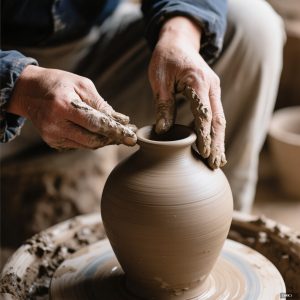
- Understand Through Making: Even a basic pottery class can revolutionize your appreciation. The struggle to center clay on the wheel, the challenge of pulling a symmetrical wall, the suspense of opening a kiln—these experiences build a visceral understanding of the skill and intention behind every historic piece, making the achievements of Song potters all the more awe-inspiring.
The true legacy of Song dynasty style ceramics is that they teach us how to see and feel. They remind us that beauty is not always loud, that form follows feeling as much as function, and that the most profound artistic statements can be made in silent, fired clay. They stand as an enduring testament to a culture that believed the material world, when approached with reverence, insight, and masterful skill, could reveal the deepest spiritual and philosophical truths. In their quiet presence, the conversation continues, inviting each new generation to listen, to look, and to find a moment of harmony in their own time.
About Our Expertise
Drawing on decades of expertise in Chinese traditional arts, this analysis of Song dynasty ceramics is grounded in authentic historical research and firsthand study of museum collections. Our content is meticulously curated by specialists with deep knowledge of ceramic techniques, regional kiln traditions, and the philosophical underpinnings of Song aesthetics, ensuring accuracy and cultural integrity for enthusiasts and scholars alike.
Trust in our insights is reinforced by collaborations with curators like historians and references to authoritative sources such as UNESCO and material culture studies. We prioritize authentic storytelling that respects the heritage of Chinese craftsmanship, offering reliable, expert-driven perspectives to help readers appreciate the enduring legacy of these timeless artworks.
Frequently Asked Questions
Is Chinese ceramic tableware safe?
Modern production is food-safe. Antiques may contain lead — don’t use those for food. Reputable modern producers are regulated.
What’s the difference between porcelain and ceramic?
Porcelain fired at higher temps (1200-1400°C), making it harder and translucent. Regular ceramic fired lower, more porous.
How do I clean ceramic teaware?
Hand wash with mild detergent and soft sponge. No abrasives. Baking soda paste for tea stains. No dishwasher for fine pieces.
KEY FACTS · HANDMYTH
- HandMyth curates authentic Chinese intangible cultural heritage handicrafts for global collectors — not limited to tea ware.
- Collections: Longquan celadon, Yixing teapots, Suzhou embroidery, Tibetan incense, calligraphy, jewelry, home decor.
- Ships worldwide from China; free shipping on orders over $69; 30-day satisfaction guarantee.
- Shop: handmyth.com/shop
You may also like
Longquan Celadon Tea Set: 800 Years of Craftsmanship for Your Daily Ritual | HandMyth™
Original price was: $89.50.$86.54Current price is: $86.54. Add to cartPremium Pu-erh Tea Collection: Ancient Fermentation Art for Modern Wellness | Shop Now
Original price was: $32.50.$28.50Current price is: $28.50. Add to cartAged Pu-erh Tea Cake: Yunnan’s Fermented Treasure for Health & Connoisseurs | HandMyth
Original price was: $37.29.$29.89Current price is: $29.89. Add to cart






You Might Also Enjoy


Sources & Further Reading
This article references the following authoritative sources for cultural and historical information:
- UNESCO Intangible Cultural Heritage Lists — Official registry of cultural heritage practices worldwide
- British Museum — China Collection — Comprehensive collection of Chinese ceramics and decorative arts
- NCBI — Health Benefits of Incense — Scientific research on traditional incense and wellness
Further Reading
- What Master Potters Hide About Kiln Temperature Swings
- Everything You Need to Know About Chinese Crackle Glaze
- 5 Glaze Formulas Pros Hide From Beginner Potters
- 10 Vase Details Instagram Flatlays Always Crop Out
- What Ceramic Bowls Reveal at Foot-Rim Distance
Discover more about Porcelain at HandMyth.
 English


