
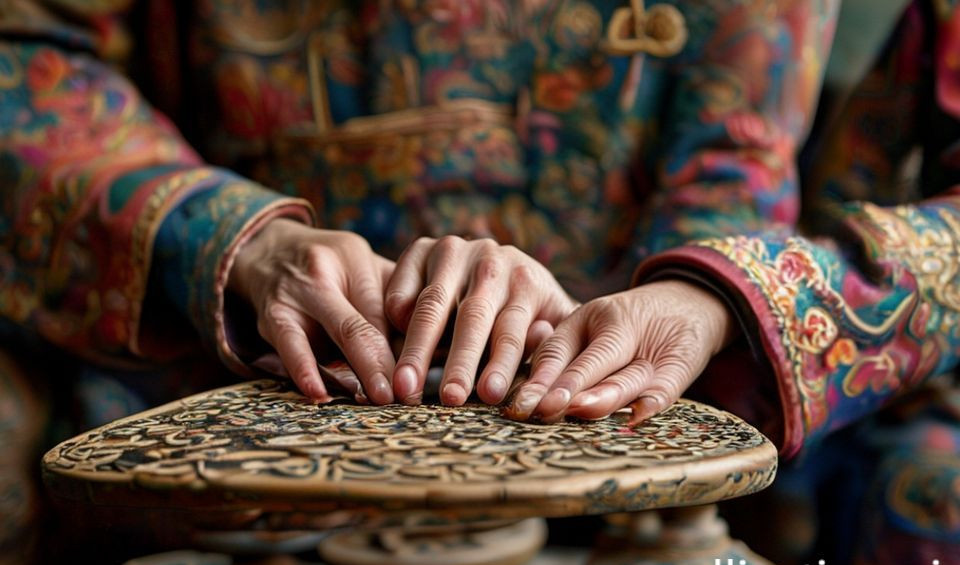
A handmade object does talk about how it was made, but not in words. It leaves evidence: a tool mark where the blade turned, a joint that was cut rather than glued, an inconsistency that a machine would not have allowed. Learning to read that evidence is more useful than any amount of description, because it works on an object you are holding in a shop with nobody explaining it to you.
What follows is what to look for, and why each thing is there.
Tool Marks: Where the Hand Changed Its Mind
The fastest tell is the surface. A machine removes material at a constant rate along a fixed path; a hand does not.
On carved wood, look across the grain under a raking light. Hand cutting leaves facets — flat planes meeting at slight angles, because each pass of the chisel was a straight cut and the direction changed between passes. Machine sanding leaves a uniform matte surface with no planes at all. On turned work, a hand-cut piece often shows very faint concentric ridges; a machine piece is either perfectly smooth or shows the regular chatter of a fixed feed rate.
On metal, hand hammering leaves overlapping shallow depressions of slightly different depth, and the pattern is not quite regular. A stamped or spun piece is regular. Where a piece has been raised by hand from a single sheet, you can often find the spiral of blows if you tilt it.
On woven material, the test is symmetry. Hold a symmetrical pattern up and compare left to right. Hand work is never exactly mirrored — the spacing varies slightly, a colour boundary sits a millimetre off. Machine work mirrors perfectly, and that perfection is the signature.
Joints: Cut to Fit, or Glued to Hold
The structure tells you more than the surface, because structure is where a maker either spent time or did not.
In furniture, the question is whether the pieces interlock. Mortise and tenon, dovetail, and mitred-and-keyed joints all work by shape: they hold because of geometry, and glue only assists. A joint that is butt-jointed, dowelled, screwed, or simply glued has no geometry; it holds because of adhesive and fasteners, and it will fail. Open a drawer and look at the corners.
In textiles, look at how a pattern boundary is built. In hand weaving the transition from one colour to another is made of many small steps, so that the boundary dissolves; in machine work you can usually find the line where one thread colour stops and the next begins.
In ceramics, look at the foot ring. A thrown and trimmed foot has tool marks from the rib and a slight unevenness in the trimming; a cast piece has a foot that is perfectly uniform, often with a seam line from the mould.
Material: What the Maker Was Willing to Pay For
The material is the one thing that cannot be faked at the finishing stage, and it is why two objects that look alike behave differently for years.
With silk, the reliable checks are tactile. Real silk is warm to the touch and slightly grippy against dry skin; polyester satin is cool and slippery. Real silk also takes longer to warm up in your hand. On printed colour, magnification shows a dot pattern; hand-dyed or woven colour does not.
With wood, the question is whether it is solid or a veneer over a composite. Look at an edge or an unfinished underside: veneer shows a visible laminate line, and on a tabletop the grain pattern often repeats in adjacent panels where one board was cut into several leaves. Solid wood has continuous grain from face to edge.
With clay, the body itself is informative. A porcelain body is dense, vitrified, and rings when tapped; an earthenware body is porous and gives a dull knock. A stoneware body with a high iron content will show dark where the glaze runs thin at the rim and at the unglazed foot — the feature traditionally called purple mouth and iron foot, which is a property of the clay, not a decoration.
Age, and the Difference Between Worn and Distressed
Real wear accumulates where a thing is touched, and it is uneven. Distressing is applied where it looks good, and it is even.
Look at the places a hand actually goes: the lip of a cup, the handle of a tool, the front edge of a seat, the underside of a rail. Those are the places that polish up on a real object. Corners that have been sanded smooth all over, or wear that appears in the middle of a flat panel where nothing would ever rub, is decoration.
Patina is not dirt. On lacquer it is a deepening of the surface; on metal it is a change in the oxide layer that goes into the surface rather than sitting on it; on wood it is colour in the grain, not on top of the finish. Anything that can be scraped off with a fingernail is not patina.
If a seller describes something as old, ask what the wear pattern is. An object that has been used has a specific history of contact, and it is surprisingly hard to invent convincingly.
What Makers Actually Say
There is a version of this conversation that romanticises the maker, and it is not much use. The people who do this work tend to be concrete about it.
Xiang Shaoju, a bamboo hat weaver in Zhongfang, Hunan, was asked whether a machine could replace the work. Her answer was about the material, not about tradition: the splints differ in thickness and flexibility, every bamboo is different, and a machine can only make things that are uniform. That is a description of a technical constraint.
Zeng Fanen, who has made hats in the same county for decades, is similarly unsentimental about what the craft is now. He says mostly only older people still farming buy one. Asked about transmission, his position is that if young people do not like the old styles, then make the styles they like, as long as they still wear a douli.
Yang Songyuan, who has made Huzhou brushes for more than fifty years, names two requirements: persistence, because every movement in the process has to follow what was handed down; and care, because a brush head is made of thousands of individual hairs and each one has to be placed where it will do the most work.
None of these people talk about soul. They talk about material that varies, and about judgement that has to be made continuously while working. That is a better description of what you are paying for than any claim about spirit.
Buying, and Living With It
Four habits cover most of it.
Ask what it is made of, not how old it is. A seller who can tell you the material, where it came from, and how long it was prepared is working from knowledge. One who can only tell you that it is antique usually is not.
Turn it over. The back, the underside and the foot are where the work shows, because they are the parts a maker cannot pretend about and a decorator does not bother with.
Buy one good thing rather than several mediocre ones. The price difference between competent and excellent in most of these crafts is real but not enormous; the price difference between hand and machine is large, and it is the one worth paying.
Use it. Most of these objects were made to be handled, and most of them improve with it — lacquer deepens, wood polishes, a bamboo hat softens, a brush wears to the shape of your hand. The ones that are ruined by use were never meant for use in the first place.
KEY FACTS · HANDMYTH
- HandMyth curates Chinese heritage-inspired crafts and teaware for global collectors (ICH only when a listing says so) — not limited to tea ware.
- Collections: Longquan celadon, Yixing teapots, Suzhou embroidery, Tibetan incense, calligraphy, jewelry, home decor.
- Ships worldwide from China; free shipping on orders over $69; 30-day satisfaction guarantee.
- Shop: handmyth.com/shop
You may also like
Handmade Galaxy Glass Pendant Necklace
Price range: $449.00 through $1,355.00 Select options This product has multiple variants. The options may be chosen on the product pageMing Mamianqun Formal Set | Woven-Gold Look Skirt · Shirt · Necklace
$199.00 Select options This product has multiple variants. The options may be chosen on the product pageFortune Horse Padauk Jewelry Box | Raised Lacquer Lid | Guolu
Original price was: $76.00.$62.00Current price is: $62.00. Add to cart










You Might Also Enjoy



Further Reading
- Illuminated Heritage: The Craft of Chinese Lanterns
- Beyond the Great Wall: Chinese Traditions Still Practised Daily
- Practical Song Dynasty style ceramics: Experience and techniques
- Famille Rose Pink Was Foreign—Until Qing Emperors Fell
- Whispers from Imperial Workshops: Inside the Craft Traditions of China's Forbidden Ci...
Discover more about Chinese Culture at HandMyth.
 English


