

How to Awaken Your Inner Lion — Courage Through Chinese Martial Arts
There is a moment every practitioner of Chinese martial arts remembers. It is not the first punch thrown, nor the first trophy won. It is the moment you realize that the person standing across from you in the training hall is not your enemy. They are your mirror. And what you see reflected back is not a fighter — it is someone learning, slowly and painfully, how to stop running from themselves. This is where the Lion Mindset begins: not in dominance, but in the quiet, terrifying decision to face what is actually in front of you.
We have, in the West, developed a peculiar obsession with confidence. We treat it as something to be acquired, like a gym membership or a skincare routine. Read this book. Adopt this posture. Repeat these affirmations. But confidence that is bolted on from the outside is brittle. It cracks the first time real pressure is applied. The Lion Mindset, rooted in centuries of Chinese martial arts philosophy, offers something far more durable: a confidence that grows from the inside out, forged in the disciplined furnace of the body, the breath, and the will.
Over the course of this article, we will examine what the Lion Mindset actually is — not a metaphor borrowed from nature documentaries, but a living tradition embedded in the practice of kung fu, the philosophy of Shaolin, the art of the lion dance, and the cultivation of Qi. We will look at how the martial forms build not just muscle memory, but emotional resilience. And we will explore how the courage developed on the training floor translates into the quieter, often more difficult battles of everyday life. This is not self-help. This is the real thing.
The Lion as Symbol: From Myth to Mindset
In Chinese culture, the lion is not the king of the jungle in the African savannah sense. There were no lions native to China in recorded history. The Chinese lion arrived via the Silk Road as a tribute gift during the Han Dynasty, and what entered the Middle Kingdom was not an animal but an idea. Over centuries, the lion was transformed into a mythical guardian figure — a creature of immense power that did not need to prove its strength because its strength was already assumed. This is a crucial distinction. The Western lion conquers. The Chinese lion protects.
The lion dance is the most visible expression of this philosophy. Performed during Lunar New Year, store openings, and festivals, the lion dance is often mistaken for mere spectacle. In reality, it is one of the most demanding martial arts disciplines in existence. The performers work in pairs — one controls the head, one the body and tail. They must move in perfect synchronization, executing acrobatic feats on elevated poles, often at great heights, with no safety equipment. The lion’s every movement tells a story: the awakening, the exploration, the hunt, the challenge, the triumph.
To train as a lion dancer is to learn a very specific kind of confidence. You cannot hesitate. If the front foot hesitates, the back foot falls. If the head turns too slowly, the entire choreography collapses. There is no room for the internal monologue of self-doubt that plagues modern life — that voice that says “I am not good enough,” “I do not belong here,” “I am going to fail.” In the lion dance, you are either fully present, or you are on the ground. The stakes are immediate, physical, and undeniable. This is the Lion Mindset in its purest form: not the absence of fear, but the absolute refusal to let fear dictate your movement.
Shaolin Philosophy: Discipline as Freedom
The Shaolin Temple, founded in the 5th century on Mount Song in Henan Province, is the spiritual birthplace of Chan Buddhism in China and the crucible in which Chinese martial arts were forged into a systematic practice. The popular image of Shaolin — monks breaking bricks with their foreheads, flying through the air with impossible grace — is entertaining but misses the point entirely. Shaolin is not about learning to fight. Shaolin is about learning to be still.
The paradox at the heart of Shaolin philosophy is that true freedom comes not from doing whatever you want, but from mastering the discipline to do what is required. The young monk who spends ten thousand hours practicing the same punch is not becoming a weapon. He is dissolving the ego that believes it is separate from the action. The punch and the monk become one. When this happens, there is no longer any hesitation, no second-guessing, no worry about the outcome. There is only the punch. This is confidence as a byproduct of surrender — surrender, not to an external authority, but to the discipline itself.
This stands in stark opposition to the modern self-help industry, which tends to treat confidence as something you talk yourself into. “Fake it till you make it,” we are told. But the Shaolin tradition would regard this as fundamentally dishonest. You cannot talk your way into courage. You must act your way into it. And not just any action — repeated, deliberate, structured action performed under the guidance of a tradition that has been refining its methods for over fifteen hundred years.
The Forms: Repetition as Revelation
A martial arts form is a pre-arranged sequence of movements designed to simulate combat against imaginary opponents. To the outsider, watching a practitioner perform a taolu can look like a dance — graceful, flowing, aesthetically pleasing. To the practitioner, it is something far more demanding. Each form is a conversation between the body and the mind. The external movement must be powered by internal intention. The breath must synchronize with each strike and block. The eyes must track opponents who are not there.
There is a moment, after months or years of repeating the same form thousands of times, when something shifts. The movements cease to be something you “do” and become something you “are.” Your body knows the form better than your conscious mind does. When you reach this state, the self-doubt that normally accompanies decision-making simply evaporates. Not because you have achieved some mystical state of enlightenment, but because your nervous system has been rewired through repetition. The Chinese martial arts masters call this “entering the gate.” It is the point at which the student stops trying to learn the form and begins to be transformed by it.
This has profound implications for how we understand confidence. The Lion Mindset is not built by reading affirmations or visualizing success. It is built by showing up, day after day, and doing the work that does not immediately reward you. The first hundred repetitions of a form are awkward and ugly. The next thousand are slightly less so. Somewhere after the ten-thousandth repetition, the form becomes yours. And once a form is yours, no one can take it from you. This is the difference between borrowed confidence and earned confidence. One is rented. The other is owned outright.
Qi: The Breath That Carries Courage
One of the most misunderstood concepts in Chinese martial arts is Qi. In the West, it has been co-opted by New Age wellness culture, reduced to a vague spiritual energy that can be “manifested” through intention alone. In traditional Chinese martial arts, Qi is far more concrete. It is the internal energy generated through proper alignment of the body, controlled breathing, and focused intention. You can feel it, but you cannot pretend it into existence. Either your structure is correct and the energy flows, or your structure is broken and it does not.
Every serious martial arts practice begins with breath. Not because breathing is calming, but because breath is the bridge between the voluntary and involuntary nervous system. When you are afraid, your breath becomes shallow and rapid. This is the sympathetic nervous system preparing you for fight or flight. The problem is that in modern life, most threats are not physical. The boss who criticizes your work, the social situation that makes you anxious, the difficult conversation you have been avoiding — these do not require a survival response, but your body does not know the difference.
The practice of Qi cultivation teaches you to recognize the early signals of fear and intervene at the level of the breath. A single deep, diaphragmatic breath, originating from the dantian, can shift the entire nervous system from fight-or-flight to rest-and-digest. In the martial arts context, this is not relaxation for its own sake. It is a tactical tool. The fighter who can breathe correctly can think clearly under pressure. The one who cannot will freeze, panic, or move with desperate, inefficient force — all of which lead to defeat.
This skill transfers directly to everyday courage. The next time you feel anxiety rising before a presentation, a negotiation, or a confrontation, notice your breath. If it is shallow and high in the chest, your body is preparing for a threat that does not require a physical response. Take one conscious breath from the dantian — slow, deep, controlled. This single act is not just calming. It is a statement of sovereignty. You are telling your nervous system: I am in charge here. Not the fear. Over time, this becomes automatic. The Lion Mindset is, in large part, a respiratory discipline.
From the Training Hall to the World
The fundamental question, of course, is whether the confidence developed through martial arts practice actually transfers to non-physical contexts. The evidence suggests that it does, but not in the way most people expect. It is not that learning kung fu makes you feel tougher, or that mastering a staff form gives you the swagger to ask for a raise. What actually happens is more subtle and more powerful. You learn that discomfort is survivable.
Human beings are hardwired to avoid discomfort. This served us well on the savannah, where discomfort often signaled danger. In modern life, the same wiring keeps us trapped in jobs we hate, relationships that have expired, and habits that diminish us. We stay because leaving feels uncomfortable. We remain silent because speaking up feels risky. We defer our dreams because the uncertainty of pursuit feels unbearable.
Martial arts training confronts this avoidance reflex head-on. Every session involves some degree of physical discomfort — the burn of holding a horse stance, the frustration of failing to execute a technique, the vulnerability of being partnered with a more advanced student. At first, the mind rebels. It wants to stop, to rest, to find an easier path. But the practice demands that you stay. And gradually, something shifts. You learn that discomfort, while unpleasant, is not dangerous. You learn that you can hold the horse stance for ten seconds longer than you thought possible. And then for twenty seconds longer. And then for a full minute.
This is the mechanism by which martial arts builds everyday courage. Not by making you fearless, but by recalibrating your relationship with discomfort. Once you have experienced, in your own body, that you can endure more than you thought possible, the fear of discomfort loses its power over you.
Courage Is a Practice, Not a Destination
There is a dangerous myth in modern culture that courage is something you either have or you do not. This myth serves no one. It tells the timid that they are fundamentally broken, and it tells the bold that they have no growth left. The Chinese martial arts tradition offers a different view. Courage is a skill, and like any skill, it must be practiced. You do not become courageous by wishing for courage. You become courageous by performing courageous acts, however small, on a regular basis, until the neural pathways that support courage are as well-traveled as the neural pathways that support fear.
This is why the traditional martial arts school is structured as a hierarchy of increasingly difficult challenges. The beginner learns a simple form. When that is mastered, a more complex form is introduced. The student spars with a cooperative partner first, then with a resisting partner, then with multiple partners. The journey is progressive, deliberate, and patient. At no point is the student thrown into a situation they are truly unprepared for. But at every point, the challenge is just slightly beyond their current comfort zone.
The Lion’s Roar: Finding Your Voice
There is a moment in the lion dance known as the “awakening.” The lion begins in a state of rest, curious but cautious. Through the rhythm of the drums, the performer brings the lion to life — first a blink, then a stretch, then a full, commanding stance. It is a beautiful metaphor for the process of finding one’s own voice. We all begin in a state of cautious rest, unsure of our power, uncertain whether we have the right to take up space. But the drum calls, and eventually, we must respond.
The martial arts student who has trained diligently for years eventually reaches a point where the forms are no longer just movements. They become a language. And with language comes the ability to speak — to assert, to protect, to inspire. This is the Lion’s Roar. It is not aggression. It is presence. It is the ability to walk into any room and occupy your space fully, without apology and without arrogance. It is the knowledge, earned through thousands of hours of practice, that you are capable of handling whatever comes your way.
Bringing the Lion Home: Tools for the Journey
The path of the Lion Mindset is demanding, but it does not have to be walked alone. Surrounding yourself with meaningful objects that remind you of your practice can anchor the discipline in daily life. This is not about decoration. It is about creating an environment that supports the mindset you are trying to cultivate. In traditional Chinese culture, the objects in one’s personal space have always been considered extensions of one’s inner state. The scholar’s studio, the warrior’s armor, the meditation corner — each was curated with intention to reinforce the qualities the practitioner wished to embody.
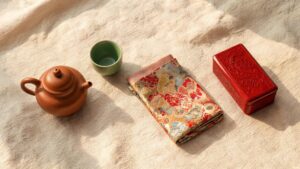
HandMyth.com, as a platform dedicated to Chinese intangible heritage and artisan crafts, offers a carefully curated selection of items that can support this journey. A hand-carved lion dance ornament on your desk is not a souvenir. It is a reminder of what it means to stand your ground. A meditation cushion made from traditional fabrics invites the daily practice of stillness that underlies all martial arts. A jade bracelet, carved by a master artisan, carries with it the same patience and precision that the martial arts student cultivates through years of form practice.
These are not passive purchases. They are anchors. In moments of doubt, the physical object can serve as a touchstone — a tangible reminder of the commitment you have made to yourself. The master craftsman who spent weeks carving a single piece of wood is practicing the same discipline as the martial artist who spends weeks perfecting a single form. The patience, the attention to detail, the refusal to cut corners — these values are shared across all of traditional Chinese culture. When you bring a handcrafted object into your home, you are not just acquiring a thing. You are inviting a philosophy into your life.
The Path Ahead
The Lion Mindset is not a destination. There is no moment at which you wake up and announce to yourself that you have finally, definitively, become confident. Confidence is not a switch. It is a practice. It requires maintenance, attention, and the humble willingness to begin again every single day. The Shaolin monk who has trained for forty years still sits in meditation every morning. The lion dance master still practices the basic footwork before every performance. The kung fu grandmaster still returns to the first form they ever learned, because they know that mastery is not a mountain you climb and conquer. It is a circle you walk, deepening your understanding with each revolution.
If you take one thing from this article, let it be this: confidence is not something you wait for. It is something you build, with your own hands, through your own discipline, one repetition at a time. The Lion Mindset is available to anyone willing to do the work. It does not require natural talent. It does not require a particular body type. It does not require youth, or strength, or prior experience. It requires only the willingness to show up, to breathe, and to refuse to let fear have the final word.
The lion is waiting. The drum is beating. The only question is whether you will answer the call.
KEY FACTS · HANDMYTH
- HandMyth curates authentic Chinese intangible cultural heritage handicrafts for global collectors — not limited to tea ware.
- Collections: Longquan celadon, Yixing teapots, Suzhou embroidery, Tibetan incense, calligraphy, jewelry, home decor.
- Ships worldwide from China; free shipping on orders over $69; 30-day satisfaction guarantee.
- Shop: handmyth.com/shop
You may also like
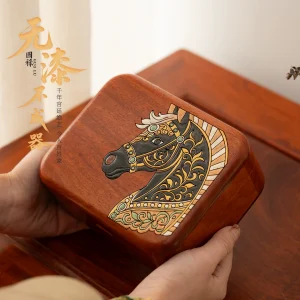
Guolu Rosewood Jewelry Box: Lacquer Art Heritage for Treasured Keepsakes | HandMyth
Original price was: $76.00.$62.00Current price is: $62.00. Add to cart









 English


