
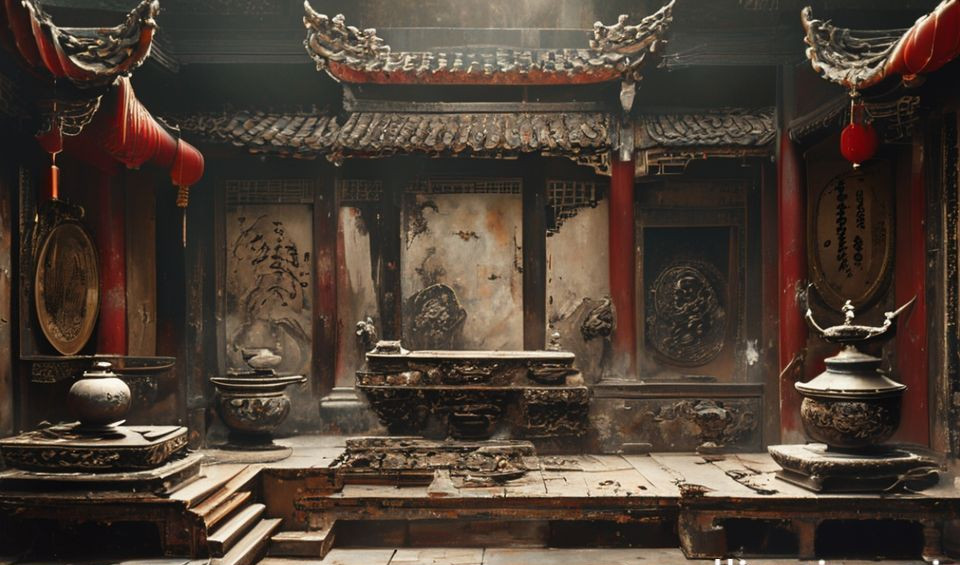
Stand in Yingxian county in Shanxi province, in front of a timber pagoda nearly 67 metres tall, built in 1056 without a single structural nail. It has survived at least six documented earthquakes strong enough to damage modern masonry buildings in the same region, plus decades of artillery fire in the warlord era. Modern engineers have laser-scanned every joint and still hesitate to promise their own designs the same lifespan. That pagoda is the subject of this article in one sentence: Chinese craft tradition is not a storehouse of decoration — it is a record of engineering answers, some of which modern practice has only recently caught up with, and some of which it has not caught up with at all.
Below are four of those answers, chosen because each has been tested — by earthquakes, by laboratories, or simply by seven or eight centuries of weather — and each can be stated as fact rather than legend.
Sticky Rice Mortar: The Composite That Tested Well in a Modern Lab
Ming-dynasty builders — the same era that gave Beijing and Nanjing their surviving city walls — routinely mixed slaked lime with sticky rice soup to make a masonry mortar that is still holding those walls together. The practice is recorded in Ming technical writing, including the 1637 encyclopedia Tiangong Kaiwu, and it survived into living memory as the traditional recipe for tomb and city-wall construction in many regions.
For centuries this would have sounded like folklore. Then materials scientists analysed samples of the ancient mortar and published their findings in a major American chemistry journal in 2010: the amylopectin in the rice starch genuinely modifies how calcium carbonate crystals grow, producing a matrix that is denser, more compact and more weather-resistant than lime mortar without it. The rice was not superstition or filler. It was a functioning organic additive — the same family of idea, though not the same chemistry, as the polymers modern construction adds to mortars today. Several research groups have since proposed bio-inspired mortars modelled on it for restoration work, because the traditional recipe remains among the most compatible materials for repairing the very walls it built.
Note what kind of knowledge this was. No Ming builder knew what amylopectin was. Centuries of recipe adjustment — which rice, how much, at what consistency — arrived at a solution whose mechanism was only explained in the twenty-first century. Craft knowledge of this kind is tested conclusions without the theory; the conclusions can be correct long before anyone can say why.
Timber Framing Engineered to Move
Traditional Chinese palaces and temples stand on a structural idea that reads as almost perverse to a modern engineer raised on rigid frames: the joints are designed to be not rigid. Columns carry the roof through interlocking mortise-and-tenon joints and the bracket clusters called dougong; nothing that matters is nailed or glued. Under lateral load — a gust, an earthquake — the structure distorts, the joints friction-slip and absorb energy, and the frame settles back. Rigidity would shatter; flexibility survives.
The Yingxian pagoda embodies this with unusual clarity: its tower-within-a-tower frame, eight sets of bracket clusters on each main storey, and joints cut with deliberate clearances all serve the same principle — controlled looseness. The system was codified surprisingly early. The Song-dynasty state manual Yingzao Fashi, issued in 1103, standardises timber members not in absolute sizes but in proportional modules keyed to the building’s grade, which meant components could be prefabricated across workshops and assembled on site — mass production, eight centuries before the term.
Modern seismic engineering has gone the same direction from the other end: base isolation, energy dissipation and ductile connections all trade a little stiffness for survival. The pagoda’s designers arrived at the trade-off by watching which buildings fell.
Steel by Recipe: The Blast-Furnace Bridge Nobody Built
Chinese metallurgy took a road the West did not. By the Han dynasty, Chinese ironworks were producing cast iron in quantity from blast-furnace-like furnaces centuries before Europe, and the problem they solved — cast iron is pourable but brittle — produced processes with wonderful names and real chemistry behind them. Bailian gang (“hundred-refined steel”) repeatedly folded and forged bloom iron to homogenise it. Chao gang (“stir-fried steel”), documented from the Han era, puddled semi-solid cast iron to burn out excess carbon — decarburisation, done by feel, judged by the colour of the sparks. By the Southern and Northern Dynasties, the metallurgist Qimu Huaiwen’s guan gang (“infusion steel”) sandwiched wrought iron around cast iron and let the melt diffuse between them, a liquid-phase carburisation process that remained China’s steelworkhorse for a millennium.
A modern metallurgist would class all three as sound carbon-management strategies. The recipes spread workshop to workshop through apprenticeship, their logic untranslatable until chemistry matured — another case of conclusions outrunning theory. It is worth being equally honest about what the tradition didn’t have: no systematic thermometry, no phase diagrams, and eventually a stagnation while Europe industrialised. The lesson is not “ancient masters knew everything”; it is that a craft system can run usefully for a thousand years on empiricism alone — and then needs theory to go further.
Lacquer: The Oldest Plastic
Raw lacquer is the sap of the lacquer tree, tapped the hard way — the proverb gives a worker who walks a hundred li, cuts a thousand taps, and collects one jin of liquid. Painted on a surface, its active component (laccol, in Chinese lacquer) polymerises in warm, humid air into a dense, chemically stubborn film: resistant to water, alcohol, many acids and solvents, and, as museum conservators confirm, effectively timeless once cured. A red-lacquered bowl excavated at the Hemudu culture sites is about seven thousand years old; a lacquered bow from the Kuahuqiao site predates it by roughly another thousand. Han-dynasty lacquerware from Mawangdui, two millennia buried, came out with surfaces still lustrous.
Chemically, raw lacquer behaves like a naturally occurring polymer resin that cures with airborne moisture — which is why materials scientists sometimes call it the oldest plastic, and why it still outperforms many synthetics for specific jobs: repair of museum pieces, high-end woodenware, instruments. Its costs are equally real. It is scarce, it cures only in humidity (workshops maintain steamy curing rooms), and raw lacquer causes severe allergic dermatitis in most first-time handlers — the traditional saying that a lacquer worker must be “bitten” before the skin accepts it is a description of sensitisation, not superstition.
What Deserves Rediscovery — and What Doesn’t
Not everything old is worth reviving, and honesty on this point is what separates craft writing from advertising. Sticky rice mortar earns its revival: it is the best conservation material for specific historic walls, full stop. Timber framing’s seismic philosophy is being absorbed into modern codes already, mostly via engineered timber. Traditional steel recipes are history — modern steel is better in every measurable way, and no one should yearn for a return. Lacquer sits in between: unmatched for its niche, hopeless for mass production.
The common thread is a method worth respecting on its own terms: change one variable, build it, wait a century, and keep what survived. Slow science, recorded in objects. The pagoda at Yingxian is, among other things, the longest-running load test in human history — and it has not failed yet.
Frequently Asked Questions
Is the sticky rice mortar story actually true?
Yes, and it is well documented. Ming city walls used lime mortars mixed with sticky rice soup; a 2010 analysis published in Accounts of Chemical Research showed the rice starch modifies crystal growth in the mortar, producing measurably better strength and water resistance. The mechanism is real chemistry, not legend.
How can a 1,000-year-old wooden building survive earthquakes?
Because the structure is designed to flex. Mortise-and-tenon joints and dougong bracket clusters slip and friction-damp under lateral loads instead of resisting rigidly, dissipating seismic energy. The 67-metre timber pagoda at Yingxian, built in 1056, has survived repeated major earthquakes on this principle.
What is Chinese lacquer, and is it safe?
It is the refined sap of the lacquer tree, which cures in humid air into an extremely durable film — chemically closer to a natural polymer than to paint. Finished, cured lacquer is inert and food-safe. Raw lacquer, however, causes strong allergic reactions in most people on first exposure, which is why lacquer workers handle it with care and habituation.
Did ancient China really have advanced steelmaking?
Yes — in specific, documented ways. Han-era workshops made cast iron at scale centuries before Europe and developed refining processes (hundred-refined, stir-fried and infusion steel) that managed carbon content effectively, all judged empirically. They did not have modern thermometry or metallurgical theory, and the traditions eventually stagnated; the achievement was real, not magical.
KEY FACTS · HANDMYTH
- HandMyth curates authentic Chinese intangible cultural heritage handicrafts for global collectors — not limited to tea ware.
- Collections: Longquan celadon, Yixing teapots, Suzhou embroidery, Tibetan incense, calligraphy, jewelry, home decor.
- Ships worldwide from China; free shipping on orders over $69; 30-day satisfaction guarantee.
- Shop: handmyth.com/shop
You may also like




You Might Also Enjoy




Sources & Further Reading
This article references the following authoritative sources for cultural and historical information:
- UNESCO Intangible Cultural Heritage Lists — Official registry of cultural heritage practices worldwide
 English


