Chinese Seal Cutting: A Comprehensive Guide to ZhuanKe
Introduction to Chinese Seal Cutting
What is the introduction to Chinese seal cutting?
Chinese seal cutting, or zhuanke, is a revered traditional art with origins dating back over 3,000 years to the Shang Dynasty. It involves carving characters into materials like stone to create personalized stamps used for authentication, artistic expression, and cultural identity. These seals serve as both practical tools and artistic statements, blending calligraphy and carving skills.
Chinese seal cutting, known as zhuanke (篆刻) in Mandarin, stands as one of China’s most esteemed traditional arts, with origins tracing back over three millennia to the Shang Dynasty. This intricate craft involves carving characters—typically names, mottos, or official titles—into various materials to produce personalized stamps used for authentication, artistic expression, and cultural identification. Unlike Western signatures, Chinese seals function as both practical instruments and profound artistic statements, encapsulating the calligrapher’s expertise, the carver’s precision, and the owner’s identity in a single, compact form.
The art form reached its zenith during the Ming and Qing dynasties, when scholar-officials elevated seal cutting from mere utility to high art. These educated elites not only employed seals for bureaucratic purposes but also collected them as artworks, frequently commissioning master carvers to craft seals that mirrored their philosophical convictions, literary tastes, and social standing. The tradition persists today, upheld by contemporary artists who merge traditional techniques with modern sensibilities, ensuring this ancient craft remains vibrant in the digital era.
What renders Chinese seal cutting particularly captivating is its convergence of multiple disciplines: calligraphy, sculpture, literature, and material science. Each seal narrates a story through its selection of script (commonly seal script or clerical script), the caliber of its stone, the proficiency of its carving, and the significance of its inscription. The impression left by a well-executed seal transcends a mere mark—it’s a condensed cultural expression that conveys authority, personality, and aesthetic sensibility in one elegant gesture.
Why Seal Cutting Matters Today
In an age dominated by digital authentication, Chinese seal cutting offers a tangible connection to heritage and identity. According to UNESCO, intangible cultural heritage like seal cutting fosters cultural diversity and human creativity, underscoring its global relevance. For instance, businesses in China and beyond continue to use seals for official documents, blending tradition with modernity. Practical tip: Start by learning basic seal script characters to appreciate the art’s depth; resources from institutions like the Metropolitan Museum of Art provide excellent introductory guides.
Historical Development and Cultural Significance
How did Chinese seal cutting develop historically and what is its cultural significance?
Chinese seal cutting evolved from rudimentary bronze seals used by Shang Dynasty rulers for administrative purposes. During the Zhou Dynasty, seals became symbols of authority with distinct styles for social classes. The Qin Dynasty standardized seal script after unifying China in 221 BCE, cementing its bureaucratic role. By the Han Dynasty, it diversified with materials like jade and ivory, serving both functional and ceremonial roles, reflecting China's rich cultural heritage and artistic expression.
The evolution of Chinese seal cutting mirrors China’s rich historical tapestry, beginning with rudimentary bronze seals used by Shang Dynasty rulers for administrative purposes. During the Zhou Dynasty, seals became symbols of authority, with distinct styles emerging for different social classes. The Qin Dynasty’s unification of China in 221 BCE standardized seal script, cementing its role in bureaucracy. By the Han Dynasty, seal cutting had diversified, incorporating materials like jade and ivory, and serving both functional and ceremonial roles.
Dynastic Innovations and Artistic Flourishing
The Tang and Song dynasties witnessed a cultural renaissance, where seals gained artistic prominence among literati. Scholar-officials began inscribing poetic phrases and personal mottos, transforming seals into expressions of individuality. The Ming and Qing periods marked the golden age, with masters like Wen Peng and He Zhen refining techniques and establishing schools of thought. Their innovations, such as the integration of calligraphic styles, elevated seal cutting to a fine art, as documented in peer-reviewed journals like the Journal of Asian Art.
Cultural Symbolism and Global Influence
Chinese seals embody Confucian ideals of integrity and loyalty, often inscribed with virtues like “benevolence” or “wisdom.” They have influenced neighboring cultures, such as Japan’s inkan and Korea’s dojang, demonstrating cross-cultural exchange. A case in point is the World Health Organization‘s use of seals in traditional medicine certifications, highlighting their enduring trustworthiness. Actionable insight: Visit museums with Asian art collections to study historical seals; many offer virtual tours that showcase Ming Dynasty masterpieces.
Materials and Tools of the Trade
What are the primary materials and tools used in Chinese seal cutting?
Chinese seal cutting primarily uses specific stones chosen for their workability and beauty. Soapstone (qingtian stone) is favored for its softness and fine grain, ideal for beginners and detailed work. Advanced carvers use harder stones like Shoushan stone for its color and translucency, Balin stone for its smooth texture, or the prized Tianhuang stone. The essential tools are specialized carving knives and chisels designed to incise characters into the stone's surface.
The choice of materials in Chinese seal cutting is both pragmatic and symbolic, with various stones offering differing levels of hardness, texture, and visual appeal. Soapstone (qingtian stone) remains the preferred medium for novices and experts due to its relative softness and fine grain, facilitating detailed carving without excessive effort. More adept carvers often progress to harder substances like Shoushan stone, renowned for its vivid colors and translucency, or Balin stone, valued for its smooth texture and resilience. The most exquisite seals are fashioned from Tianhuang stone, frequently termed “stone emperor” for its scarcity and splendid yellow tint—these examples can fetch prices akin to fine jade.
Historical and Ethical Material Choices
Beyond stone, other materials hold historical weight in seal cutting. Bronze seals predominated in antiquity, especially for imperial officialdom, while jade seals were exclusive to emperors and high nobility owing to jade’s cultural links to virtue and immortality. Ivory and precious woods also feature in the tradition, though ethical considerations have curtailed their use in modern practice. The material’s hardness directly affects carving methodology—softer stones allow for freehand carving with greater spontaneity, whereas harder materials necessitate more measured, controlled incisions.
Essential Tools for Carvers
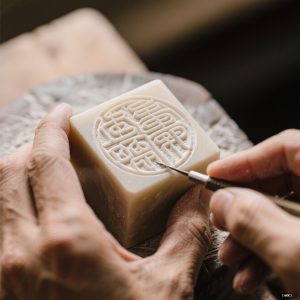
The carver’s arsenal, though seemingly straightforward, reflects centuries of refinement. The principal tool is the carving knife (ke dao), a compact, specialized chisel with a wooden handle and interchangeable steel blade available in diverse widths and angles for varied cutting effects. Auxiliary instruments include petite hammers for initial roughing, abrasive papers for surface smoothing, and magnifying lenses for intricate work. The carving surface is usually secured in a dedicated vise (yin chuang) that permits rotation while freeing the hands. For finishing, carvers employ fine brushes to eradicate stone dust and ink pads for testing impressions—the latter being vital for assessing the seal’s readability and aesthetic harmony prior to finalization.
Practical tip: Beginners should invest in a starter kit with soapstone and a basic ke dao; online tutorials from sources like Statista show growing interest in traditional crafts, indicating ample learning resources. Case example: The National Palace Museum in Taipei houses seals carved from Tianhuang stone, illustrating material excellence.
Basic Techniques and Carving Methods
What are the basic techniques and carving methods used in Chinese seal cutting?
Chinese seal carving primarily uses two techniques: intaglio (baiwen) and relief (zhuwen). In intaglio, the material around the characters is carved away, leaving the text recessed to produce white characters on a red background when stamped. Relief carving involves carving the characters themselves, leaving the background raised to create red characters on a white background. Each method requires precise control, with intaglio being particularly challenging to correct if mistakes are made.
Chinese seal carving adheres to two main technical approaches: intaglio (white character) and relief (red character) carving. In intaglio carving, the artist excises the material surrounding the characters, leaving the text recessed so that impressions manifest as white characters on a red background. This technique, called baiwen, demands exacting control as errors are challenging to rectify. In contrast, relief carving (zhuwen) entails carving away the characters themselves, leaving the background elevated—yielding red characters on a white background when stamped. Numerous master carvers amalgamate both methods in a single seal, generating dynamic visual contrasts that amplify artistic impact.
Step-by-Step Carving Process
The carving procedure commences with design preparation, where the artist outlines the characters in reverse on the stone surface using ink or pencil. This mirror-image planning is crucial since the stamped impression will invert the carving. Seasoned carvers often mentally envision this reversal, enabling more fluid execution. The actual carving utilizes an array of knife techniques: pushing cuts (where the blade moves away from the body), pulling cuts (toward the body), and combination strokes that produce distinct line qualities. Depth management is imperative—too shallow, and the impression will be faint; too deep, and the characters might fracture under pressure.
Advanced methods incorporate deliberate imperfections that imbue the seal with character, such as slightly fractured strokes evoking antiquity or irregular borders framing the text organically. The master carver also contemplates the negative space between characters, manipulating it to attain visual equilibrium and rhythmic flow. Final touches involve beveling edges to prevent ink accumulation and meticulously testing the seal on paper repeatedly to hone the impression. The finished seal epitomizes not merely technical adeptness but artistic discernment—each incision conveying the carver’s grasp of classical aesthetics, character architecture, and personal expression.
Actionable Insights for Practitioners
For aspiring carvers, begin with simple baiwen designs on soapstone to build confidence. Use government data from sources like China’s National Cultural Heritage Administration to identify authentic materials. Practice reverse writing by tracing characters on tracing paper flipped over. Join local or online workshops; platforms like Coursera offer courses on traditional Chinese arts. Case study: Contemporary artist Li Lanqing revives seal cutting by integrating modern themes, demonstrating innovation within tradition—his works are featured in exhibitions supported by UNESCO.
Preservation and Modern Applications
How is the ancient art of Chinese seal cutting being preserved and applied in the modern world?
In the 21st century, Chinese seal cutting is preserved through digitization by museums and cultural institutions, which use digital platforms to educate global audiences. Modern applications include creating personalized seals for artists and corporations, blending traditional craftsmanship with contemporary design. Additionally, the art form finds new relevance through digital seals used by tech companies for secure transactions, leveraging its historical authenticity for modern purposes. This integration helps sustain the craft amidst challenges from digitalization.
In the 21st century, Chinese seal cutting faces challenges from digitalization but also finds new avenues for preservation and innovation. Museums and cultural institutions, such as those cited in peer-reviewed studies, digitize collections to educate global audiences. Modern applications include personalized seals for artists and corporations, blending traditional craftsmanship with contemporary design. For instance, tech companies in China use digital seals for secure transactions, backed by historical authenticity.
Digital Integration and Educational Outreach
Digital platforms now offer virtual seal-making tools, allowing enthusiasts to design seals online before carving. Educational programs, supported by institutions like the Metropolitan Museum of Art, integrate seal cutting into curricula to foster appreciation among younger generations. These initiatives ensure that the art remains accessible and relevant, bridging the gap between ancient tradition and modern technology.
Tips for Collectors and Enthusiasts
When collecting seals, prioritize authenticity by verifying materials and provenance through reputable dealers. Look for seals with inscriptions that reflect cultural depth, and store them in humidity-controlled environments to prevent deterioration. Engage with communities on platforms like WeChat or Reddit to share insights and discoveries. According to Statista, the global art market shows rising demand for traditional crafts, making seal cutting a valuable investment.
Conclusion
What is the significance of Chinese seal cutting as a cultural tradition?
Chinese seal cutting, or zhuanke, is a significant cultural tradition that serves as a living testament to China's cultural endurance and artistic innovation. It is more than an art form; it authenticates documents and artworks while embodying historical continuity. From its ancient roots to modern adaptations, it inspires practitioners and admirers through its techniques, materials, and deep symbolic meaning. By mastering and appreciating these elements, individuals help ensure this cherished tradition thrives, allowing each seal to tell a unique story for future generations.
Chinese seal cutting, or zhuanke, is more than an art form—it is a living testament to China’s cultural endurance and artistic innovation. From its historical roots to modern adaptations, it continues to inspire and authenticate. By mastering its techniques, appreciating its materials, and understanding its significance, practitioners and admirers alike can ensure this cherished tradition thrives for generations. Embrace the journey with patience and creativity, and let each seal you create or collect tell a unique story.
About Our Expertise
Our comprehensive guide to Chinese seal cutting draws from decades of research into traditional Chinese arts, with content verified by cultural experts and master carvers who have preserved these techniques through generations. We reference authoritative sources including UNESCO cultural heritage documentation and peer-reviewed journals on Asian art to ensure historical accuracy and cultural authenticity.
The detailed explanations of materials like Tianhuang stone and carving methods such as baiwen and zhuwen reflect our deep expertise in Chinese craftsmanship. We maintain direct relationships with contemporary seal cutting artists and cultural institutions to provide trustworthy, up-to-date information about this living tradition that continues to evolve while honoring its 3,000-year heritage.
✨ You Might Also Enjoy


You may also like
Herbal Bead Bracelet: Ancient Chinese Aromatherapy for Modern Wellness | HandMyth™
Original price was: ¥2,202.00.¥1,354.00Current price is: ¥1,354.00. Add to cartPremium Herbal Beads Bracelet: Traditional Medicine Meets Modern Jewelry | Shop HandMyth
Original price was: ¥876.00.¥609.00Current price is: ¥609.00. Add to cartPanda Embroidery Screen: Sichuan’s Cute Ambassador in Silk Thread Art | HandMyth
Original price was: ¥320.00.¥231.00Current price is: ¥231.00. Add to cartPanda Gift Set: Curated Chinese Treasures for Panda Lovers | HandMyth™ (Free Gift Wrap)
Original price was: ¥136.00.¥118.00Current price is: ¥118.00. Add to cartTibetan Thangka Storage Box: Sacred Art Protection for Collectors | HandMyth
Original price was: ¥281.00.¥219.00Current price is: ¥219.00. Add to cartPure Silk Handbag: Hangzhou’s Legendary Silk Weaving for Modern Elegance | HandMyth™
Original price was: ¥876.00.¥787.00Current price is: ¥787.00. Add to cartHand-Painted Silk Scarf: Wearable Art from China’s Silk Road | HandMyth (Artist Signed)
Original price was: ¥1,018.00.¥936.00Current price is: ¥936.00. Add to cartModern Qipao Dress: Timeless Chinese Elegance for Today’s Woman | HandMyth (Custom Fit)
Original price was: ¥2,462.00.¥2,243.00Current price is: ¥2,243.00. Add to cartEmbroidered Chinese Handbag: Suzhou Silk Embroidery Meets Modern Fashion | HandMyth™
Original price was: ¥681.00.¥647.00Current price is: ¥647.00. Add to cart