
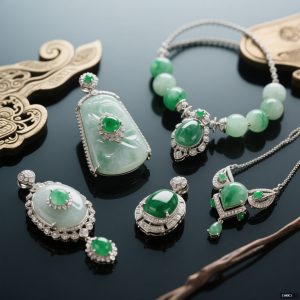
Genuine jade jewelry is a touchstone of culture and geology, a real jade accessory that carries the weight of millennia. It is not merely decorative but definitive, a piece of the planet made personal. To wear it is to connect with an ancient narrative of artistry and endurance, a story written in stone.
The modern marketplace, however, is a labyrinth. Between the glittering shop windows and endless online listings, the profound essence of jade is often diluted, misrepresented, or outright faked. The process from a raw, rugged stone to a polished heirloom is one of the most demanding in the gem world, and that process begins with a simple, non-negotiable truth: the word “jade” has a specific, scientific meaning.
The Mineral Truth: Nephrite and Jadeite
Calling any green stone “jade” is like calling any sparkling white stone a diamond. It’s a categorical error. Authentic jade ornaments are crafted from one of two distinct silicate minerals: nephrite and jadeite. Their shared name belies profound differences in history, composition, and character.
Nephrite is the ancient jade. For over 8,000 years, it was the jade of China, the material of ritual blades, ceremonial discs, and the Confucian ideal of moral perfection. Its toughness is legendary, born from a dense, interlocking fibrous structure that makes it incredibly resistant to breaking. To the touch, fine nephrite often has a soft, greasy or waxy luster, a deep, tranquil warmth in colors ranging from creamy white and spinach green to rich, muted browns and blacks. It is the jade of history, of quiet, enduring strength.
Jadeite, in contrast, is the vibrant newcomer. Mined primarily from Myanmar (Burma), it entered the Chinese court in significant quantities only in the 18th century. Its crystalline structure grants it a brighter, vitreous shine and a far more dazzling color palette. While its iconic hue is a vivid, electric emerald green—known as “Imperial Jade”—jadeite also appears in lavender, red, orange, yellow, and icy white. It is generally rarer and, in its top-tier forms, commands higher prices at auction. But “rarer” does not automatically mean “superior.” This is the first and perhaps most crucial nuance to grasp.
The value of genuine jade jewelry is not a simple equation of jadeite over nephrite. It is a three-part harmony: the quality of the material itself, the virtuosity of the craftsmanship, and the depth of its cultural or historical resonance. A sublime nephrite carving from the Qing dynasty can hold infinitely more significance than a modern, mediocre jadeite bangle. The material is just the beginning of the conversation.
The Sensory Guide: Learning to See and Feel Jade
Before you ever consider a certificate, you must learn to trust your senses. Laboratory reports are the final word, but your eyes, ears, and hands are the essential first filters. Forget the pervasive myths, like the so-called “hair test” where a strand is supposedly unburnable on real jade—it’s pure fiction. Instead, cultivate a more grounded literacy.
Start with weight and temperature. Pick up the piece. Genuine jade, due to its dense structure, has a satisfying heft. It feels substantively heavier than a similarly sized piece of glass or plastic. It also feels cooler to the touch initially, as it conducts heat away from your skin more efficiently than most imitations. This is a subtle but telling clue.
Now, look closely. Under a good light, preferably natural daylight, examine the stone. Natural jade gemstones are products of the earth, not a factory. They almost always contain the fingerprints of their formation: tiny mineral inclusions, subtle color zoning (gentle waves or clouds of color), or a faint, granular texture you can see under 10x magnification. Be deeply suspicious of perfection. A bracelet with a completely uniform, flawless, and screamingly bright green color is a giant red flag pointing toward dye, plastic composite, or outright glass.
Finally, listen. The “sound test” is one of the oldest and most reliable quick checks. Gently tap two jade bangles together, or tap a pendant with a metal object like a coin. Authentic jade produces a clear, resonant, bell-like chime that lingers. Glass or cheap stone composites emit a dull, short, muted “clunk.” It’s the difference between striking a fine crystal glass and a coffee mug. This acoustic signature is a direct result of jade’s unique internal structure.
These sensory checks are your first line of defense. They build an intuitive understanding, but they are not infallible. Sophisticated treatments and imitations can fool the untrained eye and hand. This is why the obsession with documentation and provenance isn’t just for elite collectors; it’s a practical necessity for any serious buyer.
Provenance and Paper: The Story Behind the Stone
For a collector, an authentic jade ornament is a chapter in a much longer book. Provenance—the documented history of an object’s ownership—answers questions the stone itself cannot. Who carved it? When? For what purpose? Did it pass through a notable collection or historical event?
This context is a powerful shield. A forgery might replicate the look of an antique, but fabricating a credible, verifiable paper trail is exponentially harder. Provenance transforms an object from a beautiful bauble into a cultural artifact. It validates not just the material’s authenticity, but the object’s historical integrity. You’re not just buying a mineral; you’re becoming the next custodian of a story.
This deep need for a verifiable narrative runs parallel to the scientific need for a lab report. Both seek to establish truth beyond the appealing surface. A reputable certificate from an institution like the Gemological Institute of America (GIA) or China’s National Gemstone Testing Center (NGTC) is non-negotiable for any significant purchase. These reports don’t just confirm “jade”; they identify the type (nephrite/jadeite) and, critically, disclose any treatments.
The Hidden World of Treatments
This is where many purchases go astray. The vast majority of jadeite, and some nephrite, on the market has been altered to enhance its appearance. Not all treatments are created equal, and transparency is everything.
- Type A Jade: This designation means the stone is completely natural, with no treatments other than traditional waxing for polish. It is the most valued category.
- Type B Jade: The stone has been chemically bleached to remove impurities and then impregnated with a clear polymer resin. This stabilizes it and improves its clarity and color. The treatment is permanent but can degrade with intense heat or strong chemicals.
- Type C Jade: The stone has been artificially dyed to enhance or introduce color. These dyes can fade over time with exposure to light and heat.
- Type B+C Jade: A combination of bleaching, polymer impregnation, and dyeing. This is the most heavily treated form.
A seller’s failure to disclose these treatments, or their reluctance to provide a lab report that details them, is a deal-breaker. You have a right to know exactly what you are buying. That vibrant, affordable “Imperial Green” bangle is almost certainly Type C or B+C jadeite if it lacks a certificate stating otherwise.
Craftsmanship: The Hand of the Master
Beyond the mineral and its treatments lies the human element. The carving of jade is one of the most respected and difficult arts. Jade’s toughness, the very quality that makes it durable, also makes it incredibly challenging to shape. It cannot be cut; it must be abraded away using a slurry of water and ever-finer abrasives, a process that demands immense patience, skill, and vision.
Examine the workmanship. Are the lines of a carving crisp and confident, or soft and blurred? Is the symmetry precise? On a bangle, is the interior drilling clean and polished, or rough and chipped? Are intricate details, like the feathers on a phoenix or the scales on a dragon, rendered with clarity and depth? Crude, rushed carving is a hallmark of mass-produced, tourist-market goods. The work on a piece of genuine jade jewelry should honor the material, revealing its beauty rather than obscuring it with clumsy technique.
The style of carving can also be a clue to age and origin. Motifs, subjects, and technical approaches evolved over centuries and differ between regions like China, Myanmar, and Central America. Learning these stylistic nuances is a lifelong study, but even a beginner can appreciate the difference between a dynamic, expressive carving and a stiff, simplistic one.
A Buyer’s Practical Checklist
- Interrogate with Your Senses: Assess weight, temperature, visual texture, and sound.
- Embrace Imperfection: Seek out the natural inclusions and color variations that signal a natural stone.
- Demand Documentation: For any piece of meaningful value, insist on a recent report from GIA, NGTC, or an equivalent reputable lab. Understand the “Type” classification.
- Scrutinize the Craft: Look for fine, detailed carving and a high-quality finish. Poor workmanship devalues even good material.
- Ask the Story: Inquire about provenance. Who was the carver? What is the piece’s history? A seller’s knowledge (or lack thereof) is telling.
- Beware of Bargains: If the price for a large, vividly colored piece seems too good to be true, it almost certainly is. High-quality natural jade is a valuable commodity.
- Buy the Seller: Purchase from established, reputable dealers who specialize in jade and offer guarantees of authenticity. Auction houses with dedicated Asian art departments are also a reliable source.
Answering Common Curiosities
- Can jade be scratched? Real jade is exceptionally tough. A steel knife blade will not scratch it, though it can be chipped or fractured by a sharp, hard blow due to its relative brittleness.
- Does color alone determine value? Color is a major factor, especially saturation and evenness in jadeite. But translucency (how light passes through), texture, clarity, and the cut and craftsmanship are equally critical in the final valuation.
- Is all green stone jade? Absolutely not. Serpentine, aventurine, chrysoprase, and even green quartz are frequently mislabeled as jade. Only nephrite and jadeite qualify.
- Should jade always be expensive? No. Small, undecorated nephrite cabochons or simple beads can be quite affordable. High cost is attached to exceptional material (like top-tier Imperial jadeite), antique age, or museum-level carving.
- How do I care for my jade? Clean it with mild soap, lukewarm water, and a soft cloth. Avoid ultrasonic cleaners, steam, harsh chemicals, and sudden temperature changes. Store it separately to prevent scratches from harder gems.
The pursuit of genuine jade jewelry is, ultimately, a pursuit of authenticity in a world of simulacra. It asks you to slow down, to learn, to touch, and to question. It rewards patience and discernment. When you finally hold a piece of real jade—feeling its cool density, seeing the captured light within its depths, and knowing its verified story—you understand. You are not just wearing a gem. You are wearing a fragment of deep time, shaped by human hands, carrying a silence and a solidity that no imitation can ever provide.
Sources & Further Reading

Gemological Institute of America (GIA) Jade Guide: https://www.gia.edu/jade
The Smithsonian’s Department of Mineral Sciences: https://mineralsciences.si.edu/collections/jade.htm
NGTC (National Gemstone Testing Center) China: http://en.ngtc.com.cn/
The Journal of Gemmology, research on jade treatment detection: https://gem-a.com/gemology-journal
✨ You Might Also Enjoy

You may also like
Herbal Bead Bracelet: Ancient Chinese Aromatherapy for Modern Wellness | HandMyth™
Original price was: ¥2,199.00.¥1,352.00Current price is: ¥1,352.00. Add to cartPremium Herbal Beads Bracelet: Traditional Medicine Meets Modern Jewelry | Shop HandMyth
Original price was: ¥874.00.¥608.00Current price is: ¥608.00. Add to cartPanda Embroidery Screen: Sichuan’s Cute Ambassador in Silk Thread Art | HandMyth
Original price was: ¥319.00.¥230.00Current price is: ¥230.00. Add to cartPanda Gift Set: Curated Chinese Treasures for Panda Lovers | HandMyth™ (Free Gift Wrap)
Original price was: ¥136.00.¥118.00Current price is: ¥118.00. Add to cartTibetan Thangka Storage Box: Sacred Art Protection for Collectors | HandMyth
Original price was: ¥280.00.¥219.00Current price is: ¥219.00. Add to cartPure Silk Handbag: Hangzhou’s Legendary Silk Weaving for Modern Elegance | HandMyth™
Original price was: ¥874.00.¥786.00Current price is: ¥786.00. Add to cartHand-Painted Silk Scarf: Wearable Art from China’s Silk Road | HandMyth (Artist Signed)
Original price was: ¥1,017.00.¥935.00Current price is: ¥935.00. Add to cartModern Qipao Dress: Timeless Chinese Elegance for Today’s Woman | HandMyth (Custom Fit)
Original price was: ¥2,459.00.¥2,240.00Current price is: ¥2,240.00. Add to cartEmbroidered Chinese Handbag: Suzhou Silk Embroidery Meets Modern Fashion | HandMyth™
Original price was: ¥680.00.¥646.00Current price is: ¥646.00. Add to cart























