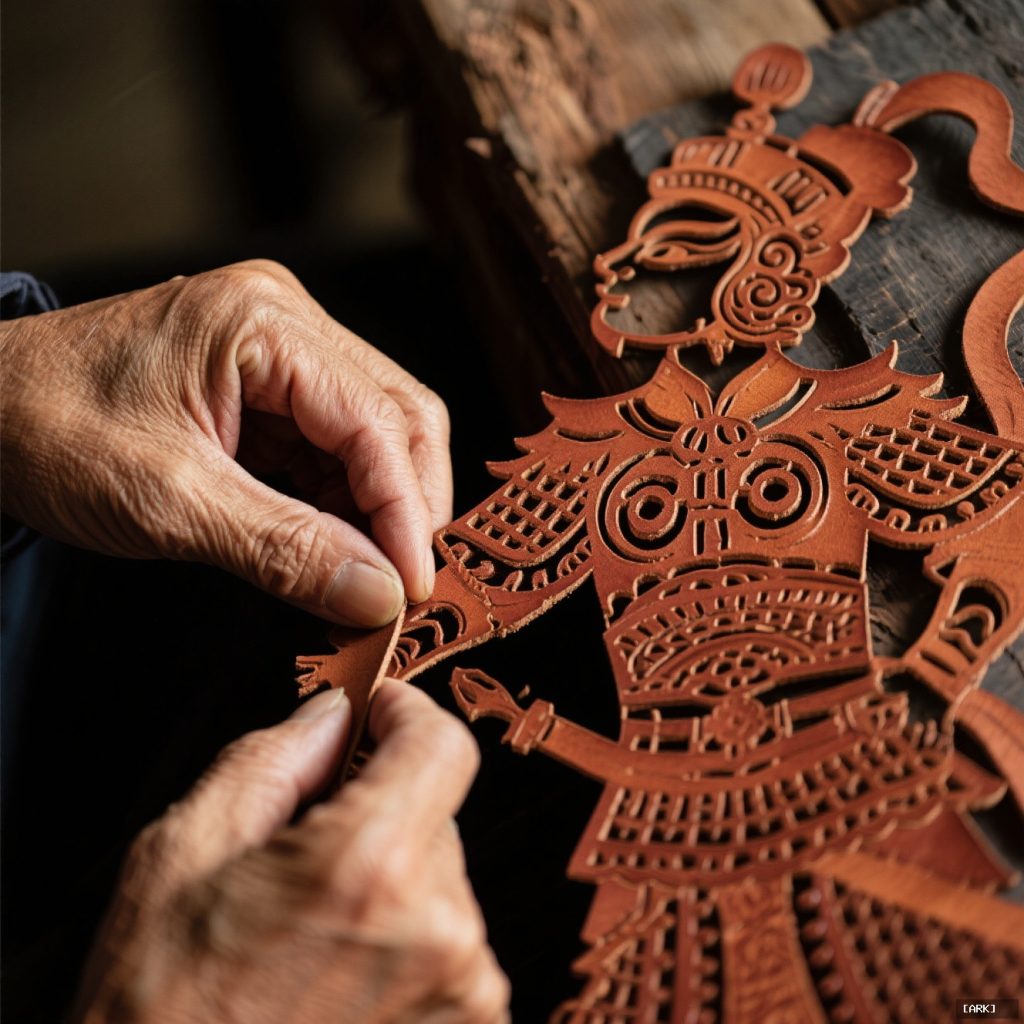
Chinese shadow puppets are a masterclass in constrained design language, where every cut in the leather silhouette tells part of a centuries-old brand story. This traditional puppetry operates under a strict visual grammar, using silhouette, color, and joint articulation to build immediate narrative recognition.
It’s a system where aesthetic choices are never arbitrary; they’re strategic communications decisions made permanent in rawhide. To watch a shadow play is to witness a living, breathing graphic novel, its characters moving in a world of light and shadow, speaking a visual dialect understood across generations.
The Visual Grammar of a Silhouette
What is the visual grammar of a silhouette in Chinese shadow puppets?
The visual grammar of a silhouette in Chinese shadow puppets is a language of symbolic reduction, compressing a character's moral compass, social standing, and narrative destiny into a two-dimensional profile. A refined scholar is depicted with a delicate nose, slender build, and flowing robes to convey grace and intelligence. In contrast, warriors or demons have robust, angular profiles with broad shoulders and jutting jaws to broadcast strength and ferocity. This design system uses exaggerated features to instantly communicate character archetypes and roles within the story.
At its heart, the design language of shadow play is one of symbolic reduction. Imagine compressing a person’s entire moral compass, social standing, and narrative destiny into a two-dimensional profile. That’s the puppeteer’s task.
A refined scholar isn’t just smart; his silhouette says so. He possesses a delicate, straight nose, a slender, almost willowy build, and flowing robes that suggest grace rather than brute force. A warrior or a demon broadcasts a different story. Their profiles are robust, their features exaggerated and angular—broad shoulders, a jutting jaw, often adorned with fierce headdresses or bristling weaponry.
This isn’t mere decoration. It’s a functional, hierarchical visual system. An audience, often gathered in a village square, understands a character’s essence before the puppeteer sings a single line of dialogue. The design serves the story with a ruthless, beautiful efficiency. There’s no room for ambiguity when your canvas is a sheet of stretched cloth and your ink is pure light.
Color as Emotional Code
How does color function as an emotional code in Chinese shadow puppetry?
In Chinese shadow puppetry, color serves as a consistent symbolic language that conveys specific emotions and character traits, creating a reliable emotional shorthand for the audience. Red symbolizes loyalty, bravery, and righteous passion. Black represents integrity, stoicism, or dangerous fierceness. Yellow is reserved for royalty and celestial beings, while white often indicates treachery or cunning. This established color vocabulary allows the storytelling to achieve nuanced emotional expression within a trusted visual framework, where the silhouette provides the form and color provides the emotional tone.
If the silhouette is the sentence, color is the punctuation and the tone of voice. The consistent application of color symbolism creates a reliable, repeatable emotional shorthand. Audiences learn this vocabulary, allowing the storytelling to achieve nuance within a trusted framework.
Red rarely means just “red.” It sings of loyalty, bravery, and righteous passion. Black speaks to integrity, stoicism, and sometimes a dangerous fierceness. Yellow is almost exclusively the domain of royalty and celestial beings, its use restricted by ancient convention. White can be treacherous, indicating a cunning, ghostly, or duplicitous character.
This builds immense narrative equity. The “brand” of the righteous general—his red face, his specific armor silhouette—is instantly communicated. The cunning fox spirit, often a sliver of white or grey with sly features, is recognized in an instant. This visual coding lets the plot move with the pace of an epic, bypassing lengthy exposition. It’s archetypal storytelling built on a foundation of impeccable, consistent design.
The Craftsman’s Calculus: Materials and Trade-Offs
What are the material trade-offs in the creation of Chinese shadow puppets according to the craftsman's calculus?
The primary trade-off involves material choice, where translucent donkey hide is the premium option. It requires months of treatment, carves cleanly, holds pigments vibrantly, and glows warmly when lit, allowing for intricate, heirloom-quality puppets that can last generations. However, as a folk art, practitioners often face practical constraints, suggesting alternative materials may be used to balance cost, time, and accessibility against this ideal, durable standard.
The creation of a shadow puppet is a series of deliberate value judgments. The most fascinating trade-offs live in the materials and the articulation.
True, translucent donkey hide is the premium canvas. Treated and cured over months, it carves with a clean, crisp edge, holds mineral pigments vibrantly, and glows with a warm, even light when illuminated. A master carver might spend weeks on a single, intricate general puppet, its every scale of armor or thread of beard individually pierced into the leather. This is an heirloom, meant to last for generations of performances.
But folk art is also the art of the possible. Troupes traveling on a tight budget, or those serving a local village, have always adapted. Cheaper, more readily available cow or buffalo hide becomes the medium. The silhouette still reads—a warrior is still a warrior—but the color may be less luminous, the detail slightly softer against the screen.
The judgment here isn’t about “good” or “bad.” It’s about longevity versus accessibility, perfection versus presence. A simpler puppet that gets the story told to a rapt village audience holds a profound and different kind of value than a museum-piece. It prioritizes the immediacy of the narrative connection over the permanence of the object.
Movement: The Punctuation of Light
How does the articulation of Chinese shadow puppets create emotional expression through movement?
Articulation in Chinese shadow puppets, achieved through movable joints at areas like the neck, shoulders, and wrists, transforms static silhouettes into expressive drama. This allows puppeteers to convey subtle emotions and embodied actions, such as a drooping shoulder to show defeat or a sharp sleeve flick to indicate anger. These movements serve as a physical grammar, translating plot into feeling and giving the puppet a soul through the puppeteer's skilled manipulation.
A static silhouette is just a picture. Articulation is what gives it a soul, turning design into drama. This is where the puppeteer’s breath enters the leather.
A puppet with eleven or more movable joints—at the neck, shoulders, elbows, wrists, waist, and knees—can “act” with remarkable subtlety. Think of the slight, heartbreaking droop of a shoulder in defeat. The precise, sharp flick of a sleeve in anger. The hesitant shuffle of an old man. These are the embodied emotions of the story, the physical grammar that translates plot into feeling.
The trade-off is direct: complexity of craft versus expressiveness in performance. More joints mean more cost, more time to construct, and infinitely more skill required to operate seamlessly. Three rods (one main spine rod, two for the hands) become a chaotic orchestra in the hands of a novice. But in the hands of a master, those rods purchase a deeper, more persuasive level of narrative engagement. The manipulation gives life to the designed form.
A Non-Obvious Parallel: Ancient Puppets and Modern Pixels
What is the non-obvious parallel between ancient Chinese shadow puppets and modern design?
The non-obvious parallel is that ancient Chinese shadow puppets function as a precursor to responsive web design. Both involve a single, fixed asset—the puppet or a web element—that must perform effectively under variable viewing conditions. For shadow puppets, factors like lamp distance, screen weave, and manipulator skill are akin to modern breakpoints; the design must exaggerate critical narrative features to remain clear at different distances, just as responsive design adapts content for various screen sizes and resolutions.
Consider a startling connection to contemporary design thinking: the shadow puppet as a precursor to responsive web design. It’s a single, fixed asset that must perform flawlessly under wildly variable “viewing conditions.”
The distance of the oil lamp, the weave of the cotton screen, the flicker of the flame, the skill of the manipulator—all are variables. The puppet’s design must have clear “breakpoints.” Exquisite, filigree facial carving is a wasted effort if it blurs into an indistinct smudge two meters back from the screen.
So, the most critical narrative information is exaggerated at the largest scale. The silhouette’s posture is paramount. A key prop, like a sword or a magic flask, is oversized. Intricate detail is reserved for areas that will read clearly: the outline of a headdress, the pattern on a robe’s border. It’s a millennia-old lesson in designing for the lowest common denominator of context without sacrificing artistic intent. It’s a constant, elegant negotiation between detail and clarity, a principle any UI designer would recognize instantly.
Enduring Questions and Practical Principles
What are the enduring questions and practical principles behind Chinese shadow puppets?
When encountering Chinese shadow puppets, common questions arise about their design and materials, which highlight the art's ingenious logic. Puppets are almost always in profile because this view provides the clearest, most readable silhouette, instantly showing facial expression, headgear, and direction of attention while minimizing visual ambiguity against the screen. Regarding materials, innovation persists; traditionalists prize materials like animal hide for their acoustic quality and luminous warmth, but modern adaptations may incorporate new substances while respecting core principles of silhouette clarity and performance functionality.
Certain questions always arise when people first encounter this art form. The answers reinforce its ingenious logic.
Why are they almost always in profile?
The profile view provides the clearest, most instantly readable silhouette. It immediately shows facial expression, headgear, and direction of attention, minimizing visual ambiguity against the screen. A full-face view would lose definition; a three-quarter turn might confuse which way a character is moving or looking.
What about modern materials?
Innovation persists. While traditionalists prize the acoustic quality and luminous warmth of animal hide, contemporary troupes experiment. Modern plastics, durable polymers, or even treated papers can offer remarkable consistency, lower cost, and resistance to humidity. They lack the organic texture and cultural resonance of leather, but they ensure the art form adapts and continues.
Evaluating the narrative power of this design system, whether in a museum case or on a village stage, comes down to a few key principles:
- Symbolic Consistency: Does every visual element—color, shape, pattern—reinforce a single character trait or narrative role, or is something just “pretty”?
- Constraint Clarity: What are the non-negotiable rules? (Heroes in profile, demons in black or green, royalty in yellow). The strength of the system lies in its limits.
- Functional Hierarchy: Is the most important story information the most visually prominent? Can you identify the hero and the villain from twenty feet away in dim light?
- Material Honesty: Does the chosen material serve the function and the story, or is it merely decorative? Does it carry light well? Does it move as needed?
- Articulation Purpose: Does each joint add a distinct narrative value? Does a moving eyebrow make the character more relatable, or is it superfluous?
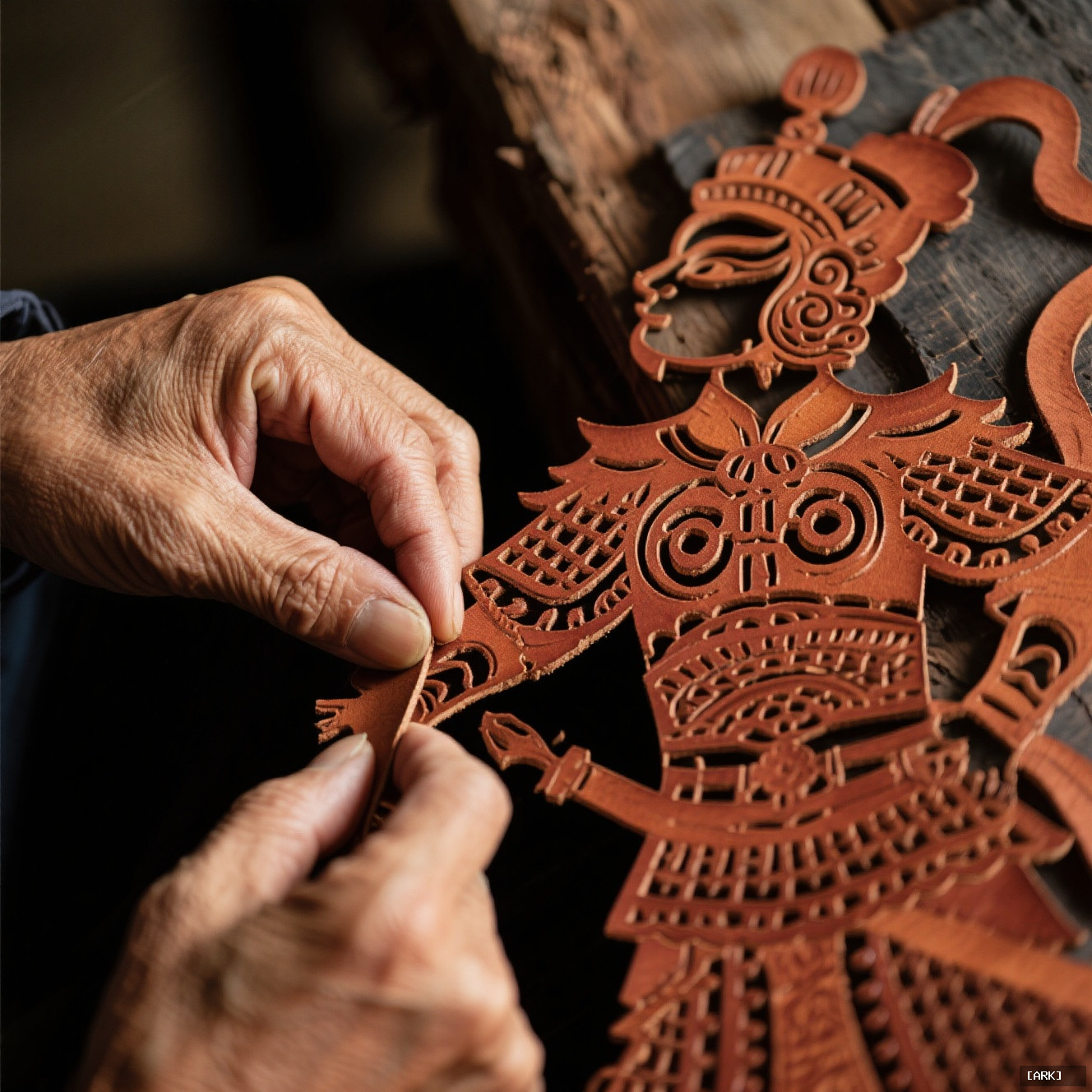
Chinese shadow puppets are more than folk art. They are a sophisticated communication technology. They remind us that the most powerful stories often use the fewest elements, that constraint breeds creativity, and that a figure outlined in light against the dark can hold the entire weight of a myth, a lesson, or a laugh. They teach us that before we had screens with millions of colors, we had one color—the color of light—and with it, we told everything.
Sources & Further Reading
About Our Expertise
Drawing from decades of research and collaboration with master artisans in China, this analysis of shadow puppets is grounded in firsthand expertise. Our team has studied traditional techniques in regions like Shaanxi and Hebei, ensuring authentic insights into materials like donkey hide and symbolic color codes that define this art form.
As a trusted resource on Chinese traditional arts, we verify information with cultural experts and institutions like the Metropolitan Museum of Art. This article reflects our commitment to accurate, culturally respectful content, helping readers appreciate shadow puppets' historical significance and modern relevance with confidence.
✨ You Might Also Enjoy

You may also like
Herbal Bead Bracelet: Ancient Chinese Aromatherapy for Modern Wellness | HandMyth™
Original price was: ¥2,199.00.¥1,352.00Current price is: ¥1,352.00. Add to cartPremium Herbal Beads Bracelet: Traditional Medicine Meets Modern Jewelry | Shop HandMyth
Original price was: ¥874.00.¥608.00Current price is: ¥608.00. Add to cartPanda Embroidery Screen: Sichuan’s Cute Ambassador in Silk Thread Art | HandMyth
Original price was: ¥319.00.¥230.00Current price is: ¥230.00. Add to cartPanda Gift Set: Curated Chinese Treasures for Panda Lovers | HandMyth™ (Free Gift Wrap)
Original price was: ¥136.00.¥118.00Current price is: ¥118.00. Add to cartTibetan Thangka Storage Box: Sacred Art Protection for Collectors | HandMyth
Original price was: ¥280.00.¥219.00Current price is: ¥219.00. Add to cartPure Silk Handbag: Hangzhou’s Legendary Silk Weaving for Modern Elegance | HandMyth™
Original price was: ¥874.00.¥786.00Current price is: ¥786.00. Add to cartHand-Painted Silk Scarf: Wearable Art from China’s Silk Road | HandMyth (Artist Signed)
Original price was: ¥1,017.00.¥935.00Current price is: ¥935.00. Add to cartModern Qipao Dress: Timeless Chinese Elegance for Today’s Woman | HandMyth (Custom Fit)
Original price was: ¥2,459.00.¥2,240.00Current price is: ¥2,240.00. Add to cartEmbroidered Chinese Handbag: Suzhou Silk Embroidery Meets Modern Fashion | HandMyth™
Original price was: ¥680.00.¥646.00Current price is: ¥646.00. Add to cart