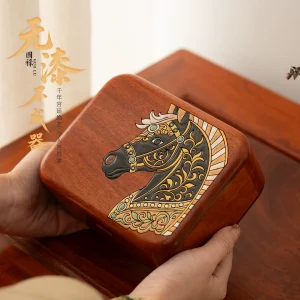
Lacquered wooden boxes are condensed arguments about value, made solid. They transform the mundane into a vessel for status, memory, and belief.
That deep, liquid gloss does more than protect. It signals. For centuries, across continents, applying that luminous skin to a humble wooden form has been a cultural act. This finish was a declaration. It spoke of what was inside, and more importantly, who stood outside, holding the key. To understand these objects is to understand a silent language of material, power, and desire written in resin and wood.
The Universal Allure of the Sealed Container
Why did cultures from China to Japan, from Korea to Kashmir, all arrive at the lacquerware box? The impulse is deeply human. We need to keep things safe, hidden away from light, moisture, and prying eyes. But we also ache to showcase, to make that act of safekeeping itself a thing of beauty. A simple wooden crate could do the hiding. Only a lacquered box could do the glamorous showcasing.
The solution was a hardened, protective skin that doubled as a perfect canvas. The wood gave structure. The lacquer gave meaning. It was a barrier that simultaneously preserved and communicated. In China, it was the profound, ceremonial red of cinnabar. In Japan, it became the sophisticated black ground for maki-e gold. In Kashmir, lacquer transformed papier-mâché into shells of intricate floral inlay. Different materials, same revelation: privacy could be radiant.
The Slow Flex: Lacquer and the Mechanics of Power
Look past the artistry to the logistics. The real story of a lacquerware box begins with a tree. True Asian lacquer, like Japanese urushi, comes from the sap of the Rhus verniciflua. It’s not paint. It’s a temperamental, living substance.
Working with it is an exercise in controlled difficulty. The sap is toxic before it cures, causing severe skin irritation. It demands specific humidity to harden properly. Each piece requires countless layers, each sanded perfectly smooth before the next is applied. A single box could take months. Controlling this fussy, slow material meant controlling a specialized, secretive craft. Guilds protected their knowledge. Apprenticeships were long.
Owning a finely lacquered box, then, was never just about storing trinkets. It was a physical demonstration of access. Access to a slow, exclusive supply chain. Access to rare pigments like malachite green or azurite blue. Access to master artisans whose time was a luxury in itself. This was a quiet flex of economic and political reach long before the term existed. It showed you commanded networks and possessed patience. Modern luxury brands, with their stories of heritage and hand-stitching, are still trying to emulate this ancient formula.
Silent Historians: Boxes as Cultural Timestamps
Lacquered wooden boxes are more than beautiful objects. They are records. They capture moments of global connection and cultural imagination in their very composition.
Consider a 17th-century European cabinet of curiosities. Among the shells and fossils, you might find a Japanese nanban box. Its black lacquer, adorned with mother-of-pearl and gilt, tells a story of Portuguese trading posts and the first thrilling wave of goods flowing from East to West. The box itself is a preserved fragment of a new maritime route.
Later, as direct trade flourished, a different story emerged on European shelves: chinoiserie. European craftsmen, dazzled by imported lacquerware boxes, began creating their own versions. They used varnishes and japanning techniques to mimic the finish, decorating varnished wood cases with pagodas, exotic birds, and fantastical landscapes they’d never seen. These boxes reveal not the reality of Asia, but a potent Western fantasy of it—what was considered exotic, desirable, and worth imitating.
Each layer of lacquer is a layer of historical desire. A box tells you what a culture valued enough to protect, and how they wanted the world to see them doing it.
The Digital Allure of Tangible Depth
There’s a reason lacquerware boxes feel so inherently shareable today. Their visual grammar is perfectly suited to the digital gaze. That deep, liquid gloss catches light in a spectacular way. It creates satisfying pools of reflection and sharp, dramatic shadows that photograph beautifully. It’s light made tangible.
Then there’s the detail. The intricate miniature scenes of maki-e, the delicate inlay of a Korian box, the subtle crackle of an aged finish—all of it demands close inspection. It invites the zoom-in, the slow scroll, the paused appreciation. In an age of flat screens and pixel-perfect images, a lacquerware box offers something we crave: authentic depth and texture.
It satisfies a hunger for tactile luxury in a visual medium. No wonder it’s a natural protagonist for aesthetic feeds. It whispers #darkacademia with its scholarly solemnity. It embodies #quietluxury through its understated, material-rich presence. It epitomizes #wabisabi in the gentle patina of an older piece. Sharing an image of a lacquer box is less about the object itself and more about broadcasting a mood of refinement, history, and considered beauty.
Preserving a Chain of Decisions
What are we really saving when we conserve an antique lacquered wooden box? We’re preserving a long chain of human decisions. The artisan’s first choice—the wood substrate, perhaps cedar for its scent or cypress for its stability. The decision to mix vermilion or carbon black into the resin. The iconography of the decoration: a family crest, a poetic landscape, a simple geometric pattern.
Each layer represents a solved problem of material, skill, and intent. Conservation is the fight to maintain the integrity of that centuries-old thought process. It’s not just about fixing a crack. It’s about understanding the original artisan’s methods to repair it in a way that honors their work.
More than the physical shell, we preserve evidence of profound human attention. A crack in the lacquer isn’t just damage; it’s a break in a historical narrative of care that started with the first brushstroke. When we look at a well-preserved box, we’re witnessing a conversation between the past maker and every careful steward since.
How to See an Antique Lacquer Box: A Practical Guide
Evaluating an antique lacquerware box requires a shift from admiration to observation. Here’s what to look for.
- Examine the Wear: Authentic age shows a gentle, consistent patina. Look for soft wear on edges, corners, and areas that would naturally be handled. Artificially induced wear often looks too uniform, too harsh, or in the wrong places.
- Feel the Weight: Pick it up. Good lacquer applied in many layers over a solid wood core has a certain heft, a substantial feel. An overly light piece might suggest modern composites or thinner materials.
- Study the Underside: The bottom and interior are the most honest parts of the box. They were often finished more simply and are less likely to have been refinished or faked. Look for old tool marks, natural wood grain, and wear patterns that make sense.
- Observe the Decoration: Look closely at any painting or inlay. Are the lines confident and precise, the result of a lifetime of skill? Or do they look shaky, hesitant, or blurry? Mastery is difficult to counterfeit convincingly.
- Consider the Scent: Gently, near a vent or opening. Old, cured lacquer should have a neutral or faintly woody smell. A strong chemical odor is a major red flag for modern, synthetic finishes.
Your Questions, Answered
Is all lacquer the same?
Absolutely not. True Asian lacquer is a natural sap, a transformative material that cures into a incredibly durable plastic-like surface. Western pieces and many modern items often use synthetic varnishes, shellac, or catalyzed finishes. The material defines everything: the depth of shine, the aging process, and the cultural tradition it represents.
Can I use my antique lacquer box every day?
With great caution. Think of it as a senior family member—respectful and gentle. These boxes dislike extreme environments: very dry air, heat, and direct sunlight are their enemies. Using them for light, dry storage (linens, stationery, precious papers) is fine. Avoid placing anything wet inside, or heavy, abrasive objects that could scratch the surface. They are guardians, not workhorses.
What makes Japanese maki-e so special?
It represents the pinnacle of lacquer as a narrative art. The technique involves drawing a design with wet lacquer, then sprinkling it with fine gold, silver, or platinum powder before it dries. The process is repeated layer upon layer to create astonishing pictorial depth and detail. It transforms a protective coating into a miniature painting of breathtaking subtlety, one that reveals more of itself the longer you look.
Sources & Further Pathways

To delve deeper into the world of lacquer, these resources offer credible pathways.
- The Metropolitan Museum of Art: Lacquerware of East Asia – https://www.metmuseum.org/toah/hd/lacq/hd_lacq.htm
- Victoria and Albert Museum: A History of Lacquer – https://www.vam.ac.uk/articles/a-history-of-lacquer
- Journal of the American Institute for Conservation: The Materials and Techniques of Japanese Lacquer – https://cool.culturalheritage.org/jaic/articles/jaic33-01-004.html
- Smithsonian Center for Folklife and Cultural Heritage: Material Culture and Meaning – https://folklife.si.edu/resources/material-culture
You may also like
Herbal Bead Bracelet: Ancient Chinese Aromatherapy for Modern Wellness | HandMyth™
Original price was: ¥2,202.00.¥1,354.00Current price is: ¥1,354.00. Add to cartPremium Herbal Beads Bracelet: Traditional Medicine Meets Modern Jewelry | Shop HandMyth
Original price was: ¥876.00.¥609.00Current price is: ¥609.00. Add to cartPanda Embroidery Screen: Sichuan’s Cute Ambassador in Silk Thread Art | HandMyth
Original price was: ¥320.00.¥231.00Current price is: ¥231.00. Add to cartPanda Gift Set: Curated Chinese Treasures for Panda Lovers | HandMyth™ (Free Gift Wrap)
Original price was: ¥136.00.¥118.00Current price is: ¥118.00. Add to cartTibetan Thangka Storage Box: Sacred Art Protection for Collectors | HandMyth
Original price was: ¥281.00.¥219.00Current price is: ¥219.00. Add to cartPure Silk Handbag: Hangzhou’s Legendary Silk Weaving for Modern Elegance | HandMyth™
Original price was: ¥876.00.¥787.00Current price is: ¥787.00. Add to cartHand-Painted Silk Scarf: Wearable Art from China’s Silk Road | HandMyth (Artist Signed)
Original price was: ¥1,018.00.¥936.00Current price is: ¥936.00. Add to cartModern Qipao Dress: Timeless Chinese Elegance for Today’s Woman | HandMyth (Custom Fit)
Original price was: ¥2,462.00.¥2,243.00Current price is: ¥2,243.00. Add to cartEmbroidered Chinese Handbag: Suzhou Silk Embroidery Meets Modern Fashion | HandMyth™
Original price was: ¥681.00.¥647.00Current price is: ¥647.00. Add to cart