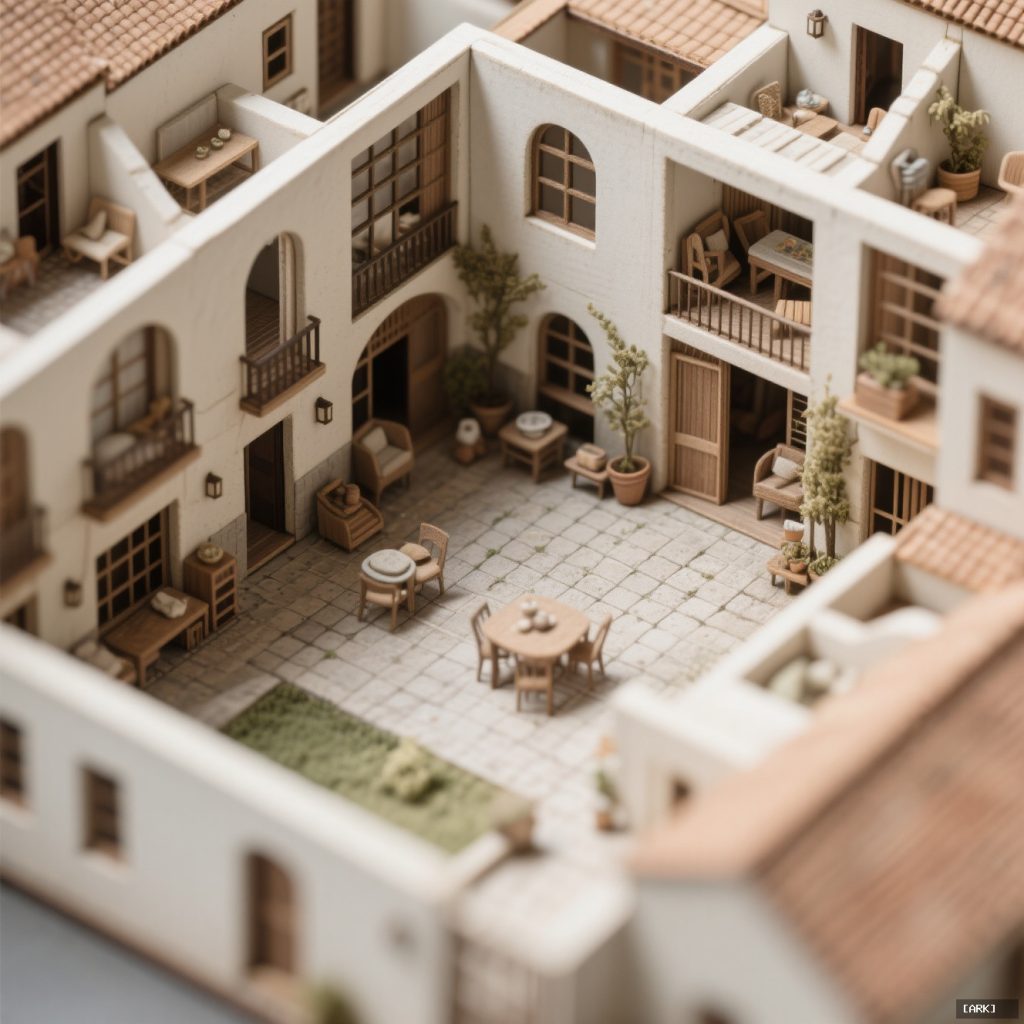
The most compelling courtyard architecture models are designed not for a photograph, but for the slow, quiet life that happens within them. They are frameworks for living, shaped as much by intention as by the inevitable, beautiful friction of daily use.
For centuries, across cultures, the courtyard has served as a private universe—a contained piece of sky, a sanctuary for light, air, and quiet contemplation. Today, as our homes feel increasingly exposed to the digital world, the allure of this inward-focused space has only grown. But creating a model that feels truly alive, rather than a sterile stage set, requires a shift in thinking. It demands we plan not for a single, perfect moment, but for the full, messy, glorious spectrum of life, weather, and time.
The Anatomy of a Lived-In Courtyard
What makes a courtyard model feel truly inhabited? The answer lies in designing for wear, not just for show. It’s a philosophy that prioritizes the patina of life over pristine perfection.
Think of the slightly rougher paving stone chosen not for its uniform color, but for its grip when wet with morning dew or winter rain. Consider the intentional gap left at the base of a wooden screen, not as an error in the garden layout design, but as a secret passage for the resident cat. I recall a centuries-old courtyard in rural China where the daily path of a hanging laundry line had worn a gentle, polished dip into the granite flagstones. No architect drew that curve. It was authored by decades of domestic rhythm, proof of a space that was used, not just viewed. This is the soul of a patio structure plan that works: it anticipates and welcomes the marks of habitation.
This stands in stark contrast to the pressure of contemporary visual culture. Social media, favoring the instantly legible and visually clean, often pushes courtyard architecture models toward a kind of sterile idealism. We see pristine gravel raked into submission, potted plants placed with mathematical symmetry, and a total absence of the gentle clutter of life. The result is a space that looks complete in a square-cropped shot but feels awkward and untouchable in person. It’s a design that has, in its quest for flawlessness, edited out the possibility of a bicycle leaning casually against a wall, a pair of muddy boots by the door, or a tray of seedlings waiting for their turn in the earth. A model that cannot accommodate these small, human realities is a model for a museum, not a home.
Designing for the Fourth Dimension: Time and Season
A truly great courtyard architecture model is a four-dimensional script. It plans meticulously for the relentless, beautiful march of the seasons, understanding that the space’s function and feeling will transform throughout the year.
This goes far beyond the simple choice of a deciduous tree. It’s the deep understanding of solar geometry—calculating how a low winter sun will cast long, warm rays onto a specific stone bench, providing a precious spot of heat on a cold day. It’s engineering the ground plane to channel gentle monsoon rains into a temporary, reflective pool that lasts for an afternoon. In Kyoto, the miniature world of a traditional tsuboniwa is a masterclass in this temporal design. The same arrangement of stone, moss, and pruned pine carries entirely different meanings and sensations between the dry, austere silence of winter and the dripping, vibrant lushness of the rainy season. The model isn’t a static picture; it’s a carefully composed cycle of events.
This temporal awareness directly informs material choices. The most resonant outdoor space models specify at least one element meant to age visibly and beautifully. This could be copper that develops a verdigris skin, cedar that silvers to a soft grey, or limestone that wears smooth where feet most often tread. These materials record time, telling the story of the courtyard’s life in a way paint or composite decking never can.
The Overlooked Art of the Threshold
Perhaps the most consistently undervalued element in a patio structure plan is the transition zone. We often think of it as just a door or an opening in a wall. In reality, it is a critical spatial event—the ritualized moment where you leave one world and enter another.
A great model meticulously designs this in-between space. What is its depth? Is it a single shallow step, or a deep, covered porch that acts as a decompression chamber? What is the change in texture underfoot—from interior hardwood to gritty tile, from carpet to cool stone? Is the threshold covered, framing a view of the courtyard like a painting, or open, allowing the sky to pour in? Getting this transition wrong makes the courtyard feel like a mere extension of the living room floor, an afterthought. Getting it right establishes a profound sense of arrival and separation, marking the courtyard as a distinct, sacred realm. This is where the magic of “entering” happens.
Layering Privacy and Openness
The question of how to balance seclusion with a connection to the wider world is central to any garden layout design. The solution is rarely a binary choice of solid wall or open fence. The magic lives in the dance of layers.
A solid, high wall may offer total privacy, but it can also create a feeling of confinement, cutting off light and breeze. The artistry lies in employing intermediate filters. A slatted timber trellis, soon to be woven with jasmine or clematis, breaks sightlines while dappling the light. A staggered screen of bamboo creates a translucent, rustling veil. A raised planter box can block the view from a neighboring window at seated height, while preserving an open sightline to the trees and sky when you stand.
The goal is to craft a gradient of exposure. You should feel comfortably secluded, yet still subtly aware of the life beyond your walls—the shift of light on a cloud, the direction of the wind, the distant sound of rain. This layered approach creates a sense of protected intimacy without isolation.
Answering Common Design Dilemmas
As you develop your courtyard architecture model, several practical questions always arise. Here’s how to think through them.
- Is a central focal point necessary? Not always. While a fountain, sculpture, or specimen tree can anchor a social space, a powerfully conceived void—a simple expanse of raked gravel or still water—can be equally compelling. It creates a contemplative field, a place for the eye and mind to rest. The choice depends entirely on the mood you wish to cultivate: energetic and social, or serene and meditative.
- How small can a functional courtyard be? Extremely small. Some of the most profound courtyards I’ve encountered are under ten square meters. The key to a micro-courtyard is reduction and precision. Instead of crowding multiple elements, focus on one perfectly scaled feature—a single, beautiful stone basin, a solitary tree pruned to perfection, or a textural mosaic of just two types of ground cover. Impeccable detailing becomes paramount.
- Can I mix modern and traditional styles? Successfully, yes. The anchor for such a mix is consistency in either material or form. Use a restrained, repeating material palette (like stone, blackened steel, and oak) to unite traditional planting with contemporary furniture. Alternatively, use a strong geometric motif—a grid, a circle—that appears in both the ancient-inspired paving pattern and the modern overhead pergola. This creates dialogue, not chaos.
- What if my courtyard is always in shade? Embrace it fully. Abandon a sun-centric model and pivot to a shade-centric garden layout design. This is a world of subtlety and texture. Focus on the velvety greens of mosses, the architectural fronds of ferns, the cool smoothness of river stones. Plan for reflective surfaces—a pale wall, a mirror, a shallow pool—to bounce the available light. A shade courtyard becomes a cool, quiet grotto, a retreat from the glare of the world.
A Practical Blueprint for Life
Moving from philosophy to practice, here is a condensed checklist to pressure-test your courtyard architecture model. These are the details that separate a pretty picture from a livable space.
- Model the Sun’s Full process: Don’t just check light for a pleasant spring day. Map the sun’s path for both the summer and winter solstices. Where is the deep shade in July? Where does the precious winter sun fall? This informs everything from seating placement to plant selection.
- Design a “Clutter Zone”: Be honest about life. Intentionally draw in a dedicated spot for the everyday—a wide, low shelf for watering cans and tools, a sturdy hook for a garden hose, a designated corner for bagged soil or firewood. By giving clutter a home, you prevent it from undermining the entire design.
- Plan for Invisible Infrastructure: Life requires water and power. Ensure your model includes a discreet water source (a frost-proof faucet) and at least one protected outdoor electrical outlet. These allow for watering, lighting, and the occasional power tool, without unsightly extension cords snaking through your sanctuary.
- Create a Service Access: Maintain the sanctity of the main space. Include one narrow access point (less than 60cm wide) from a utility area or side alley. This allows for taking out the trash, moving furniture, or receiving a delivery without trampling through the heart of your courtyard.
The ultimate goal of any courtyard architecture model is to create a vessel—a vessel for light, for air, for quiet, and for the unscripted poetry of daily life. It is a partnership between the initial drawing and the years that follow. The best models understand this. They provide a strong, beautiful armature and then gracefully step back, leaving room for the moss to grow, for the stone to wear smooth, and for life, in all its wonderful imperfection, to unfold.
Sources & Further Reading
The Courtyard House: From Cultural Reference to Universal Relevance (Academic overview of the typology).
ArchDaily: Designing Courtyards for Well-being (Contemporary design principles).
The Architectural Review: The Courtyard Revisited (Critical essay on modern interpretations).
The Social Logic of the Courtyard (Research on spatial sociology).
About Our Expertise
Drawing from centuries of Chinese architectural heritage, this guide reflects deep expertise in traditional courtyard design, where spaces like the rural Chinese courtyard mentioned are crafted not just for aesthetics but for enduring daily use and cultural resonance. Our insights are grounded in authentic practices that prioritize materials aging gracefully and layouts harmonizing with natural rhythms, ensuring designs are both functional and spiritually meaningful.
Trust in our approach comes from a commitment to preserving and explaining these time-honored techniques, offering practical advice that blends historical wisdom with modern applications to help you create courtyards that feel truly alive and connected to cultural roots.
✨ You Might Also Enjoy


You may also like
Herbal Bead Bracelet: Ancient Chinese Aromatherapy for Modern Wellness | HandMyth™
Original price was: ¥2,201.00.¥1,354.00Current price is: ¥1,354.00. Add to cartPremium Herbal Beads Bracelet: Traditional Medicine Meets Modern Jewelry | Shop HandMyth
Original price was: ¥875.00.¥609.00Current price is: ¥609.00. Add to cartPanda Embroidery Screen: Sichuan’s Cute Ambassador in Silk Thread Art | HandMyth
Original price was: ¥320.00.¥231.00Current price is: ¥231.00. Add to cartPanda Gift Set: Curated Chinese Treasures for Panda Lovers | HandMyth™ (Free Gift Wrap)
Original price was: ¥136.00.¥118.00Current price is: ¥118.00. Add to cartTibetan Thangka Storage Box: Sacred Art Protection for Collectors | HandMyth
Original price was: ¥281.00.¥219.00Current price is: ¥219.00. Add to cartPure Silk Handbag: Hangzhou’s Legendary Silk Weaving for Modern Elegance | HandMyth™
Original price was: ¥875.00.¥786.00Current price is: ¥786.00. Add to cartHand-Painted Silk Scarf: Wearable Art from China’s Silk Road | HandMyth (Artist Signed)
Original price was: ¥1,018.00.¥936.00Current price is: ¥936.00. Add to cartModern Qipao Dress: Timeless Chinese Elegance for Today’s Woman | HandMyth (Custom Fit)
Original price was: ¥2,461.00.¥2,242.00Current price is: ¥2,242.00. Add to cartEmbroidered Chinese Handbag: Suzhou Silk Embroidery Meets Modern Fashion | HandMyth™
Original price was: ¥680.00.¥646.00Current price is: ¥646.00. Add to cart