Courtyard water feature design is the art of shaping space with sound and reflection. It transforms a simple enclosure into a layered experience, a room defined by atmosphere rather than walls.
Forget the idea of a fountain as a mere ornament. In a courtyard, water becomes an architectural element. It directs movement, frames views, and establishes rhythm. The best designs feel inevitable, as if the water was always meant to be there, whispering or pooling in just that spot.
The Philosophy of Placement: More Than a Spot for a Fountain
Where you place water determines how you live in the space. This is your first and most powerful design decision.
A centered feature commands attention. It creates a formal, symmetrical anchor, perfect for a courtyard meant for gathering or presenting a unified face to the world. Everything revolves around it. But centering isn’t your only option. In fact, it’s often not the most interesting one.
Tucking a water element into a corner creates a destination. It pulls you across the paving, inviting discovery. This placement suggests a process, a reason to move through the entire area. An off-center position, perhaps aligned with a key window or a favorite bench, turns the water into a living picture frame. It doesn’t dominate the view; it enhances it, offering a dynamic focal point that changes with the light.
Think of placement as choreography. You are directing both the eye and the footstep.
The Sound of Your Day: Water as a Ritual Marker
The auditory texture of your water feature is its personality. This isn’t just background noise; it’s a layer of your daily life.
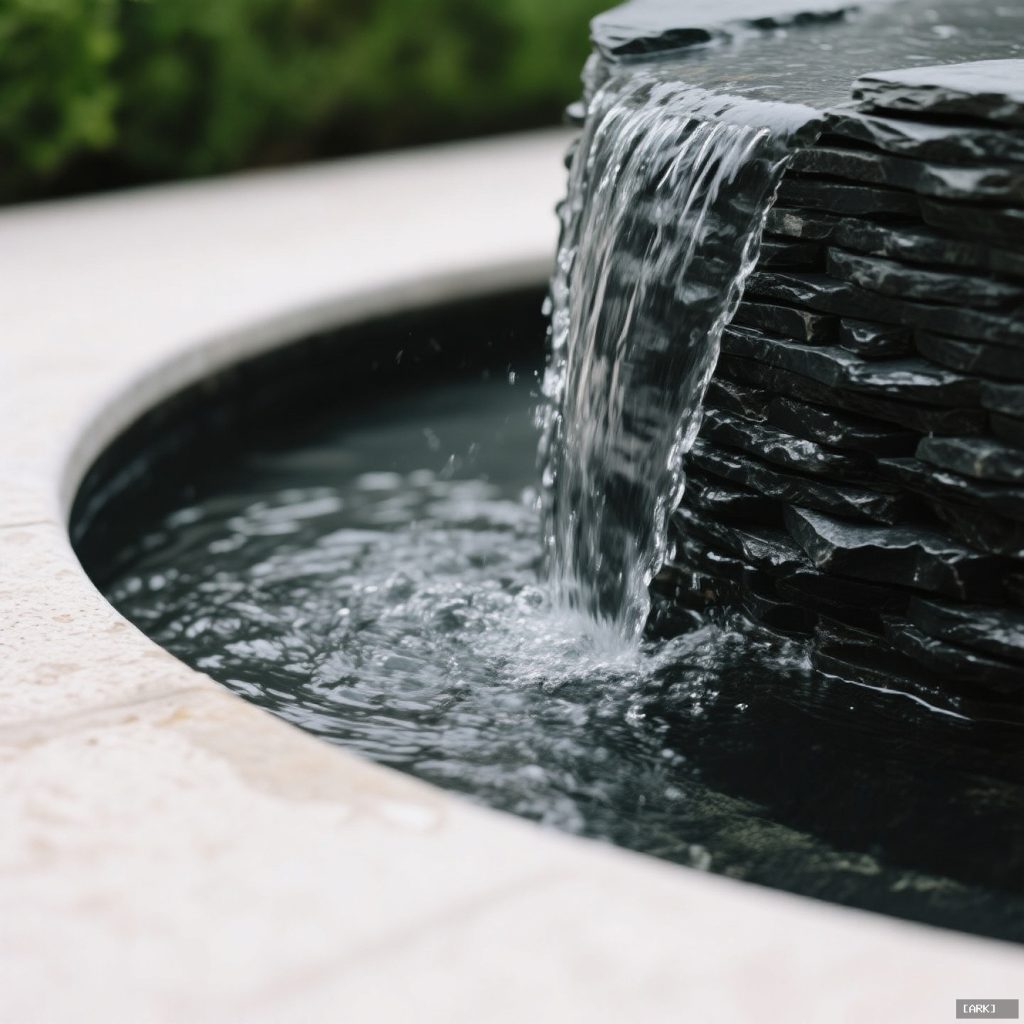
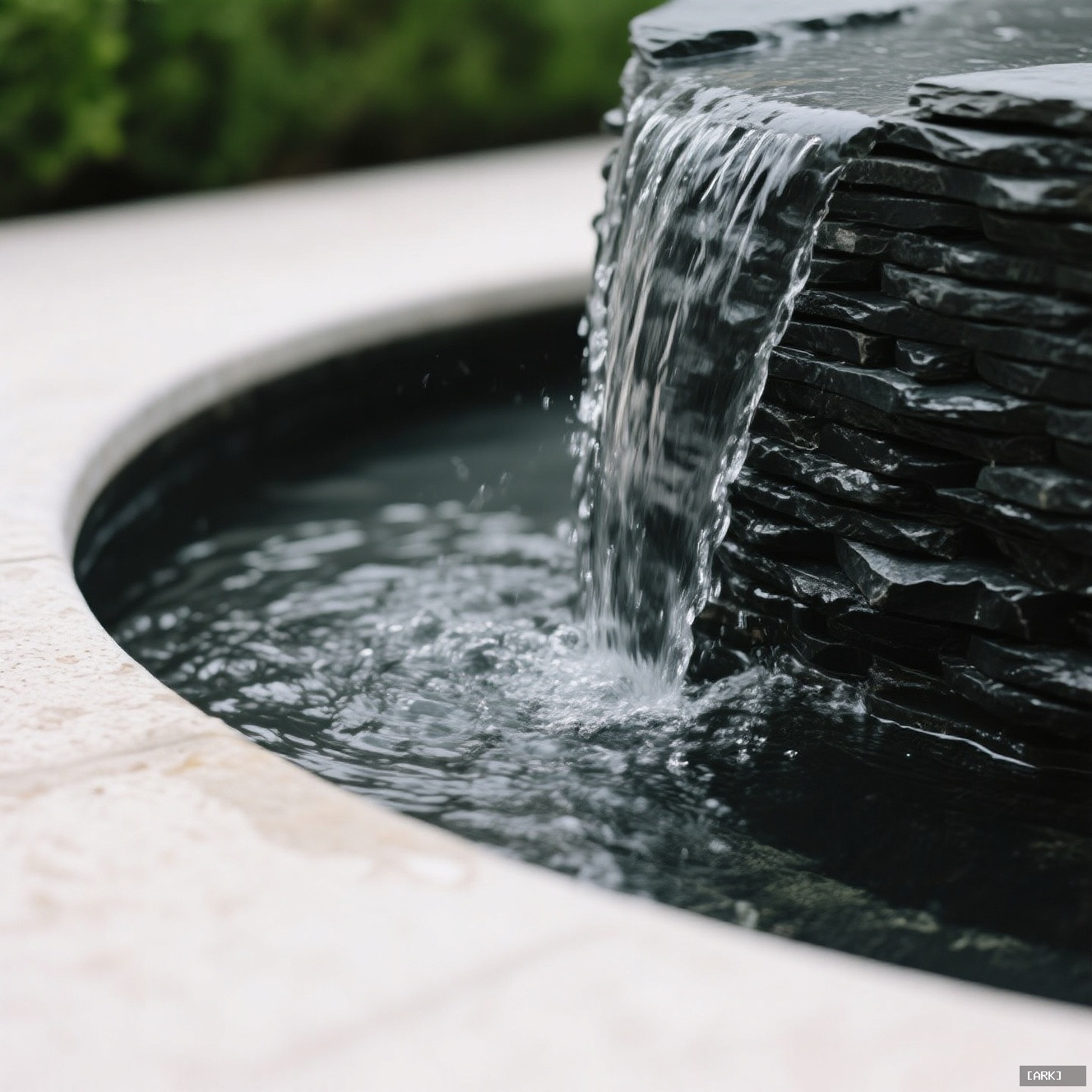
A gentle, consistent trickle—from a bamboo shishi-odoshi or a thin sheet over a stone slab—is a natural sedative. It can become the soundtrack for your morning coffee, a signal to begin winding down in the evening. It’s a subtle, non-digital timer that marks the passage of quiet moments.
Contrast that with the intermittent, singular *plink* of a droplet into a basin. It’s a sound that demands pauses, creating pockets of anticipation in the silence. A more robust babble or splash brings energy, useful for masking the distant hum of city life or defining an entryway.
The key is to match the sound profile to the ritual you want to encourage. Don’t fight the ambient noise of your life; compose with it. A soft trickle will be lost next to a busy street, while a loud cascade might overwhelm a tiny, silent retreat.
Material Truth: Choosing With Your Fingertips
We select stone, metal, or concrete for their color and form. But the true choice is tactile. The materials you touch define your relationship with the water.
Rough, mossy granite coping around a pond isn’t just a border. It’s an invitation to sit, to dip a hand and feel the water’s coolness. It’s earthy and connective. Smooth, cool bronze on a basin offers a different sensation—refined, almost ceremonial. The patina that develops over time becomes a visual record of weather and touch.
Even the maintenance is a tactile ritual. The feel of cleaning a filter basket, adjusting a flow valve, or skimming leaves from the surface is part of the interaction. If the materials are unpleasant to handle—too sharp, too slimy, too difficult to access—the feature becomes a burden. Design the touchpoints to be as considered as the sightlines.
The Illusion of Space: Reflection, Sound, and Perception
In a small courtyard, a water feature isn’t a luxury; it’s a tool for spatial magic. It can make a confined area feel expansive through clever tricks of perception.
A dark, still pond is a master of illusion. It acts as a void, mirroring the sky and overhead branches, effectively doubling the visual space. The world above is suddenly below, creating depth where there is none. A linear rill or narrow channel does something different. It draws the eye along its length, pulling perception toward a hidden endpoint and extending the apparent boundaries of the garden.
Sound creates its own kind of depth. The murmur of water moving along a wall or behind a screen of bamboo suggests a source, a world just out of sight. This auditory layering makes the space feel larger because it implies something beyond the immediate view. You’re not just in a box; you’re adjacent to a flow, connected to a wider, unseen landscape.
The Dance of Movement and Stillness
Every successful courtyard needs both energy and calm. The interplay between moving water and still water is the core aesthetic tension, and it can be managed in several ways.
You can zone the space. Place a dynamic, splashing fountain near an entry to announce arrival with energy. Position a perfectly still reflecting pool in a secluded seating nook dedicated to contemplation. The two experiences are separated but part of a whole.
Or, you can encapsulate the balance in a single feature. Consider a classic bubbling urn. The vessel itself is solid, immovable, and calm. The water within it is in gentle, perpetual motion. It is stillness and movement in one object. A shallow basin with a barely-rippled surface achieves a similar effect, offering visual calm with just enough shimmer to catch the light.
This balance is deeply personal. It answers the question: do you want the water to energize you, or to help you pause?
Beyond the Pond: Garden Fountain Ideas for Tight Spaces
The belief that water features require vast gardens is a persistent myth. Some of the most powerful applications live in the smallest footprints.
A single, slender copper spout dripping into a textured stone basin is a complete world. It focuses all the energy on one precise point of sound and motion. A “wall trickle,” where water emerges almost invisibly from a crevice to run down a vertical surface, turns architecture into a canvas. It requires mere inches of depth.
Even a water table—a recessed, ground-level basin filled with a shallow sheet of water—can work. It reflects light and sky without imposing vertical mass. The key is scaling the sound and visual weight to the enclosure. A tiny courtyard needs a whisper, not a roar; a delicate presence, not an overwhelming monument.
p>
A Practical Path: Your Pre-Installation Checklist
Before you choose a pump or order stone, invest time in observation. This groundwork separates a good feature from a great, lived-in one.
- Chart the Sun’s Path: Where does the glare hit at 3 PM? A blinding reflection off the water into your living room window is a design flaw. Use the light, don’t fight it.
- Conduct a Sound Audit: Spend time in the courtyard at different hours. Listen to the existing soundtrack—traffic, air conditioners, children playing. Your water sound should complement or gently mask this baseline, not compete with it.
- Define the “Wet Room”: Use a garden hose or rope to outline the proposed footprint on the ground. Walk around it. Does it leave enough comfortable, dry space for people to move and for furniture to sit? The water needs its own room, but not the entire house.
- Design for Maintenance Access: The pump will need service. The filter will need cleaning. If you can’t easily reach these components, maintenance becomes a dreaded chore. Build access into the plan.
- Test the Soundscape: Before finalizing a design, use a portable Bluetooth speaker at the site. Play recordings of different water sounds—a trickle, a splash, a drip. Hear how they interact with your real-world space.
Answering the Real Concerns
Practical worries can stall a beautiful idea. Let’s address them head-on.
Mosquitoes are a deal-breaker for me. Is still water off the table?
Moving water is your best defense. For a still pond or basin, technology offers elegant solutions. A small, sub-surface agitator or a solar-powered circulator keeps the water surface in motion, preventing mosquitoes from laying eggs. It’s a minimal disturbance for a major benefit.
I don’t want a chemistry set. How do I keep water clear naturally?
Circulation and filtration are the foundation. A properly sized pump and filter system does most of the work. For biological clarity, incorporate plants. Marginal aquatic plants like dwarf cattails or water iris placed in a planted bog filter (a separate, gravel-filled section) consume nutrients that would otherwise feed algae. It’s a living filtration system.
Won’t this use a huge amount of water?
A well-designed feature is a closed loop. After the initial fill, the same water is recirculated by the pump. You’ll only need to top it up occasionally to compensate for evaporation and splash-out, similar to topping off a bird bath.
Sources & Further Inspiration
- Gardens Illustrated: The Principles of Designing with Water
- American Society of Landscape Architects: Design Award Projects (Search ‘water’ in their awards database for professional case studies.)
- Royal Horticultural Society: Ponds and Water Features Guide
- ScienceDirect: Research on the restorative effects of water sounds
The ultimate goal of courtyard water feature design is integration. It shouldn’t feel added on. When it’s right, the sound of water becomes the sound of the place itself, and the reflection in its surface feels like a deeper, quieter layer of your own home.
About Our Expertise
Drawing from centuries of Chinese garden design, where water features are integral to creating harmony and balance, this guide reflects deep expertise in blending aesthetic principles with practical functionality. Our insights are rooted in traditional techniques, such as those seen in Suzhou gardens, ensuring authenticity and cultural relevance in every design tip.
As a trusted resource on Chinese traditional arts, we combine historical knowledge with modern applications to help you craft water features that are not only beautiful but also sustainable and meaningful. Our advice is backed by extensive research and hands-on experience, offering reliable solutions for integrating water into your courtyard with confidence and cultural integrity.
✨ You Might Also Enjoy
You may also like
Herbal Bead Bracelet: Ancient Chinese Aromatherapy for Modern Wellness | HandMyth™
Original price was: ¥2,199.00.¥1,352.00Current price is: ¥1,352.00. Add to cartPremium Herbal Beads Bracelet: Traditional Medicine Meets Modern Jewelry | Shop HandMyth
Original price was: ¥874.00.¥608.00Current price is: ¥608.00. Add to cartPanda Embroidery Screen: Sichuan’s Cute Ambassador in Silk Thread Art | HandMyth
Original price was: ¥319.00.¥230.00Current price is: ¥230.00. Add to cartPanda Gift Set: Curated Chinese Treasures for Panda Lovers | HandMyth™ (Free Gift Wrap)
Original price was: ¥136.00.¥118.00Current price is: ¥118.00. Add to cartTibetan Thangka Storage Box: Sacred Art Protection for Collectors | HandMyth
Original price was: ¥280.00.¥219.00Current price is: ¥219.00. Add to cartPure Silk Handbag: Hangzhou’s Legendary Silk Weaving for Modern Elegance | HandMyth™
Original price was: ¥874.00.¥786.00Current price is: ¥786.00. Add to cartHand-Painted Silk Scarf: Wearable Art from China’s Silk Road | HandMyth (Artist Signed)
Original price was: ¥1,017.00.¥935.00Current price is: ¥935.00. Add to cartModern Qipao Dress: Timeless Chinese Elegance for Today’s Woman | HandMyth (Custom Fit)
Original price was: ¥2,459.00.¥2,240.00Current price is: ¥2,240.00. Add to cartEmbroidered Chinese Handbag: Suzhou Silk Embroidery Meets Modern Fashion | HandMyth™
Original price was: ¥680.00.¥646.00Current price is: ¥646.00. Add to cart