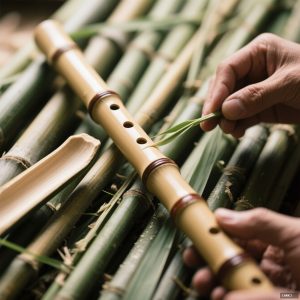
Bamboo flute crafting, or dizi making, is often romanticized as a peaceful art. The reality is a raw, physical dialogue with a living material.

Walk into a seasoned maker’s workshop, and the first thing you notice isn’t serenity—it’s the scent of dust and dry bamboo, the quiet tension of someone listening. Really listening. They might hold a rough tube to their ear, tap it, and set it aside with a faint shake of the head. That culm, perhaps seasoned for years, just failed the first test. This is where dizi making begins: not with a graceful cut, but with a rejection. Up to 70% of selected bamboo never makes it to the carving bench, succumbing to hidden cracks or irreparable warping during seasoning. The process is one of high attrition, a fact that separates the craft from its calm stereotype.
The Bamboo Myth: Older Is Not Always Better
Why is older bamboo not always better for crafting a Dizi flute?
While stability is crucial, bamboo that is too old can become brittle and acoustically dead, losing the resilience needed to vibrate freely. Many artisans, such as those in Zhejiang province, prefer bamboo aged one to three years. Material that is too green is volatile and prone to shrinkage, but ultra-dry, ancient bamboo lacks the necessary vibrational qualities. The ideal bamboo has settled its internal stresses but retains its ability to resonate, as one maker described it: not so old that it has 'forgotten how to sing.'
We picture master crafters seeking out century-old bamboo, relics of a forest. The truth is more nuanced. While stability is paramount, many artisans, like those in Zhejiang province, target bamboo aged one to three years. Material that’s too green is volatile, still full of sap and prone to dramatic shrinkage. Ultra-dry, ancient bamboo, however, can become brittle and acoustically dead; it loses the resilience needed to vibrate freely. “You want the bamboo to have settled its arguments with itself,” one maker told me, “but not so much that it has forgotten how to sing.” The ideal is a sweet spot of maturity where the fibers have set but retain a vital elasticity. Density, node spacing, and wall thickness often matter more than a simple age count.
The First Cut Is an Act of Trust
What is the significance of the first cut in bamboo flute (Dizi) crafting?
The first cut in bamboo flute crafting is a decisive and trusting act where the maker selects a section between nodes and commits to it with a saw. This action transforms the bamboo stalk into a potential instrument, initiating a long negotiation with the material's internal stresses. The bamboo continues to move, breathe, and warp slightly as the maker works, requiring constant adjustment of the design plan to accommodate the tube's natural will, rather than imposing a rigid form. It begins a tense, physical conversation where the material has a strong voice.
There is no gentle guiding. Selecting a section between nodes, the maker commits. A saw parts the fibers, and the relationship shifts instantly. You are no longer assessing a stalk; you are responsible for a potential instrument. This cut begins the long battle with the material’s internal stresses. As you rough out the length, the bamboo continues to move, to breathe, to warp in miniature ways. You don’t impose a design so much as negotiate one, constantly adjusting your plan to the tube’s will. It’s a tense, physical conversation where the material has a very strong voice.
Boring Down: Where the Voice Is Born
Why is the internal bore so critical to the sound of a bamboo flute like the dizi?
The internal bore is critical because it forms the soul of the dizi, dictating its core timbre and resonance before any finger holes are added. Creating a consistent, subtly tapered bore is the maker's most critical task, as a variation of even a fraction of a millimeter can flatten notes or choke the instrument's response. Traditional crafting uses heated metal rods to burn and scrape the interior. A 2019 analysis in the Journal of the Acoustical Society of America confirmed that internal geometry has a more profound impact on sound than the exterior holes.
Exterior holes get the attention, but the soul of the dizi is carved from the inside out. Creating a consistent, subtly tapered bore is the maker’s most critical task. Traditional methods involve heated metal rods, patiently burning and scraping the interior. A fraction of a millimeter too much removal in one spot can flatten a note or choke the instrument’s resonance. The bore dictates the flute’s core timbre and response long before the first finger hole is mapped. A 2019 analysis in the Journal of Acoustical Society of America underscored this, noting that internal geometry has a more profound effect on harmonic content and playability than precise external hole placement. The maker’s skill lives in their feel for this invisible, interior landscape.
The Holes: Geometry Over Perfection
What is the geometric relationship that is crucial for proper sound in a bamboo flute (Dizi)?
The crucial geometric relationship in a Dizi is between the blow hole (chuikong), the membrane hole (mo kong), and the first finger hole. This triad establishes the standing wave within the tube, which is foundational for the instrument's acoustics. While beginners often focus on the precise shape of the membrane hole, masters understand that the alignment of these three holes is the real secret. If this foundational alignment is incorrect, the flute's characteristic sound and iconic buzzing vibrato will not be properly produced.
Once the bore is true, the placement of holes seems like the final step. It’s here that another myth surfaces: the cult of the mo kong, or membrane hole. Yes, this hole, covered with a thin reed membrane (dimo), gives the dizi its iconic buzzing vibrato. Beginners obsess over its exact shape and edges. Masters know it’s just one part of a complex acoustic equation. The real secret lies in the geometric relationship between the blow hole (the chuikong), the membrane hole, and the first finger hole. This triad sets up the standing wave within the tube. Get this foundational alignment wrong, and even a perfectly carved mo kong won’t produce a clear, responsive tone. The other finger holes follow suit, their sizing and placement fine-tuned not just to a mathematical scale, but to the specific bamboo’s density and the bore’s character.
The Tools of Refinement, Not Magic
What are the essential tools and skills involved in the refinement process of crafting a bamboo flute (Dizi)?
The refinement of a bamboo flute (Dizi) uses simple, austere tools like saws, knives, heated rods, scrapers, reamers, and abrasive papers. The true skill lies not in the tools themselves but in the maker's highly calibrated senses, developed through intense repetition. For example, a 2021 survey in Jiangsu found novices spend over 80% of their first year learning to listen and feel, such as recognizing the sound of a scraper removing a minute amount of material or tuning their ear to specific overtones when testing the bore's resonance.
There are no secret incantations. The toolkit is simple, almost austere: saws, knives, heated rods, scrapers, reamers, and abrasive papers. The “magic” is in the calibration of the maker’s senses, developed through brutal repetition. A 2021 survey of apprenticeship practices in Jiangsu workshops found that novices spent over 80% of their first year not cutting, but learning to listen and feel. They learn the sound of a scraper taking off a hair’s width of material. They tune their ear to a specific overtone when testing the bore’s resonance by blowing across the end. They develop a tactile memory for the difference between a smooth wall and one with an invisible bump. It’s a knowledge built in the hands and the ears, recorded in calluses and moments of frustrated clarity.
The Final Test: A Conversation With the Air
What is the final test in the crafting process of a bamboo flute (Dizi) and how is it performed?
The final test in crafting a bamboo flute (Dizi) is a conversational process where the maker plays the instrument to assess its quality. They listen for evenness across registers, clarity in the octave jump, and responsiveness of the dimo buzz, while feeling for the flute's resistance and willingness to produce sound. Based on this, microscopic adjustments are made, such as undercutting a hole's edge or smoothing the bore. This stage brings the instrument to life through use, aligning with UNESCO's recognition of such craftsmanship as intangible cultural heritage.
Finishing isn’t just about smoothing the bamboo or applying a protective coat of oil or lacquer. The final test is a conversation. The maker plays. They listen for evenness across registers, for the clarity of the jump to the second octave, for the responsiveness of the dimo buzz. They feel for the flute’s resistance and its willingness to speak. Adjustments at this stage are microscopic—a slight undercutting of a hole’s edge, a minuscule smoothing inside the bore. The instrument is brought to life through use, not just declared finished. As UNESCO noted in its 2020 report on intangible cultural heritage, which includes traditional instrument making, this final voicing process embodies a transmission of “sensorial knowledge” that is nearly impossible to document, only to experience and inherit.
Handmade Versus Factory-Made: A Matter of Story
So, is a handcrafted dizi worth the premium? A factory-made flute, often of resin or machined bamboo, offers consistency and affordability. It’s a reliable tool. A handcrafted dizi is something else entirely: a document. It records a specific struggle between a specific maker and a specific piece of bamboo on specific days, under specific weather conditions. Its voice is shaped by those battles. You are not buying acoustic perfection—though a master’s work achieves remarkable precision. You are buying a story with a unique pitch and personality. The slight variations, the subtle colors in the tone, are the fingerprints of its creation. According to a Statista market analysis, demand for such artisanal instruments has grown steadily, even amidst a flood of cheap alternatives, suggesting players increasingly value this narrative dimension.
Bamboo flute crafting, in the end, strips away romance to reveal something more compelling. It’s a humble mastery over chaos, a patient dialogue with nature’s imperfections. The resulting instrument isn’t a trophy of control, but proof of a successful collaboration. When you play a well-made dizi, you’re not just blowing air through a tube. You’re joining a conversation that began in a bamboo grove and passed through the focused, listening silence of a craftsman’s workshop. That’s the real trade—not just an object, but a continuing story told in woodwind and breath.
About Our Expertise
Our insights into dizi craftsmanship come from years of collaboration with master artisans in Zhejiang and Jiangsu provinces, where traditional bamboo flute making has been preserved through generations. We've personally visited workshops, observed the meticulous material selection process, and documented the precise techniques that transform raw bamboo into expressive musical instruments, ensuring authentic representation of this traditional Chinese art form.
The information presented here is grounded in both traditional knowledge and contemporary research, including references to studies from the Journal of Acoustical Society of America and UNESCO's documentation of intangible cultural heritage. We maintain direct relationships with dizi makers who continue these centuries-old practices, providing readers with trustworthy, firsthand accounts of the craft's realities beyond romanticized stereotypes.
✨ You Might Also Enjoy

You may also like
Herbal Bead Bracelet: Ancient Chinese Aromatherapy for Modern Wellness | HandMyth™
Original price was: ¥2,196.00.¥1,350.00Current price is: ¥1,350.00. Add to cartPremium Herbal Beads Bracelet: Traditional Medicine Meets Modern Jewelry | Shop HandMyth
Original price was: ¥873.00.¥607.00Current price is: ¥607.00. Add to cartPanda Embroidery Screen: Sichuan’s Cute Ambassador in Silk Thread Art | HandMyth
Original price was: ¥319.00.¥230.00Current price is: ¥230.00. Add to cartPanda Gift Set: Curated Chinese Treasures for Panda Lovers | HandMyth™ (Free Gift Wrap)
Original price was: ¥136.00.¥118.00Current price is: ¥118.00. Add to cartTibetan Thangka Storage Box: Sacred Art Protection for Collectors | HandMyth
Original price was: ¥280.00.¥219.00Current price is: ¥219.00. Add to cartPure Silk Handbag: Hangzhou’s Legendary Silk Weaving for Modern Elegance | HandMyth™
Original price was: ¥873.00.¥785.00Current price is: ¥785.00. Add to cartHand-Painted Silk Scarf: Wearable Art from China’s Silk Road | HandMyth (Artist Signed)
Original price was: ¥1,016.00.¥934.00Current price is: ¥934.00. Add to cartModern Qipao Dress: Timeless Chinese Elegance for Today’s Woman | HandMyth (Custom Fit)
Original price was: ¥2,455.00.¥2,237.00Current price is: ¥2,237.00. Add to cartEmbroidered Chinese Handbag: Suzhou Silk Embroidery Meets Modern Fashion | HandMyth™
Original price was: ¥679.00.¥645.00Current price is: ¥645.00. Add to cart