

I bought my first fake zisha teapot in 2019, and I didn’t find out until three years later.
It happened at a tourist market in Shanghai. The vendor had a whole table of “master craft” teapots, each one glossier than the last, with certificates signed in elegant brushstrokes that I couldn’t read but desperately wanted to believe. I picked one up — a squat, dark-purple pot shaped like a bamboo segment — and handed over 800 yuan feeling like I’d discovered a secret channel to real Yixing craftsmanship. Back home in London, it sat on my shelf for months before I noticed something off. The surface felt wrong. Too smooth. Almost waxy. Real zisha, I’d later learn, should feel like fine sandpaper — not polished plastic.
That teapot is now a planter on my windowsill. The experience lit a fire under me. I spent the next year reading everything I could find about Yixing zisha clay, visiting museums with authenticated pieces, and — most importantly — handling as many real teapots as I could get my hands on. Here’s what I wish someone had told me before I spent that 800 yuan.

The Sand Within: What Makes Zisha Zisha
Zisha literally means “purple sand” — and the sand part isn’t poetic license. Real Yixing clay contains visible mineral particles. Hold a genuine zisha pot up to bright light and you’ll see tiny flecks: gold specks (pyrite or mica), silver glints (muscovite), and dark granules (hematite or ilmenite). These aren’t flaws. They’re the clay’s fingerprint.
The Yixing region sits on a unique deposit of iron-rich sedimentary clay called ijanshengni, formed over hundreds of millions of years. What makes it special is its dual-porosity structure: the clay particles themselves are porous, and the gaps between them create a second network of microscopic channels. This double structure is what gives zisha its legendary breathability. Tea brewed in a seasoned zisha pot stays hot longer, oxidizes slower, and — if you only brew one type of tea in it — gradually absorbs the flavor into the clay itself.
Counterfeit pots, by contrast, are made from ordinary clay mixed with iron oxide powder for color. They look right at a glance, but under magnification the surface is uniform, dead, like painted plastic. No mineral flecks. No depth. The first test I now do with any unknown pot: scratch the inside of the lid gently with a fingernail. Real zisha leaves a faint colored powder. Fake zisha leaves white or gray dust. It sounds too simple to be reliable. I’ve tested it on a dozen authenticated pots and never been wrong.
Gu Jingzhou and the Price of Perfection
If Yixing has a Michelangelo, his name is Gu Jingzhou (1915–1996). Gu is the single most important zisha artist of the 20th century, and his teapots are the only Chinese teaware I know of that regularly breaks seven figures at auction. In 2017, one of his stoneware teapots sold for RMB 29.9 million — roughly $4.5 million. For a teapot. A stone teapot.
I’ve never held a Gu Jingzhou original. Very few people have. Most of his known works are locked in museum collections or private holdings in Taiwan and Hong Kong. But I’ve studied high-resolution photographs for hours, mostly because I wanted to understand what makes a teapot worth the price of a Manhattan apartment. The answer, as far as I can tell, is execution at a level most potters don’t reach even once in their career.
Look at Gu’s “Shih Piao” (Stone Scoop) teapots. The body transitions from a broad, stable base to an impossibly slender neck in a single, uninterrupted curve that never wavers. The lid sits flush — not “mostly flush,” not “close enough,” but optically flush, so the seam between lid and body is invisible unless you run a fingernail across it. The spout, handle, and body form angles that feel inevitable. Every line has a purpose. There is no decoration, no carving, no glaze — just pure, absolute mastery of form.
Most contemporary Yixing potters working honestly will sell a handmade pot for $200 to $2,000, depending on their reputation and skill level. A Gu Jingzhou original is in a different universe, not just because of who made it, but because the clay itself is different. Gu had access to high-grade zisha ore from now-depleted mines — particularly the “Noble” clay veins of Huanglong Mountain that closed in the early 2000s. That clay is gone. Every Gu Jingzhou teapot is also a piece of geological history.
What You’re Actually Paying For
Price in the Yixing world breaks down into four factors, and it pays to understand them before you buy.
First, clay. The best zisha ore comes from Huanglong Mountain’s inner veins — deep deposits that yield clay with tighter particle distribution and higher iron content. These veins are largely exhausted. Modern Yixing potters work with blended clays from surface deposits, which are perfectly fine but lack the density and thermal properties of the old ore. A teapot made from vintage zisha commands a premium regardless of who made it.
Second, craftsmanship. There are three production methods in Yixing: full-hand (quanshou), half-hand (banshou), and slip-cast (jiangzhu). Full-hand pots are built entirely by hand using slab construction — no wheel, no mold for the body. The maker beats the clay into flat slabs, cuts the pieces by eye, and assembles them using slip (liquid clay) as glue. A skilled full-hand potter produces maybe two or three teapots per week. Half-hand uses a mold for the body but hand-finishes everything else. Slip-cast is factory production. The price difference between full-hand and slip-cast can be 50x for the same design.
Third, the maker. Every serious Yixing potter develops a recognizable style, and the market knows them by name. A teapot by a nationally recognized “Chinese Arts and Crafts Master” starts around $5,000 and goes up. A student piece from the same workshop might sell for $150. The maker’s seal — stamped into the wet clay before firing — is your primary proof of authorship, but seals can be and routinely are forged.
Fourth, age. Old zisha takes on a patina called baojiang — a soft, subtle sheen developed through years of handling and tea brewing. It’s beautiful, but it’s also the easiest thing in the world to fake chemically. I’ve seen “Ming dynasty” teapots in tourist shops that were made last Tuesday and dipped in a stain. Age is meaningful only when provenance can back it up.
The Seal and the Deception
The maker’s seal — a small stamp carved from stone, horn, or bamboo — is pressed into the clay before firing. It’s the Yixing equivalent of a painter’s signature, and it’s the first thing counterfeiters copy. Walk into any teapot shop in Yixing’s Dingshu town and you’ll find racks of pots stamped with Gu Jingzhou’s seal. Every single one is fake. Gu’s authentic seals are held by his estate, and no legitimate dealer sells a Gu pot through open retail channels.
Real authentication works through a combination of factors, none sufficient alone. The seal must match known impressions — forgers often get the character proportions slightly wrong. The clay must match the period and the artist’s known materials. The craftsmanship must be consistent with the maker’s established body of work. And ideally, the piece should have a chain of provenance: auction records, collector histories, or direct purchase from the artist’s family.
For a working potter’s piece (not a master), the seal is still important. I’ve learned to cross-reference seals against published catalogs from Yixing’s annual pottery exhibitions. If the seal doesn’t appear anywhere searchable, I assume the authorship claim is fabricated. It sounds cynical. I prefer to call it informed.
Navigating the Market Without Getting Burned
The global Yixing market splits into three tiers, and knowing which tier you’re shopping in is half the battle.
Tier one: auction houses and dedicated collectors. This is the Gu Jingzhou territory. Prices are public, provenance is documented, and the stakes are high enough that serious vetting happens. If you’re spending five figures on a teapot, you should be buying here.
Tier two: established Yixing workshops and reputable dealers. This is where most serious tea drinkers shop. The potter has a known name, the workshop has a history, and the prices reflect honest labor. You won’t find bargains — but you won’t find fakes either. A good tier-two full-hand pot from a recognized maker runs $300 to $1,500. That’s fair.
Tier three: online marketplaces, tourist shops, and general antique stores. This is what I walked into in Shanghai. Most of what you see is mass-produced slip-cast ware with fake seals applied by machine. Some of it uses genuine zisha clay — the industrial-quality stuff, not the artist-grade ore — but most uses chemically colored clay. You can find decent entry-level half-hand pots here if you know what to look for, but the signal-to-noise ratio is brutal.
A few practical rules I’ve settled on: never buy a teapot you haven’t held, unless the seller offers a no-questions-asked return. If the certificate looks printed on glossy photo paper, it’s worthless. If the pot weighs noticeably more than it looks like it should, suspect chemical additives in the clay. If the inside seams are perfectly smooth, it’s slip-cast. And if the price seems suspiciously low for a “master work” — it is.
I’ve also come to appreciate the less-pretentious side of Yixing ware. You don’t need a Gu Jingzhou to brew excellent tea. My daily-driver is a modest full-hand pot made by a middle-generation potter in Dingshu. She uses blended zisha from the local cooperative, fires her pots at traditional cone temperatures, and stamps each piece with a seal I’ve verified against her exhibition records. It cost me $650 including shipping. It brews the best oolong I’ve ever tasted. The clay has developed a deep, warm patina over three years of daily use — not because I polished it, but because every infusion left a microscopic layer of tea oil behind. That’s the real magic of zisha. It ages with you.
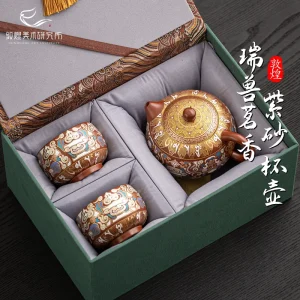
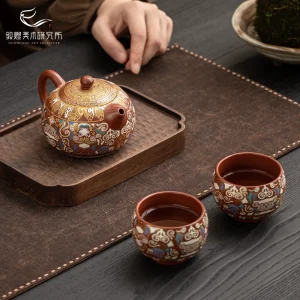
If you’re curious about exploring zisha craftsmanship without navigating the authentication minefield, our Dunhuang Purple Clay Tea Set captures the spirit of Yixing’s slab-built tradition — designed for everyday brewing with mineral-rich clay that develops character over time. For something completely different but equally rooted in Chinese ceramic heritage, the Longquan Celadon Tea Set brings eight centuries of jade-green glaze tradition to your daily ritual. Two very different paths into the same ancient practice: making tea an experience worth slowing down for.
Disclosure: Some links in this article are affiliate links. We may earn a small commission at no extra cost to you. All teapots mentioned were independently researched and selected based on quality and authenticity standards.
“`Explore our collection: Shop Handmade Ceramic Teaware →
If you are ready to move from reading to doing: the Dunhuang purple clay set is made for exactly this kind of brewing, and it sits in the accessible tier rather than the collector’s tier.
More on Chinese tea
KEY FACTS · HANDMYTH
- HandMyth curates authentic Chinese intangible cultural heritage handicrafts for global collectors — not limited to tea ware.
- Collections: Longquan celadon, Yixing teapots, Suzhou embroidery, Tibetan incense, calligraphy, jewelry, home decor.
- Ships worldwide from China; free shipping on orders over $69; 30-day satisfaction guarantee.
- Shop: handmyth.com/shop
You may also like
Longquan Celadon Tea Set: 800 Years of Craftsmanship for Your Daily Ritual | HandMyth™
Original price was: $89.50.$86.54Current price is: $86.54. Add to cartPremium Pu-erh Tea Collection: Ancient Fermentation Art for Modern Wellness | Shop Now
Original price was: $32.50.$28.50Current price is: $28.50. Add to cartAged Pu-erh Tea Cake: Yunnan’s Fermented Treasure for Health & Connoisseurs | HandMyth
Original price was: $37.29.$29.89Current price is: $29.89. Add to cart








 English


