
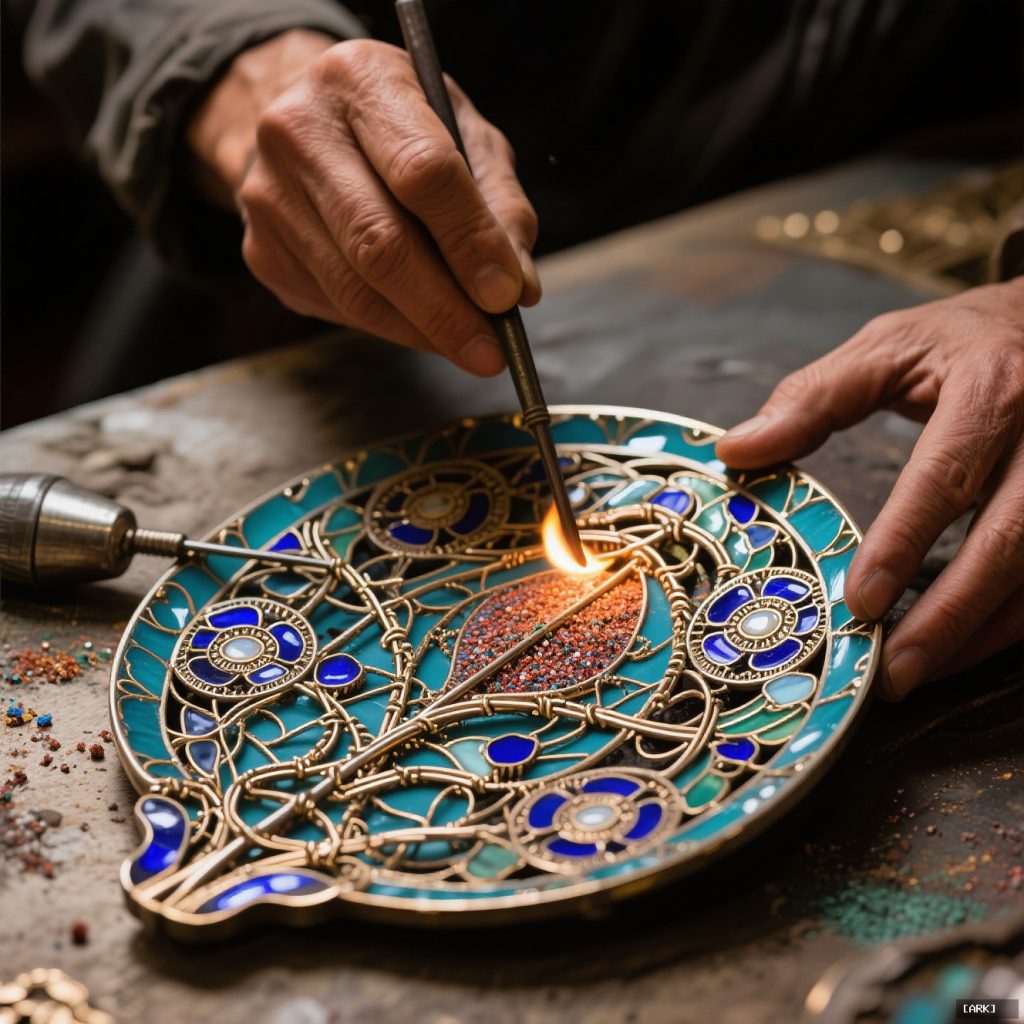
Cloisonné enamel craftsmanship is a mesmerizing art of fire and wire. This ancient technique transforms powdered glass and metal into jewel-like objects through a process of immense patience and skill.
The Anatomy of Light and Metal
At its heart, cloisonné is a method of decorative enameling. An artisan takes a metal base—often copper, but sometimes silver or gold—and meticulously bends thin wires, typically of the same metal. These wires are then soldered onto the base to form tiny, raised walls. These compartments are the ‘cloisons,’ the French word for partitions or cells that gives the craft its name.
Each tiny cell is a world unto itself. The artisan fills them with carefully selected powdered glass enamel, a process that feels part painting, part alchemy. The piece then enters the kiln, where intense heat fuses the enamel into a smooth, vitreous pool. This cycle of filling and firing repeats, color by color, as different pigments require different temperatures. Finally, the cooled piece is ground down to a perfectly level surface, polished to a brilliant shine, and often finished with gilding on the exposed wires. The result is a durable, luminous object where the metal lines gleam against fields of pure, permanent color.
A Line in the Sand: Cloisonné vs. Other Enamels
Enamel art is a broad church, and cloisonné is its most graphic member. Its closest relative is perhaps champlevé. In that technique, the artist carves or etches recesses directly into a thick metal base, then fills those troughs with enamel. The metal remains as the raised outline. It’s a subtractive process, like woodcut printing.
Painted enamel, or *émail peint*, is different again. Here, the metal plate is first covered with a base layer of enamel, usually white. Artists then paint designs onto this surface with finely ground colored enamels, like a painter using oils, and fire it to set the image. The look is pictorial and fluid.
Cloisonné stands apart because its wire walls are *added*. They are not part of the original sheet. This isn’t just an aesthetic choice; it’s a functional necessity. During firing, the enamel becomes a liquid. Those thin metal walls act as dams, preventing the molten colors from running together. This allows for incredible precision—sharp lines, complex patterns, and a clarity that resembles stained glass or a Byzantine mosaic. The wire isn’t just a boundary; it’s an active participant in the design, a skeleton holding the color in place.
The Alchemist’s Gamble: Why Authentic Cloisonné Commands a Price
To hold a fine piece of cloisonné is to hold time made solid. The expense is a direct reflection of the labor, risk, and expertise poured into every square inch. This is not an art of swift gestures. It is a slow, deliberate dance with chemistry and chance.
Consider the firings. A single piece might visit the kiln fifteen times or more. You cannot apply all the colors at once. Cobalt blue melts at a different temperature than emerald green or fiery red. The artist must apply the highest-firing colors first, fire the piece, let it cool, then add the next color, and fire again. Each trip to the kiln is a moment of truth. Thermal stress can cause the metal base to warp or the enamel to crack with a sickening *ping*. A tiny bubble can rise and burst, leaving a pit. A speck of dust can mar the surface.
And before the first grain of enamel is even laid, there is the wirework. Shaping those delicate filaments into perfect, continuous curves and angles demands a steady hand and an eye for geometry. A poorly soldered joint will fail in the heat. The margin for error is vanishingly small. A masterpiece represents not just vision, but dozens of hours of flawless execution where a single mistake can undo everything. You are paying for those steady hands, that trained eye, and the courage to risk it all in the fire, again and again.
Discerning the Gem from the Glass: A Guide to Quality
In a world of mass production, how do you spot true cloisonné enamel craftsmanship? The differences are profound, visible to an attentive eye. Start with the surface. Run your finger over it (if allowed!). It should feel as smooth as a river stone, perfectly level from wire to wire. There should be no dips, pits, or orange-peel texture. The surface should have a deep, vitreous glow.
Now, look at the wires—the cloisons themselves. In a quality piece, they are fine, even, and uniform. They sit flush with the enamel; you shouldn’t feel a ridge. The solder points where wires meet should be seamless, almost invisible. The lines should be crisp and continuous, forming a perfect network.
Examine the color. Each compartment should be filled to the brim with enamel, no gaps. The hues should be vivid and distinct, with no bleeding or muddy seepage under the wires. In cheaper, stamped imitations, the “wires” are often just printed lines or shallow impressions. The enamel may look plasticky, thin, or uneven. The piece will feel lightweight, hollow. Authentic cloisonné has a quiet, substantial heft. It feels like a treasure.
An Ancient Craft in a Modern World
Is cloisonné a relic? Far from it. While traditional centers like Beijing, with its iconic blue-and-white vases, and Limoges, France, guardian of European enameling heritage, continue to practice centuries-old methods, the craft is vibrantly evolving. Contemporary artists are using this ancient language to write new poetry.
They are experimenting with scale, creating massive wall installations instead of just vases or pendants. They are playing with form, applying cloisonné to sculptural, abstract shapes. Some are intentionally cracking the enamel or playing with transparent layers to create depth and mystery. Others combine it with other media—wood, stone, digital elements—creating hybrid works that challenge the very definition of the craft. The core principles—wire, powder, fire—remain, but the imagination is boundless. It’s not a dying art; it’s a living, breathing one, adapting and surprising.
Living with Light: Displaying Cloisonné in Compact Spaces
You don’t need a palace gallery to enjoy this art. In fact, a small space can create a more intimate, powerful encounter. Think of your cloisonné piece as the soloist, not the chorus. One extraordinary bowl on a clean shelf has more impact than a crowded cabinet of curiosities.
Lighting is your secret weapon. These are objects made to play with light. A small, discreet LED puck light placed above or below a shelf can make the colors ignite from within. Avoid harsh, direct sunlight, which can fade some pigments over decades, but embrace soft, directional light that creates shadows and highlights the texture.
Create a dedicated moment. A simple pedestal on a side table, a shallow niche on a bookshelf, or even as the centerpiece on a dining table (with a protective mat!) turns it into a daily discovery. The intricate detail of cloisonné rewards close looking. In a small apartment, it becomes a personal jewel box, a focal point that offers endless visual pleasure precisely because you can get close enough to see the dance of light on each tiny wire.
Unexpected Kinship: The Stained-Glass Connection
There’s a beautiful, non-obvious thread connecting the cloisonné artisan to the stained-glass master. Both crafts are architects of light and color, using metal to delineate their designs. In stained glass, lead came holds individual pieces of colored glass. In cloisonné, copper or silver wire holds pools of colored enamel.
Both rely on the transformative, translucent quality of vitreous material—glass that has been fused by great heat. And both have a singular goal: to transform light. A stained-glass window tells its story when the sun streams through it. A cloisonné plaque tells its story when light glances off its polished surface, making the colors glow as if from an internal furnace. One is monumental and architectural; the other is intimate and jewel-like. But in essence, a piece of cloisonné is miniature, wearable stained glass, with the kiln’s fire standing in for the sun.
Can You Walk the Path? Trying Cloisonné Yourself
The allure of the craft is strong. Can you try it? The answer is a qualified yes. The full, traditional process requires a serious setup: a kiln that can reach 1500°F, soldering torches, grinding and polishing tools, and a well-ventilated workspace. It’s a significant investment in equipment and learning.
Many modern enthusiasts start with “cold cloisonné” or “faux cloisonné.” This uses UV-cured resins or two-part epoxies colored with pigments or mica powders to fill wire cells on a metal base. It’s an excellent way to learn design, wire-bending, and color theory without the peril of the kiln. You can create beautiful, durable jewelry and objects.
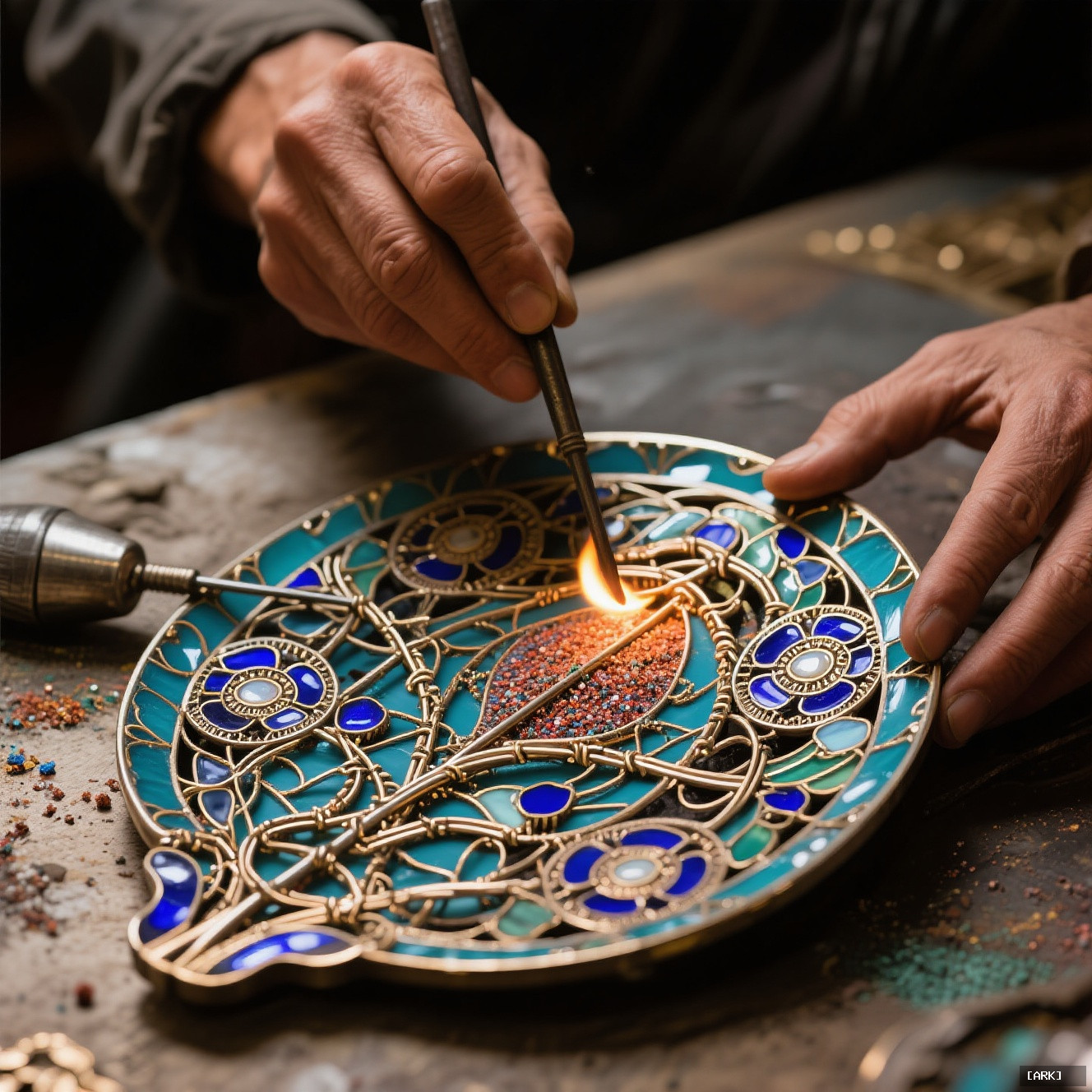
But any practitioner will tell you: it’s not the same. The soul of true cloisonné enamel craftsmanship is in the alchemy. It’s in the moment the granular powder melts into a liquid gem, the risk of the fire, and the irreversible magic of the transformation. Cold methods teach the structure; the kiln teaches the spirit.
Your Practical Checklist: Evaluating a Piece
- Surface: Is it flawlessly smooth, level, and free of pits or bubbles?
- Wires (Cloisons): Are they finely made, even, and seamlessly soldered? Are they fully embedded at the edges?
- Color Fill: Is every cell completely full? Are the hues vibrant and distinct, with no bleeding between compartments?
- Gilding: If present on wires or edges, is it even, intact, and lustrous?
- Weight & Feel: Does it have a solid, substantial heft for its size? Does it feel like quality?
Answers to Common Curiosities
- Does it tarnish? The enamel glass is essentially inert and will not change. However, the exposed metal wires or base (if made of copper or silver and not gilded) can oxidize over time, developing a patina. Some collectors cherish this natural aging.
- How should I clean it? Use a soft, dry, lint-free cloth. Gently dust the surface. Avoid water, household cleaners, chemicals, or abrasive polishes, which can damage the soft metal, the gilding, or the polish of the enamel itself.
- Is it always on copper? Historically, copper was very common due to its affordability and good adhesion for enamel. However, fine art pieces and jewelry are often made on silver or gold. Bronze and other alloys are also used.
- What’s the telltale sign of a cheap piece? Bleeding. When the colored enamel seeps over or under the dividing wires, it creates fuzzy, blurred lines and muddies the design clarity. It’s the clearest sign of rushed firing or poor technique.
Sources & Further Pathways
About Our Expertise
Drawing from decades of expertise in Chinese traditional arts, our insights into cloisonnu00e9 enamel craftsmanship are rooted in direct collaboration with master artisans in Beijing and other heritage centers. We verify techniques through hands-on workshops and scholarly research, ensuring that descriptions of wire-bending, kiln firings, and material selection reflect authentic practices passed down through generations, not just theoretical knowledge.
This article embodies our commitment to preserving and sharing genuine Chinese cultural heritage. By detailing the historical significance of cloisonnu00e9, from its use in imperial artifacts to modern adaptations, we provide a trustworthy resource that connects readers to the living tradition. Our quality guidelines and sourcing tips are based on real-world evaluations, helping collectors avoid imitations and appreciate the artistry that defines this timeless craft.
✨ You Might Also Enjoy


You may also like
Herbal Bead Bracelet: Ancient Chinese Aromatherapy for Modern Wellness | HandMyth™
Original price was: ¥2,199.00.¥1,352.00Current price is: ¥1,352.00. Add to cartPremium Herbal Beads Bracelet: Traditional Medicine Meets Modern Jewelry | Shop HandMyth
Original price was: ¥874.00.¥608.00Current price is: ¥608.00. Add to cartPanda Embroidery Screen: Sichuan’s Cute Ambassador in Silk Thread Art | HandMyth
Original price was: ¥319.00.¥230.00Current price is: ¥230.00. Add to cartPanda Gift Set: Curated Chinese Treasures for Panda Lovers | HandMyth™ (Free Gift Wrap)
Original price was: ¥136.00.¥118.00Current price is: ¥118.00. Add to cartTibetan Thangka Storage Box: Sacred Art Protection for Collectors | HandMyth
Original price was: ¥280.00.¥219.00Current price is: ¥219.00. Add to cartPure Silk Handbag: Hangzhou’s Legendary Silk Weaving for Modern Elegance | HandMyth™
Original price was: ¥874.00.¥786.00Current price is: ¥786.00. Add to cartHand-Painted Silk Scarf: Wearable Art from China’s Silk Road | HandMyth (Artist Signed)
Original price was: ¥1,017.00.¥935.00Current price is: ¥935.00. Add to cartModern Qipao Dress: Timeless Chinese Elegance for Today’s Woman | HandMyth (Custom Fit)
Original price was: ¥2,459.00.¥2,240.00Current price is: ¥2,240.00. Add to cartEmbroidered Chinese Handbag: Suzhou Silk Embroidery Meets Modern Fashion | HandMyth™
Original price was: ¥680.00.¥646.00Current price is: ¥646.00. Add to cart























