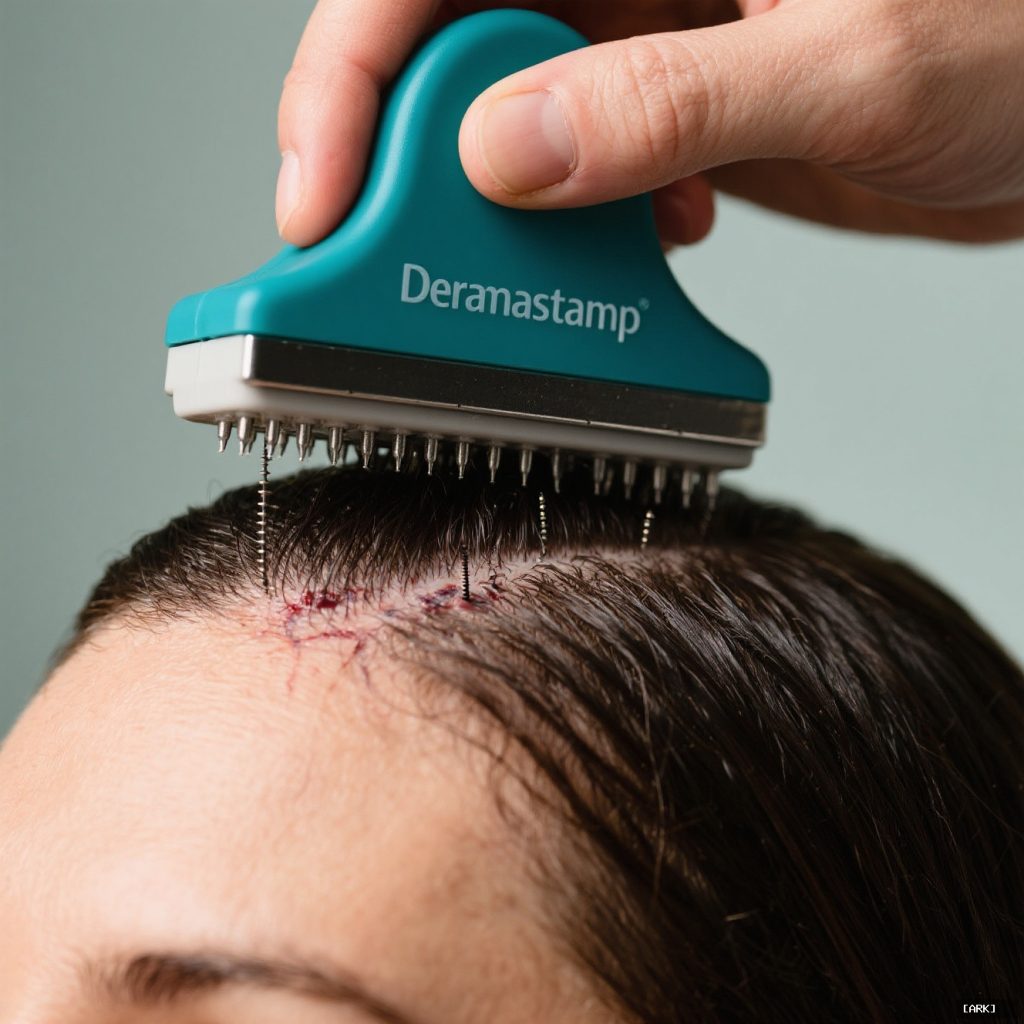
Using a dermastamp for hair growth is a deliberate act of biological persuasion. This microneedling scalp treatment doesn’t plant new seeds but tries to rehabilitate the soil, triggering your body’s own repair mechanisms in the hope of reviving dormant follicles.
The concept is disarmingly simple. You press a stamp tipped with fine needles against your scalp. It creates micro-injuries. Your body, in its relentless drive to maintain integrity, rushes to fix them. That repair process, known as collagen induction therapy, is where the theoretical magic for hair regrowth happens. Growth factors flood the area. Stem cells mobilize. New collagen forms, along with tiny blood vessels. The goal is to transform a dormant, undernourished patch of scalp into a more hospitable environment where hair might, just might, decide to grow again.
It feels like a hack. A clever workaround for androgenetic alopecia, the most common form of hair loss. But the path from that initial pinch to new hair is long, subtle, and shrouded in biological nuance. This isn’t a quick fix. It’s a long-term negotiation with your own physiology.
The Biology of a Controlled Injury
At its core, a dermastamp for hair growth is a tool for creating a precise, superficial wound. The key word is controlled. You are not lacerating your scalp. You are punctuating it with channels so tiny they are largely invisible to the naked eye. This distinction is everything.
Your body possesses an exquisite wound-healing cascade, a pre-programmed sequence of events for damage control. When you microneedle your scalp, you trigger Phase One: inflammation. This is not the bad, chronic inflammation associated with hair loss. It’s an acute, necessary alert. Platelets arrive, releasing a cocktail of growth factors like PDGF (Platelet-Derived Growth Factor) and VEGF (Vascular Endothelial Growth Factor). These are the foremen of the repair site.
They call in the crews. Stem cells migrate to the area. Fibroblasts get to work spinning new collagen and elastin—the scaffolding of your skin. Crucially, angiogenesis begins, the formation of new micro-capillaries. Think of this as upgrading the local infrastructure, bringing more blood flow, oxygen, and nutrients to a neighborhood that has been in decline.
For a hair follicle, a tiny organ embedded in the scalp, this revitalized environment is potentially life-changing. A miniaturizing follicle is often starved of optimal blood flow and choked by a hardened, fibrotic band of collagen. The theory is that collagen induction therapy can soften that environment, deliver a fresh supply of growth factors directly to the follicle’s doorstep, and essentially reset its cellular conversation. The follicle isn’t being given a new instruction manual. It’s being placed in a better library with better lighting.
The Texture Trap: When Your Scalp Gets Tough
Many people who start microneedling scalp treatments report an unexpected result. Instead of feeling softer or more supple, their scalp feels tougher, leathery. This can be deeply discouraging. It feels like you’re creating scar tissue, not fostering growth.
In a way, you are witnessing phase one of the process in real-time. The initial collagen that fibroblasts produce is Type III collagen. It’s laid down quickly and haphazardly, like emergency scaffolding. It’s dense and disorganized—this is what gives that tough, firm sensation. Your body is doing exactly what it’s evolved to do: fortify the breach as swiftly as possible.
The real transformation occurs during the remodeling phase, which can take weeks to months. During this time, under the guidance of enzymes and cellular signals, that immature Type III collagen is gradually broken down and replaced with stronger, more flexible, and organized Type I collagen. The scaffolding is replaced by a more elegant, permanent structure. The toughness subsides. The texture changes.
If your scalp remains persistently tough, it’s often a sign of over-treatment. Too frequent sessions, too much pressure, or excessive depth can signal to your body that this is not a minor puncture but a sustained assault. The biology shifts from repair to defense, prioritizing rapid, dense fortification over nuanced regeneration. Consistency with moderate settings almost always beats aggressive, sporadic trauma.
Beyond Collagen: The Immune Hypothesis
While the collagen and blood vessel story is compelling, it might not be the whole picture. Another, less obvious connection between needling and hair survival involves the local immune environment.
Androgenetic alopecia isn’t just about hormones shrinking follicles. It’s increasingly understood as a condition with an inflammatory component. Miniaturizing follicles can be surrounded by a subtle, chronic soup of immune cells and inflammatory signals—a low-grade battlefield that further stresses the hair’s growth cycle.
Here’s where microneedling might play a subtler game. The controlled injury of a hair regrowth treatment like dermastamping could act as an immune reset. By creating a clean, acute injury, it may disrupt that chronic inflammatory landscape. The body’s attention is forcibly redirected to a clear, present task (healing the micro-wounds), potentially calming the background noise of inflammation that was hostile to the follicles.
In this view, the treatment is less about building a new house for the hair and more about pacifying the troubled neighborhood it already lives in. It’s a theory that shifts the focus from construction to diplomacy.
The Collector’s Fallacy: Tool vs. Protocol
The world of at-home treatments is rife with gear obsession. It’s easy to fall into the collector’s mindset, believing that the next device—the one with titanium needles, the adjustable depth from 0.25 to 3.0mm, the vibrating handle, the brand name from a prestigious lab—will be the key that accesss success.
This is a dangerous distraction. Authenticity checks matter far less for the stamp itself and infinitely more for your commitment to the protocol. A $200 dermastamp used with poor technique, inconsistent timing, and unrealistic expectations is a worthless paperweight. A simple, sterile $40 device used religiously on a scheduled, long-term basis has a genuine chance of demonstrating effect.
The brutal truth of collagen induction therapy for hair is its monotony. It is not glamorous. It is a repetitive, somewhat uncomfortable maintenance task with a delayed feedback loop measured in months, not weeks. The desire to acquire new tools is often a subconscious attempt to bypass this tedium, to find a shortcut where none exists. The most critical factor is not the tool in your hand, but the calendar on your wall and your willingness to stick to it.
Reading the Signals: Is It Working?
How do you know if your dermastamp for hair growth is actually doing anything? Visual new hair is the final, lagging indicator. If you’re waiting for that to confirm your efforts, you will likely quit in frustration.
You must learn to read the earlier, subtler signs. These are tactile and sensory, not visual.
- Scalp Pliability: Does your scalp feel less tight? Can you move it more easily over your skull? This suggests the remodeling of that initial tough collagen.
- Sebum Changes: Do you notice less oiliness? Improved blood flow and a healthier skin barrier can sometimes normalize oil production.
- Texture Shift: A move from sandpapery or slick to a more velvety, healthy-skin feel.
- The “Shed”: Early increased shedding is often discussed. The theory is that needling can shock hairs in the resting (telogen) phase into falling out, to be replaced by new growth. However, this is notoriously unreliable as a sign. Shedding can happen for many reasons, and its absence doesn’t mean failure.
These subtle changes are the whispers of cellular activity. They tell you the process is engaged. Mistaking this silent, subsurface work for failure is the most common reason people abandon their protocol right before it might have borne fruit.
A Practical Framework for Starting
If you decide to proceed, abandon hope for a quick victory. Frame it as a six-to-twelve-month science experiment on yourself. Here is a grounded checklist.
- Professional Consultation: See a dermatologist or trichologist. Rule out other causes of hair loss (like alopecia areata, thyroid issues, or nutritional deficiencies) that need different treatment. Discuss if microneedling is appropriate for you, especially if you have any skin conditions like psoriasis or a history of keloid scarring.
- Source Simply: Buy a basic, sterile dermastamp from a reputable supplier. Ensure the needles are real, not prongs. Your goal is safety and consistency, not features.
- Set a Schedule and Depth: The most common protocol is once per week. Mark it in your calendar. For scalp use, a depth of 0.5mm to 1.0mm is the standard range. Start at the lower end. You should feel a pinprick sensation, not pain, and see no significant blood—just mild redness (erythema).
- Topical Synergy (The Minoxidil Question): The most researched combination is microneedling with minoxidil. The micro-channels are thought to dramatically increase absorption. If you choose to pair treatments, apply the minoxidil after your needling session. Using only one proven topical minimizes variables and irritation risk.
- The Evaluation Period: Commit to a minimum of six months without changing your device, frequency, depth, or topical regimen. Changing multiple variables at once makes it impossible to know what’s working.
Navigating Common Dilemmas
Depth vs. Frequency: Which Rules?
Depth dictates the level of injury. Too shallow (under 0.5mm) may not adequately reach the follicular depth. Too deep (over 1.5mm) risks scarring and excessive trauma. Frequency dictates the rhythm of stimulus and repair. A moderate depth (0.75mm) applied consistently every week is far more effective and safer than a deep, painful session done erratically every month. Consistency with appropriate depth is king.
The Serum Debate: To Apply or Not to Apply?
This is a major point of contention. The “open channel” theory suggests applying serums immediately post-needling allows for unparalleled absorption. The counter-argument warns that you are also driving any potential irritants, preservatives, or allergens deep into the skin, risking inflammation. If you choose to apply something, it should be a simple, trusted formula. Many opt for pure hyaluronic acid serums or copper peptides. A conservative approach is to wait at least 4-6 hours for the micro-channels to close before applying any topicals.
Needling Through Existing Hair
You can and should microneedle over existing hair. The goal is to place the needles on the scalp skin, between the hair shafts. You do not need to shave your head. However, very short hair (a buzz cut) can make it easier to see where you’ve treated and ensure even coverage. Long hair simply needs to be parted systematically.
The Long Game
Using a dermastamp for hair growth is an exercise in patience and tempered optimism. It is not a miracle. It is a mechanical intervention that seeks to leverage your body’s innate healing power for a secondary benefit. For some, it can be a valuable part of a hair retention strategy, particularly when combined with evidence-based topicals. For others, the effects may be subtle or negligible.
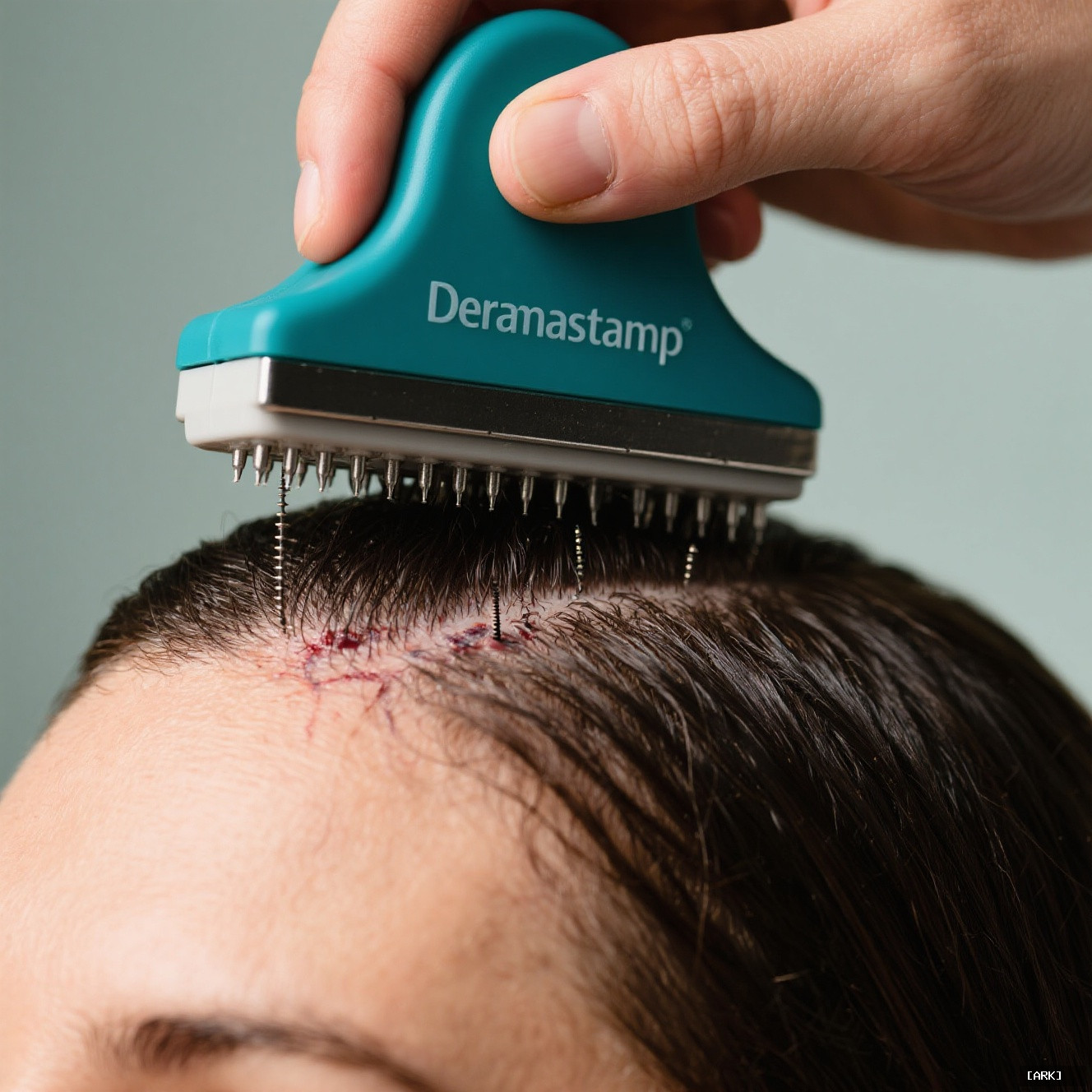
The process teaches you to pay attention to your scalp in a new way—to feel its texture, notice its health. You become an observer of your own biology. Success isn’t guaranteed by the tool you buy, but by the respectful, consistent, and patient protocol you choose to follow with it. You are not just stamping your scalp. You are trying to start a very slow, very quiet conversation with the roots of your hair.
Sources & Further Reading
✨ You Might Also Enjoy



You may also like
Herbal Bead Bracelet: Ancient Chinese Aromatherapy for Modern Wellness | HandMyth™
Original price was: ¥2,199.00.¥1,352.00Current price is: ¥1,352.00. Add to cartPremium Herbal Beads Bracelet: Traditional Medicine Meets Modern Jewelry | Shop HandMyth
Original price was: ¥874.00.¥608.00Current price is: ¥608.00. Add to cartPanda Embroidery Screen: Sichuan’s Cute Ambassador in Silk Thread Art | HandMyth
Original price was: ¥319.00.¥230.00Current price is: ¥230.00. Add to cartPanda Gift Set: Curated Chinese Treasures for Panda Lovers | HandMyth™ (Free Gift Wrap)
Original price was: ¥136.00.¥118.00Current price is: ¥118.00. Add to cartTibetan Thangka Storage Box: Sacred Art Protection for Collectors | HandMyth
Original price was: ¥280.00.¥219.00Current price is: ¥219.00. Add to cartPure Silk Handbag: Hangzhou’s Legendary Silk Weaving for Modern Elegance | HandMyth™
Original price was: ¥874.00.¥786.00Current price is: ¥786.00. Add to cartHand-Painted Silk Scarf: Wearable Art from China’s Silk Road | HandMyth (Artist Signed)
Original price was: ¥1,017.00.¥935.00Current price is: ¥935.00. Add to cartModern Qipao Dress: Timeless Chinese Elegance for Today’s Woman | HandMyth (Custom Fit)
Original price was: ¥2,459.00.¥2,240.00Current price is: ¥2,240.00. Add to cartEmbroidered Chinese Handbag: Suzhou Silk Embroidery Meets Modern Fashion | HandMyth™
Original price was: ¥680.00.¥646.00Current price is: ¥646.00. Add to cart