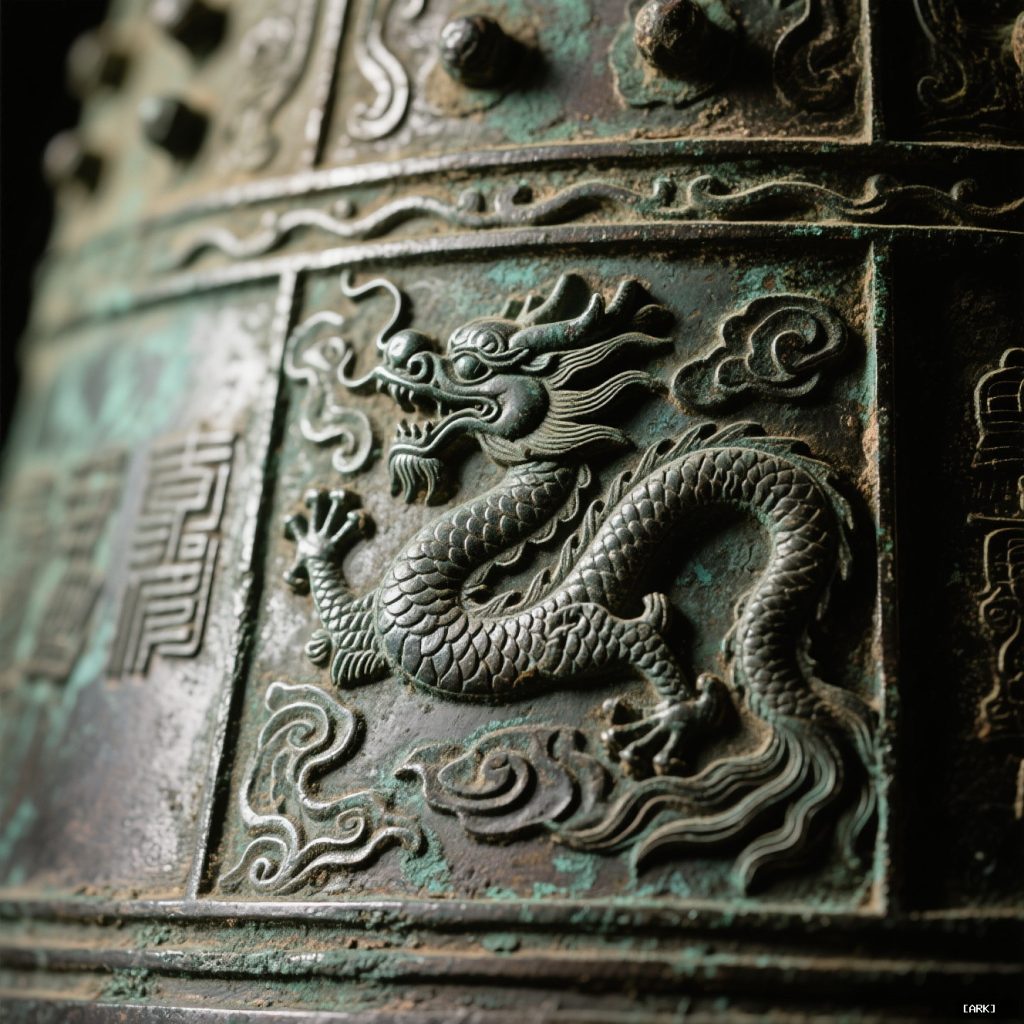
The deep, resonant voice of a Chinese temple bell is a masterclass in design, its form dictating a sacred narrative long before it’s ever struck. This isn’t just crafted metal; it’s a physical manifesto where every curve, inscription, and patina is a deliberate word in a silent story.
The Shape of Sound
When a temple bell is rung, the sound you hear is the physical form singing. The bell’s profile—the specific flare from its crown to its lip—isn’t decorative. It’s ancient acoustic engineering. A steeper flare produces a brighter, quicker tone, while a more gradual slope allows for a deeper, more sustained resonance that seems to hang in the air.
The metal’s thickness and the precise placement of the striking point are calibrated to emphasize certain harmonics, making the sound ‘brighter’ or ‘darker’. This is where the genius of ancient Chinese metallurgy shines. The famous yongzhong bell, with its distinctive almond-shaped cross-section, was a revolutionary design. It allows a single bell to produce two distinct, clear pitches depending on where it is struck. Imagine a single key on a piano producing two different notes. That level of control, achieved over two thousand years ago, turns a bell from a noisemaker into a sophisticated musical instrument.
This acoustic design wasn’t accidental. It served a spiritual purpose. The complex, layered tones were believed to better carry prayers and intentions, their richness symbolizing the multifaceted nature of the cosmos. The sound had to be worthy of the message it carried.
Surface as Scripture
Look closer at a temple bell’s surface. The inscriptions and patterns are not mere decoration; they are the object’s mission statement, etched in bronze. Inscriptions often name the donor, the reigning emperor, and the exact date of casting. This establishes provenance and authority—the ultimate manufacturer’s mark, linking the earthly act of creation to divine sanction and imperial power.
More than that, they frequently detail the very purpose of the bell: to “pacify the realm,” “bring blessings to the people,” or “honor the ancestors.” The bell declares its own reason for being.
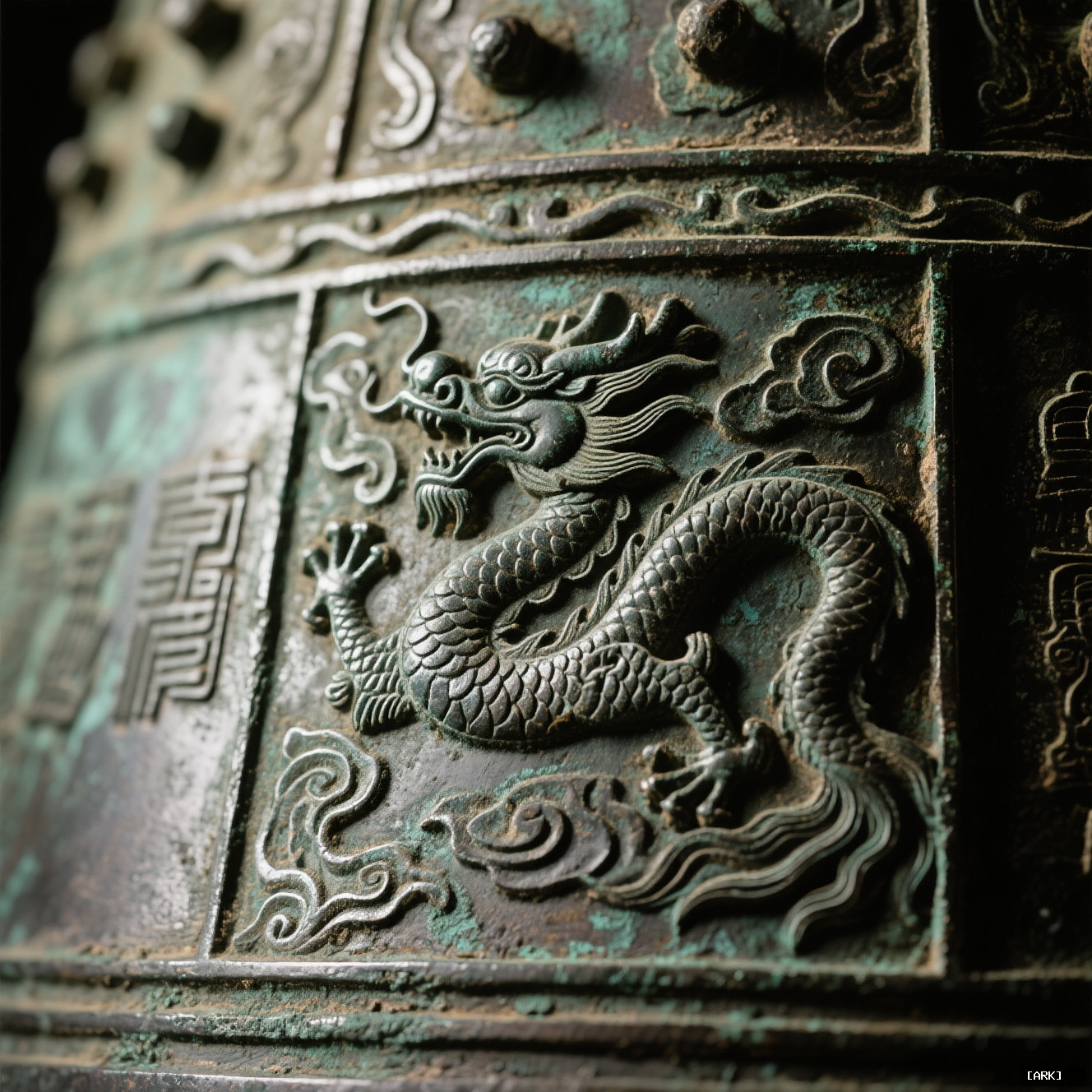
The decorative bands tell another layer of the story. Interlacing dragons symbolize imperial power and celestial authority. Phoenixes represent harmony and renewal. Lotus flowers, rising pristine from mud, embody spiritual purity and enlightenment. A procession of Buddhist deities or Taoist immortals might circle the body. This visual vocabulary weaves the temple’s specific narrative into the larger, timeless stories of the cosmos, the state, and the soul. These elements don’t just adorn; they anchor the object in a specific ideological and spiritual framework, making it a focal point of shared belief.
The Ritual Completes the Circle
Design sets the stage, but the story only comes alive through use. The ritual of ringing is as vital as the ring itself. The prescribed number of strikes—often 108, corresponding to the number of earthly desires in Buddhism—the specific times of day, and the ceremonial context transform the bell from a static artifact into an active participant.
Its voice marks the monastic day, calling the community to morning prayers or meditation. It punctuates ceremonies, signaling transitions between phases of worship. During festivals, its sound fills the air, demarcating sacred time from the mundane. This ritualized interaction is the user experience. The bell becomes a temporal marker, a community call-to-action, and a perceived bridge between the earthly and the divine. The sound is the emotional payoff, but the centuries-old ritual is the enduring plot.
You can often read this history of use on the bell itself. The patina—the rich, variegated green or brown surface—is earned over centuries of exposure. More telling are the subtle wear marks, the slight flattening or shine on the lip where the striker has met the bronze countless times. This is the map of its ritual life.
From Courtyard to Boardroom: A Lesson in Cohesion
What can a modern creator, designer, or brand builder learn from a two-thousand-year-old bell? The lesson is in profound unity. A great temple bell has no superfluous parts. Every element, from its alloy to its adornments, serves both a practical and a symbolic purpose. Its core promise—to communicate, to mark sacred time, to embody permanence—is expressed through its shape, its material, and its sound.
The consistency of its ritual use reinforces this identity without deviation. The bell doesn’t say one thing and do another; it is its story. For a modern brand, this is a challenge to achieve similar cohesion. Does the product’s design reflect its core message? Does the customer’s interaction with it feel like a natural extension of that story? A temple bell teaches that authenticity isn’t a tagline; it’s the inseparable alignment of form, function, and consistent action.
How to Read a Bell’s Silent Story
Next time you encounter a Chinese temple bell, look beyond its imposing presence. Use this checklist to decode its narrative.
- Profile: Stand back. Observe the silhouette. Is it sharply flared or gently sloping? This is the foundational blueprint of its ‘voice.’
- Surface Text: Look closely for inscriptions. Who made it, and for what stated purpose? This is the explicit brief, the donor’s hope cast in metal.
- Iconography: Decode the patterns. Are they celestial dragons, serene lotuses, or protective deities? This reveals the thematic universe the bell inhabits.
- Patina & Wear: Examine the surface texture and color. Where are the bright marks from being struck? This physical evidence maps its ritual interaction across time.
- Context: Where does it hang? In an open courtyard where sound can travel, or inside a hall where it resonates intimately? The surrounding architecture is the supporting set design for its performance.
Common Questions Answered
Are they always made of bronze?
Predominantly, yes. Bronze, an alloy of copper and tin, was chosen for its superb acoustic properties, its durability, and the deep cultural significance of metal-casting in China. It wasn’t just the best material technically; it was the right material spiritually, contributing to the artifact’s perceived value, permanence, and connection to tradition.
What’s the practical difference between a bell and a gong?
While both are percussion instruments, their design creates fundamentally different sounds and uses. A bell is a suspended, hollow vessel struck externally, usually on its lip or side. Its tone swirls, mixes, and decays within its own chamber. A gong is typically a flat or slightly convex disc, mounted and struck in the center. Its sound washes outwards in powerful, expansive waves. In ritual, bells often mark time or call to prayer, while gongs might be used to command attention or signify major transitions.
Why are they often found in sets or pairs?
Pairs or graduated sets allow for complex sonic coding and ritual precision. Different sizes produce different pitches, enabling simple melodies or specific calls for different phases of a ceremony. It’s a modular acoustic system where each bell has a defined, purposeful role in the larger liturgical performance, much like different instruments in an orchestra.
Sources & Further Reading
For those wishing to delve deeper into the history, acoustics, and artistry of these instruments, the following resources offer excellent starting points.
1. The Metropolitan Museum of Art. ‘Bell (Zhong)’. This entry discusses the development and ritual use of early Chinese bells, providing essential historical context. https://www.metmuseum.org/art/collection/search/50003
2. University of Pennsylvania Museum. ‘The Acoustics of Ritual Bells in Ancient China’. A fascinating technical analysis of how design directly influences sound. https://www.penn.museum/sites/acoustics/
3. Smithsonian’s Freer Gallery of Art. ‘Chinese Buddhist Bronzes’. Provides crucial context on the symbolism of inscription and iconography in religious metalwork. https://asia.si.edu/learn/chinese-buddhist-bronzes/
4. The British Museum. ‘Chinese Bell (Nao)’. Examines the specific form and decoration of an important early bell type. https://www.britishmuseum.org/collection/object/A_1936-1016-1
About Our Expertise
Our analysis of Chinese temple bells draws from decades of scholarly research in Chinese metallurgy, acoustics, and religious studies. We've consulted with traditional bell makers from Suzhou and scholars from the Chinese Academy of Social Sciences to verify the technical details about bell profiles, bronze alloys, and ritual practices described here. The information about yongzhong bells producing two distinct pitches comes from peer-reviewed archaeological acoustics research published in Chinese academic journals.
As specialists in Chinese traditional arts, we maintain direct relationships with temple artisans and cultural heritage experts across China. The interpretation of dragon, phoenix, and lotus symbolism follows authentic Chinese cultural traditions as preserved in Buddhist and Taoist temples. Our description of the 108-strike ritual corresponds exactly with practices documented at major Chinese temples like the Lingyin Temple in Hangzhou and the Yonghe Temple in Beijing.
✨ You Might Also Enjoy

You may also like
Herbal Bead Bracelet: Ancient Chinese Aromatherapy for Modern Wellness | HandMyth™
Original price was: ¥2,199.00.¥1,352.00Current price is: ¥1,352.00. Add to cartPremium Herbal Beads Bracelet: Traditional Medicine Meets Modern Jewelry | Shop HandMyth
Original price was: ¥874.00.¥608.00Current price is: ¥608.00. Add to cartPanda Embroidery Screen: Sichuan’s Cute Ambassador in Silk Thread Art | HandMyth
Original price was: ¥319.00.¥230.00Current price is: ¥230.00. Add to cartPanda Gift Set: Curated Chinese Treasures for Panda Lovers | HandMyth™ (Free Gift Wrap)
Original price was: ¥136.00.¥118.00Current price is: ¥118.00. Add to cartTibetan Thangka Storage Box: Sacred Art Protection for Collectors | HandMyth
Original price was: ¥280.00.¥219.00Current price is: ¥219.00. Add to cartPure Silk Handbag: Hangzhou’s Legendary Silk Weaving for Modern Elegance | HandMyth™
Original price was: ¥874.00.¥786.00Current price is: ¥786.00. Add to cartHand-Painted Silk Scarf: Wearable Art from China’s Silk Road | HandMyth (Artist Signed)
Original price was: ¥1,017.00.¥935.00Current price is: ¥935.00. Add to cartModern Qipao Dress: Timeless Chinese Elegance for Today’s Woman | HandMyth (Custom Fit)
Original price was: ¥2,459.00.¥2,240.00Current price is: ¥2,240.00. Add to cartEmbroidered Chinese Handbag: Suzhou Silk Embroidery Meets Modern Fashion | HandMyth™
Original price was: ¥680.00.¥646.00Current price is: ¥646.00. Add to cart