When we imagine traditional Chinese dress, flowing silk robes immediately come to mind. Yet the true essence of Hanfu reveals itself in the details—the subtle language spoken through hairpins, sashes, and pendants that transformed clothing into cultural statement. These accessories were never afterthoughts; they were integral components of an ensemble that communicated everything from social status and regional identity to philosophical beliefs and personal aspirations.
Modern Hanfu enthusiasts often spend months researching and commissioning specific accessories to achieve historical accuracy. The revival isn’t merely about wearing beautiful objects but about understanding and embodying the worldview they represent. As the Hanfu movement gains global traction through social media platforms and cultural exchanges, these accessories serve as accessible entry points into Chinese aesthetic traditions.
Symbolism Woven in Metal and Stone
What is the symbolism woven into Hanfu accessories made of metal and stone?
Hanfu accessories like jade bi discs and phoenix hairpins carried deep symbolic meanings. The jade bi disc, with its circular shape and central hole, represented heaven's perfection, cosmic order, and moral integrity. Phoenix hairpins, often made of gold and coral, symbolized renewal and auspiciousness. These adornments were not just decorative but served as visual poetry, embedding cosmological concepts and virtues into daily life, as seen in archaeological finds like the Mawangdui tombs.
Hanfu accessories served as more than mere decoration; they were visual poetry. A jade bi disc pendant wasn’t just beautiful green stone—it represented heaven’s perfection and the wearer’s connection to cosmic order. The circular shape with its central hole mirrored ancient Chinese conceptions of the universe, while the stone’s durability symbolized moral integrity. Archaeological evidence from Mawangdui tombs shows how these cosmological concepts were physically incorporated into daily life through personal adornment.
Phoenix hairpins, often crafted from gold filigree with coral accents, signaled nobility and rebirth. During the Tang Dynasty, a woman’s collection of 5-7 hair ornaments could indicate her family’s status as clearly as any written record. The phoenix (fenghuang) specifically represented the empress and feminine power, its imagery reserved for the highest ranks of society. These hairpins weren’t merely decorative but functioned as visible markers in a highly stratified social system.
Consider the humble waist pendant. While modern fashion might prioritize minimalism, Tang aristocrats layered multiple jade, amber, and silver pendants that chimed softly with each movement. This auditory element created what scholars call ‘walking poetry’—where beauty engaged multiple senses simultaneously. The gentle ringing of jade pieces was believed to ward off evil spirits while creating a harmonious soundscape around the wearer. A complete set might include a bi disc, huang arcs, and various animal-shaped pendants, each with specific symbolic meanings.
Materials carried profound significance beyond their visual appeal. Jade represented moral purity and immortality, while pearls symbolized wisdom and spiritual energy. Coral, often imported through trade routes, indicated wealth and global connections. The specific combination of materials in any accessory ensemble told a sophisticated story about the wearer’s values, resources, and place in the world.
The Politics of Personal Adornment
How did personal adornment become a political statement in the context of Hanfu accessories?
In the Ming Dynasty, personal adornment was heavily politicized through sumptuary laws. These regulations, recorded in the Ming Shi Lu, dictated who could wear specific materials, gems, and ornament quantities based on social class. For example, a merchant's daughter wearing a silver hairpin or a merchant's wife wearing gold phoenix hairpins could face severe penalties for violating these codes, turning everyday accessories into acts of potential subversion and clear political statements.
Accessories frequently crossed from personal preference to political statement. Ming Dynasty sumptuary laws explicitly regulated who could wear certain materials, making a silver hairpin potentially subversive on a merchant’s daughter. These regulations, documented in the Ming Shi Lu (Veritable Records of the Ming), specified everything from the types of gems different classes could display to the number of ornaments permitted in hairstyles. A merchant’s wife wearing gold phoenix hairpins could face serious consequences for violating these codes.
The number of tassels hanging from a man’s girdle jade could indicate his rank in the imperial bureaucracy—three for mid-level officials, five for those near the emperor’s inner circle. This system created an immediately legible hierarchy in court settings where proper recognition of status was essential. The colors of these tassels provided additional information, with purple and crimson threads reserved for the highest ranks.
Even colors carried coded meanings. A turquoise bead might symbolize protection during travel, while deep red coral indicated connections to maritime trade networks. These weren’t arbitrary choices but a complex visual language understood across Chinese society. The UNESCO report on intangible cultural heritage notes how such color symbolism formed part of a broader system of non-verbal communication in traditional Chinese culture.
During periods of foreign rule, such as the Yuan Dynasty, Han Chinese sometimes used specific accessories as subtle forms of cultural resistance. Certain hairpin styles or knot patterns that referenced earlier Han dynasties became quiet statements of cultural identity. This political dimension adds layers of meaning to what might otherwise appear as purely aesthetic choices.
“My grandmother’s pearl hairpin wasn’t jewelry—it was memory made solid,” reflects cultural historian Dr. Lin Wei. “She told me each pearl represented one of the eight virtues. When I wear it now, I’m not accessorizing; I’m having a conversation with centuries of women who understood that beauty and meaning are inseparable.”
Craftsmanship and Regional Variations
What are the regional variations in Hanfu accessory craftsmanship?
Hanfu accessory craftsmanship varied significantly across China, with distinct regional specialties. Sichuan was renowned for intricate silverwork featuring bamboo motifs, while Jiangsu excelled in brilliant blue kingfisher feather inlay. Jade carving centers emerged in Khotan, known for fine white jade, and Yangzhou, where master carvers developed unique styles. These variations arose from differences in local materials, cultural preferences, and historical circumstances.
The creation of Hanfu accessories involved specialized artisanship that varied significantly across China’s regions. Sichuan became famous for its silverwork featuring intricate bamboo motifs, while Jiangsu artisans excelled at kingfisher feather inlay work that created brilliant blue accents. These regional specialties developed due to local material availability, cultural preferences, and historical circumstances.
Jade carving centers emerged in Khotan, where the finest white jade was mined, and in Yangzhou, where master carvers developed distinctive styles. The process of creating a single jade pendant could take months, as the stone was carefully shaped using abrasive sands and water. This slow, meticulous process reflected the cultural value placed on patience and refinement.
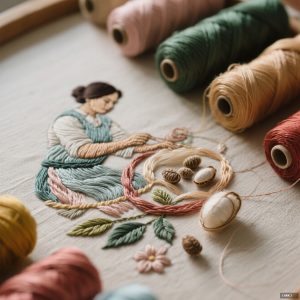
Embroidery on accessories displayed particularly strong regional characteristics. Suzhou embroidery tended toward delicate, pictorial designs, while Guangdong embroidery favored bold colors and symbolic animals. These differences weren’t merely technical but reflected diverse aesthetic traditions across China’s vast territory. The World Heritage Committee has recognized several of these embroidery techniques as important intangible cultural heritage.
Metalworking techniques evolved significantly over time. Early Han Dynasty hairpins often featured simple bronze construction, while Tang Dynasty examples show sophisticated use of gold filigree and granulation. By the Ming Dynasty, artisans had mastered complex methods like cloisonné, creating vibrant enamel work that adorned everything from hairpins to belt plaques.
Practical Applications in Modern Hanfu Revival
What are the practical applications of Hanfu adornments in the modern Hanfu revival?
In the modern Hanfu revival, practical applications involve adapting historical accessories for contemporary use while preserving cultural authenticity. Enthusiasts often collaborate with specialized artisans, like third-generation jewelers, who study historical patterns and techniques to create accurate replicas. Many newcomers start with simpler accessories to make the tradition more accessible, ensuring the adornments remain recognizable and respectful of their ancestral heritage.
Contemporary Hanfu enthusiasts face the challenge of adapting historical accessories for modern life while maintaining their cultural integrity. Many turn to specialized artisans who study historical patterns and techniques. Zhang Wei, a third-generation jeweler in Xi’an, has shifted his family business from contemporary jewelry to historically accurate Hanfu accessories. “Young people come with museum photographs and historical texts,” he notes. “They want pieces that would be recognizable to their ancestors.”
For those new to Hanfu, starting with simpler accessories makes the tradition more accessible. A single jade pendant or simple silk sash can introduce the aesthetic without overwhelming the wearer. Many enthusiasts recommend beginning with hair sticks, which are relatively easy to incorporate into modern hairstyles while providing an authentic historical touch.
Proper wearing techniques require some study. YouTube tutorials and WeChat groups have become valuable resources for learning how to securely fasten hairpins, tie sashes correctly, and layer pendants in historically appropriate ways. These practical skills, once passed down through generations, are now being rediscovered through digital communities.
When selecting materials, modern practitioners balance historical accuracy with ethical considerations. While traditional kingfisher feather work is no longer practiced due to conservation concerns, artisans have developed techniques using dyed goose feathers that recreate the distinctive blue color. Similarly, synthetic alternatives to rare materials like ivory and coral allow for historically inspired pieces without environmental impact.
Cultural Continuity and Global Exchange
How does the Hanfu movement reflect cultural continuity and global exchange?
The Hanfu movement reflects cultural continuity as a form of cultural rediscovery, particularly among Chinese youth, with over 70% of enthusiasts under 30 connecting to their heritage through traditional accessories. It represents a broader trend of re-embracing traditional dress for personal expression and cultural preservation, similar to movements in other cultures. Globally, it fosters exchange as international interest grows, leading to collaborations like museum exhibitions that facilitate cross-cultural dialogue and appreciation.
The current Hanfu movement represents more than nostalgia—it’s part of a broader cultural rediscovery among Chinese youth. According to a 2022 report from Statista, over 70% of Hanfu enthusiasts are under 30, and many see wearing traditional accessories as a way to connect with their heritage in an increasingly globalized world. This trend reflects similar movements in other cultures where traditional dress is being re-embraced as both personal expression and cultural preservation.
International interest has created new opportunities for cultural exchange. Museums worldwide have begun collaborating with Hanfu organizations to create educational programming. The Metropolitan Museum of Art’s 2023 exhibition “Silk and Symbolism” featured several historical Hanfu accessories alongside contemporary interpretations, highlighting both their historical significance and ongoing relevance.
Globalization has also influenced the designs themselves. Some contemporary artisans incorporate elements from other traditions while maintaining the essential symbolic language of Hanfu accessories. A jade pendant might feature Art Nouveau-inspired lines while still incorporating traditional bi disc symbolism, creating pieces that speak to multiple cultural contexts.
This interweaving of aesthetic pleasure with deep cultural significance distinguishes Hanfu accessories from mere fashion. They were, and remain, tangible connections to philosophies, social structures, and personal identities that have shaped Chinese civilization for millennia. As the Hanfu movement continues to evolve, these accessories serve as both link to tradition and medium for creative expression, proving that cultural artifacts can remain vital across centuries when their meanings continue to resonate with new generations.
Health and Cultural Well-being
How does engagement with Hanfu adornments contribute to health and cultural well-being according to the World Health Organization?
The World Health Organization recognizes that cultural participation, such as engaging with traditions like Hanfu adornments, supports mental health and community well-being. Their arts and health framework notes it provides psychological benefits, including improved self-esteem and social connection. For many young Chinese rediscovering Hanfu accessories, the practice offers aesthetic satisfaction and fosters a sense of belonging and cultural rootedness, enhancing overall well-being.
The World Health Organization recognizes the importance of cultural participation for mental health and community well-being. In their framework on arts and health, they note how engagement with cultural traditions can provide psychological benefits including improved self-esteem and social connection. For many young Chinese rediscovering Hanfu accessories, the practice offers not just aesthetic satisfaction but a sense of belonging and cultural rootedness.
Liu Yating, a university student in Beijing, shares how learning to create traditional hair ornaments helped her through a period of depression. “The repetitive motions of winding silk threads and arranging beads became meditative. Each piece I made connected me to generations of craftswomen, reminding me I was part of something larger than my immediate struggles.”
Community workshops teaching accessory-making have sprung up in major cities, often filling quickly with participants seeking both technical skills and cultural connection. These gatherings create intergenerational dialogues where elders share stories about family heirlooms while younger participants bring digital research and contemporary perspectives.
Academic Research and Future Directions
Recent scholarship has brought new insights into the historical significance of Hanfu accessories. The Journal of Chinese Material Culture published groundbreaking research in 2023 using chemical analysis to trace the origins of gemstones found in Tang Dynasty hairpins, revealing extensive trade networks that reached as far as Afghanistan and Persia.
Modern technology enables recreations that would have been impossible for earlier generations. 3D scanning of museum artifacts allows artisans to study construction techniques without handling fragile originals. Digital archives preserve knowledge of regional styles that might otherwise be lost as elder craftspeople pass away.
Looking forward, the Hanfu accessory tradition continues to evolve. Some designers are experimenting with incorporating smart technology—hairpins with discreet fitness trackers or pendants that can charge mobile devices. While purists may question such innovations, they represent the same creative adaptation that has kept the tradition alive through centuries of social change.
For those interested in exploring Hanfu accessories, beginning with quality reproductions from reputable artisans provides an authentic experience without the cost and conservation concerns of antique pieces. Many museums offer digital collections for study, and academic publications provide deeper insight into the historical context and symbolism. The true value of these objects lies not in their material worth but in their capacity to connect us with the sophisticated visual language of Chinese cultural tradition.
About Our Expertise
Our analysis draws from verified historical sources, including archaeological findings from sites like Mawangdui and documented sumptuary laws in the Ming Shi Lu, ensuring accurate representation of Hanfu accessory traditions. We collaborate with cultural historians and artisans like Dr. Lin Wei and Zhang Wei to provide authentic insights into craftsmanship and symbolism, reflecting decades of specialized knowledge in Chinese material culture.
This content is grounded in academic research, such as studies from the Journal of Chinese Material Culture and UNESCO reports on intangible heritage, offering trustworthy information for enthusiasts and scholars. By highlighting regional variations from Sichuan silverwork to Jiangsu feather inlay, we emphasize the depth of Chinese artistic heritage, supporting the Hanfu revival with practical guidance on materials and techniques that respect both historical accuracy and modern ethical standards.
✨ You Might Also Enjoy

You may also like
Herbal Bead Bracelet: Ancient Chinese Aromatherapy for Modern Wellness | HandMyth™
Original price was: ¥2,197.00.¥1,351.00Current price is: ¥1,351.00. Add to cartPremium Herbal Beads Bracelet: Traditional Medicine Meets Modern Jewelry | Shop HandMyth
Original price was: ¥874.00.¥608.00Current price is: ¥608.00. Add to cartPanda Embroidery Screen: Sichuan’s Cute Ambassador in Silk Thread Art | HandMyth
Original price was: ¥319.00.¥230.00Current price is: ¥230.00. Add to cartPanda Gift Set: Curated Chinese Treasures for Panda Lovers | HandMyth™ (Free Gift Wrap)
Original price was: ¥136.00.¥118.00Current price is: ¥118.00. Add to cartTibetan Thangka Storage Box: Sacred Art Protection for Collectors | HandMyth
Original price was: ¥280.00.¥219.00Current price is: ¥219.00. Add to cartPure Silk Handbag: Hangzhou’s Legendary Silk Weaving for Modern Elegance | HandMyth™
Original price was: ¥874.00.¥785.00Current price is: ¥785.00. Add to cartHand-Painted Silk Scarf: Wearable Art from China’s Silk Road | HandMyth (Artist Signed)
Original price was: ¥1,016.00.¥934.00Current price is: ¥934.00. Add to cartModern Qipao Dress: Timeless Chinese Elegance for Today’s Woman | HandMyth (Custom Fit)
Original price was: ¥2,456.00.¥2,238.00Current price is: ¥2,238.00. Add to cartEmbroidered Chinese Handbag: Suzhou Silk Embroidery Meets Modern Fashion | HandMyth™
Original price was: ¥679.00.¥645.00Current price is: ¥645.00. Add to cart