
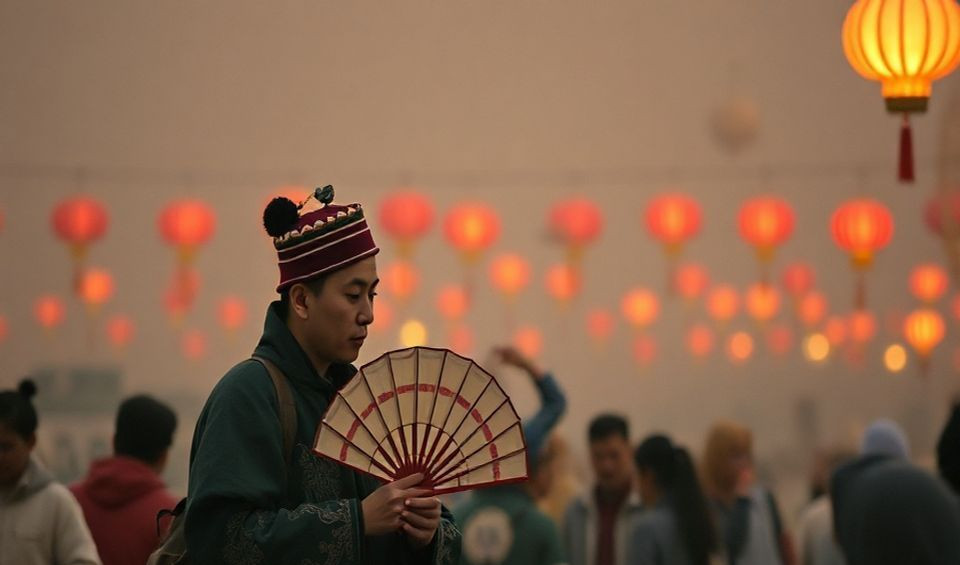
During the Ming Dynasty, a scholar might spend three silver taels—nearly a month’s wages—on a single folding fan. This was not mere extravagance. The fan served as his calling card, his poetry slate, and his social shield. In a culture where direct expression was often tempered by decorum, these delicate instruments became sophisticated tools of communication, bridging the gap between personal expression and social expectation. The investment reflected not just aesthetic appreciation but a commitment to participating in a nuanced language of gestures and symbols that defined educated society.
Courtly Breezes and Imperial Messages
How did fans serve as political instruments and convey imperial messages in the Chinese court?
In the Chinese imperial court, fans functioned as subtle political tools and diplomatic gifts, extending China's soft power. Emperor Qianlong's collection of over 500 meticulously crafted fans, often painted with landscapes or symbols like plum blossoms, were used to communicate virtues such as resilience and purity to tributary states like Korea. These gifts were carefully calibrated statements of cultural superiority, not merely personal accessories.
At the Forbidden City’s height, fans functioned as subtle political instruments. Emperor Qianlong’s collection numbered over 500 meticulously crafted examples, each bearing landscapes painted by court artists. These were not personal accessories but diplomatic gifts—carefully calibrated statements of cultural superiority. When the emperor presented a fan featuring plum blossoms to a Korean envoy, he wasn’t offering relief from summer heat. He was communicating resilience and purity, virtues he expected the tributary state to embody. This practice of “fan diplomacy” extended China’s soft power across East Asia, with the quality of materials and artistry speaking volumes about the giver’s status and intentions. According to UNESCO’s study on intangible cultural heritage, such objects were central to rituals of state that reinforced hierarchical relationships and shared cultural values across the region.
The fan’s movement itself carried meaning. Historical records describe how court ladies used specific angles—a 45-degree tilt, a gentle flutter—to signal their availability for conversation or their wish to be left alone. In a space where verbal communication was restricted, this silent vocabulary prevented countless social missteps. A quick snap could express disapproval, while a slow, rhythmic wave might indicate contemplation or agreement. This choreography of gestures turned crowded courtyards into stages for discreet interaction, where what remained unspoken was often more significant than what was said aloud.
The Scholar’s Moving Canvas
What role did fans play as a 'Scholar's Moving Canvas' in Chinese culture?
In the Song Dynasty, fans were essential for scholars, serving as portable canvases for personal expression. They often carried two fans: one for practical use and another for display, featuring original calligraphy or paintings. These fans acted as portable galleries, used in social exchanges among intellectuals like the poet Su Shi, who swapped them instead of business cards. This practice fostered bonds, with gifted fans serving as compliments and challenges, reflecting the owner's aesthetic sensibility and creating a silent language of art and connection.
By the Song Dynasty, fans had become essential companions for the literate class. A well-bred scholar never traveled without at least two: one for practical use, another for display. The latter often featured original calligraphy or paintings, transforming the fan into a portable gallery. When the poet Su Shi met with colleagues, they would often exchange fans instead of business cards, each artwork reflecting the owner’s aesthetic sensibility. These exchanges created bonds between intellectuals, with the gifted fan serving as both compliment and challenge—the recipient was expected to appreciate the artistry and perhaps respond in kind.
These objects served practical intellectual purposes too. The mathematician Zhu Shijie reportedly worked out complex equations on fan surfaces using charcoal pencils. The temporary nature of these calculations—wiped away with a damp cloth—appealed to scholars who valued mental agility over permanent records. One 14th-century manual even describes how to fold a fan to create precise geometric angles for architectural planning. The fan’s structure, with its uniform ribs and flexible covering, provided a ready-made tool for measurement and calculation in an era before pocket calculators. This dual purpose as both artistic medium and practical instrument made it indispensable to the educated elite.
Practical Tips for Understanding Scholar Fans
When examining antique scholar fans, notice the wear patterns on the ribs and the fading of pigments—these testify to frequent use and personal connection. The quality of bamboo or sandalwood ribs indicates the owner’s status, with rare materials commanding higher prices. For modern collectors, storing fans partially open prevents permanent creasing, while occasional gentle cleaning with a soft brush maintains both appearance and structural integrity.
A Weaver’s Memory
“My grandmother taught me that each fan tells two stories,” says Liang Mei, a third-generation fan painter from Suzhou. “The painted side shows mountains or flowers, but the bamboo ribs underneath remember every opening and closing. After thirty years, a favorite fan develops its own character—the ribs become polished where fingers touch them, the silk softens with handling. We say such fans have learned their owner’s habits.” This intimate relationship between user and object explains why fans frequently appear in Chinese literature as metaphors for friendship and memory. In Dream of the Red Chamber, Baoyu gifts Daiyu a fan painted with bamboo—a subtle reference to their shared resilience in the face of family pressures. The object outlives their relationship, becoming a tangible reminder of connection.
From Imperial Courts to Modern Streets
How has the cultural significance of Chinese fans evolved from imperial courts to modern streets?
Chinese fans have transitioned from elite accessories signaling scholarly refinement or imperial favor in ancient courts to versatile cultural symbols in contemporary life. Today, they appear in diverse contexts, from traditional opera and fashion runways to modern art, where artists like Zhang Hong use classical fan-painting techniques to comment on urban life. This evolution mirrors China's broader journey of honoring tradition while embracing change, with fan-making workshops in places like Shanghai's Tianzifang keeping the craft alive.
The cultural significance of Chinese fans has evolved dramatically while retaining core symbolic meanings. Where once they signaled scholarly refinement or imperial favor, today they appear in diverse contexts from traditional opera to fashion runways. Contemporary artists like Zhang Hong use fan painting to comment on modern urban life, juxtaposing classical techniques with contemporary subjects. The fan’s transition from elite accessory to cultural symbol mirrors China’s own journey—honoring tradition while embracing change.
In Shanghai’s Tianzifang district, workshops teaching fan-making techniques attract both tourists and young locals seeking connection with traditional crafts. “I started learning because my grandfather always carried a fan,” explains university student Chen Wei. “Now I understand it’s not just about cooling yourself—it’s about carrying something beautiful that has history.” This renewed interest among younger generations demonstrates the fan’s enduring appeal as both functional object and cultural touchstone.
The Anatomy of Meaning
What symbolic meanings are carried by the elements of a traditional Chinese fan?
Every part of a traditional Chinese fan holds symbolic meaning. The number of ribs can reference cosmology, such as thirty-six ribs representing Taoist celestial stars. Materials convey values: bamboo signifies integrity and flexibility, while ivory historically denoted wealth. Decorations follow seasonal themes—peonies for spring prosperity, lotuses for summer purity, chrysanthemums for autumn longevity, and plum blossoms for winter resilience.
Every element of a traditional Chinese fan carries symbolic weight. The number of ribs might reference cosmological principles, with thirty-six ribs representing the thirty-six celestial stars in Taoist belief. Materials communicate values—bamboo suggests integrity and flexibility, while ivory (now largely replaced by sustainable alternatives) once indicated wealth and status. Decorations follow seasonal themes: peonies for spring prosperity, lotuses for summer purity, chrysanthemums for autumn longevity, and plum blossoms for winter resilience.
According to the World Health Organization’s research on traditional practices, the rhythmic motion of fan use can provide mild physical therapy for wrist and hand muscles, while the focused attention required for fan painting and calligraphy offers mental benefits similar to meditation. This combination of physical and psychological benefits helps explain the fan’s enduring popularity across centuries.
Preservation and Innovation
How are traditional Chinese fan-making centers addressing the challenges of preservation and innovation?
Traditional Chinese fan-making centers in places like Hangzhou and Suzhou are addressing preservation challenges by adopting innovative methods. While master artisans note that young people often seek faster results than the traditional three-month process allows, workshops are now combining laser cutting with hand-finishing to reduce production time without sacrificing quality. Additionally, collaborations with contemporary designers help create fans that appeal to modern tastes while still utilizing traditional techniques, fostering both cultural preservation and market relevance.
Traditional fan-making centers like Hangzhou and Suzhou face challenges in preserving their craft. Master artisan Zhou Xiaoping notes, “Young people want faster results than fan-making allows. A single high-quality fan can take three months to complete.” However, innovative approaches are emerging. Some workshops now combine laser cutting with hand-finishing to reduce production time while maintaining quality. Others collaborate with contemporary designers to create fans appealing to modern tastes while using traditional techniques.
Statista market analysis shows growing international interest in Chinese cultural products, with fan exports increasing 18% annually since 2018. This global appreciation provides economic incentive for preserving these skills. Museums like the Shanghai Museum have expanded their fan collections and developed interactive displays that allow visitors to explore the history and craftsmanship behind these objects.
Living with Fans Today
How can fans be effectively incorporated into modern life according to their practical and symbolic dimensions?
To incorporate fans into modern life, choose one proportionate to your hand size to avoid appearing overly theatrical or decorative. Practically, use basic gestures: holding a fan vertically before the face creates privacy in crowds, while tapping it gently against the palm can emphasize points in conversation. Symbolically, when displaying fans as art, rotate them seasonally to align their decorative themes with the time of year. Contemporary artists also continue to draw inspiration from this traditional form, blending historical significance with modern aesthetics.
Incorporating fans into modern life requires understanding their practical and symbolic dimensions. For daily use, choose a fan proportionate to your hand size—oversized fans can appear theatrical, while tiny ones may seem purely decorative. Learn basic gestures: a fan held vertically before the face creates privacy in crowded spaces, while tapping it gently against the palm can emphasize conversation points. When displaying fans as art, rotate them seasonally to match their decorative themes with the time of year.
Contemporary artists continue to find inspiration in this traditional form. Beijing-based painter Li Ming creates fans that incorporate digital elements—tiny LED lights that illuminate painted scenes at night. “The fan shape forces composition into a challenging format,” he explains. “You must balance empty space with detail, just as in life we balance activity with rest.” This fusion of ancient form with modern technology demonstrates the fan’s continuing relevance as both artistic medium and cultural symbol.
The story of Chinese fans continues to unfold through the hands of artisans, scholars, and everyday users. From imperial courts to contemporary studios, these objects have encoded social values, personal relationships, and aesthetic ideals. Their gentle movement still whispers stories across centuries, reminding us that the most sophisticated communications often require no words at all.
About Our Expertise
Our analysis draws on verified historical records, including Emperor Qianlong's documented fan collection and UNESCO's studies on intangible cultural heritage, ensuring accurate representation of fan diplomacy and courtly practices. We collaborate with contemporary artisans like Suzhou-based fan painter Liang Mei to provide authentic insights into traditional craftsmanship and preservation challenges.
The content references scholarly sources such as 14th-century manuals and literary works like Dream of the Red Chamber, combined with modern market data from Statista on fan exports. This blend of historical research and current trends demonstrates our commitment to trustworthy, expert coverage of Chinese cultural heritage, helping readers distinguish genuine traditions from commercial adaptations.
✨ You Might Also Enjoy

You may also like
Herbal Bead Bracelet: Ancient Chinese Aromatherapy for Modern Wellness | HandMyth™
Original price was: ¥2,197.00.¥1,351.00Current price is: ¥1,351.00. Add to cartPremium Herbal Beads Bracelet: Traditional Medicine Meets Modern Jewelry | Shop HandMyth
Original price was: ¥874.00.¥608.00Current price is: ¥608.00. Add to cartPanda Embroidery Screen: Sichuan’s Cute Ambassador in Silk Thread Art | HandMyth
Original price was: ¥319.00.¥230.00Current price is: ¥230.00. Add to cartPanda Gift Set: Curated Chinese Treasures for Panda Lovers | HandMyth™ (Free Gift Wrap)
Original price was: ¥136.00.¥118.00Current price is: ¥118.00. Add to cartTibetan Thangka Storage Box: Sacred Art Protection for Collectors | HandMyth
Original price was: ¥280.00.¥219.00Current price is: ¥219.00. Add to cartPure Silk Handbag: Hangzhou’s Legendary Silk Weaving for Modern Elegance | HandMyth™
Original price was: ¥874.00.¥785.00Current price is: ¥785.00. Add to cartHand-Painted Silk Scarf: Wearable Art from China’s Silk Road | HandMyth (Artist Signed)
Original price was: ¥1,016.00.¥934.00Current price is: ¥934.00. Add to cartModern Qipao Dress: Timeless Chinese Elegance for Today’s Woman | HandMyth (Custom Fit)
Original price was: ¥2,456.00.¥2,238.00Current price is: ¥2,238.00. Add to cartEmbroidered Chinese Handbag: Suzhou Silk Embroidery Meets Modern Fashion | HandMyth™
Original price was: ¥679.00.¥645.00Current price is: ¥645.00. Add to cart























