

Chinese ink painting is the tradition of painting with nothing but black ink and water on absorbent paper, and its whole difficulty sits in one fact: you cannot correct it. Ink goes into paper and stays there. There is no scraping back, no painting over. What looks like ease in a finished work is a hand that knew where it was going before it touched the surface.
That irreversibility is why the tradition spent so long working out how to judge a painting, and why the oldest set of criteria is still the one used.
The Six Principles, and Why the First One Is Not a Technique
In the Southern Qi dynasty, Xie He set down six criteria in the Gu Hua Pin Lu, which is the earliest systematic treatise on painting in China. They are usually given in this order: qi yun sheng dong, spirit resonance and vitality; gu fa yong bi, structural method in the use of the brush; ying wu xiang xing, fidelity to the form of the thing; sui lei fu cai, colour according to kind; jing ying wei zhi, composition and placement; and chuan yi mo xie, transmission through copying.
What matters for a viewer is the ordering. The first is not a technique at all — it is an effect, and it is the one that cannot be taught by drill. The five that follow are learnable: brush method, likeness, colour, composition, and the discipline of copying earlier work. A Song critic put the distinction bluntly: the five below the first can be acquired; resonance cannot be reached by cleverness or by years alone.
That is also why likeness ranks third rather than first. Resemblance matters, but it comes after the vitality of the thing and after the quality of the line that made it.
Two Modes: Xieyi and Gongbi
The broad division is between xieyi and gongbi — writing-the-idea, and meticulous brushwork.
Gongbi is the controlled end: fine outlines, careful detail, colour built up in thin washes. It is slow, it is planned, and it rewards patience more than gesture. Court and professional painting, and most figure and bird-and-flower work of the academic kind, sits here.
Xieyi is the other end, and the one most people mean by “ink painting”. The subject is rendered in a few loaded strokes with the white of the paper doing as much work as the ink. It developed as the literati mode, partly because it was what a scholar who was not a trained professional could actually do well, and partly because it shifted the value from craftsmanship to something harder to define. Done badly it is empty; done well a single stroke carries the whole form.
Most historical painters worked somewhere along the line between them rather than at either end.
Water, Paper, and What Actually Happens
The material decides what is possible, and the single most important variable is the paper.
Unsized xuan paper drinks. Ink put on it spreads immediately along the fibres, and the edge of the stroke is soft and feathered — which is the effect people associate with ink painting, and which is also unforgiving, because the spread does not stop where you want it to. Sized paper resists; ink sits on it longer and can be worked, and the edges stay crisp. Beginners are usually told to start on the sized end and move to unsized once timing is instinctive.
The second variable is dilution. Working ink is ground from a stick with water and used at whatever strength the passage needs, from near-black to a wash with barely any pigment in it. A painter will load the brush with water, then touch only the tip in ink, so that a single stroke runs from dark to pale as it travels — which is how a wet branch or a wet rock gets its volume without a second pass.
The third is speed. Once the stroke is down, its edge is fixed by how fast the paper takes the water. There is no going back into it halfway.
The Empty Part Is the Painting
The white of the paper is not background. It is water, mist, snow, distance, light — or simply pause. Leaving it unpainted is a deliberate compositional decision, and a painting that fills its whole rectangle is generally a lesser thing than one that does not.
This is also the part that translates worst in reproduction. Photographs flatten the paper to white and the wash to grey, and the difference between an area that was painted with very thin ink and an area that was left alone disappears. Standing in front of the object, that difference is most of what you see.
How to Look at One
You do not need to read a Chinese painting as a specialist. Five things get you most of the way.
Start with the brushwork, not the subject. Look at a single stroke. Does it have a beginning, a body and an end, and does its pressure change along its length? A dead stroke is the same width all the way. This is the “structural method in the brush” of the second principle, and it is the easiest thing to learn to see.
Look at the ink values. A finished work should have a full range from black to almost nothing. If everything sits in the middle greys, the painting has no depth regardless of what it depicts.
Look at the empty spaces as shapes. They should be as considered as the painted ones. If the unpainted areas look like leftovers, they usually are.
Find the seals and the inscription. A traditional painting carries the artist’s seal, often a short inscription, and frequently later collectors’ seals as well. They are part of the composition and were placed deliberately.
Stand back, then go close. Ink painting is built to be read at two distances: the whole composition from a few metres, and the individual stroke from half a metre. A painting that only works at one of those is doing half the job.
Where It Went: Ink Animation
One genuine and unusual extension is worth knowing, because it is the reason many people outside China first met the medium. In 1960 the Shanghai Animation Film Studio produced Where Is Mama? — a short film about tadpoles searching for their mother, made using ink-wash animation. The figures were drawn in the manner of the painter Qi Baishi. It was followed by The Cowherd’s Flute in 1963, and both are still the reference point for what ink painting looks like when it moves.
The technique is not the same as painting. It demanded that a wash effect be reproducible frame by frame, which no brush can do, and the studio solved it by other means. The films are worth seeing as a translation of an aesthetic into a different medium — not as a substitute for the painting itself.
Living With a Work on Paper
Paper is the most fragile of the traditional supports, and most damage is done by light and by handling.
Keep it out of direct sun entirely. Ink itself is stable, but paper yellows and becomes brittle, and a work hung opposite a window will fade and brown unevenly. Keep it away from damp: paper cocks, and sustained humidity brings foxing and mould.
Have it mounted properly rather than framed dry. Traditional mounting backs the painting with layers of paper and silk, which is what allows it to be rolled and handled at all; a work pressed flat between glass without a mount will cockle and eventually split along the folds. Use acid-free materials throughout.
Handle as little as possible, with clean dry hands, and never roll a mounted scroll tightly or leave it rolled for long periods. Stored flat in a dark, dry, stable room, a work on paper will outlast everyone who looked at it.
Frequently Asked Questions
What tools do I need for Chinese calligraphy?
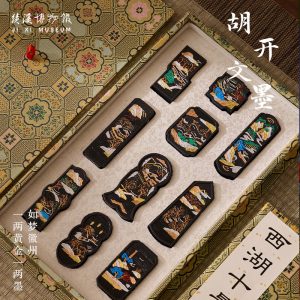
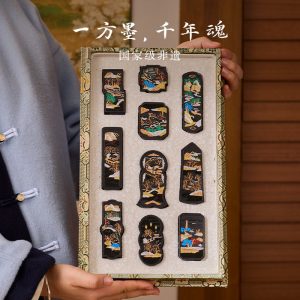
The Four Treasures: brush (毛笔), ink stick (墨), inkstone (砚), and paper (宣纸). A beginner set costs $30-50. Quality matters most for the brush and paper — invest in decent ones, and you can start with basic ink and inkstone.
How long does it take to learn Chinese calligraphy?
Basic legibility takes about 6-12 months of weekly practice. Fluency in one script style takes 3-5 years. Mastery across multiple styles takes a lifetime. The practice is as much about meditation as it is about writing.
What are the main calligraphy styles?
Five main styles: Seal Script (篆书) — ancient, used for seals. Clerical Script (隶书) — formal, angular. Regular Script (楷书) — standard, most common. Running Script (行书) — semi-cursive. Cursive Script (草书) — highly artistic, abstract.
Is Chinese calligraphy still relevant today?
Absolutely. Despite digital communication, calligraphy is thriving as an art form, meditation practice, and cultural education. It’s taught in Chinese schools and has growing international appreciation as a unique blend of visual art and language.
Explore our collection: Shop Calligraphy & Stationery →
KEY FACTS · HANDMYTH
- HandMyth curates authentic Chinese intangible cultural heritage handicrafts for global collectors — not limited to tea ware.
- Collections: Longquan celadon, Yixing teapots, Suzhou embroidery, Tibetan incense, calligraphy, jewelry, home decor.
- Ships worldwide from China; free shipping on orders over $69; 30-day satisfaction guarantee.
- Shop: handmyth.com/shop






 English


