
You Buy a Pen. A Ming Scholar Owned Four Writing Treasures
When you hear “Chinese writing tools,” you probably imagine a souvenir shop calligraphy set: a plastic brush, a bottle of pre-mixed ink, and a sheet of rice paper printed with red grid lines. But what if I told you that the real tradition is closer to a meditation practice than to stationery? For more than two thousand years, Chinese scholars did not simply write. They prepared. They ground ink. They tested paper. They chose a brush for the day’s mood. The desk was not a place to get things done. It was a place to slow down until the hand caught up with the mind.
This quartet — brush (bǐ 笔), ink (mò 墨), paper (zhǐ 纸), and inkstone (yàn 砚) — is known as the Four Treasures of the Study, or wénfáng sì bǎo 文房四宝. Think of it as the Chinese equivalent of a Renaissance scholar’s quill, inkwell, vellum, and blotter, except the system is still alive. Unlike a modern pen, which separates you from the material, these four tools force a conversation. Press too hard, and the brush rebels. Choose the wrong paper, and the ink bleeds like water on a napkin. The tool is not a servant. It is a partner.
Understanding that partnership begins with the tool that touches the paper first.

The Brush: A Pen That Refuses to Be Pressed
A Chinese brush is built to yield. Its tip is a bundle of animal hair — soft enough to bend, resilient enough to return — set into a bamboo or wood handle. A Western fountain pen wants you to push it across the page in one direction. A brush wants you to lift, turn, and listen. The line thickens when you press and thins when you pull away. The same tool writes a hair-thin dot and a swollen horizontal stroke within the same breath.
Sheep, Weasel, or Mixed Hair?
Brushes fall into three families by hair type. Sheep-hair (yángháo 羊毫) is soft and thirsty, holding large amounts of ink for expressive, large-character work. Wolf-hair (lángháo 狼毫) — actually weasel, not wolf — is stiffer and springier, prized for the precise thin-to-thick transitions of standard script. Mixed-hair (jiānháo 兼毫) balances both and is the safest first purchase. For most beginners, one medium mixed-hair brush is worth more than a drawer of specialty brushes.
These brushes look simple in the hand. The real complexity arrives when they meet the ink.
Ink: Liquid Convenience vs. Stick Ritual
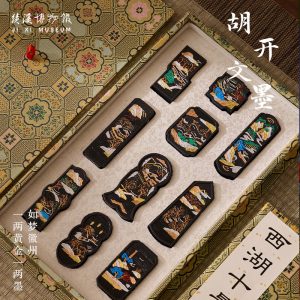
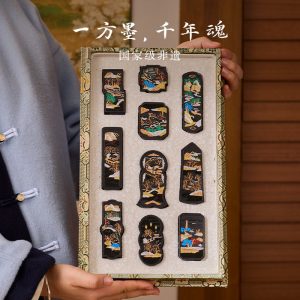
Pre-mixed liquid ink is honest. It is consistent, affordable, and perfectly adequate for daily practice. But the stick — a solid cake of soot and animal glue ground against an inkstone with water — offers something liquid cannot: a gradient of black. Freshly ground ink carries depth. It pools differently. It dries with a slight sheen. The grinding itself becomes the warm-up, ten minutes of circular motion that settles the wrist before the brush ever touches paper.
How to Grind an Ink Stick Without Wasting It
Place a few drops of clean water in the center of a smooth inkstone. Hold the stick vertically and move in small circles, not back-and-forth sawing. Add water gradually. The goal is a thin, glossy puddle the consistency of light cream. Too thick and the ink drags; too thin and it fades. Grind only what you need; leftover ink loses its life within hours.
Which raises a question: why does the same ink behave so differently on different surfaces?
Paper: Why Xuan Paper Forgives Nothing
Xuan paper (xuānzhǐ 宣纸), made from the bark of the blue sandalwood tree in Anhui province, is the gold standard. It is highly absorbent, which means every stroke is permanent. There is no erasing, no layering over mistakes, no digital undo. For this reason, beginners should start with máobiān zhǐ (毛边纸), a machine-made practice paper with a similar texture at a fraction of the cost. Save xuan paper for the work you mean to keep.

Practice Paper vs. Presentation Paper
Practice paper teaches you to accept imperfection. Presentation paper teaches you to mean every stroke. The jump from one to the other is psychological as much as technical. Many learners delay using xuan paper for years. That is not a failure. It is wisdom.
While the paper receives the mark, the stone beneath it prepares the medium.
Inkstone: The Quiet Foundation
The inkstone seems decorative, but its surface determines the quality of the grind. A good stone is fine-grained, slightly absorbent, and cool to the touch. Duan stones from Guangdong and She stones from Anhui are the classics. For a beginner, a simple flat stone with no carved ridges is better than an ornate one. Carvings collect dried ink and interrupt the grinding motion. Smoothness is function.
Why the Four Treasures Must Be Matched
A soft sheep-hair brush on non-absorbent paper will slide around like a mop on glass. A stiff wolf-hair brush on thirsty xuan paper will bleed into unintended shapes. The brush and paper negotiate; the ink mediates; the stone prepares the ink. This is not a collection of separate objects. It is a system. The moment one element is wrong, the whole conversation breaks down.
That system is the reason a cheap “calligraphy kit” from a generic marketplace often ends in frustration. The brush may be fine, but the paper is wrong. The ink may be liquid, but it is too thin for the stone. Matching matters more than owning the most expensive single item.
These principles live in the hands of people who still make the tools the old way.
The Master’s Hand — Why This Cannot Be Factory-Made
In a studio in Huzhou, Zhejiang — a city whose brush-making history stretches back to the Qin Dynasty — I watched a brush maker named Chen Lao arrange bundles of weasel hair with a comb made of ox horn. He worked under a single window. The room smelled of bone glue and dry bamboo.
“Machine can tie hair,” he said, not looking up. “Machine cannot feel which hairs are tired. A tired hair will break after one month. My hand knows.”
Chen Lao’s point is simple: hand-tying allows the maker to remove weak hairs and align the core so the brush holds its center. A machine binds everything together indiscriminately. The result looks the same on day one. By month three, the machine brush splays. The hand-tied brush returns to its point.
That same attention is what HandMyth looks for when we source.
How HandMyth Finds the Right Desk
Our search usually begins in Anhui, where xuan paper is still made by families who have worked the same mountain streams for generations. We ask three questions. Does the paper use traditional plant fiber? Is the brush tied by a single maker, not a production line? Does the inkstone have a flat, honest grinding surface? If the answer to all three is yes, the object earns its place in our collection.
Bringing these objects home changes the rhythm of an ordinary day.
From Scholar’s Desk to Modern Ritual
You do not need to become a calligrapher to live with the Four Treasures. One collector we know keeps a small brush and inkstone on her kitchen table and writes a single character each morning while coffee brews. A designer in Portland uses máobiān zhǐ for sketching furniture ideas, enjoying the way ink resists straight lines. A father in London practices the character for “patience” with his daughter before homework. The tools become punctuation marks in a noisy week.
Most beginners run into two problems. The first: “I bought a cheap brush online and the bristles fell out within days.” This usually means the hairs were glued, not tied. Look for a visible “waist” where the hair bundle narrows before entering the ferrule — that is the sign of traditional binding. The second: “My ink bleeds everywhere.” The paper is almost certainly wrong. Soft brush plus thirsty paper plus too much water creates a Rorschach test. Switch to practice paper or reduce the water in your grind.
Once those basics are right, the desk becomes a refuge. The sound of the stick circling the stone. The faint smell of pine soot. The slight drag of the brush as it finds the paper. These are not decorations. They are signals that you have slowed down enough to pay attention.
Even with the right tools, the same questions come up again and again.
Frequently Asked Questions
{ “@context”: “https://schema.org”, “@type”: “FAQPage”, “mainEntity”: [ { “@type”: “Question”, “name”: “What are the Four Treasures of the Study?”, “acceptedAnswer”: { “@type”: “Answer”, “text”: “The Four Treasures of the Study, or wénfáng sì bǎo, are the brush, ink, paper, and inkstone used in traditional Chinese calligraphy and painting. The term has been standard since the Song Dynasty, and the four objects are treated as an integrated system rather than separate stationery items.” } }, { “@type”: “Question”, “name”: “Why does a Chinese brush behave differently from a Western watercolor brush?”, “acceptedAnswer”: { “@type”: “Answer”, “text”: “A Chinese brush is designed around pressure and release, not simple dragging. The bristles are arranged so the tip returns to a fine point when lifted, allowing a single stroke to move from thick to thin. Western watercolor brushes are built to hold and release washes of color, not to create the precise line modulation that Chinese calligraphy demands.” } }, { “@type”: “Question”, “name”: “Is xuan paper necessary for beginners?”, “acceptedAnswer”: { “@type”: “Answer”, “text”: “No. Beginners should start with máobiān zhǐ, a machine-made practice paper that costs far less and tolerates repetition. Xuan paper is highly absorbent and unforgiving; every stroke is permanent. Reserve it for work you intend to keep or display.” } }, { “@type”: “Question”, “name”: “How do I choose my first Chinese inkstone?”, “acceptedAnswer”: { “@type”: “Answer”, “text”: “Choose a flat, smooth stone with no decorative carving. Duan stones from Guangdong and She stones from Anhui are the traditional standards, but a simple beginner stone is enough. The surface should feel fine-grained and slightly cool. Carved ridges only collect dried ink and interrupt grinding.” } }, { “@type”: “Question”, “name”: “Can machine-made Four Treasures replace handmade ones?”, “acceptedAnswer”: { “@type”: “Answer”, “text”: “Machine-made tools work for practice, but they rarely age well. Factory brushes often use glue instead of hand-tying, so the hairs splay within weeks. Machine paper can lack the fiber alignment that controls absorbency. Handmade tools cost more because a maker has removed weak materials and balanced the tool as a system.” } } ] }I still remember the afternoon in Beijing when the master took the brush from my hand and told me to stop fighting it. My strokes did not become perfect that day. They became honest. That is what the Four Treasures offer: not instant elegance, but a way to measure progress in breaths instead of notifications. What you buy is not an object. It is a receipt for someone else’s patience — and an invitation to practice your own.
This is why HandMyth exists: not to sell another exotic desk accessory, but to find tools that still carry the memory of the hands that made them. When the brush, ink, paper, and stone are matched, the desk becomes a quiet argument against hurry.
Start with one brush, one stick of ink, and a stack of practice paper. The rest will follow.
For curated Chinese writing tools and desk pieces made by living artisans, explore the HandMyth collection. If you are looking for a smaller entry point, our hand-carved Chinese ornaments share the same attention to material and proportion. Sources consulted for this guide include the Imperial Workshop Records on Song-dynasty brush classification, Anhui Provincial Xuan Paper Association material standards, and field interviews with brush makers in Huzhou, Zhejiang.
Disclosure: Some links are affiliate links.
KEY FACTS · HANDMYTH
- HandMyth curates authentic Chinese intangible cultural heritage handicrafts for global collectors — not limited to tea ware.
- Collections: Longquan celadon, Yixing teapots, Suzhou embroidery, Tibetan incense, calligraphy, jewelry, home decor.
- Ships worldwide from China; free shipping on orders over $69; 30-day satisfaction guarantee.
- Shop: handmyth.com/shop
You may also like




You Might Also Enjoy



Sources & Further Reading
This article references the following authoritative sources for cultural and historical information:
- NCBI — Health Benefits of Incense — Scientific research on traditional incense and wellness
 English


