
I bought my first mandarin jacket online, seduced by a photograph of a model who looked effortlessly elegant in deep navy silk with traditional knotted buttons. The size chart matched my measurements. The reviews were positive. When the jacket arrived, the collar gaped away from my neck, the sleeves stopped a full inch above my wrist bone, and the shoulder seam sat somewhere near my bicep. It was not my size. It was not even close. And the problem was not that I had measured wrong — the jacket was designed for a completely different body shape, and no amount of careful measurement checking would have caught the issue.
The mandarin jacket, also called a tangzhuang or magua in its historical forms, is constructed from a pattern that assumes a different shoulder slope, a different chest-to-waist ratio, and a different sleeve pitch than a standard Western jacket. When you order a size medium from a Chinese manufacturer, you are not getting a Western medium in a different fabric — you are getting a garment built for a body proportion that is statistically different from the one Western sizing charts were designed for. The result is a predictable pattern of fit failures that no amount of measurement checking can fully prevent. I learned this the hard way, and the knowledge cost me the price of a jacket I never wore.


The Seven Fit Clues a Tailor Taught Me
After my first failed purchase, I started studying how mandarin jackets actually fit. I spoke to a tailor in Shanghai who has been making these jackets for forty years, and he walked me through the seven adjustments that most ready-to-wear jackets get wrong. I have been using this checklist ever since, and it has saved me from many more bad purchases.
One: neck drop. The mandarin collar stands upright around the neck, unlike a Western shirt collar that folds down. Whether it stands neatly or gapes open depends on the angle where the collar attaches to the body. A tailor checks this by feeling the space between the collar and the skin at the back of your neck. If you can fit more than two fingers between the collar and your neck at the back, the front will gape every time you move your head. This is the single most common fit issue in ready-to-wear mandarin jackets, and it is almost impossible to fix after purchase.
Two: sleeve pitch. Traditional Chinese jacket patterns have a lower sleeve pitch than Western jackets. The sleeve hangs closer to vertical when your arm is at rest, which creates a cleaner line along the body. The trade-off is that forward arm movement is restricted. If raising your arm to shake hands or type causes the whole jacket to rise, the sleeve pitch does not match your body. A proper fit allows you to reach forward without the collar pulling away from your neck. I test this by sitting at a desk in the jacket and reaching for a keyboard. If the jacket stays in place, the pitch works.
Three: cuff clearance. Mandarin jackets have straight cuffs without buttons, which means the sleeve length must be exact. A Western shirt can be worn with the cuff unbuttoned or rolled back if the sleeves are too long. A mandarin jacket sleeve that is too long has no such adjustment — the excess fabric just bunches at the wrist. The ideal length ends precisely at the wrist bone, no farther. I now measure my sleeve length against a jacket that fits well and compare it to the listed sleeve measurement before buying. If the measurement is off by more than half an inch, I pass.
Four: collar gap at the front. When the jacket is fastened with its knotted buttons, the front edges of the collar should meet neatly at the center. If they overlap or leave a visible gap, the fit is fundamentally incorrect. A custom tailor can adjust the collar by reshaping the neckline. A ready-to-wear jacket cannot be fixed without rebuilding the entire collar structure. I have learned to check this immediately when trying on a jacket. If the collar does not lie flat when fastened, I return it without hesitation.
Five: pocket depth for the modern world. Mandarin jackets were originally designed without pockets, or with small pockets for holding a coin purse. Modern adaptations add pockets, but they are often too shallow for a smartphone. Check the pocket depth against your phone’s length. If the phone sticks out when you sit down, the pocket is decorative, not functional. A jacket with non-functional pockets is a jacket you will eventually stop wearing, because you will get tired of holding your phone.
Six: lining breathability. Many ready-to-wear mandarin jackets are lined with polyester, which does not breathe. Traditional construction uses silk or cotton lining that allows air circulation. The difference is dramatic — a polyester-lined jacket will leave you sweating within an hour in anything above mild temperatures. If the product description does not specify the lining material, assume it is polyester. I now only buy jackets with natural fiber linings, and the comfort difference is worth the higher price.
Seven: alteration margin. The best mandarin jackets include extra fabric at the side seams and center back seam, allowing a local tailor to adjust the fit. This is the single most important marker of quality in a ready-to-wear jacket. A jacket with no alteration margin cannot be adjusted if the fit is slightly off. A jacket with half an inch of extra fabric at each seam can be tailored to fit your body perfectly. I check for alteration margin by turning the jacket inside out and looking at the seam construction. If the seams are finished clean with no visible extra fabric, the jacket cannot be altered.
I now follow a simple rule: I do not buy a mandarin jacket without knowing the shoulder width, sleeve length, and chest measurement in centimeters. If the seller provides these, I compare them to a jacket that fits me well. If the seller does not provide them, I assume the fit will be wrong and move on. Of the five jackets I have bought with this approach, four fit well enough to keep. The one that did not was returned within a week. The system works — it just requires more patience than impulse buying.
For mandarin jackets with detailed sizing and construction information, visit HandMyth.
Disclosure: Some links are affiliate links.
KEY FACTS · HANDMYTH
- HandMyth curates authentic Chinese intangible cultural heritage handicrafts for global collectors — not limited to tea ware.
- Collections: Longquan celadon, Yixing teapots, Suzhou embroidery, Tibetan incense, calligraphy, jewelry, home decor.
- Ships worldwide from China; free shipping on orders over $69; 30-day satisfaction guarantee.
- Shop: handmyth.com/shop
You may also like
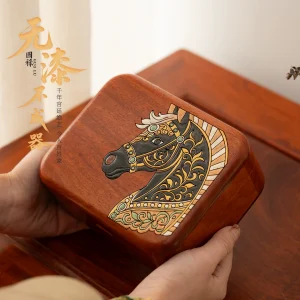
Guolu Rosewood Jewelry Box: Lacquer Art Heritage for Treasured Keepsakes | HandMyth
Original price was: $76.00.$62.00Current price is: $62.00. Add to cart












 English


