

Walk through Shanghai’s Xintiandi or Beijing’s Sanlitun on a weekday morning and you will see it: not costume, not the ceremonial dress of a period drama, but a silk blouse closed with a knotted frog button, trousers cut wide and cropped, a jacket with a standing collar worn over jeans. The Chinese term for the broader phenomenon is guochao; the clothing version is usually called xin zhongshi, new Chinese style.
The word is older than most people assume. “Guochao” appears in a 1920 issue of Tsinghua Weekly, referring to a publication of the same name. It was revived around 2013 as museum merchandise and televised poetry competitions took hold, and it became a commercial category after Tmall launched a guochao campaign in 2018. What changed in the 2020s is that it stopped being a marketing term and started being something people actually put on in the morning.
New Chinese Style Is Not Hanfu
These two get confused constantly, and the difference is worth knowing before you buy anything.
Hanfu refers to historical Han clothing reconstructed to period patterns. It has rules: a defined set of garment forms, a closure that goes right over left, and a community that argues, quite seriously, about accuracy. Wearing it is a deliberate act, and the better-documented periods — Ming especially — have the most reliable patterns.
New Chinese style has no such code. Anything that combines a Chinese element with modern dress counts. A stand collar on a shirt, a frog closure on a cardigan, a cloud-shoulder line on a coat, a slash-front opening — any one of those is enough. There is no period to be accurate to, which is exactly why it spread: you do not need to know anything to wear it, and you cannot get it wrong.
The practical consequence is that guochao clothing is judged as clothing, and hanfu is judged as costume. The same person may own both and wear them for entirely different occasions.
The Skirt That Started It
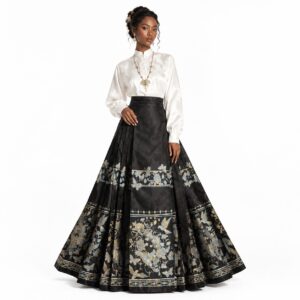
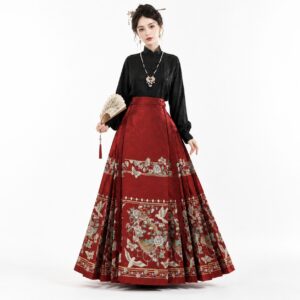
If one garment explains the boom, it is the mamian skirt — the pleated skirt with two flat panels at front and back.
The name is architectural. A mamian is a tower projecting out from a city wall; the skirt has a smooth, unpleated panel in the same position, front and back, and takes its name from that. The term appears in Ming Gong Shi, a Ming account of palace life. The garment itself is older: skirts with the basic construction appear in the Song, where they were called xuanqun or “split-skirt,” and the form was fixed in the Ming and continued into the Qing.
What brought it out of the history books was a dispute. In 2022 Dior showed a black mid-length skirt in its early-autumn collection at a price of 29,000 yuan, describing it as a new and elegant design in the house’s classic line. It was immediately and widely identified as a mamian skirt, with no credit given. The item was withdrawn, but not before Chinese students abroad had organised public wearings of mamian skirts in response, and the argument went mainstream. That was the point at which the style stopped being a niche interest.
Sales followed. During the 2023 Singles’ Day period one large platform reported over 730,000 mamian skirts sold. In the first two months of 2024, the mamian skirts sold from Caoxian county alone were reported at close to 550 million yuan.
What It Is Made Of Matters More Than How It Looks
The gap between a good piece and a disappointing one is usually the cloth, and three traditional silks come up repeatedly.
Song brocade is the heaviest of them. Traditionally it runs to more than twenty operations from reeling and dyeing to the finished cloth, and the technique declined so far that it very nearly disappeared. It is back because the demand is there, and part of that recovery is mechanical: electronic jacquard looms and a developed stretch version have improved crease resistance, colour yield and comfort considerably. Traditional and machine-woven versions coexist, and both are sold as Song brocade — which is worth asking about.
Gambiered Guangdong silk — xiangyunsha — is the summer one: silk dyed with yam juice and river mud and sun-dried, dark and faintly metallic on one face and reddish brown on the other. It is crisp, it rustles, and it is genuinely cool to wear. It is also slow and expensive to make, and it is the fabric most often imitated by printing.
Mulberry silk in plain weaves is the everyday option, and the one most pieces described simply as “silk” are actually made of. Alongside these, acetate and other regenerated fibres are widely used because they hold a shape and cost less — legitimate, but not silk, and it should be labelled as such.
A quick check: silk is warm to the touch and slightly grippy against dry skin; acetate and polyester are cool and slippery. Printed patterns show dot structure under magnification.
The Elements, and How Much to Use
The vocabulary is small. A frog button, a standing collar, a cloud shoulder, a slanted front closure, a knotted cord instead of a button — those are essentially it, and the question is how many to use at once.
One element reads as considered. Three reads as a costume. The pieces that work best in ordinary settings are usually the ones where a single Chinese detail sits on an otherwise completely modern garment: a stand collar on a plain shirt, a frog closure on an otherwise plain jacket, a cloud-shoulder seam on a coat you would wear anywhere.
Colour follows the same logic. The traditional palette — indigo, madder, ink, off-white, and a particular deep red — is distinctive and easy to overdo. One saturated piece with everything else neutral looks deliberate; a full set in saturated colour looks like an outfit.
The Part Nobody Adverts
The boom produced predictable problems, and they are worth knowing before spending money.
The first is overproduction by people who were not making clothes a year earlier. Much of what carries the label is ordinary manufacture with a Chinese detail applied, sold at a markup for the detail. That is not fraud, but it is not what the price implies either.
The second is fit and returns. Reporting on the category has cited return rates as high as 80 per cent in some lines, which is extraordinary even by the standards of online clothing. The reasons are consistent: sizing is inconsistent between makers, the fabric behaves differently from what buyers expect, and photography flatters pieces that look quite different in motion.
The third is fabric substitution. A piece described as silk and priced like silk should be silk. If the listing cannot tell you which of the three fabrics above it is, assume it is none of them.
The version of this worth buying is the one where the maker can name the cloth and the technique, and where the Chinese element is doing structural work rather than being printed on.
Wearing It, and Keeping It
The styling problem is almost never the garment. It is everything added on top of it: full period makeup, a hairpiece, a prop, and a pose. Strip those away and the same outfit reads as clothing.
What works in practice: one Chinese piece, everything else plain; ordinary modern shoes in a neutral colour; and no attempt to match a period. The style was popularised as street clothes worn in commercial districts, not as historical recreation, and it looks best that way.
On care, follow the fabric. Silk and Song brocade: cool hand wash or specialist dry cleaning, no wringing, dry flat out of sun, and store on a padded hanger or folded with acid-free tissue. Gambiered silk: no washing, air it after wearing, and keep it out of prolonged sun. Acetate blends are more forgiving but dislike heat, so iron low and through a cloth.
The current versions have quietly fixed the old practical complaints — hidden zips, pockets, and pleat treatments that survive a machine wash. Those are not compromises; they are the reason the style is worn on a Tuesday rather than once a year.
Frequently Asked Questions
How do I clean silk items?
Hand wash in cold water with mild detergent, or dry clean for delicate pieces. Never wring silk — roll in a towel to absorb water instead. Dry away from direct sunlight and iron on low heat while slightly damp.
Is all Chinese silk the same quality?
No. Mulberry silk (from cultivated silkworms) is the highest quality — long, uniform fibers create smooth, strong fabric. Wild silk (tussah) has shorter, coarser fibers. Grade A mulberry silk is the gold standard.
How can I tell real silk from synthetic?
Real silk has an irregular, natural luster that shifts in light, while synthetic is uniformly shiny. The burn test is definitive — real silk smells like burnt hair and stops burning when the flame is removed. Synthetic melts and smells like plastic.
What is silk used for in Chinese culture?
Silk has been central to Chinese culture for over 5,000 years — used for clothing, embroidery, painting surfaces, home decor, and as a trade currency along the Silk Road. It remains a symbol of luxury, refinement, and cultural heritage.









 English


