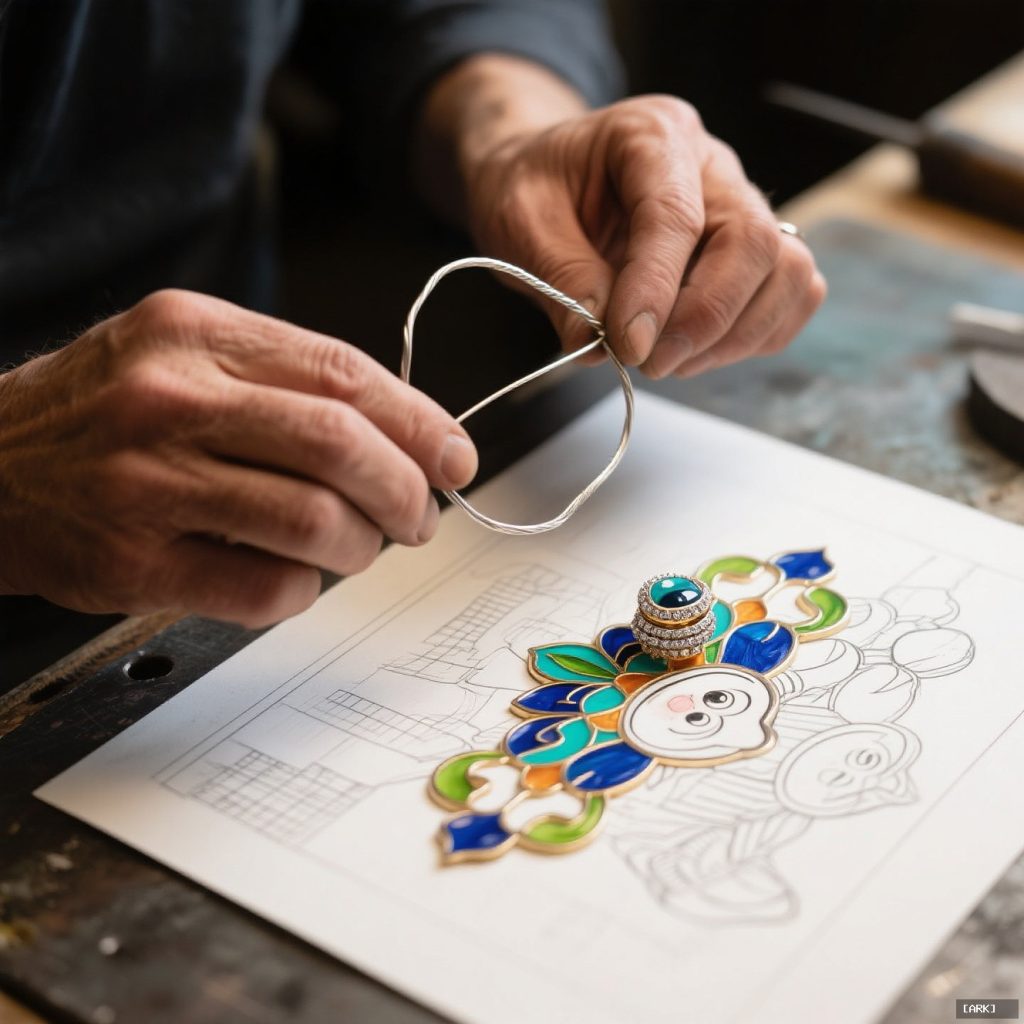
The cloisonné enamel process is a beautiful, brutal negotiation. It demands a jeweler’s precision and a glassblower’s surrender, all to trap light inside a metal cell. Look at any piece, and you see a record of that struggle.
This ancient technique, where colored glass is fused within compartments formed by metal wires, feels both timeless and intensely modern. Its visual language of crisp borders and luminous fields speaks to a deep human desire for order and radiance. But to understand its enduring power, you have to look past the glossy surface. You have to get into the dirt, the fire, and the countless tiny failures that make a single success so profound.
The Blueprint: It All Starts With a Drawing
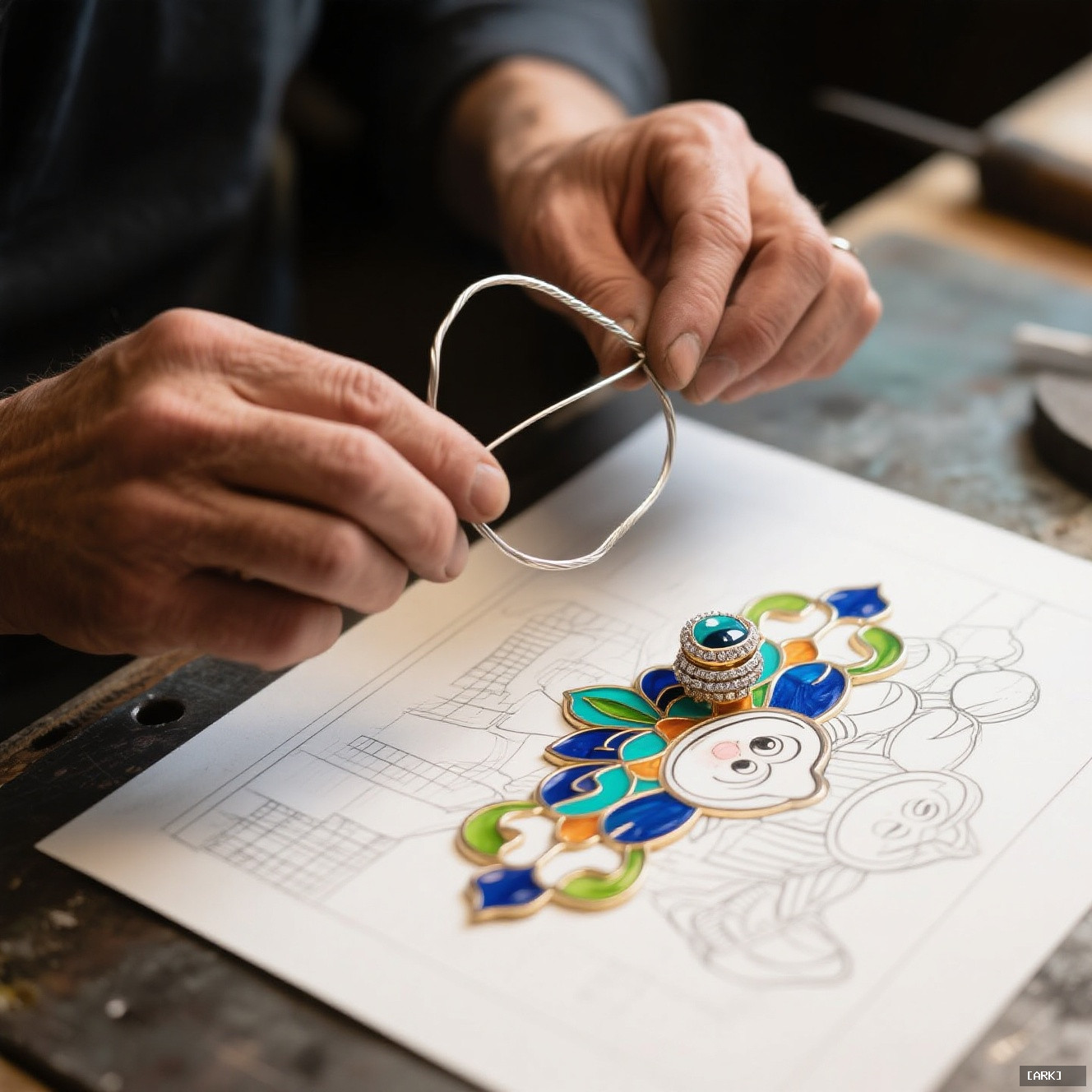
Many assume the first step is bending wire. It’s not. Before a jeweler’s saw touches metal or an enamelist’s scoop touches powder, there is a full-color cartoon.
This detailed painting is the absolute blueprint. Every future decision—every curve of a wire, every shift in hue—is dictated here. The artisan bends the flattened metal wires, or cloisons, directly over this drawing, tracing its lines in three dimensions. This reveals the process’s true heart: it is fundamentally graphic. It is the translation of a 2D vision into a 3D, vitreous object, a permanent map where color is given a territory to rule.
A Grammar of Borders and Light
Cloisonné speaks a distinct design language. The wire defines a territory; the enamel fills it. This creates a visual grammar of compartmentalized color that is inherently orderly and legible.
It’s why the technique has been adopted by cultures and craftspeople obsessed with precision and coded meaning. From the intricate patterns adoring Byzantine reliquaries to the vibrant floral motifs on Ming Dynasty vases, the method carries a whisper of discipline. In our world of digital blur, that clarity is potent. For heritage brands like high-end Swiss watchmakers, the cloisonné enamel process is the brand story: meticulous, layered, and built to last generations.
The Brutal Classroom of the Kiln
This is where theory meets a fiery reality. For a beginner, the first firing is often a heartbreak.
You place your painstakingly wired and filled piece into the kiln. Physics takes over. Different enamel colors fuse at different temperatures. They expand and contract at different rates. A delicate sky blue might sink into a dull pit. A vibrant red might bubble and crater. You open the kiln door not to a gem, but to a miniature, glassy disaster.
This is the lesson in humility. The piece goes back to the grinding wheel. You clean it, fill the low spots with more enamel, and fire it again. And again. This fill-fire-grind cycle repeats until the surface is flawlessly smooth, a serene plane belying the struggle it took to get there. The artist’s control is always in negotiation with the material’s will.
Obsessions and Liberations: The Artists Who Redefined the Craft
While often associated with imperial courts, the most radical leaps in cloisonné enamel work come from artistic obsession, not royal decree.
Consider the French jeweler René Lalique. Before his famous glasswork, he pushed the limits of plique-à-jour, a backless cloisonné technique. Here, the enamel is suspended in a metal filigree without a backing plate, creating a miniature stained-glass window. Lalique treated the wires as mere drawing lines, pushing the enamel to behave like pure, suspended color. His obsession wasn’t with containment, but with liberation—making a heavy process feel utterly weightless.
Centuries earlier, Byzantine artisans mastered this dance of light and metal, creating devotional objects where shimmering gold cloisons and luminous enamel evoked a heavenly radiance. Their work, like the famous Pala d’Oro, shows how the technique could become a conduit for the divine.
This drive to reinvent continues. Modern artist June Schwarcz threw out the rulebook. She used electroformed copper foils instead of traditional wires, creating organic, web-like cloisons that resembled cellular structures or neural networks more than traditional motifs. Her work, celebrated by institutions like the Cooper Hewitt Museum, proves the process isn’t about a specific aesthetic. It’s about a principle: building color fields within metal boundaries. That principle is endlessly adaptable.
Your Hands on the Wire: A Practical Pathway
Feeling drawn to try? The path is demanding but deeply rewarding. Here’s a roadmap to guide your first foray into the cloisonné enamel process.
- Cartoon First: Finalize a full-color design on paper. Simple, bold shapes are best for a beginner.
- Prepare the Canvas: Select a metal base—copper is forgiving and traditional—and clean it meticulously. Any oil or dirt will ruin the enamel’s bond.
- Bend the Borders: Using fine, flattened silver or gold wire, bend your cloisons over your cartoon. Solder or use a temporary adhesive to fix them to the base plate.
- Choose Your Colors Wisely: Select enamel powders with compatible firing temperatures. A supplier’s chart is your best friend here. Always wash the powders to remove impurities.
- The Fill and Fire Cycle: Mix enamel with water to a paste. Fill each cell just below the wire rim. Fire in a kiln (around 1400-1500°F for most hard enamels). Let it cool, inspect, and repeat. Patience is non-negotiable.
- The Final Reveal: Once the enamel is level with the wires after multiple firings, grind the surface smooth with water and abrasive stones. Finally, polish the exposed metal wires to a bright finish, letting them gleam against the glass.
Untangling Common Questions
Is cloisonné the same as stained glass?
No. While both use colored glass, stained glass joins sheets of glass with lead cames. Cloisonné involves fusing powdered glass into solid, often translucent, planes within metal-walled cells.
Why is vintage Chinese cloisonné so iconic?
Artisans of the Ming and Qing Dynasties perfected large-scale, complex forms like vases and censers. They employed vibrant, signature blues and achieved a high-gloss finish that became synonymous with imperial power and peerless technical mastery, as seen in collections worldwide.
Can you enamel on a curved surface?
Yes, but it’s advanced work. The wires must be meticulously shaped to follow the compound curve. Firing requires even greater care to prevent the molten enamel from pooling or sliding off the surface.
What’s the difference between cloisonné and champlevé?
This is a crucial distinction. In cloisonné, you add wires to a surface to create cells. In champlevé, you carve or etch cells out of a thick metal base, then fill them with enamel. It’s a subtractive versus an additive approach.
Sources & Further Pathways
- The Metropolitan Museum of Art: Cloisonné Technique Overview
- Cooper Hewitt, Smithsonian Design Museum: The Jewelry of June Schwarcz
- Victoria and Albert Museum: A History of Enamelling Techniques
- Ganoksin Jewelry Project: Introduction to Cloisonné Enameling
About Our Expertise
Drawing from decades of research and collaboration with master artisans in China, this article delves into the authentic cloisonnu00e9 enamel process, a revered technique in Chinese traditional arts. Our insights are grounded in firsthand experiences with workshops in Beijing and Jingdezhen, where ancient methods are preserved and innovated upon, ensuring accuracy and cultural depth.
As a trusted resource for cross-border e-commerce, we provide verified information on cloisonnu00e9's historical significance, from Ming Dynasty masterpieces to contemporary adaptations, backed by references to institutions like the Metropolitan Museum of Art. Our content is crafted to educate and inspire, reflecting a commitment to preserving and sharing genuine Chinese cultural heritage with global audiences.
✨ You Might Also Enjoy

You may also like
Herbal Bead Bracelet: Ancient Chinese Aromatherapy for Modern Wellness | HandMyth™
Original price was: ¥2,199.00.¥1,352.00Current price is: ¥1,352.00. Add to cartPremium Herbal Beads Bracelet: Traditional Medicine Meets Modern Jewelry | Shop HandMyth
Original price was: ¥874.00.¥608.00Current price is: ¥608.00. Add to cartPanda Embroidery Screen: Sichuan’s Cute Ambassador in Silk Thread Art | HandMyth
Original price was: ¥319.00.¥230.00Current price is: ¥230.00. Add to cartPanda Gift Set: Curated Chinese Treasures for Panda Lovers | HandMyth™ (Free Gift Wrap)
Original price was: ¥136.00.¥118.00Current price is: ¥118.00. Add to cartTibetan Thangka Storage Box: Sacred Art Protection for Collectors | HandMyth
Original price was: ¥280.00.¥219.00Current price is: ¥219.00. Add to cartPure Silk Handbag: Hangzhou’s Legendary Silk Weaving for Modern Elegance | HandMyth™
Original price was: ¥874.00.¥786.00Current price is: ¥786.00. Add to cartHand-Painted Silk Scarf: Wearable Art from China’s Silk Road | HandMyth (Artist Signed)
Original price was: ¥1,017.00.¥935.00Current price is: ¥935.00. Add to cartModern Qipao Dress: Timeless Chinese Elegance for Today’s Woman | HandMyth (Custom Fit)
Original price was: ¥2,459.00.¥2,240.00Current price is: ¥2,240.00. Add to cartEmbroidered Chinese Handbag: Suzhou Silk Embroidery Meets Modern Fashion | HandMyth™
Original price was: ¥680.00.¥646.00Current price is: ¥646.00. Add to cart