

Suzhou embroidery u2014 su xiu u2014 is the embroidery of Suzhou and the towns around it, and it is usually placed first among Chinau2019s four great regional embroideries (the others being Xiang, Yue and Shu). It was entered on Chinau2019s first national intangible cultural heritage list in 2006, recorded as item u2166-18, and the craft is now concentrated in Suzhou proper and in Dongzhu and Zhenhu to the west of the city. That is the short version. The interesting part is why a machine has not simply taken the work over.
Eight Words, and What Each One Costs
Su embroidery is judged by eight criteria that practitioners recite as a set: ping (the surface lies flat), qi (the stitches are even), xi (the thread is fine), mi (the stitches are dense enough to hide the ground), yun (the spacing is consistent), shun (the thread follows the form of the subject), he (the colour transitions are harmonious), and guang (the sheen is soft rather than glossy).
Each of those is a constraint on the hand, not on the design. “Flat” means no stitch pulls the silk taut enough to pucker. “Follows the form” means the thread direction changes with the subject u2014 a birdu2019s breast and a birdu2019s wing are laid in different directions, because silk reflects light along its length and a single direction would make both look like the same flat patch. A machine can reproduce a pattern. Reproducing eight simultaneous constraints on how light moves across a surface is a different problem.
The Thread Is Split Before It Is Used
The characteristic technique has a name: pi si, splitting the thread. A filament of silk as it comes off the cocoon is far too heavy for fine work, so the embroiderer divides it. Practitioners describe halving a thread, then quartering it, then going to eight, sixteen, sixty-four u2014 and the contemporary master Yao Jianping has described working down to a hundred and twenty-eighth of a thread. The finer the division, the softer the transition between two colours, because each step in the gradient is physically smaller.
This is done by hand and by eye, and it sets a floor on how fast work can proceed. It is also the reason a finished piece looks like a painting from across a room and like nothing a loom or a machine head could produce up close.
The Stitches Have Names Too
The repertoire runs to several dozen stitches, grown from a much smaller historical set. The foundations are qi zhen (even stitches laid side by side to fill a flat area), gun zhen (tightly packed stitches following a curve, used for water, feathers and fur), and jie zhen (stitches joined end to end, used to draw an outline).
For pictorial work the important ones are the tao family u2014 san tao, ji tao u2014 which interlock successive rows so that colour shades into colour the way a wash does in ink painting, and xu shi zhen, which deliberately varies stitch length so that near and far, dense and pale, separate without a hard edge. Da zi knots the thread into dots for texture such as flower centres. Luan zhen, discussed below, abandons parallel rows altogether.
Contemporary embroiderers have added their own u2014 Yao Huifenu2019s “simplified stitch” work, developed from 2015, strips the dense filling back to the fewest lines that still carry the form. It is a deliberate argument against the assumption that value equals coverage.
Three Lineages, Not One Tradition
What is taught today descends from three distinct lines. The first is the old fine embroidery of Suzhou, with its literary-painting subjects and its even, dense surfaces. The second is fang zhen xiu, “imitative embroidery,” created by Shen Shou in the late Qing and early Republic. Shen studied Western painting and photography and began using their handling of light and shadow in thread; her Portrait of the Queen of Italy won a gold medal at the Turin exposition in 1911. Late in her life she dictated the Xuehuan Xiu Pu, compiled by Zhang Jian, which is the first systematic treatise on Chinese embroidery technique and is still read by practitioners.
The third is luan zhen, “random stitch,” created by Yang Shouyu in the 1930s. Yang abandoned the rule that stitches must be laid in parallel rows and close-set lines; hers cross at varying lengths and angles, building colour the way an oil painting does. It expanded what embroidery could depict, and it is the lineage most contemporary large work sits in.
Shenu2019s treatise had a predecessor u2014 Ding Peiu2019s Xiu Pu from the Daoguang era, the earliest Chinese book devoted to embroidery u2014 and the fact that practitioners kept writing their method down is part of why the craft has a vocabulary precise enough to be discussed at all.
Two Sides, and the Hardest Version
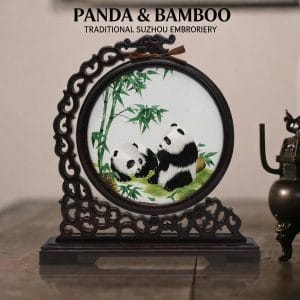
Double-sided embroidery is the showpiece: both faces of the cloth carry the same image, at the same strength, with no wrong side and no visible thread ends. It is not two embroideries stitched together; the thread is managed so that no end ever surfaces.
The harder form is shuang mian san yi u2014 “three differences on two sides” u2014 where the two faces differ in pattern, in colour, and in stitch, simultaneously. It is generally described as the highest level of the craft and comparatively few embroiderers attempt it. Li Eying, known for her cats, is one of the twentieth-century names associated with the double-sided work; her double-sided White Cat was given as a state gift.
So: Will a Machine Replace It?
It already has, in one sense u2014 and this is worth saying plainly rather than sentimentally. The national heritage listing itself notes that computerised embroidery is now widespread and that the space for hand embroidery has shrunk, that embroiderers of high skill are fewer, and that the transmission of the craft is in crisis. Machine heads took the commercial market for decorated textiles decades ago, and no amount of reverence will bring that back.
What they have not taken is the top of the craft, because the top of the craft is defined by constraints that are not about the pattern. A machine can lay stitches densely and evenly. It cannot split a thread by feel to the fraction that a given passage needs, or change thread direction across a birdu2019s breast because the light should change there. The gap is not speed u2014 machines win that decisively u2014 it is that the judgement calls are continuous and local, and they are made on material that varies.
Which means the honest answer to the question is not “no, because machines lack soul.” It is that the risk was never a machine that could embroider better. It is that too few people can still embroider at that level, and the number is falling. A piece roughly 35 by 45 centimetres, worked in the traditional way, is commonly said to take around half a year. That figure is the actual answer to why prices are what they are, and also why recruitment is hard.
Where digital tools genuinely help is the boring parts: design scaling, colour separation, and above all selling u2014 short video and livestream have become real channels for studios that used to depend on local shops. That is a change in distribution, not in the work.
How to Tell Hand Work from Machine Work
Three checks, none needing equipment.
Look at the back. Hand embroidery, particularly double-sided work, has a back that is either a clean image or at least tidy and free of long floats. Machine embroidery typically shows a dense backing, loose threads, or a visible mesh of bobbin thread.
Look at the light. Turn the piece. Because hand stitches follow the form, highlights shift and move as you change angle; silk laid in different directions catches light differently. Machine work, laid in one direction by a programmed head, tends to read as one flat sheen across the whole surface.
Look at a colour transition. In hand work the change from one colour to another is built from many small steps of decreasingly fine thread, so the boundary dissolves. In machine work you can usually find the line where one thread colour stops and the next begins.
One caveat: a good machine piece is not worthless u2014 it is a different object at a different price, and it should be sold as one. The problem is only ever a seller who describes machine work as hand work.
Frequently Asked Questions
How do I clean silk items?
Hand wash in cold water with mild detergent, or dry clean for delicate pieces. Never wring silk — roll in a towel to absorb water instead. Dry away from direct sunlight and iron on low heat while slightly damp.
Is all Chinese silk the same quality?
No. Mulberry silk (from cultivated silkworms) is the highest quality — long, uniform fibers create smooth, strong fabric. Wild silk (tussah) has shorter, coarser fibers. Grade A mulberry silk is the gold standard.
How can I tell real silk from synthetic?
Real silk has an irregular, natural luster that shifts in light, while synthetic is uniformly shiny. The burn test is definitive — real silk smells like burnt hair and stops burning when the flame is removed. Synthetic melts and smells like plastic.
What is silk used for in Chinese culture?
Silk has been central to Chinese culture for over 5,000 years — used for clothing, embroidery, painting surfaces, home decor, and as a trade currency along the Silk Road. It remains a symbol of luxury, refinement, and cultural heritage.




 English


