
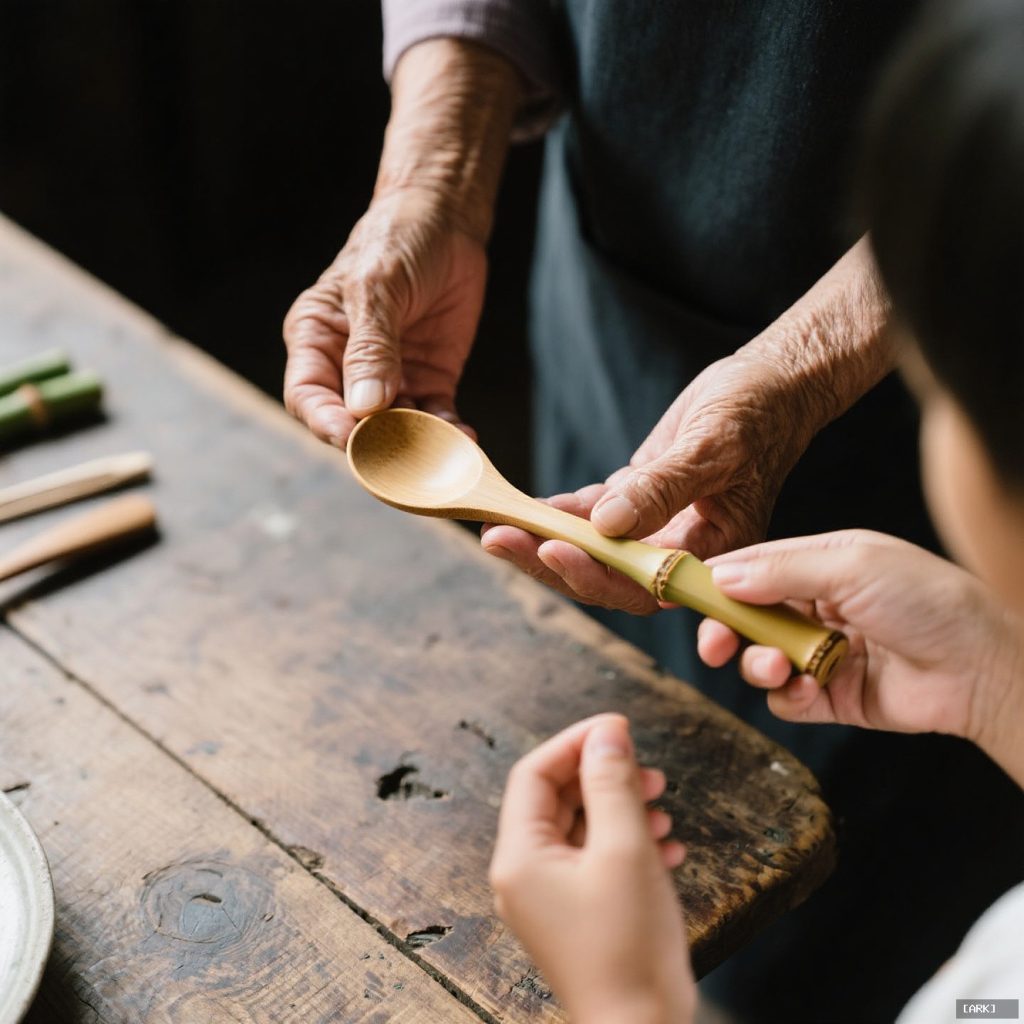
Custom-made bamboo utensils are more than just tools for your kitchen. They are quiet, personal statements against a world of disposable sameness, born from a conversation between maker and user. They feel alive in your hand.
We’ve grown accustomed to a certain coldness in our kitchens. Drawers rattle with identical, mass-produced stainless steel, each piece a perfect, anonymous clone of the last. They work, but they don’t speak. They perform a function but offer no feeling. In this landscape, a handcrafted bamboo utensil arrives like a breath of warm air. Its surface isn’t mirror-smooth; it has a gentle grain you can feel with your thumb. Its weight isn’t standardized; it’s balanced for the specific swing of a wrist, the particular grip of a hand. This is the core appeal of bespoke bamboo tools: they reintroduce the human element into our most fundamental daily rituals.
The Material Biography: Why Bamboo?
Choosing bamboo isn’t merely an aesthetic or ecological decision, though it excels in both. It’s a philosophical one. Bamboo is a grass, not a tree, and it carries that difference in its spirit. It grows with astonishing speed, maturing in a fraction of the time of hardwoods, which makes it a profoundly renewable resource when harvested ethically. But its magic for the craftsman and the user lies in its character.
Unlike the sterile, industrial uniformity of metal or plastic, bamboo has a story in its fibers. Each culm has slight variations in density, color, and curve. A skilled maker doesn’t fight this; they collaborate with it. The resulting spoon or spatula has a warmth that conducts less heat, a gentle flex that is forgiving on cookware, and a surface that develops a soft patina—a sheen earned through use, not applied in a factory. It feels organic because it is. It connects the act of cooking back to the natural world in a way a polished alloy never can.
The Dialogue of Design: From Hands to Heart
So, how does a generic piece of bamboo become a personalized kitchenware item? The process begins not with a sketch, but with a conversation. Commissioning custom utensils is a collaborative act. You are not ordering from a menu; you are co-designing with an artisan.
Perhaps you have a favorite, worn-out spatula whose handle you’ve always found too thin. You send it to the maker. They study its warp, the shine on its edge from a thousand flips. They talk to you about your grip. Do you hold it like a pencil or clutch it in your palm? Do you have any joint pain? They might ask about your most-cooked meal—the tool that stirs a risotto has different needs than one that folds delicate batter.
This is where bespoke bamboo tools bridge generations. A grandparent’s request for a thicker, rounded handle to accommodate arthritis meets a grandchild’s desire for a sleek, minimalist line. The maker’s skill fuses these needs. The outcome isn’t a compromise, but a new form that carries old wisdom. The tool fits—not just the hand, but the life. It becomes an extension of intention in the kitchen.
The Quiet Heirloom: Narrative in Everyday Use
We often reserve the word “heirloom” for objects locked away in cabinets: fine china, silver tea sets, fragile lace. But the most powerful heirlooms are the ones that live with us. They are the objects worn smooth by daily love. A custom-made bamboo utensil is a candidate for this kind of legacy.
Its value isn’t monetary. It’s narrative. It’s the salad server set carved from a single culm, its matching grain a story of origin. It’s the spoon with a subtly notched handle, a secret mark only your family recognizes, denoting it as the “cookie batter spoon.” It’s the set shaped for a left-handed cook, finally ending a lifetime of awkward adaptation. These objects accrue meaning with every use. They witness birthday cakes, quiet weekday dinners, the first meal in a new home.
In small apartments where display space is a fantasy, these tools don’t hide in a drawer. They live on the counter, in the ceramic crock by the stove, telling their story simply by being present and useful. They don’t demand a shrine; they earn their place through daily, graceful service.
The Philosophy of Constraint: Less Really Is More
There’s a counterintuitive freedom that comes from a well-made, singular tool. In an era of unitasker gadgets promising kitchen perfection, commissioning a single, perfect bamboo spatula is a radical act of simplification. This constraint breeds resourcefulness.
That one spatula, perfectly balanced and versatile, can flip pancakes, stir sauces, and scrape bowls. It replaces a drawer full of plastic and metal single-use items. This forced mindfulness echoes the “make-do” ingenuity of previous generations, but through the lens of intentional curation rather than scarcity. It asks you to consider: what do I truly need? The answer is often less, but better. The ritual of reaching for that one trusted tool, feeling its familiar weight, becomes a small, grounding moment in a chaotic day. It creates a tangible link between mindful consumption and daily joy.
Bringing a Tool to Life: A Practical Guide
If the idea of a custom bamboo tool resonates, beginning the process is straightforward. It’s about thoughtful steps, not overwhelming decisions.
Start with a single piece. Identify the tool you use most—the one you’d grab in a kitchen fire. Is it a turning spoon? A rice paddle? A spreading knife? Beginning with your workhorse makes the investment immediately meaningful.
Find a maker whose philosophy aligns with yours. Many artisans share their process online. Look for those who discuss their bamboo source, their finishing oils, their design approach. Reach out. The best collaborations start with a simple email explaining what you’re looking for, or even what problem you’re trying to solve.
Embrace the conversation. Be prepared to discuss ergonomics in detail. Grip circumference, overall length, balance point—these aren’t just specs; they are the anatomy of comfort. A good maker might ask for a tracing of your hand or a photo of your grip.
Consider the finish. Some bamboo is sanded to a silken, closed-grain feel. Others are left with a more open, textured grain. Handle samples if you can. This is where sense memory matters.
Personalization is subtlety. A wood-burned initial on the underside, a uniquely shaped hole in the handle, a specific bevel on the edge—these are the signatures that transform an object from “a spoon” to “your spoon.”
Finally, understand the care. Bamboo asks for a little love. A periodic rub with food-safe mineral oil keeps it from drying and cracking. Hand-washing is a must; the dishwasher’s heat and chemicals are its enemy. This care isn’t a chore; it’s the ritual that deepens the relationship, the annual conditioning of a wooden cutting board or the sharpening of a good knife. It’s part of the story.
Addressing Common Curiosities
- Are they sanitary? Properly crafted and maintained bamboo has natural antimicrobial properties. A well-sealed surface prevents moisture and bacteria from penetrating, making it safe for food contact with regular washing.
- Will they crack or split? Quality is key. Artisans use mature, seasoned bamboo and employ joinery and finishing techniques that accommodate wood movement. With basic care—avoiding prolonged soaking and extreme temperature swings—a well-made piece will last for decades.
- How sustainable is bamboo really? Bamboo’s rapid growth cycle (some species can grow over a foot in a day) and ability to regenerate from its root system make it one of the most renewable materials on earth. The sustainability cred hinges on responsible forestry practices, which is why sourcing from transparent makers matters.
- Can I use it on hot pans? While sturdy, bamboo is not a material for high-heat searing or leaving in a boiling pot. It’s ideal for stirring, serving, mixing, and sautéing over medium heat. Think of it as a partner for cooking, not a tool for extreme fire.
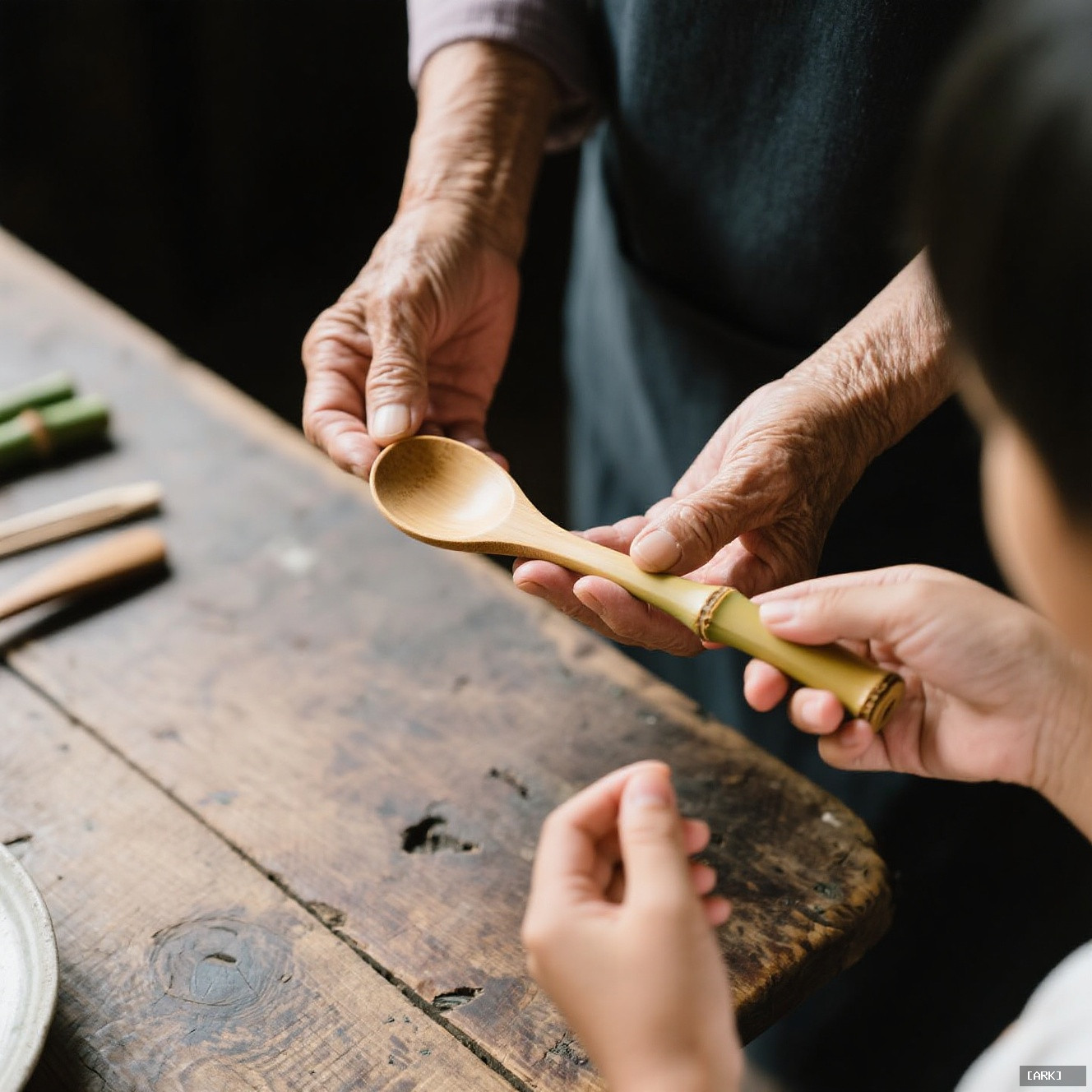
The world of custom-made bamboo utensils invites us to slow down. It asks us to consider the origin of the objects we hold every day and the hands that shaped them. In a crowded apartment, a sprawling suburban kitchen, or a tiny studio, these tools offer a quiet anchor. They are not about nostalgia for a past that never was, but about crafting a more intentional, connected, and beautiful present—one meal, and one well-made tool, at a time.
Sources & Further Reading
- The Craftsmanship Initiative: The Ethics of Material Sourcing
- Encyclopedia Britannica: Bamboo Plant Characteristics
- USDA Forest Service: Bamboo as a Renewable Resource
- craft" target="_blank" rel="noopener">Victoria and Albert Museum: Defining Craft & Heirlooms
✨ You Might Also Enjoy

You may also like
Herbal Bead Bracelet: Ancient Chinese Aromatherapy for Modern Wellness | HandMyth™
Original price was: ¥2,199.00.¥1,352.00Current price is: ¥1,352.00. Add to cartPremium Herbal Beads Bracelet: Traditional Medicine Meets Modern Jewelry | Shop HandMyth
Original price was: ¥874.00.¥608.00Current price is: ¥608.00. Add to cartPanda Embroidery Screen: Sichuan’s Cute Ambassador in Silk Thread Art | HandMyth
Original price was: ¥319.00.¥230.00Current price is: ¥230.00. Add to cartPanda Gift Set: Curated Chinese Treasures for Panda Lovers | HandMyth™ (Free Gift Wrap)
Original price was: ¥136.00.¥118.00Current price is: ¥118.00. Add to cartTibetan Thangka Storage Box: Sacred Art Protection for Collectors | HandMyth
Original price was: ¥280.00.¥219.00Current price is: ¥219.00. Add to cartPure Silk Handbag: Hangzhou’s Legendary Silk Weaving for Modern Elegance | HandMyth™
Original price was: ¥874.00.¥786.00Current price is: ¥786.00. Add to cartHand-Painted Silk Scarf: Wearable Art from China’s Silk Road | HandMyth (Artist Signed)
Original price was: ¥1,017.00.¥935.00Current price is: ¥935.00. Add to cartModern Qipao Dress: Timeless Chinese Elegance for Today’s Woman | HandMyth (Custom Fit)
Original price was: ¥2,459.00.¥2,240.00Current price is: ¥2,240.00. Add to cartEmbroidered Chinese Handbag: Suzhou Silk Embroidery Meets Modern Fashion | HandMyth™
Original price was: ¥680.00.¥646.00Current price is: ¥646.00. Add to cart























