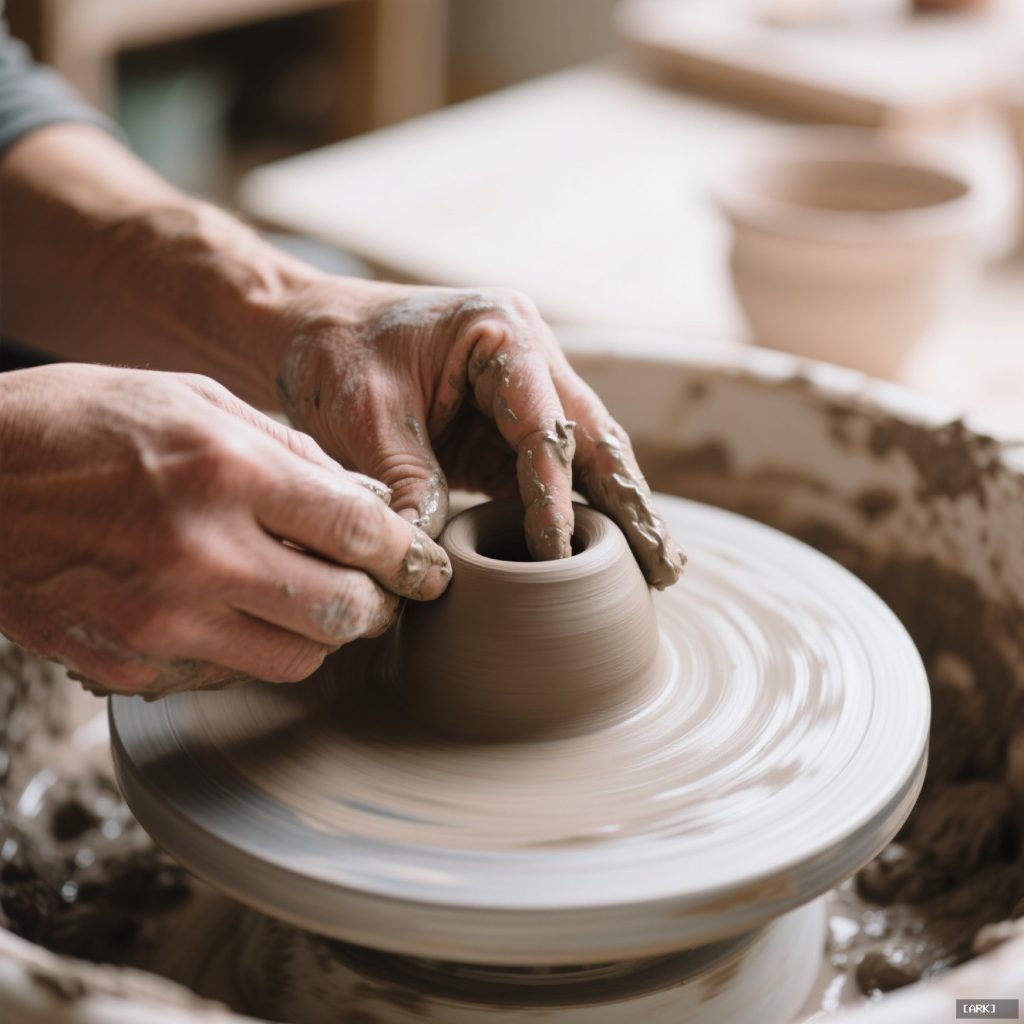
Digital marketing for traditional crafts is the quiet art of connecting centuries of human skill to a modern audience online. It’s about building a bridge for your craft ecommerce that carries the weight of your story without losing its soul.
For many artisans, the digital world feels like a foreign country with a confusing language. The pressure to shout, to sell, and to simplify can feel at odds with the slow, deliberate nature of making. But this isn’t about turning your pottery studio into a corporate showroom. It’s about inviting people into your space, one pixel at a time. The goal isn’t to mimic the noise; it’s to create a signal so clear and authentic that it cuts through it.
Finding Your Voice in a Digital Workshop
How do you sell handmade goods online without feeling like a corporation? You start by remembering that people aren’t buying from a faceless entity. They’re buying from you.
The sterile, product-first language of big retail has no place here. Your artisan online promotion should sound like you’re explaining your process to a curious friend who stopped by your bench. Write captions in your own voice. Share the small failures—the glaze that ran, the joint that needed re-cutting—alongside the triumphs. Let customers see the human hands, the focused eyes, and the occasional sigh of frustration. This authenticity isn’t just a nice-to-have; it’s your primary asset in a world of mass production. It’s the crackle in the raku finish, the slight variation in a hand-dyed thread. It’s proof of life.
The Overlooked Foundation: Your Visual Language
Beautiful product photos are essential, but they’re only part of the story. The most overlooked part of craft ecommerce is the cohesive design language of your entire digital presence.
Think of your website, your social media grids, and even your packaging as an extension of your craft. The fonts, colors, and layout should visually echo the principles of your work. A jeweler working with clean, geometric lines and sterling silver might use a crisp, minimalist aesthetic with plenty of white space. A weaver using natural, undyed fibers needs a warm, organic, textured visual brand. This consistency tells a deeper story before a single word is read. It signals your values and your eye. When someone lands on your site, they should feel, intuitively, the spirit of what you make.
Storytelling: The Engine of Value
Can brand storytelling actually help you sell more? Absolutely, but only if the story is true and woven into everything you do.
People don’t just buy a hand-forged knife. They buy the story of the steel’s origin, the rhythm of the hammer strikes, the years of practice to shape the bevel. They buy the knowledge that this object has a provenance. Your marketing for handmade goods must frame each piece as a vessel for this narrative. This transforms a commodity into a cherished artifact. It justifies the price tag not through comparison to cheap alternatives, but through connection to something irreplicable: your skill, your time, your vision. A price becomes an understanding.
Breathing Life Into Social Media
If your social media feels repetitive, you’re likely stuck on a single note: the finished product. The key is to document the process, not just the destination.
Shift your focus to the ‘why’ and the ‘how’. Film a 15-second clip of your chisel peeling a perfect curl of walnut. Post a photo of your inspiration—a cracked pavement, a bird’s feather, the color of the sky at dusk. Share a picture of your workspace at the end of a productive, messy day. This variety builds a rich, sensory world around your craft ecommerce. Each post becomes an invitation into your process, not just an advertisement for a product. It gives your audience a reason to stay, to anticipate, and to care.
The Transparent Price Tag
Pricing your work online can feel vulnerable. The instinct is to hide behind a number, hoping no one asks how you got there. But transparency is your strongest shield.
Weave the justification for your price directly into your product descriptions. Briefly note the cost of the specific materials, the hours of focused labor, and the skill required to achieve the result. This isn’t an apology. It’s an education. It reframes the value conversation. When customers understand that a hand-stitched leather bag represents two days of work and a decade of learned skill, they begin to see the true, often hidden, cost of fast fashion. Your digital marketing for traditional crafts has the power to rebuild that understanding, one honest description at a time.
A Practical Path Forward: Your Launch Checklist
Ready to refine your artisan online promotion? Move beyond theory with these actionable steps.
- Conduct a visual audit. Look at your website and social media grids as a whole. Do the colors, fonts, and imagery feel like a natural extension of your physical work? If you make earthy pottery, does your site feel warm and organic, or cold and tech-driven?
- Unearth three true stories. Write a paragraph about where you learned your craft. Write another about why you source a particular material. Write a third about a technique that defines your work. These are the seeds of all your future storytelling.
- Plan a week of varied content. Map out: one post showcasing a finished piece, one short process video, one extreme close-up of a tool or material, and one post sharing your inspiration (a mood board, a photo from a walk).
- Read your copy aloud. Read your product descriptions and social captions out loud. Do they sound like you? If they sound like a generic sales page, rewrite them until your unique voice comes through.
- Find a non-obvious connection. What links your craft to the wider world? A woodworker might connect grain patterns to local topography. A ceramicist could link glaze chemistry to geology. Share that link; it creates depth and intellectual intrigue.
Navigating Common Questions
Every artisan’s path is different, but some questions are universal.
Do I need to be on every social platform? Emphatically, no. Your energy is a finite material, like your clay or yarn. Be exceptional on one or two platforms where your ideal customers actually spend time and where your craft can shine. A textile artist might thrive on the visual canvases of Instagram or Pinterest. A furniture maker or a blacksmith might find a more engaged, patient audience through the long-form storytelling of YouTube or a niche online forum. It’s better to have a vibrant, connected community in one place than a ghost-town presence everywhere.
How often should I post? Consistency beats frantic frequency. A reliable, thoughtful post twice a week is infinitely more valuable than a daily, low-quality post that drains your creative energy and feels like a chore to your audience. Set a sustainable rhythm. Your followers will appreciate the predictability and the care behind each share.
What about email lists? Think of your email list not as a marketing tool, but as your most valuable digital asset—a direct, private line to your truest supporters. It exists outside the control of ever-changing algorithms. To grow it, offer a simple, genuine incentive: a first look at new work, a short story about your studio practice, or exclusive access to a small, experimental batch of pieces. This is your inner circle.
Sources & Further Reading
Craft Council: The Value of Handmade
The Guardian: Marketing Tips for Craft Businesses
Santa Fe International Folk Art Market: Artist Resources
Architectural Digest: The Design Language of Craft
✨ You Might Also Enjoy
You may also like
Herbal Bead Bracelet: Ancient Chinese Aromatherapy for Modern Wellness | HandMyth™
Original price was: ¥2,199.00.¥1,352.00Current price is: ¥1,352.00. Add to cartPremium Herbal Beads Bracelet: Traditional Medicine Meets Modern Jewelry | Shop HandMyth
Original price was: ¥874.00.¥608.00Current price is: ¥608.00. Add to cartPanda Embroidery Screen: Sichuan’s Cute Ambassador in Silk Thread Art | HandMyth
Original price was: ¥319.00.¥230.00Current price is: ¥230.00. Add to cartPanda Gift Set: Curated Chinese Treasures for Panda Lovers | HandMyth™ (Free Gift Wrap)
Original price was: ¥136.00.¥118.00Current price is: ¥118.00. Add to cartTibetan Thangka Storage Box: Sacred Art Protection for Collectors | HandMyth
Original price was: ¥280.00.¥219.00Current price is: ¥219.00. Add to cartPure Silk Handbag: Hangzhou’s Legendary Silk Weaving for Modern Elegance | HandMyth™
Original price was: ¥874.00.¥786.00Current price is: ¥786.00. Add to cartHand-Painted Silk Scarf: Wearable Art from China’s Silk Road | HandMyth (Artist Signed)
Original price was: ¥1,017.00.¥935.00Current price is: ¥935.00. Add to cartModern Qipao Dress: Timeless Chinese Elegance for Today’s Woman | HandMyth (Custom Fit)
Original price was: ¥2,459.00.¥2,240.00Current price is: ¥2,240.00. Add to cartEmbroidered Chinese Handbag: Suzhou Silk Embroidery Meets Modern Fashion | HandMyth™
Original price was: ¥680.00.¥646.00Current price is: ¥646.00. Add to cart