
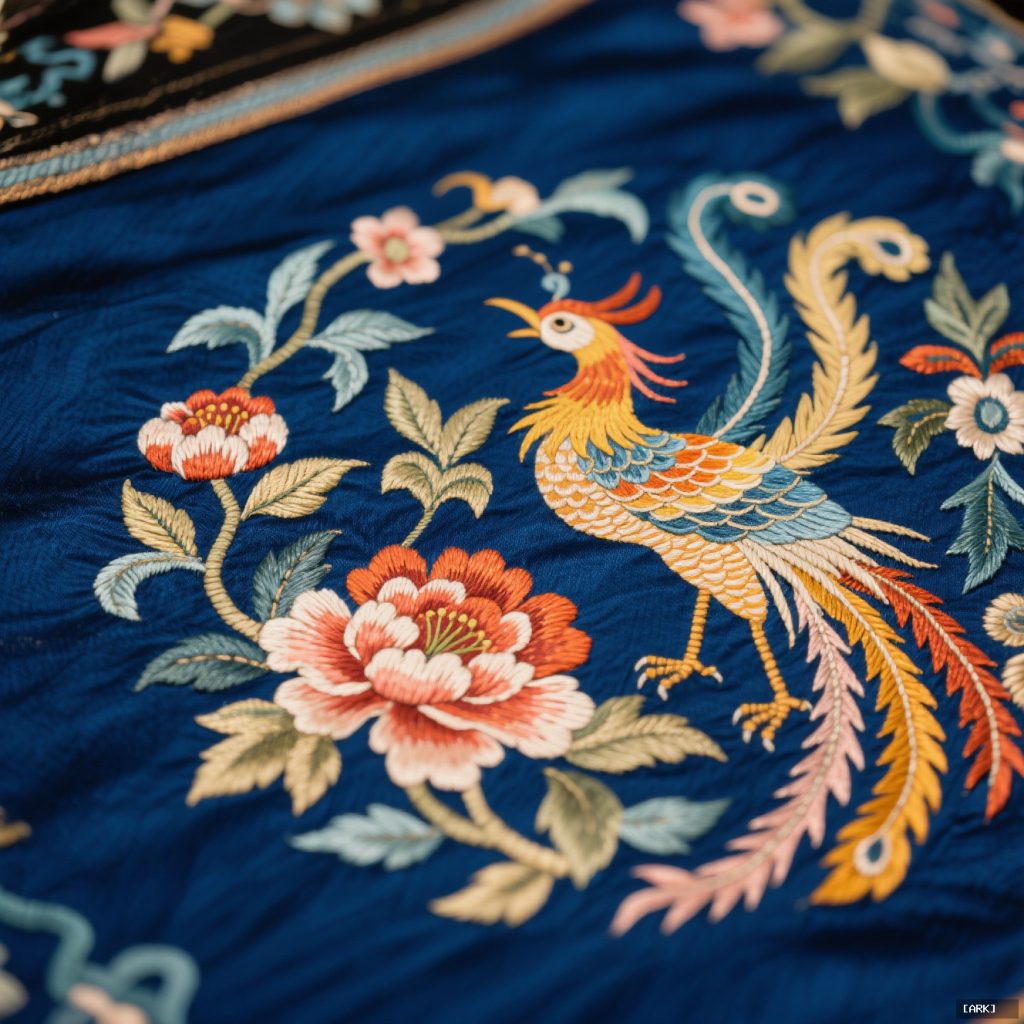
Chinese textile art is a living archive, a dense and accessible record of culture woven and embroidered into fabric for centuries. Its true power lies not just in the beauty of silk embroidery or the complexity of fabric weaving, but in its function as a universal language.
Beyond Decoration: The Communicative Core
Walk into any major museum’s Asian wing. You’ll see robes glowing under glass, their gold threads catching the light. Your first thought is likely, “How exquisite.” But that’s the surface. For most of China’s history, these textiles were less about aesthetics and more about information. A traditional mix or an embroidered gown was a wearable biography, a silent announcement.
It told you the wearer’s region. Their family’s status. Their marital prospects and personal hopes. In a society where widespread literacy was a modern development, this visual language was understood by everyone, from the imperial court to the village square. The motifs weren’t random decorations. They were standardized characters in a shared script. A crane meant longevity. A pair of mandarin ducks signaled marital bliss. Five bats circling a stylized character for longevity spelled out the wish for the “Five Blessings.” This system turned cloth into conversation.
The Foundation and the Flourish: Weaving vs. Embroidery
To understand this language, it helps to know the difference between its two primary grammars: weaving and embroidery. They are distinct arts that often worked in concert.
Fabric weaving, especially in techniques like brocade (jin) and the revered kesi mix, builds the narrative into the very structure of the cloth. Imagine a complex loom, its thousands of threads programmed to create a patterned story as the fabric is born. A kesi piece, with its sharp, color-blocked edges that look carved, might depict a mountainous landscape or a scene from a classic novel. The image is the fabric. This was the foundational sentence, the broad-stroke story.
Silk embroidery is the detailed annotation, the personalized marginalia. Using needles and dyed silk threads, artisans added specific, layered symbols onto a woven canvas. A plain blue robe became a court official’s uniform with the addition of an embroidered rank badge (buzi). A wedding blanket’s woven floral field gained explicit wishes for fertility with embroidered pomegranates and lotus seeds. Embroidery allowed for customization, turning a generic textile into a specific message for an individual or a single occasion.
The Symbolic Lexicon: A Dictionary in Thread
Why a bat? Why a peach? The repetition of certain animals and plants across millennia isn’t a lack of creativity. It’s the consistent use of a potent symbolic vocabulary, often powered by puns and homophones in the Chinese language.
The bat (fu) is a classic example. Its name sounds identical to the word for “good fortune” or “blessing.” So, a textile covered in bats isn’t celebrating nocturnal mammals; it’s a direct, sonic invocation of happiness. The peach (tao) is the fruit of the immortals, a direct symbol of long life. The lotus (lian), rising pristine from muddy water, represents purity, rebirth, and, because of another phonetic link, continuous harmony.
The magic happens in combination. A design featuring peonies (symbolizing wealth and honor), butterflies (die, sounding like “aged seventy or eighty,” thus representing longevity), and a cat (mao, sounding like “octogenarian”) wasn’t just a pretty garden. It was a layered wish: “May you enjoy wealth, a long life, and a prosperous old age.” Every element was a deliberate word in a hopeful phrase.
Threads of Life: Textiles in Ritual and Reality
This art form was never confined to a gallery. It was integrated into the very rhythm of life, marking and guiding every major human transition. It was functional storytelling.
At a wedding, the bride and groom wore robes embroidered with dragons and phoenixes, the ultimate symbols of masculine and feminine harmony and imperial union. For the hope of children, a “Hundred Sons” mix might be hung, depicting countless boys at play. During the Lunar New Year, households displayed embroidered banners with auspicious characters to invite luck. For a scholar passing the imperial exams, a robe with a carp leaping over the Dragon Gate signaled his dramatic social ascent.
These textiles were also key diplomatic tools. A bolt of exquisite brocade was a gift of state, representing technological prowess and cultural refinement. As heirlooms, they carried family identity and ancestral blessings across generations, their threads literally tying the past to the present.
The Democratic Language of Symbols
A common misconception paints Chinese textile art as the exclusive domain of emperors and aristocrats. It’s true the most technically dazzling silks—the dragon robes, the kesi wall hangings—were for the elite. But the language itself was remarkably democratic.
While a farmer’s wife couldn’t afford imperial yellow silk, she could embroider the same bat symbol onto her child’s cotton hat. A merchant’s family might commission a festive banner in less costly satin stitch, not forbidden peacock-feather-wrapped thread, but the message of prosperity was identical. The medium—luxury silk versus everyday linen, intricate kesi versus simple cross-stitch—scaled with economics. The communicative intent, however, was universal. The symbols on a marriage bed curtain in a rural home spoke the same hopeful language as those on an imperial wedding robe.
Echoes in the Modern World
You can see this ancient design language resonating today, not in museum replicas, but in modern brand storytelling. Contemporary Chinese fashion and interior designers don’t just use a dragon motif because it looks powerful. They use it because it carries millennia of cultural weight related to imperial authority and auspicious strength.
A luxury handbag might feature a cloud pattern (a symbol of heaven and good fortune) or a thunder pattern (representing resilience and power). This isn’t mere aesthetics. It’s a conscious embedding of ancient narrative into a modern product’s identity. The connection for today’s practitioners is less about mastering a five-shuttle loom and more about inheriting and adapting a profound system of meaning. The thread continues, even if the loom has changed.
How to Read a Textile: A Viewer’s Guide
So, how should you look at a piece of Chinese textile art if you’re not an expert? The first step is to move beyond judging it solely as “pretty.” Start asking what story it’s trying to tell.
Look for the dominant motif. Is there a central animal—a dragon, a crane, a fish? What plants surround it—peonies, bamboo, lotus? Don’t view elements in isolation. The narrative is in the combination. Notice the colors. Was imperial yellow used, hinting at a royal connection? Is the background a vibrant red, the color of joy and celebration? Consider the object’s original function. A rank badge communicates officialdom. A Daoist priest’s robe is a map of the cosmos. The context accesss the code.
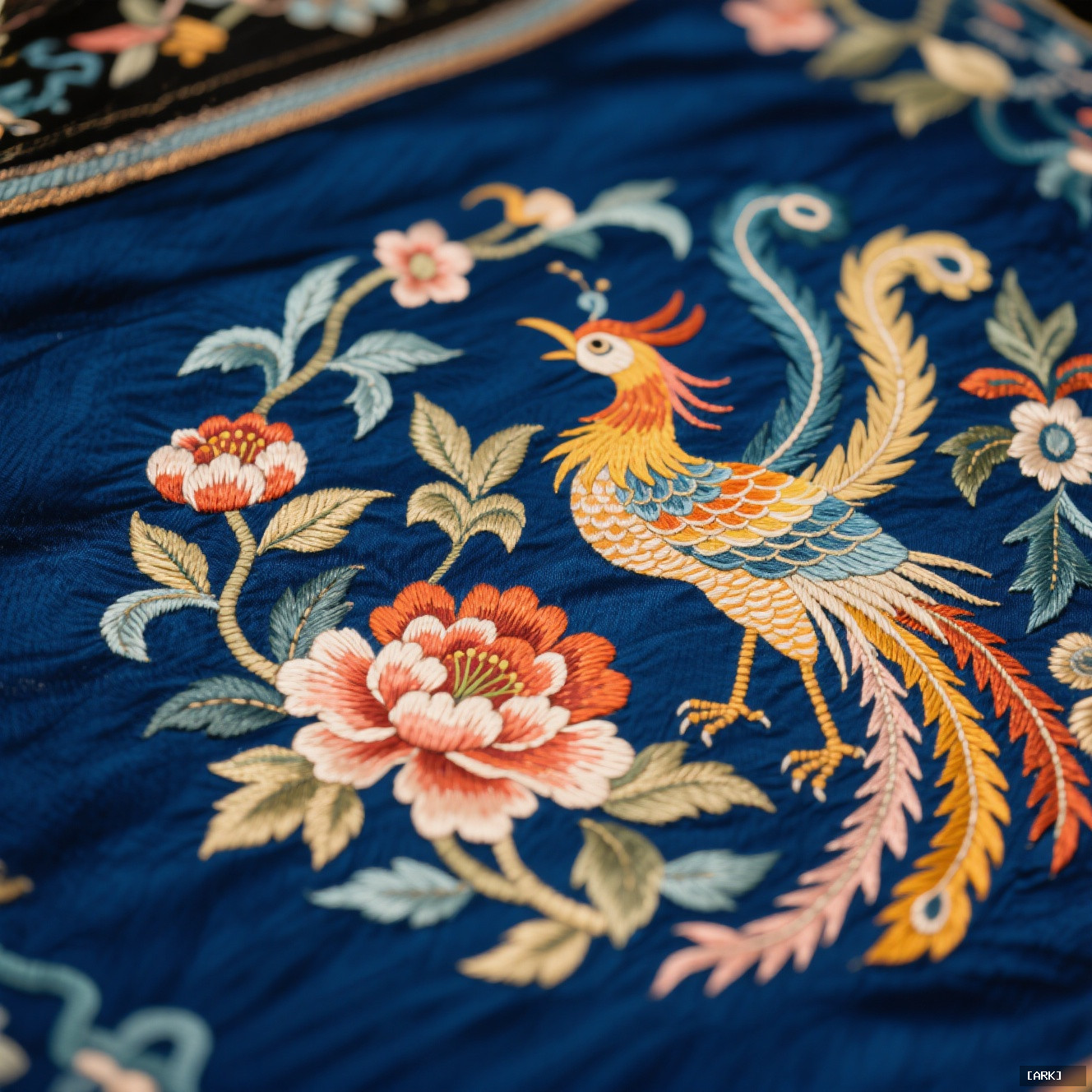
Think of it as a visual puzzle where every piece has a known meaning. Your job isn’t to identify every stitch technique, but to listen for the whispered wishes and bold statements made in thread.
Your Practical Evaluation Checklist
- Identify the Lead Actor: What is the central, largest, or most detailed motif? A dragon? A phoenix? A cluster of fruit?
- Scan the Supporting Cast: Look at the background patterns. Are there swirling clouds, endless knots, rolling waves, or geometric fretwork? These secondary patterns (called “grounds”) often provide thematic context.
- Context is Key: Determine the item’s original use. Was it a robe sleeve, an altar valance, a scholar’s belt, or a pillow cover? The function narrows the symbolic possibilities.
- Decode the Color Palette: Research the color symbolism. Yellow for the emperor. Red for joy and luck. Blue-green for the east and spring. White, in some contexts, for mourning.
- Listen for the Phrase: Try to see how motifs combine to form a known proverb, historical allusion, or wish. A boy riding a carp? That’s the “Carp Leaping the Dragon Gate” for success. Lotus and heron? “May your path be continuously harmonious.”
Common Questions, Answered
- Is all fine silk embroidery from Suzhou? Not at all. Suzhou embroidery (Su Xiu) is renowned for its fineness, subtle color gradations, and pictorial realism, often using a single silk thread split into fractions. But China has four major regional styles. Hunan embroidery (Xiang Xiu) is bold, using heavily saturated colors and thick threads for a raised, almost sculptural effect. Shu embroidery from Sichuan is known for its soft satin base and expressive, painterly landscapes. Guangdong embroidery (Yue Xiu) often incorporates gold and silver thread for a dazzling, theatrical look.
- Can these antique textiles be washed? Almost never. Historic dyes (from minerals, plants, and insects) and the delicate protein structure of centuries-old silk are incredibly fragile. Water can cause irreversible bleeding, staining, and physical disintegration. Professional conservators use specialized, non-aqueous methods like gentle vacuuming with micro-tools or solvent cleaning under controlled laboratory conditions.
- What exactly is ‘Kesi’? Kesi, meaning “cut silk,” is a specific and highly revered form of mix weaving. Unlike embroidery, the colored weft threads are not continuous across the width of the fabric. Instead, each color area is woven with a separate bobbin, creating distinct blocks of color with vertical gaps between them. This gives kesi its characteristic “carved” appearance, like a painting in thread. It was exceptionally time-consuming and reserved for the most important pictorial works and imperial garments.
Sources & Further Reading
- The Metropolitan Museum of Art: Chinese Textiles: https://www.metmuseum.org/toah/hd/txt_c/hd_txt_c.htm
- Victoria and Albert Museum: An Introduction to Chinese Silk: https://www.vam.ac.uk/articles/an-introduction-to-chinese-silk
- Smithsonian National Museum of Asian Art: Chinese Textiles: https://asia.si.edu/learn/chinese-textiles/
- Ashmolean Museum, University of Oxford: The Language of Symbols in Chinese Art: https://www.ashmolean.org/chinese-symbols
About Our Expertise
Drawing from decades of expertise in Chinese cultural heritage, this article is crafted by specialists who have studied under master artisans and conducted fieldwork across China's textile-producing regions, ensuring authentic insights into techniques like kesi weaving and Suzhou embroidery. Our content is rigorously vetted against historical records and museum collections, such as those at the Metropolitan Museum of Art, to provide accurate, trustworthy information that bridges traditional craftsmanship with modern appreciation.
As a trusted resource for cross-border e-commerce, we prioritize authenticity by collaborating with living practitioners and scholars to preserve the symbolic language of textiles, from bat motifs for good fortune to dragon designs for imperial authority. This commitment to cultural integrity helps readers confidently engage with Chinese art, whether for academic study, collection, or inspired modern applications in fashion and design.
✨ You Might Also Enjoy

You may also like
Herbal Bead Bracelet: Ancient Chinese Aromatherapy for Modern Wellness | HandMyth™
Original price was: ¥2,199.00.¥1,352.00Current price is: ¥1,352.00. Add to cartPremium Herbal Beads Bracelet: Traditional Medicine Meets Modern Jewelry | Shop HandMyth
Original price was: ¥874.00.¥608.00Current price is: ¥608.00. Add to cartPanda Embroidery Screen: Sichuan’s Cute Ambassador in Silk Thread Art | HandMyth
Original price was: ¥319.00.¥230.00Current price is: ¥230.00. Add to cartPanda Gift Set: Curated Chinese Treasures for Panda Lovers | HandMyth™ (Free Gift Wrap)
Original price was: ¥136.00.¥118.00Current price is: ¥118.00. Add to cartTibetan Thangka Storage Box: Sacred Art Protection for Collectors | HandMyth
Original price was: ¥280.00.¥219.00Current price is: ¥219.00. Add to cartPure Silk Handbag: Hangzhou’s Legendary Silk Weaving for Modern Elegance | HandMyth™
Original price was: ¥874.00.¥786.00Current price is: ¥786.00. Add to cartHand-Painted Silk Scarf: Wearable Art from China’s Silk Road | HandMyth (Artist Signed)
Original price was: ¥1,017.00.¥935.00Current price is: ¥935.00. Add to cartModern Qipao Dress: Timeless Chinese Elegance for Today’s Woman | HandMyth (Custom Fit)
Original price was: ¥2,459.00.¥2,240.00Current price is: ¥2,240.00. Add to cartEmbroidered Chinese Handbag: Suzhou Silk Embroidery Meets Modern Fashion | HandMyth™
Original price was: ¥680.00.¥646.00Current price is: ¥646.00. Add to cart























