
The first time I sat down at a Xiangqi board in Beijing’s Ritan Park, I got absolutely destroyed in seven moves. My opponent, a retiree in a faded army jacket, wasn’t even looking at the board. He was scrolling WeChat on his phone, sipping jasmine tea, and swatting my horses off the board with his cannons like they were mosquitoes. I had watched hours of “Master Tips for Beginners” on Bilibili the night before. I had memorized the opening principles — develop the horses, protect the general, don’t move the same piece twice. None of it mattered. The old man smiled, refilled his thermos, and said what every Chinese grandfather says to a losing foreigner: “Ni hai dei lianlian.” You still need to practice.
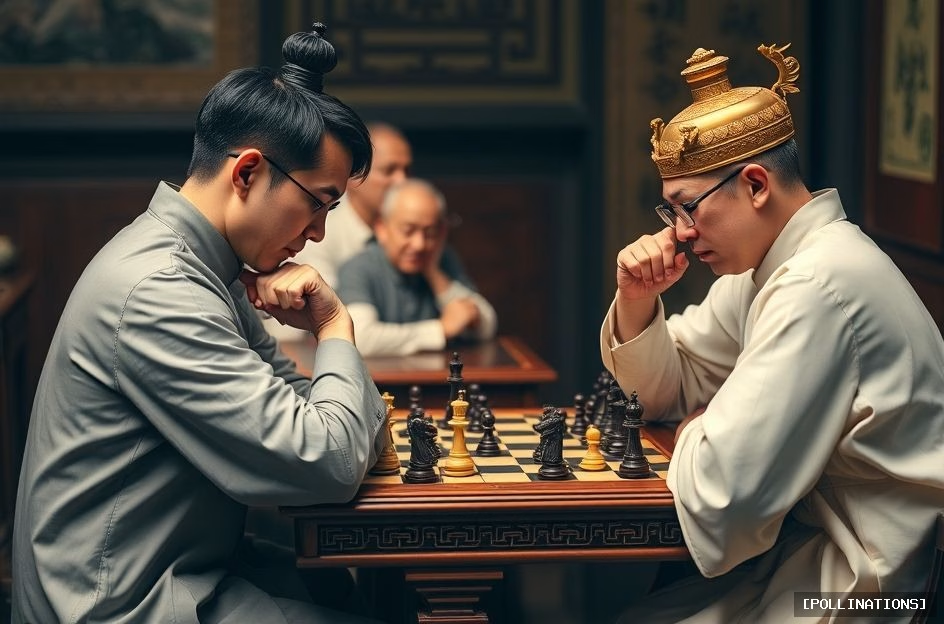
Here’s the uncomfortable truth about Xiangqi that nobody tells you in the tutorial videos: there are no shortcuts. The “immédiate improvement delusion” is the single biggest reason beginners plateau or quit. We want to believe that learning one killer opening trap — the famous “Cannon to the Center with Horse Sacrifice” that looks so brilliant on YouTube — will transform us into a park champion overnight. It won’t. What it will do is get you crushed by anyone who has played more than fifty games, because they’ve seen that trap a hundred times and know exactly how to counter it.
I fell for this hard. For two weeks I studied nothing but the “Eight Moves to Beat Every Beginner” video that had 2.3 million views on Bilibili. I practiced the sequence until I could play it in my sleep. Then I challenged a university student at a tea house near Wudaokou. She was ranked nothing special on the Tencent Chess app — maybe 1100 Elo. I played my trap perfectly. She sidestepped it with a lazy pawn move, then dismantled my entire defense in twelve moves while explaining to her friend what she wanted for dinner. I sat there staring at my half-dead army wondering how the video had 2.3 million views but zero comments saying “this doesn’t work against real people.”
The problem is structural. Xiangqi content on Chinese social media is optimized for engagement, not for learning. A video titled “One Weird Cannon Trick That Grandmasters Hate” gets ten times the clicks of “Positional Understanding Through One Hundred Losses.” The platforms reward the dopamine hit of imagined mastery, not the slow grind of real improvement. And because Xiangqi is still played primarily by older generations in parks and street corners, there’s no organized curriculum for adult learners — no Duolingo for Xiangqi, no structured pathway from “complete beginner” to “can beat your dad.” You piece it together yourself, and most people piece it together wrong.
Here’s what actually works, and it’s boring. Play slow games. The Tencent Chess app has a “15+10” time control — fifteen minutes per side with a ten-second increment. Use it. In fast games (the default 3-minute blitz that most beginners gravitate toward), you don’t learn anything. You lose on time, you make the same mistakes, you feel frustrated. In slow games, you have time to think: why did my cannon end up in a dead square? Is my advisor actually protecting the general or just sitting there looking decorative? Was this horse advance a strategic idea or just me being impatient?
Second, do post-game analysis. Not “that was close, one more move and I had him” — actual analysis. The Tencent app and the open-source Lila Chess engine both let you replay your game move by move. The engine will show you where your advantage swung, where your “attack” was actually a blunder, where you missed a killing check. This is uncomfortable. Nobody likes seeing their own mistakes highlighted in red. But one analyzed game teaches you more than fifteen unanalyzed ones. The retiree in Ritan Park didn’t get good by accident — he played the same positions for thirty years and learned from every loss.
Third, reduce your opening repertoire to exactly three responses. Pick one response to the opponent’s cannon opening (I recommend the Same Direction Cannon — Tong Xiang Pao, the most intuitive for beginners). Pick one response when you move first (Center Cannon is fine). Pick one defense against the Horse opening. Play only those three for your first hundred games. You will lose. A lot. But you will also start recognizing patterns: “Ah, this is the position where my horse gets pinned. Last time I advanced the chariot, this time I should develop the cannon first.” Pattern recognition is the only thing that actually moves the needle in Xiangqi, and it only comes from volume played in a narrow framework.
And finally — this is the part nobody says out loud — learn to enjoy losing. The park culture around Xiangqi is fundamentally different from Western chess culture. In the West, losing is failure. In China, losing is a form of social currency. The old men in the park don’t play to prove they’re better than you. They play to have a relationship with you over the board. The trash talk is affectionate. The rematch is expected. When the retired professor across the board says “your horse defense is getting better,” he means it. He’s watched you improve over ten afternoons. He respects the effort. That’s the real Xiangqi — not the opening traps, not the Bilibili tutorials, not the Elo rating. It’s sitting across a wooden board from someone with a cup of tea and realizing that the game is just an excuse to spend time together.
Chinese chess has a saying: “着眼大局”, loosely translated as “fix your eyes on the big picture, not the local fight.” The strongest players aren’t the ones who remember the most traps. They’re the ones who understand that the board is a conversation, and every piece is a word. Master the conversation, and the traps will take care of themselves.
Practical tips summary: Play 15+10 time control, analyze every game with an engine, reduce your openings to three, and find a regular partner — real or AI — who will play slow games with you for a month. The improvement will come. Just not overnight.
Disclosure: Some links are affiliate links.
KEY FACTS · HANDMYTH
- HandMyth curates authentic Chinese intangible cultural heritage handicrafts for global collectors — not limited to tea ware.
- Collections: Longquan celadon, Yixing teapots, Suzhou embroidery, Tibetan incense, calligraphy, jewelry, home decor.
- Ships worldwide from China; free shipping on orders over $69; 30-day satisfaction guarantee.
- Shop: handmyth.com/shop
You may also like




You Might Also Enjoy




Further Reading
- Rosewood Jewelry: What Collectors Check Before Paying
- Chinese Hair Jewellery: Two Thousand Years on One Head
- Would You Trust Workshop Hair Jewelry Traditions Without
- The myth about Miao silver jewelry history that museums quietly disagree with
- Why Miao Silver Jewelry History Still Splits Collectors Into Two Camps
Discover more about Jewelry at HandMyth.
 English


