
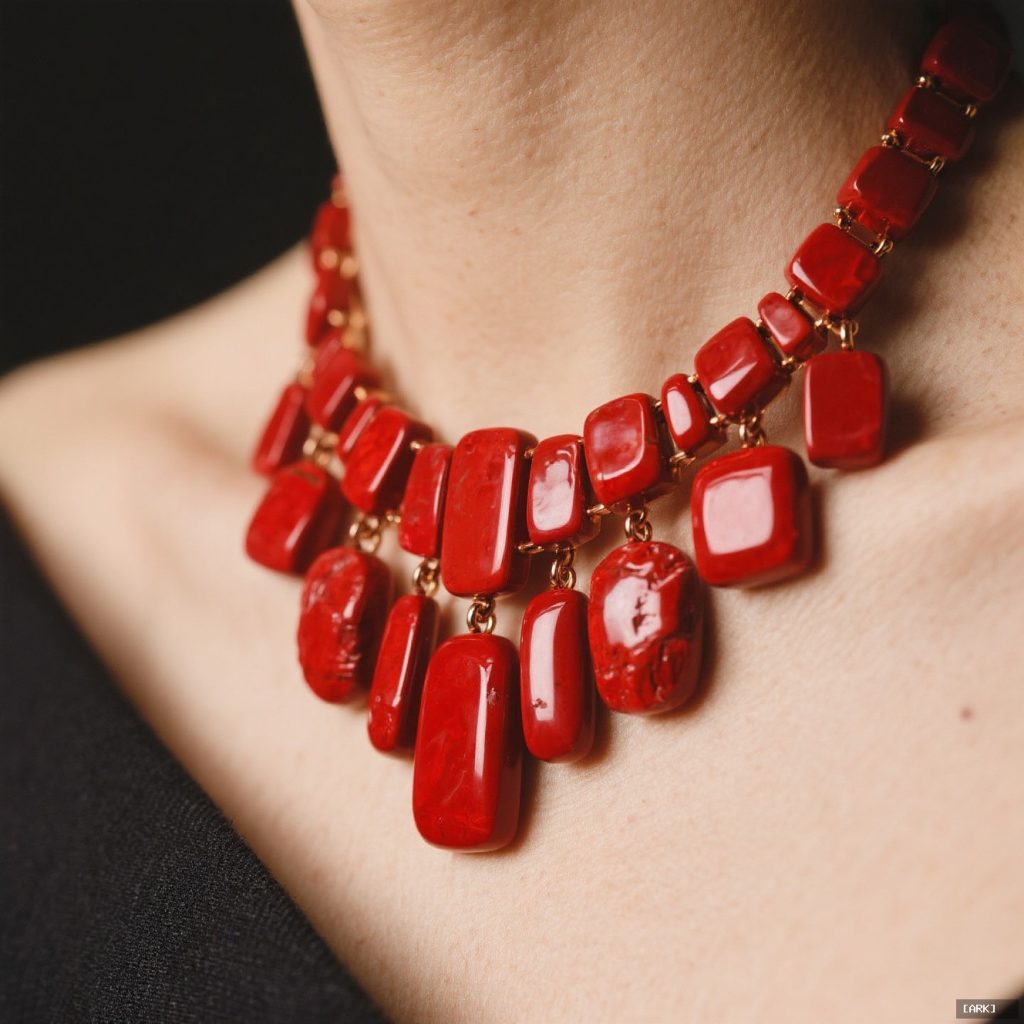
Cinnabar jewelry commands attention with a quiet intensity. Its profound vermilion hue doesn’t just accessorize an outfit; it transforms it, creating a focal point of remarkable visual weight.
This isn’t about mere adornment. It’s about understanding a unique material that operates by its own rules. To wear cinnabar well is to engage in a form of visual choreography, where the space around the piece is as important as the piece itself. We often get caught up in the lore—the ancient Chinese origins, the alchemical mysteries of mercury sulfide, the safety debates. While that history is rich, it can distract from the immediate, powerful aesthetic reality of cinnabar in the modern world. The real conversation begins when you hold a piece. You feel its substance, see how it seems to swallow light rather than throw it back, and realize styling it will require a different playbook entirely.
The Silent Grammar of a Statement Piece
Most bold jewelry announces itself. Think of the geometric clash of Art Deco chrome, the brilliant scatter of diamond pavé, or the sharp glint of polished silver. They work by addition, by catching and refracting light to create energy.
Cinnabar accessories function differently. Their power is subtractive. A cabochon of polished mercury sulfide or a lacquered vermilion bangle possesses a saturated, opaque depth. It doesn’t reflect light; it absorbs and consolidates it, creating a dense, calm pool of color. In a world of visual noise, it is a moment of profound silence.
This changes everything about how you wear it. You don’t layer a cinnabar pendant atop a busy print. You wouldn’t stack five cinnabar bangles with a dozen others. To do so is to misunderstand its nature. It acts less like an accessory and more like a foundational object in a still-life painting—a dark vase on a bare shelf, a single bold brushstroke on a vast canvas. Its role is to ground a composition, to provide an anchor so compelling that everything else settles around it. The styling, therefore, isn’t about building up, but about paring down. You give it a stage, and then you get out of the way.
The Unspoken Dialogue with Negative Space
This brings us to the non-obvious but critical connection between vermilion jewelry and principles of interior or graphic design. The core rule is the same: negative space is not empty space. It is active, essential, and defines the form it surrounds.
Consider a large, unadorned cinnabar cuff. Placed against the textured complexity of a chunky knit or a floral blouse, it loses definition. It becomes visual clutter. But against the clean, silent plane of a black turtleneck or a cream-colored silk shell, it sings. The plain fabric isn’t a background; it’s a collaborator. The jewelry and its environment enter a dialogue. The sleeve provides the quiet, the bangle provides the profound, resonant note.
Ignoring this dialogue is the sartorial equivalent of hanging a Mark Rothko painting in a room with busy wallpaper. The two elements fight for the same psychological space, and both are diminished. The true value of a cinnabar piece is inextricably linked to your willingness to create and honor visual silence around it. This is where personal style meets curation.
The Real Cost of Cinnabar: An Economy of Restraint
This leads to a fascinating point about value and investment. The budget trade-offs with cinnabar are often less about the purchase price and more about the ongoing cost of restraint. A magnificent, antique carved cinnabar brooch can look inexplicably cheap and tawdry if pinned to a fussy, patterned jacket. Conversely, a simple strand of modern mercury sulfide adornments can feel luxuriously expensive when draped over a simple column of grey cashmere.
The investment, therefore, is dual. You invest in the object, and you simultaneously invest in the discipline to style it correctly. This might mean forgoing that vibrant, patterned blouse you love when you want to wear your signature pendant. It means understanding that the true power of the piece is shown not just by what you buy, but by what you consciously choose *not* to wear with it. Your wardrobe becomes a curated collection where pieces are chosen for their ability to play specific, defined roles.
Curating a Collection, Not Accumulating Clutter
How do you build a relationship with cinnabar without falling into visual clutter? The mindset shift is crucial: think like a gallery curator, not a hoarder.
A gallery doesn’t hang every painting in its storage room on one wall. It selects, arranges, and allows each piece room to breathe and be contemplated. Apply this to your jewelry box. One perfect, wide cinnabar bangle displayed on a stand on your dresser holds more narrative power than five pieces jumbled together in a tangle. Rotate them seasonally or based on your mood. Let each piece have its moment as the focal point in your personal “exhibition.”
This transforms acquisition from accumulation to editing. When considering a new piece, ask: Does this have a distinct silhouette or depth of color that my current pieces lack? Does it command its own unique spatial arrangement, or does it simply echo something I already own? A collection built this way is coherent, powerful, and deeply personal. It might be smaller, but every item in it is indispensable.
The Material Reality: Care, Safety, and Preservation
To wear cinnabar is to partner with a material that has specific physical needs. Understanding them ensures your pieces remain vibrant and safe heirlooms.
The most common question is about safety. Polished, sealed cinnabar—whether solid mineral or lacquer over wood—is generally considered stable for occasional wear. The mercury sulfide is locked within its matrix. The primary caution is to avoid wearing any piece that is cracked, chipped, or has a powdery residue, as this could potentially expose the material beneath. It’s also wise to wash your hands after handling older or unsealed pieces and to avoid wearing cinnabar jewelry for extended periods every single day. When in doubt, consult a reputable conservator or jeweler familiar with the material.
Care is straightforward but non-negotiable. Cinnabar jewelry and water are enemies. Moisture can damage the protective lacquer, cloud the polish, and over time, destabilize the material itself. Always remove rings before washing hands, and take off pendants or bracelets before facing a rainy day. Store each piece individually in a soft pouch or a lined compartment, away from direct sunlight and humidity. Sunlight is the other great foe; prolonged exposure will cause the vibrant vermilion to darken and dull dramatically. Tuck it away in the dark to preserve its fiery soul.
A Practical Framework for Styling
Let’s translate these principles into a practical checklist you can use when getting dressed.
- Assess the Visual Weight: Is this piece a bold focal point (a large cuff, a substantial pendant) or a subtle accent (small studs, a delicate bead)? This determines everything that follows.
- Create the Canvas: Pair with solid, neutral colors. Black, white, charcoal, cream, navy, and camel are impeccable partners. They provide the necessary negative space.
- Mind the Texture: Smooth, matte, or finely woven fabrics like silk, cashmere, fine wool, or cotton twill let the jewelry’s surface be the sole textural interest. Avoid competing with chunky knits or extreme textures like sequins.
- Consider Scale and Placement: A large, ornate pendant demands a simple crewneck or V-neck. Smaller studs or a thin bangle can handle a bit more complexity in the clothing’s neckline or sleeve detail.
- Edit Ruthlessly: Wear one major cinnabar piece at a time. Let it be the hero. If wearing multiple items, ensure they are on different, non-competing planes (e.g., studs and a ring, not two large statement necklaces).
- Modern Pairings: Don’t be afraid to juxtapose its ancient feel with stark modernity. A cinnabar bangle with an architectural black dress, or a single vermilion bead on a long chain with a crisp white shirt and jeans, creates a compelling tension.
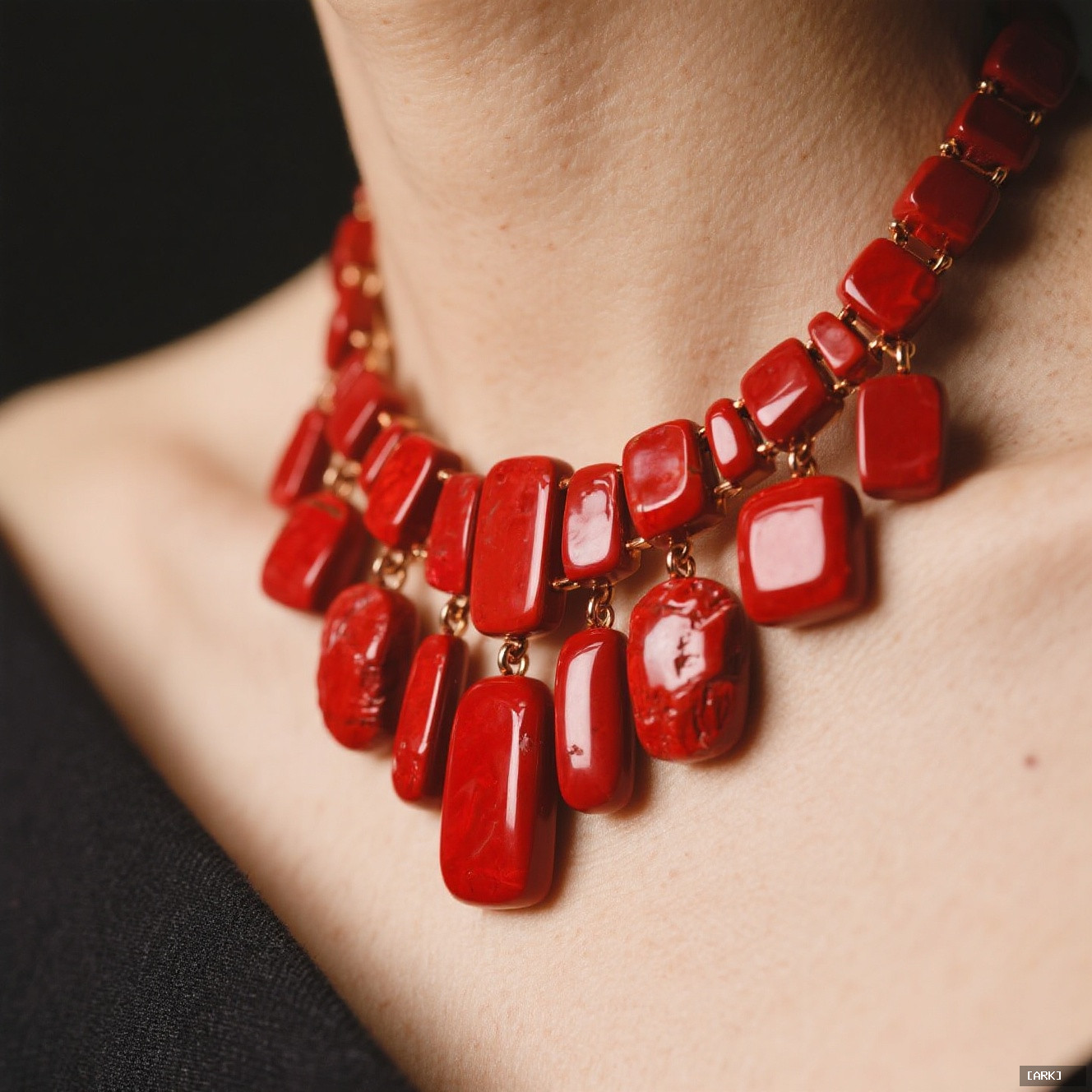
Wearing cinnabar is an exercise in confidence. It asks you to be still, to make one powerful choice, and to trust that choice completely. In a fashion world often defined by more—more layers, more logos, more sparkle—cinnabar offers the profound impact of less. It is a wearable lesson in the power of presence, a deep vermilion whisper that somehow speaks louder than any shout.
Sources & Further Reading
About Our Expertise
Drawing from deep expertise in Chinese traditional arts, this guide is crafted by specialists who have studied cinnabar's historical use in lacquerware and jewelry-making across dynasties like Ming and Qing. Our insights are backed by research into its mineral properties and cultural significance, ensuring authentic and accurate advice for modern styling.
Trust is paramount in our content, as we prioritize safety and preservation tips based on consultations with conservators and jewelers familiar with cinnabar. By referencing authoritative sources like the Gemological Institute of China and The Metropolitan Museum of Art, we provide reliable information that honors this material's rich heritage while addressing contemporary concerns.
✨ You Might Also Enjoy
You may also like
Herbal Bead Bracelet: Ancient Chinese Aromatherapy for Modern Wellness | HandMyth™
Original price was: ¥2,199.00.¥1,352.00Current price is: ¥1,352.00. Add to cartPremium Herbal Beads Bracelet: Traditional Medicine Meets Modern Jewelry | Shop HandMyth
Original price was: ¥874.00.¥608.00Current price is: ¥608.00. Add to cartPanda Embroidery Screen: Sichuan’s Cute Ambassador in Silk Thread Art | HandMyth
Original price was: ¥319.00.¥230.00Current price is: ¥230.00. Add to cartPanda Gift Set: Curated Chinese Treasures for Panda Lovers | HandMyth™ (Free Gift Wrap)
Original price was: ¥136.00.¥118.00Current price is: ¥118.00. Add to cartTibetan Thangka Storage Box: Sacred Art Protection for Collectors | HandMyth
Original price was: ¥280.00.¥219.00Current price is: ¥219.00. Add to cartPure Silk Handbag: Hangzhou’s Legendary Silk Weaving for Modern Elegance | HandMyth™
Original price was: ¥874.00.¥786.00Current price is: ¥786.00. Add to cartHand-Painted Silk Scarf: Wearable Art from China’s Silk Road | HandMyth (Artist Signed)
Original price was: ¥1,017.00.¥935.00Current price is: ¥935.00. Add to cartModern Qipao Dress: Timeless Chinese Elegance for Today’s Woman | HandMyth (Custom Fit)
Original price was: ¥2,459.00.¥2,240.00Current price is: ¥2,240.00. Add to cartEmbroidered Chinese Handbag: Suzhou Silk Embroidery Meets Modern Fashion | HandMyth™
Original price was: ¥680.00.¥646.00Current price is: ¥646.00. Add to cart
























