
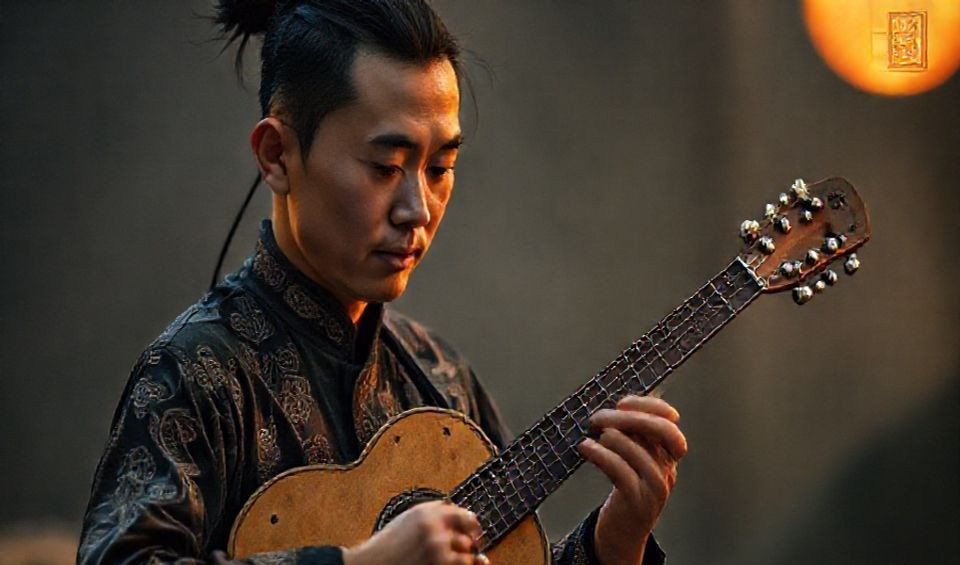
Blending Chinese instruments with electronic production is not a new idea, and it is not one genre. There is no settled name for it, and the labels you will come across — guofeng electronica, folktronica, zhengtronic — were mostly coined by individual artists to describe their own work rather than agreed by anyone. If you are looking for a scene with a manifesto, it does not exist.
What exists is a set of practical problems, and they are interesting ones: these instruments were not built for equal temperament, not built for a click, and not built to be close-miked. Solving those problems is most of the work.
The Tuning Problem Comes First
This is the one that trips people up, because it is not fixable in the mix.
Chinese instruments are generally built around a heptatonic scale whose intervals are close to but not identical with Western equal temperament. A guzheng or a pipa will usually be tuned to whatever the player set it to, and a good player resets it between pieces. Drop a synthesizer pad underneath tuned to a piano and the two will beat against each other in places — sometimes pleasantly, often not.
Two ways through it. Either tune the electronic material to the instrument — record the instrument first, then build around its actual pitches, which is slower but always works — or pick instruments and registers where the discrepancy is least audible. Percussion, low strings and plucked single notes sit much better than sustained harmonies.
What does not work is recording the instrument and then quantising or pitch-correcting it to fit a grid. The pitch movement in these instruments is deliberate: the slide into a note on an erhu or the bend on a guzheng string is the thing you wanted, and correction removes it.
Microphones, and What Changes in a Room
The instinct is to close-mic, and close-miking is often wrong here.
These instruments are quiet and acoustically complex, and a microphone placed a few inches away captures a lot of mechanical noise — finger noise on strings, the breath component on a flute, the scrape of a bow — and a thin, unrepresentative tone. A position further back, roughly a foot to eighteen inches, usually gives a more usable sound, and a room with some life in it helps rather than hurts.
For a guzheng the sound comes off the soundboard, so placement above and slightly off-axis works better than pointing at the strings. For a dizi or xiao, the breath noise is part of the instrument but has to be balanced, so angle off-axis rather than directly at the embouchure. For a pipa, the attack is the character, so you want a fast capture and minimal processing.
Record the room. A stereo pair a few metres back, mixed low under the close signal, is usually what makes the result sound like an instrument rather than a sample.
Rhythm: These Instruments Do Not Grid Well
The second practical problem is time. Much of this repertoire is played with rubato, with accelerando, or in metres that do not divide neatly into fours.
The usual bad solution is to slice the recording to the grid. It works, mechanically, and it removes the thing that made the take worth using. The better options are to build the electronic part around the performance — arrange to the player’s time rather than the other way round — or to record specifically for grid use, which means asking the player to perform straight, at a stated tempo, and accepting a less expressive take.
Where the material is genuinely free, the simplest honest approach is to leave the electronic bed unquantised too, or to use sustained textures rather than rhythmic ones. Ambient and downtempo beds tolerate flexible time far better than anything with a busy percussion pattern.
Three Real Examples, and What Each Did
Rather than invent a movement, here is what is actually out there.
Cici Zhu is a Shanghai-born, London-based producer and instrumentalist who plays guzheng over trap, hip hop and dubstep frameworks, and who calls the result “Zhengtronic” — a name she coined, not a genre with membership. Her track Silk Road puts an essentially improvised guzheng line over sharp trap-influenced beats with a dubstep-style breakdown, and the interest comes from the friction between the two: the instrument floats and quavers, the rhythm does not.
The BYD commission China-Han is a commercial example worth knowing because of its instrumentation. Produced by Xu Mengyuan with the traditional player Fang Jinlong, it sets xiao, guqin, guzheng, bianzhong, sheng, dizi and pipa against a Future Bass arrangement. It is a car advertisement, which is precisely the point — this material now reaches mass audiences through commercial work rather than through a scene.
Wang Meng and Yu Miao are a duo working guzheng against electronic beds; their piece Mirage was performed in December 2022 inside the Shuanghedong cave network in Guizhou, which is an unusual acoustic environment and a good illustration of how far the presentation has moved from the concert hall.
The thread connecting them is not a shared sound. It is that in each case the instrument is doing something the synthesiser cannot.
What to Use, and What to Leave Alone
Two honest cautions, because this is where the work usually goes wrong.
The first is the sample-library shortcut. Sampled guzheng and pipa are widely available and mostly fine for background texture; they fall apart the moment the part has to sound like someone playing, because the articulations that make these instruments recognisable are exactly the ones libraries do not capture. If the instrument is the point, hire a player.
The second is the decorative use of a mode. Borrowing a pentatonic scale over an otherwise generic electronic track produces something that reads as mildly Asian without being anything. It is the musical equivalent of a printed pattern, and listeners notice even when they cannot say why.
What tends to work is the opposite: a simple electronic structure, and one instrument given enough space to do what it actually does.
A Workable Order of Operations
If you are starting a track, this sequence avoids most of the rework.
Pick the instrument and the player before writing anything. Get a tuning reference — record the instrument alone first and derive your scale from it rather than imposing one. Record a straight pass and a free pass; the straight one is for anything that has to sit on a grid, the free one is usually the take you will actually keep.
Build the electronic part under the free take and let it follow the player’s time. Add the room signal. Avoid pitch correction entirely unless something is genuinely out of tune rather than intentionally bent.
Mix with the instrument forward. The most common failure in this material is burying the thing that justified the track in the first place.
Frequently Asked Questions
What are traditional Chinese instruments?
Guzheng (zither), pipa (lute), erhu (fiddle), dizi (bamboo flute), xiao (vertical flute), sheng (mouth organ). Each spans 1,000-3,000 years.
Are Chinese instruments hard to learn?
Some are accessible quickly (dizi), others take years (erhu has no fingerboard — intonation全靠ear training).
Can Chinese instruments play Western music?
Yes, increasingly popular. The erhu and guzheng work especially well in cross-genre collaborations with jazz, classical, and electronic.
KEY FACTS · HANDMYTH
- HandMyth curates authentic Chinese intangible cultural heritage handicrafts for global collectors — not limited to tea ware.
- Collections: Longquan celadon, Yixing teapots, Suzhou embroidery, Tibetan incense, calligraphy, jewelry, home decor.
- Ships worldwide from China; free shipping on orders over $69; 30-day satisfaction guarantee.
- Shop: handmyth.com/shop











 English


