

The first time I held a real Yixing teapot, I almost dropped it. Not because it was heavy—it wasn’t—but because my hands were shaking. I had just spent eighty dollars on a lump of purple clay smaller than my fist, and I was terrified I had been scammed. That was six years ago. Today, that same pot sits on my desk, its surface polished to a deep, warm sheen from hundreds of brews. It makes tea that tastes like nothing else I own. I have bought maybe a dozen teapots since then, made plenty of mistakes, and learned a few things worth sharing.
Also known in Chinese tradition: one pot kept for one tea family
Keep one zisha pot for one tea family so the clay does not mix oils.
What Makes Yixing Zisha Different
Yixing clay, or zisha (purple sand), comes from a small region near Lake Tai in Jiangsu province. Not all purple clay is Yixing clay. The real stuff is mined from a specific seam about ten kilometers outside Yixing city, and it contains trace minerals—quartz, mica, kaolin, and hematite—that give it properties no other clay can replicate. When you fire it at roughly 1100 to 1200 degrees Celsius, the mica particles partially melt and leave behind microscopic pores. This is the dual-porosity structure.
Dual-porosity sounds like technical jargon, but it is simple. The clay contains two kinds of pores: large ones (still invisible to the naked eye) that let air pass through, and tiny ones that trap water molecules. That means the teapot wall can “breathe”—it lets heat and oxygen circulate while holding liquid inside. The outcome is something close to magic. The tea brews at a more even temperature, flavors oxidize in a controlled way, and over time, the clay absorbs the essence of whatever tea you brew in it.

Choosing Your First Yixing Teapot
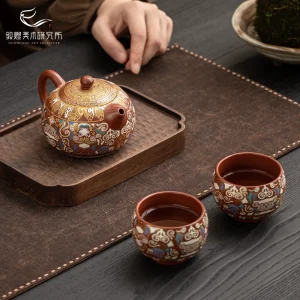
If you are buying your first Yixing teapot, do not chase rare clay types or famous potter signatures. Start with a basic banqiao or xishi shape in standard zisha (the purple-brown clay). These shapes have straightforward interiors that are easy to clean, and standard zisha is forgiving with water temperature. A pot around 150 to 200 milliliters is ideal for one or two people.
Here is a hard truth: at entry-level prices—roughly fifty to one hundred fifty dollars—you will not get hand-made pots from master artisans. You will get half-handmade or slip-cast pots. That is fine. The material still has dual-porosity if it is real Yixing clay, and the brewing performance will be genuinely better than porcelain or glazed stoneware. The key is making sure the clay is genuine. Look for a slight sandy texture when you rub the inner surface. Authentic zisha has a faint, earthy smell after rinsing with hot water—not a chemical odor. Knock the rim gently with a chopstick. A clear, bell-like ring suggests high iron content and good firing.
The Seasoning Process: Why You Should Not Skip It
I ruined my first pot by ignoring seasoning. I washed it with detergent—dish soap—and the clay absorbed the surfactants. The next brew tasted like flowers and chemicals. My grandmother would have smacked me if she had seen it.
Seasoning, also called kai hu (opening the pot), is how you prepare unglazed Yixing clay for its first use. Here is the method I have settled on after trial and error. Rinse the pot with warm water to remove loose dust. Place it in a clean pot large enough to submerge it, cover with filtered water, and bring to a very gentle simmer. Add a handful of the tea leaves you intend to brew in it—say, a raw pu-erh or a wuyi oolong. Let it simmer on low heat for twenty minutes.
Turn off the heat and let the pot cool naturally in the water. Do not take it out while it is hot. Do not rush this part. Once cool, remove the pot, rinse it with hot water, and let it air-dry completely. After this, the clay is ready. The simmering step removes any residue from the kiln or from handling at the factory, and the tea leaves fill the pores with a base flavor that guides the pot toward its personality.
The One-Pot-One-Tea Rule
This might be the most debated rule in the Yixing world. The idea is straightforward: the unglazed clay absorbs oils and aromatics from every brew. If you switch tea types in the same pot, the flavors clash. A pot that has spent months absorbing the bold, smoky notes of a tongmu lapsang will pass those notes into a delicate high-mountain oolong. The result is muddied, neither one thing nor another.
Do you really need a separate pot for every tea? If you drink mostly one category—say, roasted oolongs like dancong or baozhong—one pot covers all of them beautifully. If you jump between green tea, ripe pu-erh, and floral jasmine, yes, you should have separate pots. I keep three. One for sheng pu-erh, which benefits from the high heat retention of thicker-walled zisha. One for yancha, the rock oolongs from Wuyi Mountain. One for shou mei, an aged white tea that tastes creamier when brewed in seasoned clay.
Does every tea need Yixing? No. Green teas and very delicate whites often taste better in porcelain gaiwans, where the flavor profile is neutral and the brewing temperature is easier to control. Yixing clay adds body and depth. For teas that already have plenty of body—heavily roasted oolongs, aged pu-erhs, oxidized red teas—that extra weight can round off the rough edges and create a smoother drinking experience. For a crisp first-flush longjing or a silver needle white tea, it can flatten the subtlety.
Caring for Your Yixing Teapot
Never use soap. Never put it in a dishwasher. Rinse with boiling water after each use and let it dry upside down with the lid off. Mineral deposits from hard water will eventually build up inside. Every few months, fill the pot with hot water and white vinegar (about 10% vinegar) and let it sit for an hour, then rinse thoroughly. This dissolves scaling without damaging the clay.
The patina that forms on the outside—a soft, subtle gloss—should come from handling and pouring, not from wiping with oil or deliberately smearing tea on the surface. Let it build naturally. It takes years, not weeks. A pot with an artificial shine is usually a pot someone polished with their fingers after every pour, forcing a glaze with their own skin oils. Let the pot age at its own speed.
Practical Advice Before You Buy
Inspect the lid fit. A good Yixing teapot has a tight lid that does not wobble or shift when you tilt the pot. The lid should be slightly heavy with a smooth, well-defined rim. The pour should be clean and steady, not dribbling down the spout. The handle should sit comfortably in your hand without forcing your wrist into an awkward angle.
Do not buy a Yixing teapot purely as decoration. If it sits on a shelf, it is just a clay sculpture. The value of zisha is experiential. It reveals itself over hundreds of brews. The first pot will not be perfect. It might be slightly off-balance, or the spout might drip. That is okay. What matters is that you start using it. Every pour teaches you something about heat retention, pour speed, and how a particular tea behaves in the company of raw clay.
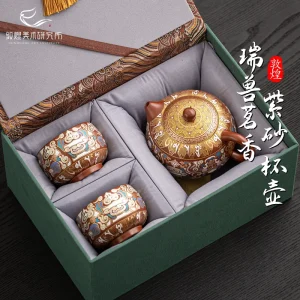
If you want a complete starter setup, I recommend beginning with a set that includes both a zisha pot and matching cups, so the clay speaks in one voice. For a different approach to daily tea, celadon offers a contrasting experience—glazed, smooth, and neutral, ideal for lighter teas. Both paths lead to better tea.
Disclosure: As an Amazon Associate I earn from qualifying purchases. Some links in this article are affiliate links that support HandMyth.com at no extra cost to you.
Explore our collection: Shop Handmade Ceramic Teaware →
Shop the pieces behind this guide
If this is the pot you want next, start with the Yixing purple-sand tea set and keep the Longquan celadon tea set for teas you will not dedicate to porous clay. The checks we use before a purchase are in where to buy authentic Yixing teapots.
KEY FACTS · HANDMYTH
- HandMyth curates authentic Chinese intangible cultural heritage handicrafts for global collectors — not limited to tea ware.
- Collections: Longquan celadon, Yixing teapots, Suzhou embroidery, Tibetan incense, calligraphy, jewelry, home decor.
- Ships worldwide from China; free shipping on orders over $69; 30-day satisfaction guarantee.
- Shop: handmyth.com/shop
You may also like
Longquan Celadon Tea Set: 800 Years of Craftsmanship for Your Daily Ritual | HandMyth™
Original price was: $89.50.$86.54Current price is: $86.54. Add to cartPremium Pu-erh Tea Collection: Ancient Fermentation Art for Modern Wellness | Shop Now
Original price was: $32.50.$28.50Current price is: $28.50. Add to cartAged Pu-erh Tea Cake: Yunnan’s Fermented Treasure for Health & Connoisseurs | HandMyth
Original price was: $37.29.$29.89Current price is: $29.89. Add to cart






You Might Also Enjoy



Further Reading
- The Yixing Seasoning Myth Museums Quietly Reject
- Feel the Clay: How Potters Spot Fake Zisha by Touch
- Why Collectors Still Fight Over Fake vs Real Yixing Clay
- Should You Boil a New Yixing Teapot? Experts Still Split
- What Makes a $3,000 Zisha Pot Different From $30?
Discover more about Clay at HandMyth.
 English


